
TL;DR:
For the past 35 years, a concerted effort has been made to reshape the Ethiopian historical narrative. Since the ascent of the Tigray People’s Liberation Front (TPLF), there has been a systematic attempt to project modern administrative boundaries—specifically the region of Tigray—backwards into antiquity. By claiming to be the “sole heirs” to the marvels of Yeha and Aksum, modern Tigrinya-speaking elites have utilized archaeology as a tool for political legitimacy on the world stage. Explore this article to find out how the North was systematically subjugated.
Check these related articles for an in depth synthesis.


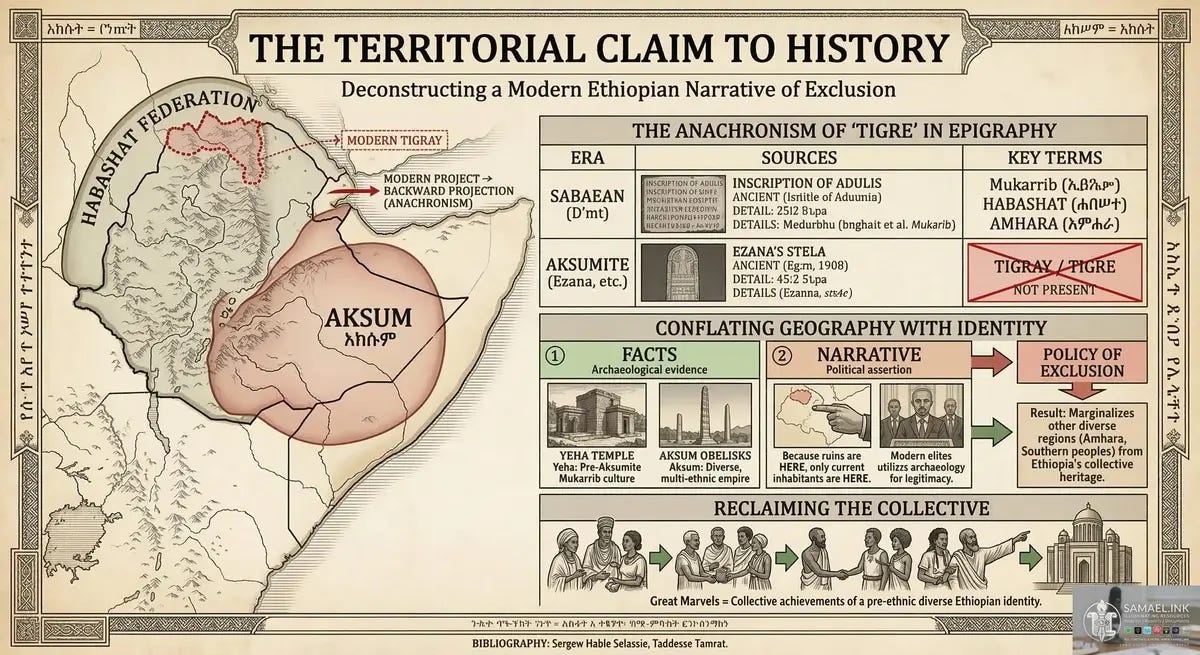
The Anachronism of “Tigre” in Epigraphy
The primary flaw in this narrative is the total absence of a “Tigre” or “Tigray” identity in the foundational records of the region. Whether examining the Sabaean inscriptions of the D’mt period or the Ge’ez stelae of the Aksumite Empire, the term is non-existent.
In contrast, the original tribal identifier found in the earliest Kings’ Lists and medieval hagiographies is Amhara (Ge’ez: አምሐራ, romanized: ʾAmḥarā). As noted by Sergew Hable Selassie in Ancient and Medieval Ethiopian History to 1270, the “Amhara” were recognized as a distinct political and cultural entity long before “Tigray” emerged as a consolidated provincial label in the Solomonic era.
Conflating Geography with Identity
The current narrative relies on a “simple fact” of geography: because the ruins of Aksum and Yeha are located within the modern Tigray Regional State, the inhabitants must be their exclusive descendants. This logic ignores the multi-ethnic synthesis of the Aksumite state.
Yeha (Sabaean: 𐩺𐩱𐩰, romanized: Yḥʾ): Represents a pre-Aksumite culture linked to the title of Mukarrib (Sabaean: 𐩣𐩫𐩧𐩨, romanized: mkrb, lit. ‘federator’).
The Habashat (Ge’ez: ሐበሠተ, romanized: ḥbšt): The collective term for the highland Semitic speakers, a grouping that included the ancestors of both the Amhara and the Agaw, who were central to the empire’s expansion.
The Strategy of Exclusion
By framing Tigray as the “most archaeologically rich” and the “sole cradle” of Christianity and Islam in the Horn, the narrative creates a sense of exclusion. It suggests that the rest of Ethiopia—specifically the Amhara and southern peoples—are peripheral to the “true” Ethiopian story.
However, as Taddesse Tamrat argues in Church and State in Ethiopia (1270–1527), the migration of the Aksumite political center southward was not a “loss” of identity, but a continuation of the state. The claim that the heritage belongs only to those currently residing in the northern highlands is a modern invention designed to fill a perceived historical void for a movement that sought to distance itself from the broader Ethiopian “Amhara-centric” narrative.
Reclaiming the Collective
The endeavor to conflate regional names with ancient tribal markers is a modern political project, not a historical reality. To understand the true history of the region, one must look past the 35-year-old narrative of exclusion and recognize that the “Great Marvels” of the past were the collective achievements of a diverse Ethiopian identity that predates modern ethnic divisions.
How Amda Seyon I Rebranded Power

The historical communication between Highland Christian sovereigns and the Sultanates of Egypt was defined by the “Nile Paradox,” a high-stakes geopolitical "laundering" where theological adversaries managed a persistent “double hostage” architecture. The