
TL;DR:
The year 1063 CE marked a violent rupture in the Horn of Africa, where the fragile peace between the Makhzumi Sultanate and the Zagwe Kingdom shattered under the weight of economic desperation. Driven by the crushing 10% Ushr tax levied by the Alids of Dahlak at the coast, the Makhzumi Malik attempted to bypass this stranglehold by planting fortified merchant colonies deep within the highlands. The Zagwe viewed these "Investment Certificates" not as trade ventures, but as an existential territorial invasion designed to siphon off the region's gold and civet before it could reach the royal treasury. This misunderstanding of intent, fueled by the Alids' relentless financial squeeze, ignited a full-scale military collision on the rugged escarpment overlooking the Awash Valley.
The resulting Battle of 1063 was a pyrrhic victory that fundamentally altered the political DNA of the region. While the Zagwe succeeded in destroying the initial Makhzumi market-colonies, they failed to secure the territory, leaving a "poisoned" landscape of bloodshed and economic ruin. The true victors were the Alids of Dahlak, who watched the highland powers bleed each other dry and subsequently raised their protection fees, capitalizing on the instability. This disaster forced the Makhzumids to abandon their mercantile dream of peaceful integration and pivot toward a brutal, militarized existence. By the 1070s, the language of their land grants shifted from "markets" to "frontier fortresses," birthing a new class of warrior-settlers known as the Ghazi.
This transformation culminated in the 1090s, where the Makhzumi state evolved into a garrison society, conducting annual military inspections ('Arḍ) to ensure the loyalty and readiness of its highland cavalry. However, the very system designed to save the Sultanate—the hereditary Iqta—eventually became its undoing. By the 1120s, the central authority of the Malik had crumbled under the weight of autonomous warlords who withheld taxes and turned their weapons inward. The result was a fragmented highland, ripe for Zagwe reconquest and the eventual rise of the Sultanate of Adal, proving that the Alid tax had not stopped the trade, but had instead forced it to grow teeth, only to have those teeth turn on the hand that fed them.
The Trigger: The "Waqf" of the Frontier
In the early 1060s, the political landscape of the Horn was defined by a suffocating economic reality. The Alids of Dahlak, controlling the strategic choke points of the Red Sea, had imposed a 10% Ushr tax on all goods passing through their ports. For the Makhzumi Sultanate, whose wealth was derived from the gold and civet of the highlands, this levy was an existential threat. It threatened to drain the lifeblood of the Sultanate before it could even reach the sea. In a desperate bid to circumvent this coastal stranglehold, the Makhzumi Malik initiated a radical strategy: the aggressive "planting" of Muslim merchant colonies deep within the highland territories of the Argobba and the eastern Amhara foothills.
These were not merely trading posts; they were designated as Waqf, or religious endowments, intended to support new mosques and the establishment of "Friday Markets" (Suq al-Jum'a). The Makhzumi vision was one of sovereign production. By creating "loyalist" territory in the interior, they hoped to ensure that the production of gold and civet remained under their direct control, bypassing the Alid tolls entirely. They believed that by integrating these highland communities into the Islamic economic sphere through the promise of shared profit, they could create a self-sustaining loop of wealth that ignored the coast.
The Zagwe Kingdom, however, perceived this move through a lens of immediate threat. To the Zagwe King, likely Tatadim or a contemporary successor, these new settlements were not benign markets. They were fortified tax-collection hubs, designed to siphon off highland resources before they could reach the Zagwe administration. The "Investment Certificates" issued by the Makhzumi Sultan were viewed as legal instruments of invasion, granting foreign merchants the right to extract wealth from lands that the Zagwe considered their own. What began as a dispute over trade routes rapidly escalated into a conflict over sovereignty and territorial integrity. The Makhzumids saw a path to economic survival; the Zagwe saw a siege.
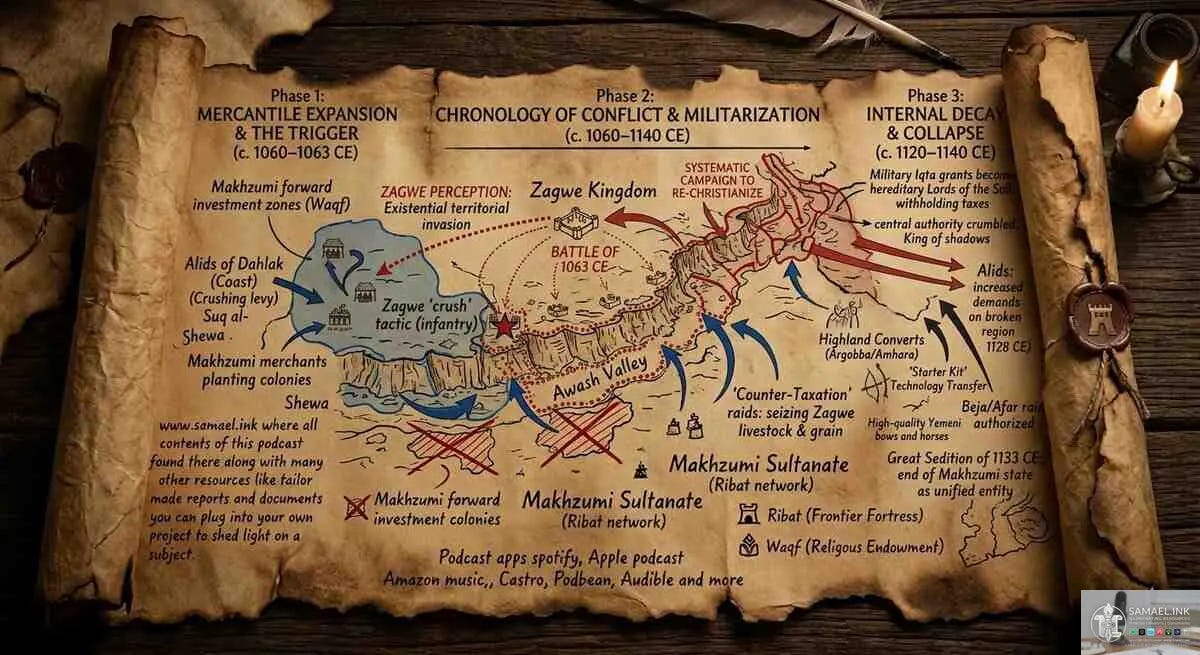
The Battle of 1063 CE
The tension reached its breaking point in 1063 CE, forcing a large-scale military collision between the Makhzumids and the Zagwe. The Zagwe King mobilized a massive highland infantry force with the singular objective of dismantling these new "Investment" colonies. The battle took place on the rugged escarpment overlooking the Awash Valley, a terrain that favored the defenders but offered little respite for the attackers.
The military dynamics of the engagement were stark. The Zagwe employed a traditional highland "crush" tactic, relying on superior numbers and heavy infantry to overwhelm the merchant-militias of the Makhzumi colonies. Their strategy was one of brute force, aiming to physically destroy the infrastructure of the new trade towns. In contrast, the Makhzumids relied on highly mobile cavalry and professional archers, many of whom were of Zubayrid or Yemeni descent. Their strategy was defensive yet agile, fighting to protect their "Investment"—the physical infrastructure of the new towns and the lives of the settlers.
The result was a Pyrrhic victory for the Zagwe. They successfully destroyed several of the new mosques and markets, inflicting significant damage on the Makhzumi presence. However, they could not hold the territory. The Makhzumids, though battered, retreated further into the Shewan interior, leaving behind a "poisoned" landscape. The human cost was staggering; local traditions record significant bloodshed among the new highland converts, the very people the Makhzumids had sought to integrate. Economically, the blow was devastating. The destruction of these markets crippled the highland economy, making it even harder for both powers to pay the Alid taxes at the coast. The war had achieved nothing but mutual exhaustion, while the Alids of Dahlak watched from the sidelines, their coffers swelling with the taxes of a broken region.
The Aftermath: The "Tribute of Desperation"
By 1065 CE, the exhaustion from the 1063 battle led to a grim realization for both the Makhzumids and the Zagwe. While the two highland kings had bled each other white, the Alids of Dahlak were growing richer. The conflict had not weakened the coastal tax collectors; it had strengthened them. The Alids seized upon the instability to increase the Khafara, or protection fee, arguing that the "Highlands were unstable" and thus required greater security measures. This was a cynical exploitation of the war, turning the devastation of the interior into a revenue stream for the coast.
The post-1063 status quo was a disaster for the highland powers. The Makhzumids had lost their "Forward Investment" colonies and were forced to rely on internal Shewan taxes, which were insufficient to meet their needs. The Zagwe had secured their borders but lost the "Market Fees" that the Makhzumi colonies had provided, leaving a vacuum in their own revenue streams. Meanwhile, the Alids emerged as the clear winners, having successfully taxed the profit out of the merchant and the soldier alike.
This dynamic forced a fundamental shift in the Makhzumi strategy. The failure of the mercantile approach meant that the Sultanate could no longer rely on peaceful trade to sustain itself. The "Investment Certificates" of the past were obsolete. The new reality demanded a different kind of investment—one of blood and iron. The Makhzumids realized that to keep their highland subjects from reverting to Zagwe control or being impoverished by the coast, they had to give them the means to take resources by force. The transition from a merchant-state to a militarized frontier state was no longer a choice; it was a necessity for survival.
The Transition to the Military Iqta
The 1070s marked the formalization of this shift, as the Makhzumids changed the language of their land grants. The "Mercantile Investment" of the 1060s was replaced by the "Military Iqta" (Arabic: اقطاع, iqṭā‘, lit. 'allotment'). This was not merely a semantic change; it represented a complete restructuring of the state's relationship with its subjects. The new grants, dating from around 1070 CE, stopped emphasizing "Markets" and started emphasizing Ribats (Frontier fortresses).
The role of the Malik transformed from a patron of trade to a Protector of the Faith. The Sultan no longer promised "Trade Profits" to his followers; he promised "Protection of the Faith." This shift turned the Makhzumi Sultanate into a garrison state, where the primary function of the land was to support a standing military force. The Iqta system was designed to bypass the Alid 10% Maks at the coast by allowing the Iqta holders to retain a larger share of local agricultural taxes (Kharaj) in exchange for maintaining the defense of the Shewan frontier against the Zagwe.
The documents of this era reflect a stark change in tone. The earlier certificates focused on Suq (Market) and Tijara (Trade). The new grants spoke of Jund (Soldier/Army) and Ribat (Frontier Fort). The "Soldier-Settler" model became the norm, where the Sultan granted land to groups of "Highland Converts" on the condition that they provide a specific number of mounted archers for the Sultan's seasonal campaigns. This created a self-sustaining military machine, funded by the land itself, independent of the coastal trade routes that the Alids controlled.
The Arming of the Highland Converts
The 1070s also saw a massive "Technology Transfer" from the Zubayrid and Yemeni merchant-mercenaries to the indigenous Argobba and Amhara Muslims. The Iqta documents often included a "Starter Kit" for the settler: high-quality Yemeni bows and horses. This gave the Highland Muslims a distinct military advantage over the Zagwe infantry, who relied primarily on spears and shields. The composite bow, a weapon of the steppes and the desert, became the signature arm of the new highland cavalry.
The Ribat network that sprang up across the eastern escarpment was far more than a collection of villages. These were stone-fortified highpoints overlooking the Awash Valley, functioning as early warning systems against Zagwe incursions and as staging grounds for "Counter-Taxation" raids. In these raids, the Makhzumids would seize Zagwe livestock and grain to offset the gold lost to the Alids at the coast. This was a shift from a mercantile economy to an extractive one, where wealth was taken by force rather than earned through trade.
The geopolitical standoff that emerged between 1075 and 1100 CE was defined by this new reality. The primary grant had shifted from market plots to frontier forts. Loyalty was no longer based on shared profit but on shared defense and faith. The relationship with the Zagwe had evolved from rival traders to existential enemies, while the Alids were now viewed as "distant suzerains" whose power was waning in the face of the highland militarization. This period laid the foundation for the future Sultanate of Adal, as the hardened, militarized population of the eastern escarpment broke away from the "Quietist" merchant traditions of old Shewa.
The Military Inspections of the 1090s
By the 1090s, the Makhzumi state had fully consolidated its identity as a highland military power. The "Military Inspections" ('Arḍ, Arabic: عرض, lit. 'review') of this decade represented the final step in this transformation. The Sultan no longer just checked the ledgers for gold and civet; he personally inspected the horses and composite bows of the Iqta holders. These reviews were held annually on the plains of the Awash Valley, specifically at the foot of the Shewan escarpment.
Every holder of a Military Iqta was required to present themselves, their mounts, and their weaponry. The most striking feature of these records was the presence of the "New Muslims"—highland converts from the Argobba and Amhara peripheries who had mastered the art of light cavalry. The inspections enforced a specific standard: one high-quality Yemeni composite bow, two quivers of arrows, and a straight-bladed sword. This standardization ensured that the Makhzumi army was a cohesive and formidable force, capable of challenging the Zagwe on their own terms.
The 1090s inspections were a direct middle finger to the Alids of Dahlak. By militarizing the highlands, the Makhzumids were effectively telling the coast: "We are spending the gold on soldiers to defend the interior, so there is less left for your taxes." The Ribats were exempted from certain trade taxes because they provided the Sultan with "Standing Readiness" (Ribat al-Khayl). Instead of paying the Ushr to the Alid agents, the Makhzumids used their new cavalry to "tax" the Zagwe livestock and grain directly. This shift from a mercantile to an extractive economy marked the birth of the "Frontier Spirit," a decoupling from the global maritime economy and a focus on highland expansion.
The Internal Decay of the Iqta System (1120–1130 CE)
However, the very system that saved the Makhzumi Sultanate from the Alids eventually became its undoing. The Military Iqta was designed as a temporary grant in exchange for service. But by the 1120s, these grants had become hereditary. The Iqta holders, the "New Muslims" of the highlands, stopped seeing themselves as "The Sultan's Soldiers" and started seeing themselves as "Lords of the Soil."
The localized power of these warlords grew unchecked. Instead of sending a portion of the highland taxes to the central treasury to pay the Alid maritime tolls, the local lords kept the gold to fund their own private retinues. The central Sultanate became "Land Poor." The Sultan held the title of Malik al-Habasha, but he no longer had the direct income to maintain the professional Zubayrid guard that had previously kept the Zagwe at bay. The unity of the 1090s had fractured into a patchwork of autonomous fiefdoms.
While Shewa was fracturing, the Red Sea was experiencing a massive shift. The Najahid dynasty, the Alids' partners, collapsed, and a renewed Zaydi Imamate surged in the Yemeni highlands. The Alids of Dahlak lost their primary naval protector and, to survive the Zaydi expansion, increased their demands on the African coast. The "Squeeze" of 1128 CE saw the Alids demanding an "Emergency Subsidy" from the Makhzumids. When the central Sultan in Shewa couldn't pay because his Iqta lords were withholding taxes, the Alids authorized the Beja and Afar to raid deeper into the highland markets than ever before.
The Great Sedition of 1133 CE
The records of the 1130s describe a period of Fitna (internal strife) within the Sultanate. The "New Muslims" of the highlands, who had been inspected and armed in the 1090s, now turned those composite bows against the Sultan's tax collectors. The military reviews ceased. The Sultan could no longer command the presence of the highland cavalry. The Great Sedition of 1133 CE marked the end of the Makhzumi state as a unified entity.
Seeing the Islamic frontier in chaos, the Zagwe Kings began a systematic campaign to re-Christianize the Amhara and Argobba foothills, capturing several key Ribats that had been abandoned by the feuding Muslim lords. The timeline of this collapse was swift and brutal. By 1122 CE, the last recorded unified Arḍ (Inspection) had taken place. By 1126 CE, the Zaydi Imamate had captured Zabid, severing the Alids' connection to Yemen. By 1133 CE, the Great Sedition had torn the Sultanate apart. And by c. 1140 CE, the Zagwe had annexed the eastern escarpment "Investment" zones.
The legacy of this period was profound. The militarized Iqta system had created a warrior-aristocracy that would eventually resist the Solomonic Restoration of 1270 CE. The Amhara and Argobba Muslims inspected in the 1090s were the direct ancestors of the cavalry that would later define the Sultanate of Ifat. The Alid tax at the coast had not stopped the trade; it had just forced the trade to grow teeth. But by 1080, every merchant in Shewa was also a soldier, and by 1140, the Makhzumi Malik was a King of shadows, holding the titles of the 7th century while the 12th century belonged to the local warlords and the Zagwe spear.
What was the primary catalyst for the Battle of 1063 CE?
The primary catalyst was the Makhzumi Sultanate's attempt to bypass the 10% Ushr tax levied by the Alids of Dahlak by establishing fortified merchant colonies (Waqf) in the highlands, which the Zagwe Kingdom viewed as a territorial invasion.
Why did the Battle of 1063 result in a Pyrrhic victory for the Zagwe?
Although the Zagwe successfully destroyed the Makhzumi market-colonies, they could not hold the territory. The Makhzumids retreated, leaving a devastated landscape that crippled the highland economy and ultimately benefited the Alids, who raised their taxes on the unstable region.
How did the Makhzumi land grant system change in the 1070s?
The system shifted from "Mercantile Investment" focused on markets (Suq) to "Military Iqta" focused on frontier fortresses (Ribat). The language of the grants changed from promising trade profits to promising protection of the faith and military service.
Who were the "Highland Ghazi" and what was their origin?
The "Highland Ghazi" were a new social class of frontier warriors composed of indigenous Argobba and Amhara Muslims who were armed and trained by Yemeni mercenaries. They formed the backbone of the militarized Makhzumi state and later the Sultanate of Adal.
What was the purpose of the 'Arḍ (Military Inspections) in the 1090s?
The 'Arḍ were annual reviews where the Sultan inspected the horses, composite bows, and swords of the Iqta holders to ensure the readiness of the highland cavalry. It served as a direct challenge to Alid authority by demonstrating the Sultan's ability to maintain a standing army independent of coastal trade.
How did the Iqta system contribute to the decline of the Makhzumi Sultanate?
The Iqta grants, originally temporary, became hereditary by the 1120s. This turned the Iqta holders into autonomous warlords who withheld taxes from the central treasury, leading to the "Land Poor" status of the Sultan and the fragmentation of the state.
What role did the Zaydi Imamate play in the collapse of the Makhzumi-Zagwe stalemate?
The rise of the Zaydi Imamate in Yemen around 1126 CE caused the collapse of the Najahid dynasty, the Alids' naval partners. This forced the Alids to increase their demands on the Makhzumids, exacerbating the internal financial crisis and triggering the Great Sedition.
What was the "Great Sedition" of 1133 CE?
The Great Sedition was a period of internal civil war within the Makhzumi Sultanate where the hereditary Iqta lords turned their weapons against the central Sultan's tax collectors, effectively ending the unified military power of the state.
How did the Zagwe Kingdom exploit the Makhzumi decline?
Taking advantage of the internal chaos and the cessation of military inspections, the Zagwe launched a systematic campaign to re-Christianize the Amhara and Argobba foothills, recapturing the abandoned Ribats and annexing the eastern escarpment by 1140 CE.
What was the long-term legacy of the Makhzumi militarization?
The militarization created a warrior-aristocracy that resisted the later Solomonic Restoration and formed the foundation of the Sultanate of Ifat and Adal. It demonstrated that the Alid tax had forced the highlands to militarize, creating a "Frontier Spirit" that defined the region's politics for centuries.


