
TL;DR:
In the turbulent landscape of the 9th and 10th centuries, the Islamic presence in the Horn of Africa fractured into two distinct and opposing power centers, driven by divergent survival strategies rooted in their ancestral identities. The Makhzumids, descendants of the pragmatic Meccan merchant clan, chose a path of deep indigenization, migrating into the central highlands to forge the Sultanate of Shewa. By marrying into local Sidama and Agaw lineages and merging Meccan mercantile law with highland tribal structures, they transformed into “Highland Sovereigns,” deriving their authority from the soil, agriculture, and the loyalty of the local populace. Their power was terrestrial, built on the production of gold, civet, and ivory, and their identity became increasingly intertwined with the African interior they sought to rule.
Conversely, the Alids, specifically the Suleimaniad branch claiming direct descent from the Prophet Muhammad, rejected integration in favor of preserving their “Sharifian” purity. Remaining anchored to the Dahlak Archipelago and the Tihama coast, they became “Maritime Aristocrats” whose legitimacy rested entirely on their genealogical prestige and their control of the Red Sea trade routes. Acting as the indispensable diplomatic intermediaries, they managed the ports and the flow of goods between the African interior and the wider Islamic world, effectively holding the “Gate” through which all wealth and religious legitimacy had to pass. This strategic choice kept them wealthy and spiritually revered but geographically confined, creating a “velvet prison” where their status as the Family of the Prophet prevented them from ever truly becoming part of the highland society.
The resulting dynamic was a tense symbiosis defined by a fundamental economic and political friction: the Makhzumids controlled the production of wealth in the mountains, while the Alids controlled the distribution of that wealth at the sea. This divergence sparked the first major “Highland-Coastal” conflicts in the region’s history, centering on the imposition of transit taxes known as Maks and the struggle for control over the Zula-Dahlak trade corridor. While the Makhzumids eventually asserted their independence by adopting titles like Sultan al-Barr and establishing their own religious judiciary, the Alids maintained their role as the spiritual gatekeepers, creating a dual sovereignty model that would shape the political geography of the Horn of Africa for a millennium.
The Great Divergence: Two Paths to Power in the Horn of Africa
To comprehend the profound split that occurred between the Alids and the Makhzumids during the 9th and 10th centuries, one must look beyond simple geography and examine the survival strategies each group adopted upon arriving in the Horn of Africa. These two factions, both originating from the Quraysh tribe of Mecca, faced the same new environment but responded with diametrically opposed philosophies. The result was a historical schism that created two distinct models of Islamic governance: the “Highland Sovereigns” of the Makhzumids and the “Maritime Aristocrats” of the Alids. This divergence was not merely a matter of location; it was a fundamental difference in how they understood legitimacy, power, and their relationship to the indigenous populations they encountered.
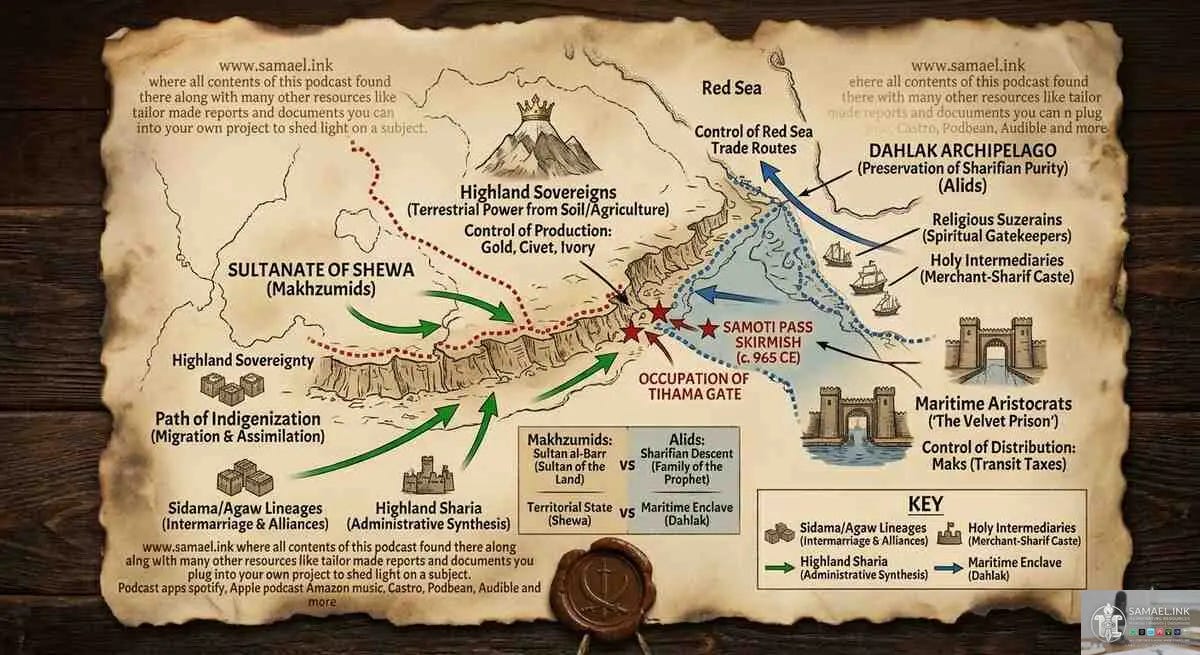
The Makhzumi Strategy: The Path of Indigenization
The Makhzumids, historically the military and mercantile elite of Mecca, approached their new reality with the pragmatism that had defined their clan for generations. Unlike the religious aristocracy of the Alids, the Makhzumids were accustomed to the rough-and-tumble of trade and administration. Upon their arrival in the region that would become Shewa, they made a calculated decision to disappear into the local fabric of society. This was not a retreat but a strategic consolidation.
Their primary mechanism for this integration was marriage. To secure the vital trade routes that stretched from the Red Sea coast deep into the interior, the Makhzumi leaders forged alliances with the families of the local Sidama and early Semitic-speaking highland groups. These were not superficial unions; they were the bedrock of a new political order. By intermarrying with the ancestors of the Argobba and Amhara peoples, the Makhzumids wove their lineage into the very DNA of the highland societies. They ceased to be foreign overlords and became part of the local kinship networks, gaining the loyalty of the people through blood ties rather than the sword alone.
Administratively, the Makhzumids refused to impose a rigid, purely Arab system of governance. Instead, they engineered a synthesis, blending Meccan mercantile law with the existing tribal structures of the highlands. This flexibility allowed them to rule effectively in a land where tribal custom held as much sway as written decree. By the time they formally established the Sultanate of Shewa around 896 CE, they had transformed. They were Muslims in faith, but culturally, they were “Highlanders.” Their power was no longer derived from a distant connection to the Hejaz but was rooted firmly in the land, the agricultural surplus, and the labor force of the interior. They became the “Kings of the Mountain,” rulers who understood the soil and the seasons as intimately as the markets of Mecca.
The Alid Strategy: The Fortress of Bloodline
In stark contrast, the Alids, specifically the Suleimaniad branch, pursued a strategy of exclusion and preservation. Their power was not built on trade or military prowess in the traditional sense, but on their “Pure Bloodline”—their direct descent from Ali and Fatima, the Prophet Muhammad’s cousin and daughter. This genealogical claim was their sole source of authority in the eyes of the wider Islamic world. To dilute this lineage through intermarriage with non-Sharifian locals would have been to destroy the very foundation of their power.
Consequently, the Alids retreated to the Dahlak Archipelago and the Tihama coast, creating a maritime enclave that served as a “Sharifian Barrier.” They remained “foreign” by choice, maintaining a culture and social structure that was indistinguishable from the Hejaz. They became the “Holy Intermediaries,” a diplomatic layer that stood between the African interior and the global Islamic community. If a Highland King, whether Makhzumi or later the Zagwe, wished to send gifts to the Caliph or engage in trade with Yemen and Egypt, they had to pass through the Alid-controlled ports. The Alids did not rule the land; they ruled the gate.
This strategy created a unique social dynamic often described as a “Velvet Prison.” The Alids on Dahlak were wealthy, respected, and spiritually elevated, yet they were effectively trapped on the coast. They could not move inland without losing their status, nor could they abandon the coast without losing their purpose. They became an elite “Merchant-Sharif” caste, dependent on the flow of goods from the interior but unable to produce anything themselves. Their existence was defined by their role as the guardians of the threshold, the necessary bridge between the “barbarous” highlands and the civilized centers of the Islamic Empire.
The 10th Century Divergence: Sovereignty vs. Status
By the 10th century, the divergence between these two groups had hardened into a structural reality that defined the region’s politics. The Makhzumids had become the sovereigns of the land, building a state based on territory and local alliance. The Alids had become the arbiters of status, controlling the maritime chokepoints and the religious legitimacy that flowed through them.
The Alids did not move to the highlands because they viewed themselves as “Global Elites.” Their gaze was fixed on Mecca, Medina, and Damascus. To move into the highlands would have been to disconnect from the source of their power: the heart of the Islamic Empire. They believed that the highlands were “barbarous” and that their authority depended on maintaining a distance from the local population. The Makhzumids, however, were “Rebel Merchants.” They cared little for the Caliph’s approval and everything for the Gold and Civet trade. They moved where the money was—the Highlands—and in doing so, they built a state that was resilient, localized, and deeply rooted in the African soil.
The Roots of the Conflict: From Hijaz to Ethiopia
To fully grasp the nature of this conflict, one must trace the origins of these two groups back to their status in the Hijaz during the 6th and 7th centuries. In the pre-Islamic and early Islamic social hierarchy of Mecca, the Banu Hashim (Alids) and the Banu Makhzum occupied vastly different niches. The Alids were the “Religious Aristocracy,” custodians of the Kaaba’s spiritual legacy, whose prestige was rooted in divine right and blood. They were often land-rich but politically marginalized by the more aggressive merchant clans. The Makhzumids, conversely, were the “Military and Mercantile Elite,” the clan of Khalid ibn al-Walid, who controlled the caravan trade and the police functions of the city. They were pragmatists who initially opposed Muhammad to protect their trade interests before becoming the administrative backbone of the early Caliphate.
When these groups were displaced to the Horn of Africa, their original “brand identity” dictated their operational models. The Alids, carrying the burden of prophetic lineage, could not afford to integrate. Their legitimacy was fragile and depended on the perception of purity. The Makhzumids, carrying the mantle of the merchant-prince, could adapt and evolve. Their legitimacy was practical and depended on the ability to generate wealth and maintain order.
Once in Ethiopia, this distinction became absolute. The Alids remained on the coast, controlling the ports and the “entry” into the Islamic world. The Makhzumids moved into the interior, forming a territorial state in Shewa. The Alids married other Arabs to keep their lineage clear; the Makhzumids married local elites to secure their rule. The Alids ruled because they were the “Family of the Prophet”; the Makhzumids ruled because they controlled trade and local alliances.
The Revenue Conflict: The Clash of Sword and Seal
After the formal establishment of the Shewa Sultanate in 896 CE, a “symbiotic friction” developed between the two powers. The Makhzumids in Shewa were the producers of wealth, monopolizing the interior trade of gold, civet, ivory, and slaves from the Hadiya and Sidama regions. However, to get these goods to the global market, they had to pass through the Dahlak Archipelago, which was controlled by the Alids or their proxies, the Wajidites and Ziyadids.
This created an immediate economic conflict. The Alids on the coast imposed heavy “transit duties” on Highland goods, viewing themselves as the “Guardians of the Gate.” They claimed these taxes were necessary to fund the defense of the Red Sea against piracy and the Abbasid navy. The Makhzumids, however, viewed these taxes as extortion. Diplomatically, the tension was exacerbated by the Alids’ attitude; they treated the Makhzumi Sultans as “provincial” or “indigenized” converts, while the Alids maintained their “Sharifian” superiority as the literal family of the Prophet.
The conflict escalated when the Makhzumids attempted to bypass the Alid ports. They tried to open new caravan trails that exited further south, avoiding the Alid-controlled Dahlak zone. The Alids responded with their superior maritime mobility and alliances with coastal Beja and Afar tribes, launching raids on these “illegal” caravans. The Makhzumids, in turn, descended the escarpment with their larger, highland-adapted armies to secure the watering holes and trade depots. However, they lacked a navy and could not strike the Alid power base on the islands.
By the late 10th century, a stalemate was reached. The Makhzumids controlled the land, but the Alids controlled the water. A “Treaty of Necessity” was established, creating a “Double-Sovereignty” model. The Makhzumids agreed to pay a standardized transit fee in exchange for the Alids providing “diplomatic cover.” The Alids began acting as the official ambassadors for the Makhzumi Sultanate in the courts of the Fatimids and the Ziyadids. The Makhzumids held the Sword (Highland military power), while the Alids held the Seal (Maritime and religious legitimacy).
The Breaking Point: Bloodshed and the Battle for the Gate
The friction eventually moved from the counting house to the battlefield. The first major recorded military engagements centered on the Zula-Dahlak trade corridor. The Skirmish at the Samoti Pass around 965 CE saw Alid-aligned coastal levies ambush a major Makhzumi caravan attempting a tax-free descent. Oral traditions and later chronicles suggest this was a bloody engagement resulting in the loss of hundreds of highland troops and the seizure of the year’s gold and civet exports.
In retaliation, the Makhzumi Sultan mobilized a large-scale infantry force and descended the escarpment to occupy the coastal watering holes and trade depots opposite the Dahlak Archipelago. While they could not cross the water, they effectively “starved” the Alid ports of highland grain and supplies for over a year. This blockade led to several lethal coastal skirmishes as the Alids tried to break the land siege.
The resolution came through the “Sharifian Neutrality.” The Makhzumids realized they could not conquer the islands, and the Alids realized they could not starve the highlands forever. A formal agreement was signed, recognizing the Alids as the “Religious Suzerains” of the coast in exchange for lower tax rates. This established a “Cold Peace” defined by high taxes and mutual suspicion, a dynamic that would persist for centuries.
The Administrative Schism: Titles and Legitimacy
To signal their break from the Alid sphere, the Makhzumids began adopting titles that emphasized territorial sovereignty over lineal status. They moved away from the simple title of Amir and adopted Sultan al-Barr (Sultan of the Land), explicitly claiming that their authority came from the soil and the people of the Highlands. In diplomatic correspondence with the Fatimids, they used the title Malik al-Habasha (King of the Abyssinians), signaling that they were the “Heirs of Aksum” and the true rulers of the African interior.
Furthermore, the Makhzumids began appointing their own Qadis (Judges) and Imams from within the local integrated elite. This ended the Alid monopoly on religious interpretation in the region and created a “Highland Sharia” that was more favorable to the local merchant class. The Alids, in response, issued excommunication threats, but the administrative split was complete. The Makhzumids had become a native dynasty, while the Alids remained “Arabs in Africa,” looking toward the Red Sea and maintaining a culture that was indistinguishable from that of the Hejaz.
The Legacy of the Divergence
This conflict defined the structural relationship of the Horn of Africa for the next thousand years. It established the “Highland-Coast” dichotomy that would characterize the region’s politics. The Highlands remained the source of production and military manpower, the domain of the Makhzumi model. The Coast remained the source of religious status and global connectivity, the domain of the Alid model.
As Taddesse Tamrat noted in his seminal work, “The Makhzumids provided the body of the Islamic presence in Ethiopia, but the Alids provided its face to the outside world.” The first recorded wars between Shewa and Dahlak were not over religion, but over the “Maks” (customs). They were two Islamic powers fighting over the same gold coin, a struggle that shaped the destiny of the Horn of Africa.
What was the primary difference in survival strategies between the Makhzumids and the Alids?
The Makhzumids chose a path of indigenization, marrying into local highland families and integrating into the local culture to build a territorial state. The Alids chose a path of preservation, maintaining their “Sharifian” bloodline purity and remaining on the coast to control maritime trade and religious legitimacy.
Why did the Alids remain on the coast rather than moving to the highlands?
The Alids’ power was based on their genealogical claim as descendants of the Prophet. Moving into the highlands and marrying local populations would have diluted this lineage, destroying the very source of their authority. They viewed themselves as “Global Elites” connected to the Islamic heartland, not local rulers.
What was the “Velvet Prison” of the Alids?
It refers to the situation where the Alids on the Dahlak Archipelago were wealthy and respected as the “Family of the Prophet” but were effectively trapped on the coast. They could not move inland without losing status, yet they depended entirely on the highland trade for their wealth, creating a dependency that limited their political freedom.
How did the Makhzumids legitimize their rule in the highlands?
They legitimized their rule through marriage alliances with local elites (Sidama, Agaw, Argobba), administrative synthesis of Meccan law with tribal structures, and eventually by adopting titles like Sultan al-Barr and Malik al-Habasha to emphasize their connection to the land and the people.
What was the “Maks” and why did it cause conflict?
The Maks was a transit tax or toll imposed by the Alids on goods passing through the Dahlak Archipelago. It caused conflict because the Makhzumids, who produced the wealth in the highlands, viewed it as extortion, while the Alids viewed it as a necessary fee for protection and religious legitimacy.
What was the outcome of the military conflicts in the 10th century?
The conflicts, such as the Skirmish at the Samoti Pass and the Occupation of the Tihama Gate, resulted in a stalemate. Neither side could fully defeat the other. This led to a “Treaty of Necessity” where the Makhzumids paid a standardized fee in exchange for the Alids providing diplomatic cover, establishing a “Double-Sovereignty” model.
How did the Makhzumids challenge the Alids’ religious authority?
The Makhzumids challenged the Alids by appointing their own local Qadis and Imams, creating a “Highland Sharia” that was independent of the Alid-controlled religious judiciary. They also adopted titles that emphasized their sovereignty over the land, reducing the Alids to mere “Islanders” in their own eyes.
What role did the Zagwe dynasty play in this dynamic?
The rise of the Christian Zagwe dynasty in the north created a three-way pressure on the region. It added a third major power to the equation, forcing the Makhzumids and Alids to navigate a complex geopolitical landscape where they had to balance their rivalry with the threat posed by the Christian north.
What is the significance of the “Highland-Coast” dichotomy?
This dichotomy established a structural division in the Horn of Africa that persisted for centuries. The highlands became the center of production and military power, while the coast remained the center of religious status and global trade. This division shaped the political and economic development of the region.
How does Taddesse Tamrat describe the relationship between the Makhzumids and the Alids?
Tamrat describes the relationship as one where the Makhzumids provided the “body” of the Islamic presence in Ethiopia (the physical state, the people, the land), while the Alids provided the “face” (the religious legitimacy, the connection to the wider Islamic world, the diplomatic interface).


