
TL;DR:
The relationship between the Walashma dynasty and the Zagwe Kingdom during the 12th and 13th centuries represents one of the most consequential yet understudied power dynamics in medieval Horn of Africa history. Initially functioning as commercial middlemen who controlled the caravan trails through the Afar lowlands, the Walashma gradually transformed from pragmatic protectors of Zagwe trade routes into predatory expansionists who exploited the Zagwe dynasty's internal fractures. This transformation was not driven by religious ideology alone but by mercantile calculation—the Walashma recognized that controlling the physical pathways between the Christian highlands and the Red Sea ports gave them leverage over both economic and political outcomes.
The Solomonic Restoration of 1270 CE marked a critical inflection point in this relationship. Contrary to traditional narratives that frame this transition as an immediate religious confrontation between Christian and Islamic powers, the evidence suggests a more complex arrangement. Yekuno Amlak, the first Solomonic king, presented himself to the Mamluk Sultan in Egypt as a pluralistic sovereign who ruled over substantial Muslim populations and commanded "Muslim armies." The Walashma initially supported his revolt against the Zagwe, viewing a new dynasty as more manipulable than the entrenched Lasta-based administration. This created a brief period of cooperation where Muslim cavalry commanders, particularly the Wärjih, served alongside Christian forces under a unified command structure.
However, this pluralistic model proved unsustainable as both powers consolidated their authority. The Walashma's execution of the last Makhzumi Sultan in 1285 CE signaled the end of the "Grand Bargain" and the beginning of two centuries of conflict between the Solomonic Kingdom and the Sultanate of Ifat. The tax ledgers from the 1290s reveal Yagbe'u Seyon's desperate attempts to maintain the "Amhara Amir" model through tax exemptions and land grant recognitions, but the Walashma's increasingly Sharifian ideology forced Muslim populations into a binary choice. By the time of 'Amda Seyon's reign (1314-1344 CE), the appointment of 'Alī b. Sabr ad-Dīn as a vassal Sultan of Ifat represented the final attempt at incorporation before the relationship deteriorated into open warfare.
The Era of the "Caravan Enforcers" (c. 1150 – 1200 CE)
The Walashma dynasty did not emerge as sovereign equals to the Zagwe kings. Instead, they occupied a position of strategic importance as the "Middlemen" who controlled the physical infrastructure of trade between the Ethiopian highlands and the Red Sea ports. This distinction is crucial for understanding the nature of their early interactions.
The Zagwe kings, particularly during the reigns of Imrahana Kristos and Gebra Maskal Lalibela, maintained a dependency on high-status imports from Egypt and the Levant. Silk, incense, and Coptic icons were not merely luxury goods but essential elements of royal legitimacy and religious practice. While the Alids controlled the Dahlak ports on the Red Sea coast, the Walashma controlled the actual trails through the Afar lowlands and the Ifat escarpment. This geographic reality gave them leverage that port control alone could not provide.
During this period, the interaction between the two powers was characterized by "Pragmatic Protection." The Zagwe paid the Walashma "Safe Passage" fees, and in exchange, the Walashma used their Alid-backed tribal alliances with the Afar to ensure that Zagwe caravans were not raided by desert nomads. This arrangement was mutually beneficial but inherently unstable, as it relied on the continued weakness of the Zagwe's ability to project power into the lowlands.
The 13th Century Shift: Predatory Expansion
As the Zagwe dynasty began to fracture between approximately 1210 and 1270 CE, the Walashma interaction turned aggressive. Internal succession crises between the Lasta and Tigrayan branches created opportunities that the Walashma were quick to exploit.
The Walashma began establishing "Market Colonies" in the eastern Zagwe borderlands. They utilized the same "Investment Certificates" strategy that the Makhzumids had pioneered, but with significantly more military backing. This was not merely commercial expansion but territorial predation disguised as economic development.
Perhaps more strategically significant was the religious dimension of this expansion. The Walashma encouraged the conversion of Agaw and Amhara border tribes, creating what amounted to a "Fifth Column" within the Zagwe state. These communities looked to the Walashma Maliks for legal arbitration and to the Alid remnants for spiritual guidance, rather than to the Christian Zagwe King. This dual loyalty undermined the religious unity that was central to Zagwe legitimacy.
Interaction Dynamics: A Comparative Analysis
The differences between the Zagwe-Makhzumi interaction and the Zagwe-Walashma interaction reveal fundamental shifts in how Islamic powers approached the Ethiopian highlands:
The Walashma approach was fundamentally different from their predecessors. Where the Makhzumids sought parity and negotiated from a position of shared sovereignty, the Walashma operated as a mobile, mercantile power that exploited the Zagwe's lack of naval access and their internal dynastic instability.
The 1270 "Betrayal": The Transition to the Solomonic Line
The most critical interaction occurred during the final years of the Zagwe dynasty. The Walashma recognized that the Zagwe were becoming a "Sinking Ship" and positioned themselves accordingly.
Evidence suggests the Walashma provided tactical neutrality, and potentially logistical support, to Yekuno Amlak during his revolt against the last Zagwe King, Yetbarak. The Walashma calculated that a new, grateful Solomonic King would be easier to manipulate than an entrenched Zagwe administration. This calculation proved partially correct but ultimately backfired.
Once Yekuno Amlak took the throne in 1270 CE, he used the very trade wealth the Walashma had facilitated to build a massive Christian army that would eventually challenge the Walashma for the next two centuries. The Walashma had inadvertently strengthened their future rival.
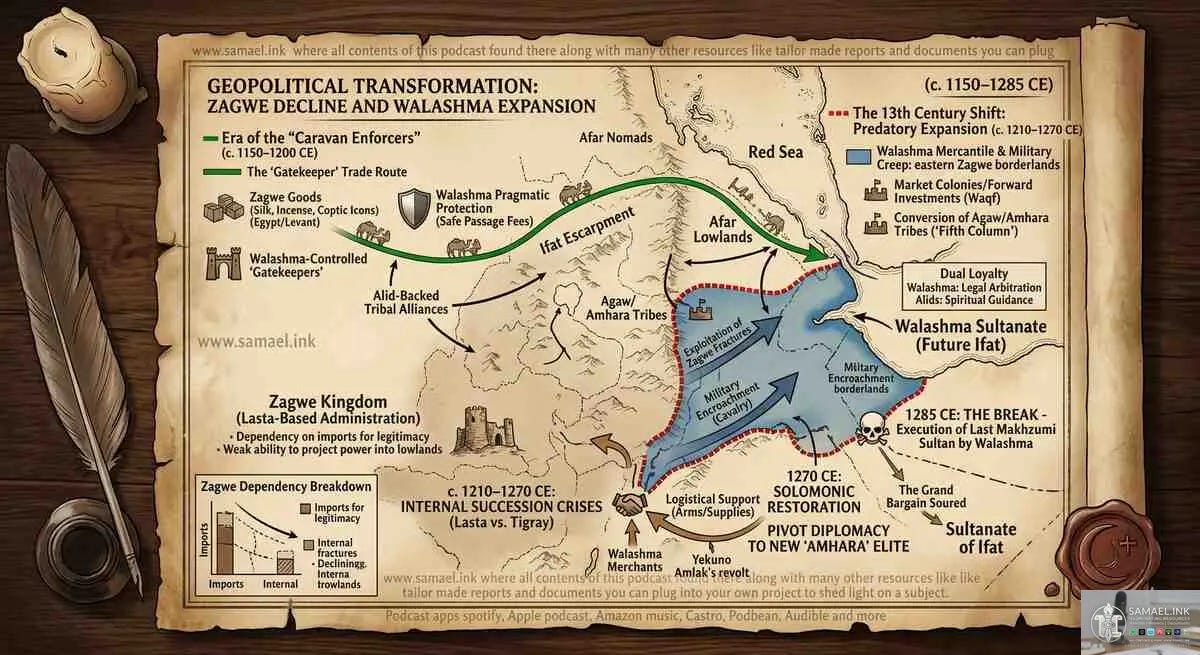
As historian Taddesse Tamrat observed in Church and State in Ethiopia (1972): "The Zagwe saw the Walashma as their 'Gatekeepers' to the world; the Walashma saw the Zagwe as a 'Hinterland' to be slowly consumed."
Reevaluating the "Anti-Muslim" Narrative
The evidence of Yekuno Amlak's letter to the Mamluk Sultan in Egypt (c. 1273–1274 CE) complicates the traditional "Crusader" narrative often projected onto the Solomonic Restoration. In this correspondence, Yekuno Amlak explicitly presents himself as a pluralistic sovereign, claiming to rule over a vast number of Muslims and even boasting of his "Muslim armies."
This necessitates a direct reevaluation of the Walashma-Solomonic interaction. It was not a sudden religious war but a transition from one form of Highland-Maritime partnership to another. Yekuno Amlak did not see himself as the destroyer of Islam in the Horn but as its new, more efficient Protector.
By calling himself an Amir in the Egyptian court, Yekuno Amlak was using Islamic political vocabulary to signal legitimacy to Cairo. He was effectively telling the Mamluks: "I am a better partner for your trade than the decaying Makhzumids or the provincial Zagwe." The "Muslim armies" he referenced were likely the very Military Iqta holders (the Argobba and Amhara Muslims) who had been neglected by the feuding Makhzumi princes. These professional cavalries likely defected to Yekuno Amlak, seeing him as a stronger Malik who could guarantee their land grants.
The Walashma-Solomonic "Grand Bargain"
The Walashma support for Yekuno Amlak against the Zagwe was not neutrality—it was an active investment in a new Highland order. The Walashma, as masters of the caravan trails, provided the logistical infrastructure for Yekuno Amlak's rebellion. They moved the arms and supplies he needed to sustain a long-term revolt against the Lasta-based Zagwe.
Both Yekuno Amlak and the Walashma wanted to remove the Zagwe bottleneck. The Zagwe were seen as an insular, Lasta-centric dynasty that did not understand the "Global Red Sea" economy. Yekuno Amlak's rise was, in its first decade, a Joint Venture between the new Amhara elite and the Walashma merchant-princes.
Why the Relationship Soured (Post-1285)
The conflict only emerged when Yekuno Amlak and his successors became too successful. Once Yekuno Amlak consolidated the highlands, he no longer needed the Walashma as partners—he wanted them as vassals.
The Walashma's Alid Pivot saw them stop being "logistical supporters" and start using their Alid-backed lineage to declare themselves independent Sultans of Ifat. When the Walashma executed the last Makhzumi Sultan in 1285 CE, they were not just taking Shewa—they were seizing the "Islamic half" of the Grand Bargain before Yekuno Amlak could claim it for himself.
As Taddesse Tamrat noted: "Yekuno Amlak didn't fight the Muslims to destroy them; he fought the Zagwe to own the Muslims and their trade. The Walashma simply moved faster to claim the inheritance."
Chronological Correction: 1270 – 1274 CE
The Muslim Arm of the 1270 Revolt
The chronicles of the Solomonic Restoration and the subsequent Hagiographies provide a fascinating look at the Muslim officers who spearheaded Yekuno Amlak's rise. These were the elite cavalry commanders of the Makhzumi Iqta system who, seeing the Sultanate in Shewa collapse into "Shadow Sultans," took their swords and composite bows to the new "Amhara Amir."
By 1270 CE, these men were not converts to Christianity; they were Muslim professionals serving a Highland King who promised them land stability and trade protection.
The Wärjih Cavalry
The Wärjih were a pastoralist-merchant Muslim group known for their extreme mobility. They served as Yekuno Amlak's vanguard. Because they moved between the highlands and the Afar lowlands, they acted as the intelligence network for the rebellion. They were led by local Maliks who had abandoned the Makhzumi Sultan. Their participation was the "Logistical Glue" that allowed Yekuno Amlak to move troops through the rugged Shewan escarpment without being ambushed by the Zagwe.
The "Amhara Muslim" Lords
The chronicles refer to "Great Men" from the districts of Amhara and Wegda who were Muslims. While many names were later "Christianized" in the royal annals, oral traditions in the Argobba and Ifat regions identify early commanders such as Sheikh Muhammad al-Irfani and members of the Makhzumi cadet branches who defected to Yekuno Amlak. They were the holders of the Military Iqta traced in the 1090s. They supported Yekuno Amlak because the Zagwe were trying to annex their lands, and the Makhzumi Sultans were too weak to defend them.
The 1285 "Execution" as a Power Play
When the Walashma executed the last Makhzumi Sultan in 1285 CE, it was a direct response to Yekuno Amlak's success. The Walashma feared that if Yekuno Amlak controlled the Makhzumi heartland, they would be reduced to mere "Coastal Agents."
The Walashma moved into Shewa to "liberate" the remaining Muslim lords from Yekuno Amlak's pluralistic state. They used their Alid-backed status to tell the Muslim commanders: "Why serve a Christian Amir when you can serve a Sharifian Sultan?" By killing the last Makhzumi, the Walashma destroyed the "Middle Ground." They forced the Muslim lords to choose: either fully join the Solomonic state as vassals or join the new Sultanate of Ifat as holy warriors (Ghazis).
The Tax Ledgers of the 1290s
The Tax Ledgers and administrative records of the 1290s, during the reign of Yekuno Amlak's son, Yagbe'u Seyon, reveal a desperate attempt to maintain the "Amhara Amir" pluralistic model. While the Walashma were busy consolidating the new Sultanate of Ifat and executing the last of the Makhzumi line, the Solomonic court was trying to bribe the specialized Muslim cavalries to stay loyal to the "King of Kings."
The primary target of this diplomacy was the Wärjih and the remaining Makhzumi Iqta holders of the Shewan interior.
The "Wärjih" Tax Exemptions (c. 1290 – 1294 CE)
The Wärjih were the logistical masters of the Horn. They owned the pack animals and knew the hidden trails that bypassed the Walashma customs houses in Ifat. Yagbe'u Seyon issued "Decrees of Protection" that exempted the Wärjih from the standard tithes (Asrat) paid by Christian peasants. In exchange for tax-free movement, the Wärjih acted as the Intelligence Network for the Solomonic court. They reported on Walashma troop movements and the arrival of Alid-backed envoys from the Mamluk court in Egypt.
The 1290s "Military Review" of the Muslim Vassals
Mirroring the Makhzumi inspections of the 1090s, Yagbe'u Seyon held his own reviews of the Muslim light cavalry in Amhara and Wegda. The ledgers show the distribution of grain and salt (the primary currency) to Muslim "Lords of the March." Yagbe'u Seyon formally recognized the old Makhzumi land grants. He told the Muslim lords: "If you fight for the Solomonic line, your land remains yours under Sharia law." This created a "Dual-Legal" system within the early Solomonic state. While the King was the head of the Christian Church, he acted as the Protector of the Iqta for his Muslim officers.
The 1294 "Fitna" and the Walashma Counter-Move
The Walashma in Ifat viewed these tax exemptions as a direct threat to their "Sharifian" monopoly. They launched a counter-campaign to "reclaim" the Wärjih. The Walashma used their Alid-backed status to claim that any Muslim serving the "Amhara Amir" was technically in a state of apostasy if a "rightful" Sultan (the Walashma) existed nearby. The ledgers of 1294 show a sudden spike in "War Expenses" as Yagbe'u Seyon had to deploy his own Muslim cavalry to stop the Walashma from raiding the Wärjih markets.
The 1290s were the last decade of true "Multicultural" military cooperation. As the Walashma grew stronger and more ideologically "Sharifian," they forced the Muslim populations of the highlands into a total binary. By the time of Amda Seyon (1314 CE), the Solomonic Kings realized that "bribing" the Wärjih was no longer enough. The "Amhara Amir" experiment was replaced by the "Crusading Negus," leading to the total destruction of the remaining Makhzumi cultural influence and the start of the 200-year war with Ifat.
The Era of 'Amda Seyon and the Appointment of 'Alī b. Sabr ad-Dīn
By the time of 'Amda Seyon I (r. 1314–1344 CE), the "Amhara Amir" model had evolved from a tactical alliance into a formal tributary administrative system. The appointment of 'Alī b. Sabr ad-Dīn is the ultimate evidence that the Solomonic state did not initially seek to "destroy" the Islamic Sultanates but to incorporate their Walashma leadership into the Imperial hierarchy as high-ranking vassals.
Following the rebellion of his brother Haqq ad-Dīn I, 'Alī was appointed by 'Amda Seyon to lead the Sultanate of Ifat. In the Solomonic chronicles (The Glorious Victories of 'Amda Seyon), 'Alī is treated as a high official of the Empire. He was expected to provide Military Levy (Jund) and ensure the safety of the Wärjih caravan trails.
Like Yekuno Amlak before him, 'Amda Seyon utilized the Walashma as his "Islamic Arm." He recognized that a Christian King could not effectively rule the Afar and Adal lowlands without a Sharifian-legitimized proxy. However, 'Alī was caught between two worlds. To the King, he was a vassal Amir; to his Muslim subjects and the Alid remnants, he was a Sultan tasked with Jihad.
The Wärjih, who had enjoyed the "Tax Exemptions" of the 1290s under Yagbe'u Seyon, found themselves in an increasingly untenable position. As the Walashma consolidated power in Ifat and the Solomonic state grew more centralized, the middle ground that had allowed Muslim commanders to serve a Christian king while maintaining their faith disappeared.
What was the primary difference between the Makhzumi and Walashma approaches to the Zagwe Kingdom?
The Makhzumids sought shared Highland Sovereignty through border skirmishes and stalemates, while the Walashma employed mercantile extortion through deep cavalry raids and proselytizing expansionism.
How did the Walashma initially benefit from the Zagwe dynasty's existence?
The Walashma collected "Safe Passage" fees from the Zagwe for protecting caravans traveling through the Afar lowlands and Ifat escarpment, leveraging their tribal alliances with the Afar to prevent raids by desert nomads.
What evidence suggests Yekuno Amlak was not initially hostile to Islam?
His 1273 letter to the Mamluk Sultan in Egypt explicitly claimed to rule over a vast number of Muslims and boasted of "Muslim armies," presenting himself as a pluralistic "Amhara Amir" rather than a religious crusader.
Who were the Wärjih and what role did they play in the Solomonic Restoration?
The Wärjih were a pastoralist-merchant Muslim group known for extreme mobility. They served as Yekuno Amlak's vanguard and intelligence network, moving troops through the Shewan escarpment without Zagwe ambush.
Why did the Walashma execute the last Makhzumi Sultan in 1285 CE?
The Walashma executed the last Makhzumi Sultan in 1285 CE primarily to prevent the newly established Solomonic Dynasty, under Emperor Yekuno Amlak, from gaining a strategic foothold in the Muslim heartlands of the Horn of Africa. The execution was the climax of a long-standing geopolitical rivalry and a calculated move to ensure that the Walashma—not the Christian highlands—became the sole inheritors of the declining Makhzumi state.


