
TL;DR:
The rise of the Solomonic Dynasty in 1270 CE was not solely a Christian restoration but a complex political maneuver that relied heavily on Muslim military expertise. Yekuno Amlak’s ascent was facilitated by the Wärjih cavalry and defectors from the Makhzumi Sultanate, who served as the logistical and military backbone of the new regime. These Muslim officers operated under the title of “Amhara Amir,” functioning as a pluralistic bridge between the Christian highlands and the Islamic lowlands, securing trade routes and intelligence networks essential for the stability of the realm.
However, this delicate balance of power fractured by the late 13th century due to the consolidation of the Walashma dynasty and the rise of the Sultanate of Ifat. The execution of the last Makhzumi Sultan in 1285 CE marked the end of the “Middle Ground,” forcing Muslim lords to choose between the Solomonic state and the emerging Sultanate of Adal. Over the following centuries, the conflict evolved from internal dynastic struggles into a civilizational war involving external powers, including the Mamluks, Ottomans, and Portuguese, fundamentally altering the geopolitical landscape of the Horn of Africa.
By the 16th century, the original model of the “Amhara Amir” had collapsed, replaced by rigid religious frontiers and international proxy wars. The death of Bahr Negash Yeshaq in 1578 CE symbolized the end of northern autonomy and the isolation of the Ethiopian highlands. This historical trajectory demonstrates that the medieval Ethiopian state was defined less by religious uniformity and more by pragmatic alliances that eventually succumbed to the pressures of global imperialism and ideological polarization.
The Chronicles of the Solomonic Restoration
For the history researcher, the period surrounding the Solomonic Restoration offers a critical case study in state-building and religious pluralism. The traditional narrative often simplifies the 1270 CE coup led by Yekuno Amlak as a purely Christian revival against the Zagwe dynasty. However, the Gädl (hagiographies) and royal chronicles reveal a more intricate reality. The restoration was spearheaded by Muslim officers who were integral to the military machine of the new “Amhara Amir.”
These men were not converts seeking spiritual salvation; they were professional soldiers serving a Highland King who promised land stability and trade protection. By 1270 CE, the elite cavalry commanders of the Makhzumi Iqta system had observed the Sultanate in Shewa collapsing into “Shadow Sultans.” Seeing an opportunity for security, they took their swords and composite bows to Yekuno Amlak. This alliance was not born of theological agreement but of mutual necessity. The Solomonic King needed the mobility and intelligence of the Muslim lowlanders, while the Muslim lords needed the protection of a strong central authority against the encroaching Zagwe and rival factions.
The “Muslim Arm” of the 1270 Revolt
The Gädl of local saints and the royal chronicles, including precursors to the Kebra Nagast, explicitly mention the presence of “Ismaelites” and “Hagarites” within the royal camp. Two specific groups distinguished themselves during this foundational period.
The Wärjih Cavalry
The Wärjih were a pastoralist-merchant Muslim group renowned for their extreme mobility. Their role was pivotal as Yekuno Amlak’s vanguard. Because they moved seamlessly between the highlands and the Afar lowlands, they acted as the intelligence network for the rebellion. Their command was led by local Maliks who had abandoned the Makhzumi Sultan. Their participation served as the “Logistical Glue” that allowed Yekuno Amlak to move troops through the rugged Shewan escarpment without being ambushed by the Zagwe. Without the Wärjih, the geography of the highlands would have been a defensive barrier rather than a strategic asset.
The “Amhara Muslim” Lords
The chronicles refer to “Great Men” from the districts of Amhara and Wegda who were Muslims. While many names were later “Christianized” in the royal annals to fit a homogenous narrative, oral traditions in the Argobba and Ifat regions identify early commanders such as Sheikh Muhammad al-Irfani and members of the Makhzumi cadet branches who defected to Yekuno Amlak. Their motivation was pragmatic: they were the holders of the Military Iqta traced back to the 1090s. They supported Yekuno Amlak because the Zagwe were attempting to annex their lands, and the Makhzumi Sultans were too weak to defend them.
The 1285 “Execution” as a Power Play
The fragility of this alliance became apparent when the Walashma executed the last Makhzumi Sultan in 1285 CE. This event was a direct response to Yekuno Amlak’s success and marked a turning point in the region’s history.
The Walashma feared that Yekuno Amlak was successfully integrating the Muslim cavalry of the highlands. If Yekuno Amlak controlled the Makhzumi heartland, the Walashma would be reduced to mere “Coastal Agents.” Consequently, they launched a pre-emptive strike, moving into Shewa to “liberate” the remaining Muslim lords from Yekuno Amlak’s pluralistic state. They utilized their Alid-backed status to persuade the Muslim commanders: “Why serve a Christian Amir when you can serve a Sharifian Sultan?”
By killing the last Makhzumi, the Walashma destroyed the “Middle Ground.” They forced the Muslim lords to choose: either fully join the Solomonic state as vassals or join the new Sultanate of Ifat as holy warriors (Ghazis). This binary choice eliminated the nuanced political space that had previously allowed for cooperation.
The Resulting “Feudal” Map (Late 13th Century)
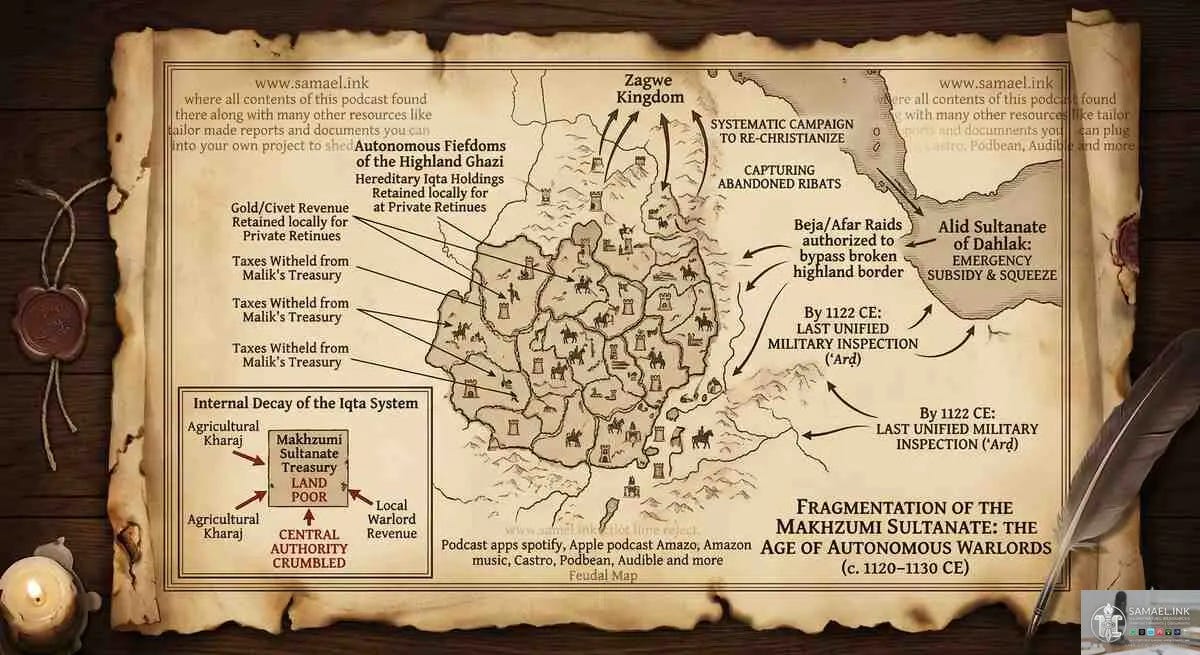
The geopolitical landscape of the late 13th century can be summarized by the following alignment of actors:
This map illustrates the tension between the Highland consolidation and the Coastal expansion. The Wärjih occupied the critical transit zones, making them the prize for both sides
The Diplomatic “Double-Game”
This context explains Yekuno Amlak’s 1273 letter to the Mamluk Sultan. He was not lying about his “Muslim armies”; he was bragging about them. To Egypt, he presented himself as the “Amhara Amir” who ruled the Muslims. To the Highlands, he was the “Solomonic King” who restored the Christian line.
The tragedy of this arrangement was that the Walashma’s creation of Ifat in 1285 shattered this pluralistic vision. It turned a Highland-Highland partnership into a Highland-Coastal holy war. The chronology of the final break is clear:
1270–1273 CE: High cooperation. Muslim Wärjih and Makhzumi defectors help Yekuno Amlak secure the South.
1274 CE: The Mamluk Sultan (Egypt) ignores Yekuno Amlak’s letter, preferring to deal with the Walashma merchants who actually control the ports.
1280 CE: Friction begins as Yekuno Amlak starts building Christian monasteries on former Iqta lands.
1285 CE: The Ifat Coup. The Walashma execute the last Makhzumi Sultan, annexing the Islamic core and ending the “Amhara Amir” experiment.
The Tax Ledgers of the 1290s
The Tax Ledgers and administrative records of the 1290s, during the reign of Yekuno Amlak’s son, Yagbe’u Seyon, reveal a desperate attempt to maintain the “Amhara Amir” pluralistic model. While the Walashma were busy consolidating the new Sultanate of Ifat and executing the last of the Makhzumi line, the Solomonic court was trying to bribe the specialized Muslim cavalries to stay loyal to the “King of Kings.”
The primary target of this diplomacy was the Wärjih and the remaining Makhzumi Iqta holders of the Shewan interior. The Wärjih were the logistical masters of the Horn. They owned the pack animals and knew the hidden trails that bypassed the Walashma customs houses in Ifat. Yagbe’u Seyon issued “Decrees of Protection” that exempted the Wärjih from the standard tithes (Asrat) paid by Christian peasants. In exchange for tax-free movement, the Wärjih acted as the Intelligence Network for the Solomonic court. They reported on Walashma troop movements and the arrival of Alid-backed envoys from the Mamluk court in Egypt.
Mirroring the Makhzumi inspections of the 1090s, Yagbe’u Seyon held his own reviews of the Muslim light cavalry in Amhara and Wegda. The ledgers show the distribution of grain and salt (the primary currency) to Muslim “Lords of the March.” Yagbe’u Seyon formally recognized the old Makhzumi land grants, telling the Muslim lords: “If you fight for the Solomonic line, your land remains yours under Sharia law.” This created a “Dual-Legal” system within the early Solomonic state. While the King was the head of the Christian Church, he acted as the Protector of the Iqta for his Muslim officers.
However, the Walashma in Ifat viewed these tax exemptions as a direct threat to their “Sharifian” monopoly. They launched a counter-campaign to “reclaim” the Wärjih. The Religious Appeal used by the Walashma claimed that any Muslim serving the “Amhara Amir” was technically in a state of apostasy if a “rightful” Sultan (the Walashma) existed nearby. The ledgers of 1294 show a sudden spike in “War Expenses” as Yagbe’u Seyon had to deploy his own Muslim cavalry to stop the Walashma from raiding the Wärjih markets.
The 1332 Campaign and the Burning of Ifat
By the time of ‘Amda Seyon I (r. 1314–1344 CE), the “Amhara Amir” model had evolved from a tactical alliance into a formal tributary administrative system. The appointment of ‘Alī b. Sabr ad-Dīn is the ultimate evidence that the Solomonic state did not initially seek to “destroy” the Islamic Sultanates, but to incorporate their Walashma leadership into the Imperial hierarchy as high-ranking vassals.
Following the rebellion of his brother Haqq ad-Dīn I, ‘Alī was appointed by ‘Amda Seyon to lead the Sultanate of Ifat. In the Solomonic chronicles (The Glorious Victories of ‘Amda Seyon), ‘Alī is treated as a high official of the Empire. He was expected to provide Military Levy (Jund) and ensure the safety of the Wärjih caravan trails. Like Yekuno Amlak before him, ‘Amda Seyon utilized the Walashma as his “Islamic Arm.” He recognized that a Christian King could not effectively rule the Afar and Adal lowlands without a Sharifian-legitimized proxy.
However, the Wärjih found themselves in a lethal “pincer” during ‘Amda Seyon’s 1332 campaign. When ‘Alī b. Sabr ad-Dīn eventually succumbed to the pressure of his own religious elite and joined a grand coalition of seven Islamic provinces against ‘Amda Seyon, the Wärjih had to choose. The majority chose the Walashma. In retaliation, ‘Amda Seyon launched a “Scorched Earth” campaign through the Awash Valley, specifically targeting the Wärjih settlements. The chronicles record the “Burning of the Wärjih towns,” marking the end of the 60-year “Golden Age” of Muslim-Solomonic cooperation.
The 1332 campaign was the funeral for the “Pluralistic Experiment.” When ‘Alī b. Sabr ad-Dīn’s coalition failed, ‘Amda Seyon did not just defeat the army—he dismantled the Ifat infrastructure. By burning the Walashma centers, ‘Amda Seyon proved that the “Amhara Amir” would only exist as long as the “Islamic Sultan” remained a subordinate vassal. This total military defeat drove the remaining Alid-backed Walashma families further east into the Adal lowlands (Harar/Zeila region), transforming them from “Imperial Vassals” into the eternal “Enemies of the State.”
The Migration to the Lowland Rim (1350 – 1376 CE)
The late 14th century marks the final transition of the Walashma from “Imperial Amirs” to the independent Sultanate of Adal. When ‘Alī b. Sabr ad-Dīn was imprisoned by ‘Amda Seyon, the Solomonic state attempted to “manage” the Islamic provinces by appointing puppet rulers from the same family. However, this policy failed because it ignored the Alid remnants in the lowlands who provided the spiritual and ideological “fuel” for a new kind of resistance: the Imamate.
The surviving Walashma princes, led by Haqq ad-Dīn II, realized that the Shewan highlands were no longer tenable under Solomonic military pressure. They shifted their center of gravity East, toward the Harar plateau and the port of Zeila. In the lowlands, the Walashma re-connected with the decentralized Suleimaniad Alid clans of the Afar and Somali peripheries. While the “Amhara Amirs” in the highlands were seen as Solomonic collaborators, the Walashma in the lowlands claimed the title of Ghazi (Holy Warrior). They utilized their Alid marriage alliances to preach a message of Jihad that bypassed the feudal treaties of the 13th century.
Between 1376 and 1400 CE, the interaction between the Walashma and the Alid remnants produced a new administrative figure: the Imam. While the Walashma held the title of Sultan, the actual military mobilization was often led by Imams—religious leaders who claimed direct inspiration and Sharifian authority. Zeila became the “Anti-Dahlak.” While the Alids had once used the coast to tax the highlands, the new Adal state used the coast to arm the lowlands. They imported superior weaponry from the Mamluks and the Ottomans (later) to challenge the Solomonic “Amhara Amirs.”
The Internationalization of Conflict (1403 – 1543 CE)
The period between 1403 and 1415 CE represents the first “Internationalization” of the conflict in the Horn. Following the death of Sa’d ad-Dīn II at the hands of the Solomonic King Dawit I, the ten sons of the fallen Sultan fled to the Rasulid court in Yemen. This was not merely a flight of refugees; it was a high-level diplomatic mission. The Walashma utilized their deep Suleimaniad Alid connections to convince the Rasulid Sultan, al-Malik al-Nāṣir Aḥmad, that the “Amhara Amir” model was dead and had been replaced by a Christian power that threatened the entire Red Sea trade.
During their decade in Yemen, the Walashma princes were exposed to the military revolutions occurring in the Mamluk and Rasulid states. They were trained with early hand cannons and improved Yemeni composite bows. The Rasulids provided the dhows and naval intelligence required for a “Reverse Invasion.” When the sons of Sa’d ad-Dīn returned to the African coast in 1415 CE, they did not return as “Vassals.” They returned as the leaders of a Pan-Islamic coalition.
This escalation culminated in the Jihad of Imam Ahmad ibn Ibrahim al-Ghazi (Gragn) in the 1520s. Backed by Ottoman (Turkish) musketeers and cannons, Gragn launched a “Scorched Earth” invasion that conquered almost the entire Solomonic Highlands by 1535. In 1541 CE, a Portuguese fleet commanded by Estêvão da Gama arrived at the port of Massawa. Estêvão sent his brother, Cristóvão da Gama, inland with a force of 400 musketeers and several light cannons.
The interaction between Cristóvão da Gama and Imam Ahmad Gragn was the first high-stakes “Gunpowder Duel” in African history. At the Battle of Wofla in August 1542, the Portuguese were overwhelmed. Cristóvão da Gama was captured and executed by Ahmad Gragn personally. However, the death of Vasco da Gama’s son was not the end. The 140 surviving Portuguese musketeers joined the remnants of the Solomonic army under King Gelawdewos. At the Battle of Wayna Daga (February 1543), a Portuguese musketeer successfully shot and killed Imam Ahmad Gragn. With the Imam dead, the Adalite coalition collapsed.
The Northern Frontier: Bahr Negash Yeshaq
The figure of Bahr Negash Yeshaq enters the stage during the most volatile period of the 16th century (c. 1530s – 1578 CE). He represents the final, tragic collapse of the “Amhara Amir” pluralistic model in the North. While the Walashma were fighting a Jihad in the South, Yeshaq was the “King of the Sea” in the North, attempting to balance the Solomonic throne, the Ottoman expansion, and the Portuguese intervention.
The title Bahr Negash (King of the Sea) was the Solomonic administrative answer to the Alid and Ziyadid maritime claims. Yeshaq was the governor of the northern maritime provinces (modern Eritrea and Tigray). His capital was at Debarwa. He controlled the “Gate of the Highlands”—the pass from the port of Massawa to the interior. When Cristóvão da Gama landed, Bahr Negash Yeshaq was their primary host. He provided the Wärjih scouts, the local transport, and the highland logistics that allowed the 400 Portuguese musketeers to reach the young King Gelawdewos.
After the death of Imam Ahmad Gragn (1543), the Solomonic Kings (Gelawdewos and later Minas) attempted to centralize power and reduce the autonomy of the northern lords. This was a fatal mistake. Bahr Negash Yeshaq, who had saved the dynasty by hosting the Portuguese, felt sidelined. He viewed the King’s centralization as an insult to his “Amhara Amir” style of local sovereignty. In a shocking reversal of the 1541 war, Yeshaq formed an alliance with the Ottoman Turks (who occupied Massawa under the Habesh Eyalet).
The interaction between the Bahr Negash, the Ottomans, and the Solomonic King Sarsa Dengel led to the bloodiest civil war of the century. At the Battle of Addi Qoro (1578 CE), King Sarsa Dengel marched North to end the “Bahr Negash Rebellion.” The combined forces of Yeshaq and his Ottoman Turkish allies were decimated. Bahr Negash Yeshaq was killed on the battlefield, and the Ottoman commander was also slain. The End of the Northern Autonomy meant that Sarsa Dengel abolished the independent power of the Bahr Negash, turning the North into a strictly controlled imperial province. This ended the era where a Northern Lord could act as an independent “Amir” of the Red Sea.
Diplomatic Artifacts: Golden Crosses and Ottoman Letters
To understand the geopolitical tension of the 15th and 16th centuries, we must look at the physical artifacts of diplomacy: the Golden Crosses that allowed the “Amhara Amirs” to bypass Mamluk restrictions, and the Ottoman Correspondence that signaled the final collapse of that very system.
The Solomonic Kings utilized a unique form of “Diplomatic Immunity” when sending envoys to Jerusalem and Cairo. High-ranking envoys, often monks or specialized Wärjih agents, carried hand-held crosses made of gilded bronze or solid gold. These crosses weren’t just religious; they were Sovereign Seals. They often featured the “Lion of Judah” or specific Ge’ez epigraphy identifying the bearer as a personal representative of the Aṣe (Emperor). In Mamluk-controlled Palestine, a “Passport Cross” served as a visual guarantee of payment. It signaled to local governors that the Negus had already paid the “Protective Tax” (Khafara) at the border, preventing the envoys from being sold into slavery or detained as spies.
By the 1560s, the diplomacy of the Cross was replaced by the diplomacy of the Musket. Bahr Negash Yeshaq’s letters to the Ottoman Sultan (Suleiman the Magnificent or Selim II) and the Pasha of Zabid (Yemen) represent a masterful—if treacherous—re-framing of the Solomonic state. In his correspondence, Yeshaq did not claim to be a “rebel.” He claimed to be a Liberator. He argued that the Solomonic King (Minas and later Sarsa Dengel) had sold the sovereignty of the Horn to the Portuguese. He referred to the King as a puppet of the “Ifranj” (Franks/Europeans). He appealed to the Ottoman Caliphate by framing the Portuguese presence as a “Crusader” beachhead.
Yeshaq’s betrayal was so profound because it used the “Amhara Amir” logic against the King. He argued that the Emperor had broken the pluralistic “Highland-Maritime” balance by bringing in a foreign European power (the Portuguese). When Sarsa Dengel finally executed Yeshaq in 1578, he didn’t just kill a traitor; he killed the last northern leader who attempted to play the Ottomans and the Portuguese against each other to maintain local autonomy.
Conclusion
The history of the Solomonic Restoration and its subsequent conflicts reveals a complex tapestry of religious and political pragmatism. The initial integration of Muslim officers into the Christian state demonstrated a capacity for pluralism that was eventually eroded by external pressures and internal centralization. The transition from the “Amhara Amir” model to the “Crusading Negus” and the “Ghazi Sultan” marked a shift from regional cooperation to ideological warfare. The legacy of this period is evident in the isolation of the highlands and the enduring tensions along the Red Sea coast. The artifacts of this era, from the Golden Crosses to the Ottoman Firmans, stand as testaments to a time when the Horn of Africa was a contested ground for global empires.
Who were the Wärjih and what was their role in the 1270 revolt?
The Wärjih were a pastoralist-merchant Muslim group known for extreme mobility. They served as Yekuno Amlak’s vanguard and intelligence network, allowing troops to move through the Shewan escarpment without ambush.
What event in 1285 CE marked the end of the “Middle Ground” between Solomonic and Muslim powers?
The execution of the last Makhzumi Sultan by the Walashma in 1285 CE destroyed the Middle Ground, forcing Muslim lords to choose between the Solomonic state or the Sultanate of Ifat.
How did Yagbe’u Seyon attempt to maintain loyalty among Muslim lords in the 1290s?
Yagbe’u Seyon issued “Decrees of Protection” that exempted the Wärjih from standard tithes in exchange for intelligence services and loyalty, recognizing their old Makhzumi land grants under Sharia law.
What was the significance of the 1332 campaign under ‘Amda Seyon?
The 1332 campaign resulted in the burning of the Walashma capital and the crushing of the Wärjih settlements, ending the 60-year “Golden Age” of Muslim-Solomonic cooperation and shifting the conflict to a holy war.
Where did the Walashma family migrate after losing power in the highlands?
The surviving Walashma princes migrated East toward the Harar plateau and the port of Zeila, reconnecting with Alid clans to form the Sultanate of Adal.
How did the conflict become internationalized between 1403 and 1543 CE?
The conflict involved the Rasulids in Yemen providing military aid to Walashma exiles, followed by the arrival of Portuguese musketeers to support the Solomonic King against the Ottoman-backed Imam Ahmad Gragn.
What was the outcome of the Battle of Wayna Daga in 1543 CE?
At the Battle of Wayna Daga, a Portuguese musketeer killed Imam Ahmad Gragn, causing the Adalite coalition to collapse and restoring the Solomonic line, though the highlands were permanently scarred.
Who was Bahr Negash Yeshaq and why did he rebel against the Solomonic King?
Bahr Negash Yeshaq was the “King of the Sea” in the north who rebelled because he felt sidelined by the King’s centralization efforts. He allied with the Ottomans to maintain northern autonomy.
What happened to Bahr Negash Yeshaq in 1578 CE?
Yeshaq was killed at the Battle of Addi Qoro by King Sarsa Dengel, ending the independent power of the Bahr Negash and turning the North into a strictly controlled imperial province.
What diplomatic artifact did Solomonic envoys carry to ensure safe passage through Mamluk territory?
Envoys carried Golden Crosses (Mäsqäl) which served as Sovereign Seals and visual guarantees of payment, signaling that the Negus had paid the Protective Tax to prevent detention or enslavement.


