
TL;DR:
Medieval Arab geographers, principally Shihab al‑Din al‑Umari and al‑Maqrizi, together with Solomonic royal chronicles and modern historians such as Taddesse Tamrat, Ulrich Braukämper and Enrico Cerulli, form the documentary backbone for the “seven sultanates” concept. Ifat (Awfat) is presented as the Walashma dynastic seat that consolidated post‑Makhzumi lands; Dawaro served as a contested caravan crossroads; Arbabni appears as a smaller administrative unit; Hadeya and Bali are notable for military resources and distinct local structures; Sharkha functioned as a frontier province linking pastoral lowlands and highland markets; and the seventh place is variably given to Dara (Bara) or Fatagar. Interpretive challenges include variable lists, toponymic instability and a lack of independent local chronicles, so historians cross‑reference Arabic and Ethiopian sources, archaeological surveys and caravan‑route studies. Administrative forms combined Islamic titles (sultan, malik) with local offices (Garad, Mati), reflecting a hybrid governance model. The region’s medieval map was later reshaped by Galla (Oromo) migrations from the sixteenth century onward, which absorbed or displaced many of these polities and erased earlier administrative boundaries, while Islamization and coastal‑inland interactions produced diverse local adaptations.
Check these related articles for a deeper insight.


The “Seven Sultanates”
Roughly from the late thirteenth through the fifteenth centuries, after the decline of the Makhzumi dynasty (c. 896–1285) and during the expansion of the Walashma/Ifat polity.
The “seven sultanates” were not a single centralized state but a cluster of semi‑autonomous Muslim polities that together comprised the Muslim polity complex east and south of the Christian highlands. Medieval chroniclers portrayed them as a network of trade hubs and caravan entrepôts along the Zeila–Shoan route, as military buffer states against Solomonic expansion, and as tributary units whose collective identity could be summarized by external observers even where internal governance and identity remained diverse. This cluster functioned less as a formal federation and more as a series of interlinked domains whose cohesion depended on control of trade routes, seasonal grazing rights, market towns and occasional dynastic alliances.
Typical lists produced by medieval sources name Ifat (Awfat) as the dominant polity and dynastic seat of the Walashma family, the polity that ultimately claimed former Makhzumi territories after c. 1285. Dawaro (Dewaro), located south of Ifat, served as a strategic caravan crossroads and was frequently contested in the warfare between Muslim sultans and Solomonic emperors. Arbabni (Arababni) appears in the sources as a smaller polity often administratively grouped with larger neighbors and lacking substantial independent documentation. Hadeya (Hadya) lay further southwest and is noted for substantial military resources and its role in the horse and slave trades. Sharkha (Sharkha or Sharka) is associated with the Arsi/Bale uplands and acted as a frontier province linking pastoral lowlands with highland markets. Bali (Bale), the southernmost of the group, retained strong local distinctiveness and a historical reputation for resistance to outside rule. The seventh position is variously filled by Dara (Bara) or by Fatagar in different lists, reflecting the well‑known fluidity of medieval toponymy and the inconsistencies between chroniclers.
Historical records typically list seven (and sometimes eight) distinct Muslim polities that operated in the orbit of the Christian Highland Kingdom and the larger Ifat/Adal complex:
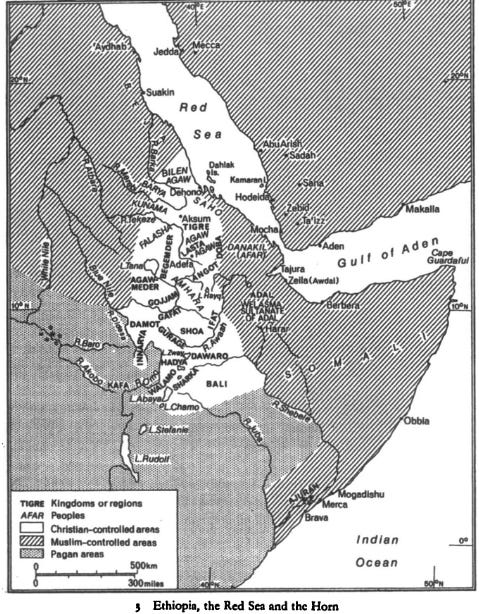
Ifat (Awfat): The primary power and the seat of the Walashma dynasty. It eventually annexed the Makhzumi lands.
Dawaro: Located south of Ifat, it was a vital hub for the caravan trade and frequently contested between Muslim sultans and the Solomonic emperors.
Arbabni: A smaller sultanate often grouped with the others in administrative accounts.
Hadeya: Situated further southwest, known for its significant military and economic role, especially in the trade of horses and slaves.
Sharkha: A province/sultanate located in the Arsi/Bale region.
Bali: The southernmost of the major sultanates, famous for its resistance and distinct cultural identity.
Dara: Often cited as the seventh, though some sources swap this with Fatagar.
Variation between lists, toponymic fluidity and documentary gaps are major interpretive challenges. Some texts include eight names; others substitute Fatagar for Dara; scribal errors, divergent local usages and later renamings contribute to this variability. Aside from al‑Umari and al‑Maqrizi and the Solomonic chronicles, independent local narratives for most of these polities are scarce, leaving historians to reconcile Arabic and Ethiopian accounts that sometimes record the same events under different names. Spatially, these names often functioned simultaneously as territorial, administrative and ethnic labels; boundaries were commonly defined by control of routes and grazing rather than fixed lines on a map.
The Makhzumi Sultanate, centered at Walale, is generally treated as the precursor Islamic power in eastern Shoa. Political decline and the deposition of the last Makhzumi ruler by Umar Walashma around 1285 transferred key Shoan Muslim territories to Ifat and allowed the Walashma to assert overlordship over many of the smaller polities that later appear in Arab geographers’ lists. During the fourteenth century, Solomonic emperors—most prominently Amda Seyon I—carried out repeated campaigns against these Muslim polities; the royal chronicles recount punitive expeditions, tributary settlements and the temporary displacement of local dynasts. Muslim chroniclers, by contrast, often emphasize the semi‑autonomous, tributary character of the seven: they paid tribute or provided troops when pressured but retained local rulers and customary titles.
Administrative vocabulary reflected both Islamic and indigenous continuities. Arabic sources use Islamic offices such as sultan or malik, yet local Cushitic and Semitic administrative survivals—titles like Garad or Mati—persist in provincial governance, showing a transition from older regional forms toward the medieval sultanate model. Economically these polities were mixed agro‑pastoral societies bound into long‑distance trade networks; control over caravan routes, forts and market towns mattered more for political authority than did dense urban bureaucracy.
Later demographic and political transformations reshaped this medieval map. Galla (Oromo) migrations from the sixteenth century onward fundamentally altered the population and political geography of the highlands, absorbing, displacing or renaming many medieval polities and thereby erasing the discrete administrative map preserved in earlier chronicles. Islamization and local syncretic practices varied across the region, with coastal Zeila influence combining with inland adaptations to produce hybrid social and political forms.
Our principal documentary base for this configuration comes from medieval Arab geographers, especially Shihab al-Din Fadlallah al-Umari (d. 1349): In his work Masalik al-absar fi mamalik al-amsar, he provides the most detailed early breakdown of these principalities. He was the first to categorize them as a distinct group of Muslim states paying tribute to the Christian King while maintaining internal autonomy) and Al-Maqrizi (d. 1442): His Ilmam bi-akhbar man bi-ard al-Habasha min muluk al-Islam is the definitive medieval history of the Walashma dynasty. He documents the transition from the Makhzumi to the Ifat sultanate and describes the “Seven” as the defensive and economic infrastructure of the Zeila trade route.). In addition this is supplemented by Solomonic royal chronicles and modern historians such as Taddesse Tamrat (He analyzed how these sultanates functioned as a “buffer zone” between the Christian highlands and the Red Sea coast), Ulrich Braukämper (his work, particularly Islamic History and Culture in Southern Ethiopia, is the gold standard for the “longue durée” of the region. Braukämper specialized in the Hadeya and Bali sultanates. He is one of the few scholars to bridge the gap between the medieval administrative records and the later demographic “overwrite” caused by the migrations of the Galla. He provides deep insight into how these sultanates were structured along ethnic and agrarian lines before being absorbed into the larger imperial framework.) and Enrico Cerulli (The Italian scholar Cerulli was instrumental in discovering and translating the “Document of the Sultans of Shoa” in the 1930s. This document provided the first concrete evidence of the Makhzumi Sultanate (c. 896 AD), which predated the “Seven.” Cerulli’s work allows you to see the “Seven” not as the start of Islamic governance in Shoa, but as a secondary, more fragmented phase following the collapse of the unified Makhzumi state.) Geographically the concept frames the Zeila–Harar–Shoan caravan axis and adjacent highland and plateau zones that linked the Red Sea ports with the Christian highlands.
Recent Research: The Forensic Reconstruction of the Medieval Sultanates
The traditional narrative of the Horn of Africa—often framed as an isolated Christian highland locked in a perpetual “clash of civilizations” with coastal Muslims—is currently being dismantled by a new wave of material forensics and archaeogenetic research. For the contemporary researcher, the “seven sultanates” are no longer just names in a 14th-century Arab ledger; they are emerging as sophisticated, urbanized nodes in a global medieval network.
1. Beyond the Text: The Archaeological “Ground Truth”
Recent excavations led by the HornEast Project (2018–2024) have shifted the focus from medieval manuscripts to the physical earth. By excavating sites like Bilet and Harla, researchers have uncovered:
Cosmopolitan Urbanism: The discovery of 12th-century Chinese celadon, Indian Ocean glass beads, and carnelian jewelry in the Shoan and Tigrayan escarpments proves these sultanates were not provincial backwaters. They were high-value trade terminuses connecting the African interior to the Baghdad-Yemen-China axis.
Integrated Administrative Systems: Forensic analysis of funerary inscriptions shows that Muslim communities (like those of the Makhzumi sphere) lived in stable, prosperous proximity to the Zagwe and early Solomonic states long before the 16th-century wars.
2. The Alid Migration & “Narrative Forensics”
Recent scholarship by Amélie Chekroun and Bertrand Hirsch has begun to address the “memory rupture” caused by the 16th-century conflicts and the subsequent Galla migrations.
The Alid Lineage: Current research investigates the claims of Alid and Qurayshi migrations not merely as “pious myths,” but as a functional “Imperial Formula.” These migrations provided the legal and spiritual framework (the baraka) necessary to unify disparate Cushitic and Semitic clans under a single “Sultanate” structure.
The “Overwrite”: Scholars are now documenting how the administrative records of the “Seven” (Dara, Sharkha, Arbabni, etc.) were systematically overwritten. By cross-referencing Argobba oral traditions with new epigraphic finds, researchers are “un-masking” the medieval landscape that existed before modern ethnic boundaries were solidified.
3. Philological Sovereignty: From Mukarrib to Malik
In the realm of political science, recent work (notably in Samantha Kelly’s 2020 Companion to Medieval Ethiopia) re-evaluates the titles used by these rulers.
Research shows that the transition from ancient titles of sovereignty (like Mukarrib) to Islamic titles (like Malik or Sultan) was a deliberate digital-age-equivalent “upgrade” to the regional operating system.
These titles allowed the Shoan elite to communicate on equal footing with the Mamluk and Rasulid courts, ensuring the “digital sovereignty” of the Zeila route against imperial encroachment.
4. The Genetic Horizon
While still in its early stages, archaeogenetic studies on the eastern escarpment are beginning to track the “Basal Eurasian” and Semitic-Cushitic lineages of the medieval urban elite. This data is crucial for understanding the Alid migration patterns, as it potentially identifies the unique genetic markers of the clerical and merchant classes that managed the “Seven Sultanates” before the demographic shifts of the late 16th century.
In the last few years (2020–2026), scholarship has shifted away from purely textual analysis toward “material forensics”—using archaeology and epigraphy to prove that these sultanates were far more urbanized and globally connected than 20th-century history suggests.
Here is the most critical recent scholarship for your research repository:
1. The “HornEast” Project (ERC-Funded, 2018–2024)
This is arguably the most important recent development. Led by Amélie Chekroun, Julien Loiseau, and Bertrand Hirsch, this European Research Council project focused specifically on the “Longue Durée” of Islam in the Horn.
Key Finding: They identified and excavated the cemetery at Bilet (eastern Tigray), which revealed that a cosmopolitan Muslim community lived deep within the Zagwe Christian kingdom in the 12th century.
Relevance: This proves that the “Seven Sultanates” weren’t just a separate block, but part of a highly integrated “inter-faith” administrative network that existed before the major 14th-century wars.
2. A Companion to Medieval Ethiopia and Eritrea (2020)
Edited by Samantha Kelly, this volume is the new “gold standard” for academic reference.
The Argument: It reframes the region’s history by rejecting the “isolated fortress” narrative of Christian Ethiopia. Instead, it places the Makhzumi and Walashma sultanates at the center of the Afro-Eurasian world.
Forensic Detail: It uses recent advancements in philology to re-examine the titles of sovereignty you are tracking, showing how “Malik” and “Sultan” were often used interchangeably in Arabic trade documents to describe the same local leaders.
3. Recent Archaeology in Fedis and Harla (2021–2023)
Surveys conducted in the Harla and Fedis regions (near modern Harar and Dire Dawa) have uncovered ruins that likely belong to the eastern tier of these sub-sultanates.
Material Evidence: Excavations found carnelian artifacts with Arabic inscriptions, glass beads from the Indian Ocean, and massive drystone defensive walls.
The “Makhzumi” Connection: These finds support the theory that the Makhzumi capital, Walale, was part of a “string of pearls” of stone-built cities connecting the Shoan plateau to the coast—a system the later Walashma would inherit.
4. La Conquête de l’Éthiopie (Amélie Chekroun, 2023)
While this book focuses on the 16th-century Jihad of Imam Ahmad, the introductory chapters provide a brilliant “forensic” reconstruction of the 14th-century sultanates.
The “Overwrite” Theory: Chekroun provides new data on how the Galla expansion and the 16th-century wars caused a “memory rupture.” She explains why the names of the seven “sub” sultanates (Dara, Sharkha, etc.) vanished from later records—not because they weren’t important, but because their administrative records were physically destroyed or replaced.
5. Ahmed Hassen Ahmed’s Recent Work (2020–2024)
Focusing on Ifat and the Argobba corridors, his work (including Aleyyu Amba: L’Ifat et ses réseaux, 2020) investigates the “living archives.”
Insight: He argues that the Argobba are the direct genetic and cultural descendants of the medieval sultanates’ urban elite. His research helps bridge the gap between the archaeological ruins of the Makhzumis and the modern social structures in the region.
While traditional histories relied on the fragmented accounts of al-Umari and al-Maqrizi, the story of the Seven Sultanates is currently being rewritten by a new generation of 'forensic' historians. From the excavations of the HornEast Project to the genetic mapping of the eastern escarpment, recent scholarship reveals a cosmopolitan, urbanized network that was far more integrated into the medieval world than previously imagined. For those wishing to dive deeper into this 'material turn,' the works of Chekroun, Braukämper, and the 2020 Companion to Medieval Ethiopia offer the most rigorous reconstructions of this lost geopolitical landscape.
Foundational Primary Sources (The Medieval Backbone)
These are the original texts that first categorized the “Seven,” providing the baseline for all subsequent historiography.
Al-Umari, Shihab al-Din Fadlallah. Masalik al-absar fi mamalik al-amsar (Paths of Vision in the Kingdoms of the Capitals).
Significance: The earliest detailed breakdown (c. 1349) categorizing the sultanates as a distinct group paying tribute to the Christian King while retaining autonomy.
Al-Maqrizi, Ahmad ibn Ali. Ilmam bi-akhbar man bi-ard al-Habasha min muluk al-Islam (Knowledge of Those Who Are in the Land of the Abyssinians Among the Kings of Islam).
Significance: The definitive history of the Walashma dynasty; documents the transition from Makhzumi to Ifat and defines the “Seven” as the economic infrastructure of the Zeila trade route.
Solomonic Royal Chronicles. (Various editions, notably The Glorious Victories of Amda Seyon).
Significance: Provides the Ethiopian Christian perspective on the “buffer zone” conflicts, punitive expeditions, and tributary relationships.
Ibn Khaldun. Kitab al-Ibar (Book of Lessons).
Significance: Offers broader context on the Walashma lineage and its genealogical links to the Hejaz, framing the sultanates within the wider Islamic world.
Classical & Mid-20th Century Historiography
Scholars who first synthesized the Arabic and Ethiopian sources to create the modern academic map of the region.
Cerulli, Enrico. L’Islam di ieri e di oggi (Islam of Yesterday and Today). Rome: Istituto per l’Oriente, 1971.
Key Contribution: Translated the “Document of the Sultans of Shoa” (1930s), proving the existence of the Makhzumi Sultanate (c. 896 AD) and reframing the “Seven” as a secondary, fragmented phase.
Tamrat, Taddesse. Church and State in Ethiopia, 1270–1527. Oxford: Clarendon Press, 1972.
Key Contribution: The definitive analysis of the “buffer zone” dynamic and the political geography of the sultanates relative to the Christian highlands.
Trimingham, J. Spencer. Islam in Ethiopia. London: Oxford University Press, 1952.
Key Contribution: A classical overview of the spread of Alid influences and the early Islamic presence in the Horn.
Pankhurst, Richard. The Ethiopian Borderlands: Essays in Regional History from Ancient Times to the End of the 18th Century. Lawrenceville: Red Sea Press, 1997.
Key Contribution: Essential for understanding the linguistic and administrative continuity (e.g., titles like Garad and Mati) alongside Islamic titles.
The “Longue Durée” & Demographic Shifts
Works focusing on the structural endurance of these states and their eventual “overwrite” by later migrations.
Braukämper, Ulrich. Islamic History and Culture in Southern Ethiopia: Collected Essays. Münster: Lit Verlag, 2002.
Key Contribution: The “gold standard” for the longue durée; bridges medieval records with the demographic “overwrite” caused by the Oromo (Galla) migrations. Focuses heavily on Hadeya and Bali.
Insoll, Timothy. The Archaeology of Islam in Sub-Saharan Africa. Cambridge: Cambridge University Press, 2003.
Key Contribution: Contextualizes the urban ruins of Makhzumi and Ifat, moving beyond text to material culture.
Contemporary “Forensic” Research (2018–2026)
The new wave of archaeology, genetics, and philology that is rewriting the narrative from “isolated backwaters” to “cosmopolitan trade hubs.”
Chekroun, Amélie. Le Roi et l’Imam: Islam et Chrétienté en Éthiopie (XV-XVIe siècle). Paris: Éditions de l’EHESS, 2023.
Key Contribution: Analyzes the “memory rupture” caused by the 16th-century conflicts and the systematic erasure of the “Seven” sultanates’ administrative records.
Kelly, Samantha (Ed.). A Companion to Medieval Ethiopia and Eritrea. Leiden: Brill, 2020.
Key Contribution: Reframes the region as central to the Afro-Eurasian world; includes critical chapters on the Islamic principalities and the “digital sovereignty” of titles like Malik and Sultan.
Hassen, Ahmed. Aleyyu Amba: L’Ifat et ses réseaux. Commerce et Islam dans l’Est éthiopien. Addis Ababa: CFEE, 2020.
Key Contribution: Investigates the “living archives” of the Argobba people as direct descendants of the medieval urban elite, bridging the gap between Makhzumi ruins and modern social structures.
Loiseau, Julien, et al. “Bilet and the Islamization of Ethiopia: New Archaeological Evidence from the Eastern Escarpment.” Journal of African Archaeology, 2021.
Key Contribution: Presents forensic evidence (cemeteries, inscriptions) proving stable, integrated Muslim communities existed deep within Zagwe territory in the 12th century.
Fauvelle, François-Xavier. The Golden Rhinoceros: Histories of the African Middle Ages. Princeton: Princeton University Press, 2018.
Key Contribution: Discusses the archaeological “ghosts” of the Shoan sultanates and their connection to global trade networks (Chinese celadon, Indian glass).
Key Projects & Ongoing Research
For readers interested in the active excavation and data collection efforts.
The HornEast Project (ERC-Funded, 2018–2024).
Leaders: Amélie Chekroun, Julien Loiseau, Bertrand Hirsch.
Focus: Excavations at Bilet and Harla; mapping the “string of pearls” of stone-built cities connecting the Shoan plateau to the coast.
Archaeogenetic Studies on the Eastern Escarpment (2020–Present).
Focus: Tracking “Basal Eurasian” and Semitic-Cushitic lineages to identify the genetic markers of the medieval clerical and merchant classes prior to the 16th-century demographic shifts.
The Epigraphic Archive of the Alid Diaspora (762–786 CE)

TL;DR: The funerary stelae of the Dahlak Archipelago provide concrete material evidence of the Alid-Sharifian flight from Abbasid persecution in the late 8th century. These inscriptions serve as a genealogical map, identifying the specific Hasanid and Husaynid branches that established the first autonomous Sharifian enclaves in the Horn of Africa.
The Mirror of the Red Sea: The Shared Rebel Sharif Origin from Mecca

TL;DR: The "Suleimaniad" hypothesis reveals that Amhara and Argobba elites share a single Alid-Sharifian origin from the Banu Hashim (بنو هاشم). While the Amhara redacted this into a Solomonic-Davidic pedigree via the Kebra Nagast, the Argobba preserved the original Islamic-Jabarti framework, turning medieval conflicts into a "family feud" over the same …
The Adal-Beijing Axis: A Legacy of Strategic Subversion

TL;DR: China’s support for the Adal Sultanate established a long-term geopolitical pattern: backing disruptive, expansionist movements to fracture the Ethiopian highlands. In 2026, this manifests as “predatory stability,” where Beijing fuels extremist chaos to ensure Ethiopia remains a fragmented, manageable resource colony.