
The Blemmyes Protectorate
Aksum’s Desert Tax Farmers on Roman Soil
The 4th-century "Northern Creep" of the Aksumite Empire (Ge'ez: አክሱም, romanized: Aksum) was facilitated by the Blemmyes (Greek: Βλέμμυες), nomadic proxies who established a "State within a State" by extracting Roman taxes from the Thebaid and channeling bullion through desert networks to the Aksumite metropole. This protectorate relied on the Temple of Philae (Ancient Egyptian: 𓊪𓊸𓄿𓈑, romanized: p-jw-rq) as an administrative hub where "pilgrimage" served as a legal loophole for Aksumite agents to oversee the flow of grain and gold. The system only collapsed in the 6th century when the Byzantine Empire funded a counter-proxy, the Nobadae (Νοβάδαι), to displace the Blemmyes and close the Nile gates, forcing an Aksumite retreat from the northern frontier. Learn more about “The Nile Paradox”.
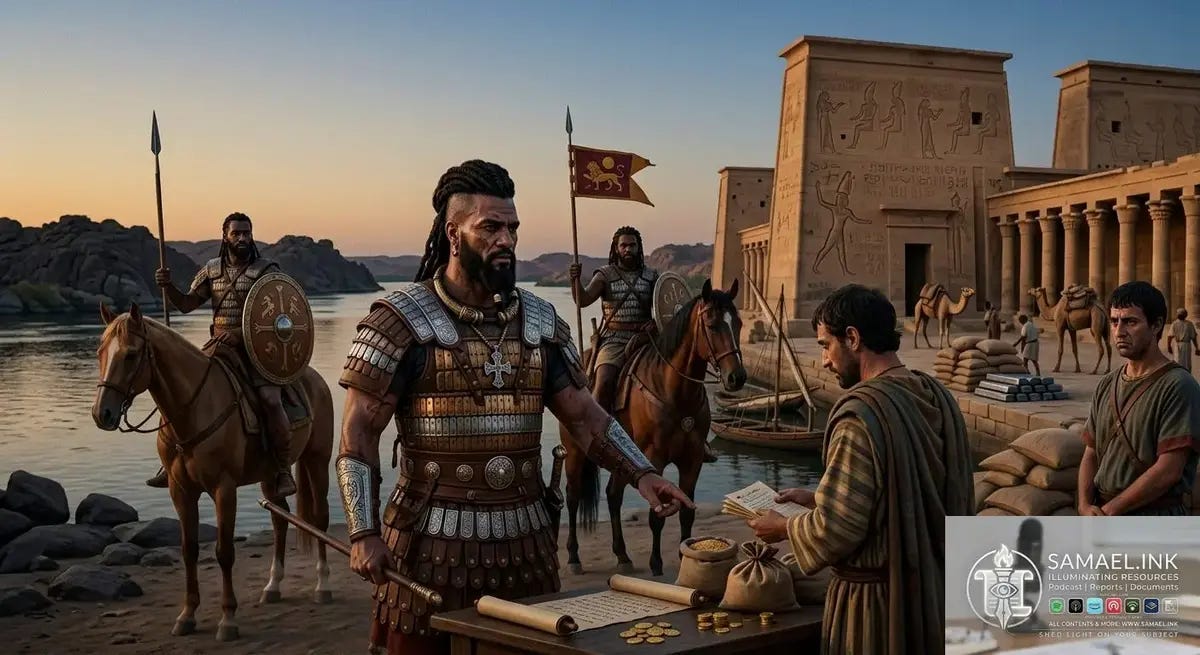
The Mercenary-Governor Model
The Blemmyes were the strategic bridge in the Aksumite "Northern Creep." Following Ezana’s successful "mashing" of the Kushite state in 350 CE, Aksum possessed the "Gold Boost" but lacked the desire to colonize the malarial Nile lowlands. Instead, they weaponized the Blemmyes. Read more from HYohannes and www.habeshahistory.com to learn more on Aksumite governance during this period.
Tax Extraction: Byzantine papyri and historical accounts (including those of Olympiodorus of Thebes) indicate that the Blemmyes occupied Roman cities like Philae, Elephantine, and Syene (Aswan).
The Flow of Bullion: They did not merely loot; they established a formal system of tax farming. The revenue extracted from Roman citizens—in the form of grain, gold, and trade duties—was channeled through the Blemmyes' desert networks back to the Aksumite metropole. Aksum essentially "outsourced" its imperial expansion to these nomadic proxies.
The "Double Hostage" of the Nile Gates
The Blemmyes held the keys to the southern Egyptian economy, creating a "Double Hostage" situation for the Byzantines.
The Byzantine Dilemma: If the Romans attempted to "mash" the Blemmyes, Aksum could retaliate by "drying" out the trade routes or supporting further desert raids.
The Aksumite Buffer: For the Aksumite King, the Blemmyes provided a "deniable" military presence. Aksum could maintain a "frenemy" diplomatic status with Rome while their Blemmyes proxies physically occupied Roman soil and extracted the wealth of the Nile. Read more on The Nile Paradox
The Religious "Laundering" at Philae
The Temple of Philae served as the administrative and spiritual headquarters for this Blemmyes-Aksumite protectorate.
Extraterritoriality: The Blemmyes compelled the Romans to allow them access to the temple of Isis. This was a legal "loophole" that allowed Aksumite agents and Blemmyes tax-farmers to reside within Roman territory under the guise of "pilgrimage."
The Economic Hub: Philae became the "laundry" where Roman taxes were converted into the "prestigious spoils" that fueled the Aksumite gold standard.
The "Drying Out" of the Protectorate
The Blemmyes' role as Aksum's tax-farmers only ended when Justinian identified them as a threat to his imperial grain supply in the 6th century.
Justinian’s Counter-Move: By 540 CE, the Byzantines realized the Blemmyes were the vanguard of an Aksumite superpower. Justinian forcibly closed the Temple of Philae and funded the Nobadae (Nubians) to act as a "counter-proxy."
The Final Mashing: The Nobadae King Silko—backed by Byzantine military hardware—eventually "mashed" the Blemmyes, driving them away from the Nile. This effectively "dried" out Aksum’s northern tax revenue and forced the Empire’s retreat to the inland metropole of Kubrā.
Summary of the Blemmyes' Administrative Role
The Blemmyes were the physical "seal" on Aksum's northern ambitions. Their ability to extract tax from Rome was the ultimate proof that, for a century, the Nile's gold flowed south, not north. Learn more on Aksum’s hidden inland city.