
TL;DR:
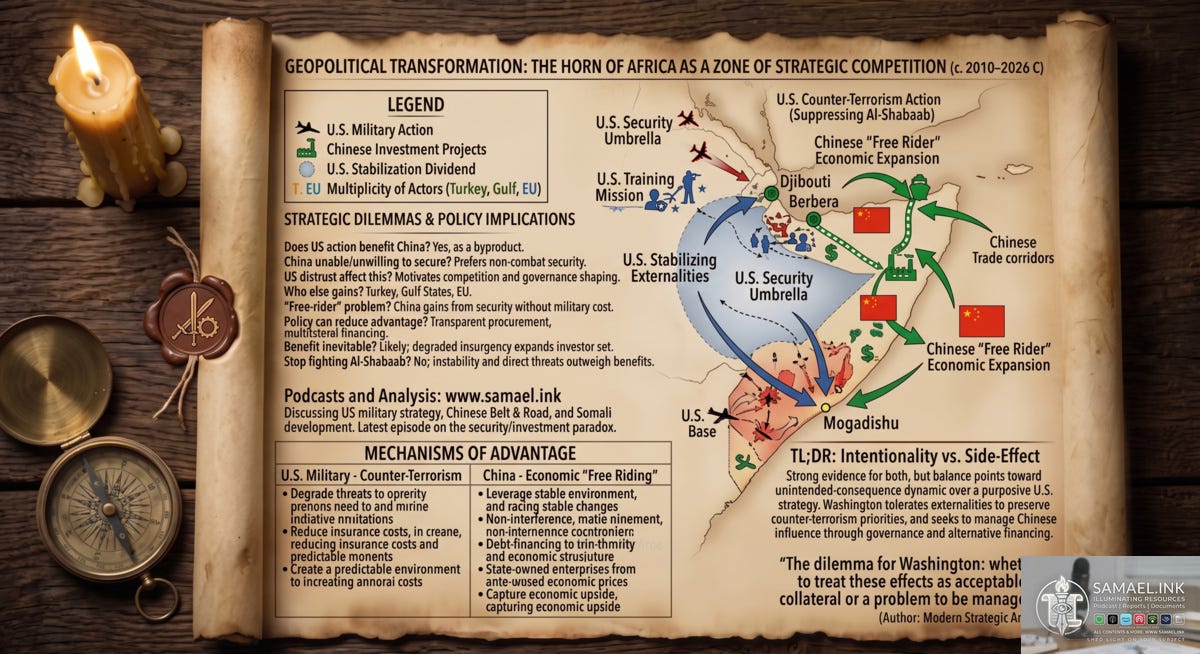
The surge in U.S. counter‑terrorism operations against Al‑Shabaab in Somalia over the past decade has prompted an enduring debate: is the United States deliberately “clearing the path” for Chinese economic expansion by providing the security environment needed for large‑scale investment, or is any benefit to Beijing an unintended byproduct of U.S. strategic priorities? Examining the operational record, stated policies, and regional geopolitics between roughly 2010 and early 2026 shows strong evidence for both interpretations, but the balance of incentives and actions points toward an unintended‑consequence dynamic over a purposive U.S. strategy to favor Chinese commercial interests.
Why stability matters for investment
Major infrastructure projects—ports, rail links, pipelines and large construction ventures—require predictable security. Al‑Shabaab’s attacks on infrastructure, transport corridors and foreign personnel have historically deterred investors and increased insurance and security costs. U.S. strikes, training missions and intelligence support that degrade Al‑Shabaab’s capabilities reduce immediate violent risks, lower operational hazards and thereby expand the feasible footprint for any foreign investor, including China.
Mechanisms that advantage China
China’s long‑standing non‑interference policy and preference for economic, rather than military, instruments of influence mean Beijing typically avoids deploying large combat forces abroad. Instead China relies on commercial deals, loan financing, state‑owned enterprises, and private security solutions to protect its overseas projects. When the U.S. and partners spend military resources suppressing insurgent threats, they create a security umbrella that effectively lowers the entry cost for Chinese projects. This “free rider” effect is structurally significant: Beijing captures economic upside from a security environment shaped in part by U.S. kinetic action without bearing battlefield costs.
Arguments against a deliberate U.S. facilitation
Multiple lines of evidence temper the “cleaning for China” hypothesis. U.S. operations in Somalia are primarily framed and resourced around counter‑terrorism and homeland security objectives—the prevention of external terrorist attacks, disruption of Al‑Shabaab’s external plotting networks, and preservation of U.S. regional influence. The U.S. also actively seeks to limit unfettered Chinese strategic footholds, promoting transparency in port deals, scrutinizing Chinese debt instruments, and encouraging Western or allied alternatives. Washington’s competition with Beijing for influence in the Horn—including diplomatic pressure, aid conditionality and public critique of Beijing’s opaque contracts—runs counter to a simple narrative of facilitating China.
The crowded influence landscape
China is only one of several external actors seeking influence in the Horn. Turkey, the EU, Gulf states and increasingly Gulf rivals deploy their own investments, military ties and soft power. U.S. security assistance can therefore create openings that any actor with sufficient capital or political will can exploit. The multiplicity of competitors means that improved security does not necessarily translate into a unilateral Chinese windfall; rather it expands the prize pool for multiple external partners.
Intentionality versus side‑effect
Evidence favors the interpretation that benefits to China are largely collateral. The U.S. has strategic reasons—counter‑terrorism, regional presence, alliance management—to act militarily. The security dividends for foreign investors, including Chinese entities, are the predictable externalities of a successful counter‑insurgency campaign. That said, Washington appears to tolerate these externalities in pursuit of its own objectives; there is limited appetite in U.S. policy to let power vacuums persist even if doing so would constrain Chinese commercial activity. In short, Washington may accept that China gains commercially from improved security so long as U.S. geopolitical priorities—stability, counter‑terrorism success, and influence—are preserved.
Strategic and normative tensions
This dynamic produces strategic dilemmas. Stabilizing Somalia helps global trade and regional governance but also risks accelerating debt‑financed projects that can bind recipient states to external creditors. If U.S. security action inadvertently subsidizes commercial expansion by rivals, policymakers must decide whether to try to shape post‑stability governance (procurement standards, transparency, alternative financing) or accept a competitive commercial environment where China remains a major beneficiary.
Policy implications
If the U.S. aims to reduce the perception of subsidizing Chinese expansion, it can pursue complementary measures: promote multilateral stabilization financing that conditions transparency, expand Western or allied private investment vehicles with competitive terms, and strengthen Somali governance capacity to negotiate deals on equitable terms. Operationally, continued security assistance can be paired with robust economic governance programs that shape the rules of the post‑conflict economy rather than ceding that terrain to the largest capital exporters.
Conclusion
The available evidence suggests the U.S. is not intentionally “cleaning” for China in the Horn; rather, U.S. counter‑Al‑Shabaab operations produce security externalities that lower barriers for all investors, including China. That outcome creates both opportunities and dilemmas: it stabilizes the environment for reconstruction and trade while riskily amplifying the leverage of powerful external economic actors. Whether Washington treats those effects as acceptable collateral or a problem to be managed depends on broader policy choices about economic governance, multilateralism and strategic competition.
Does U.S. military action in Somalia directly benefit China?
Yes—improved security reduces the risk premium for investment, which benefits all investors, including China, though this is typically a byproduct rather than an explicit U.S. aim.
Is China unable or unwilling to provide its own security for projects?
China generally avoids deploying combat troops and prefers non‑combat security approaches (private contractors, local partnerships), making large U.S. military efforts disproportionately valuable to its investments.
Could the U.S. be deliberately helping China gain footholds?
Direct evidence of a deliberate U.S. strategy to favor China is weak; U.S. actions are driven primarily by counter‑terrorism and regional influence objectives, not a commercial subsidy for Beijing.
How does U.S. distrust of China affect this dynamic?
U.S. competition with China motivates Washington to shape post‑stability governance and limit strategic footholds, even while accepting the security externalities that benefit Beijing.
Does Turkey or other actors also gain from U.S. security efforts?
Yes; the improved security environment benefits multiple external players—Turkey, Gulf states, EU actors—creating a competitive investment landscape.
What is the “free‑rider” problem here? The free‑rider problem is that China (and others) reap the benefits of security provided largely by U.S. military action without bearing the corresponding military costs.
Can policy choices reduce China’s advantage?
Yes; promoting transparent procurement, bolstering Somali negotiating capacity and offering competitive multilateral financing can limit opaque, debt‑heavy deals and distribute benefits more evenly.
Does U.S. action create long‑term dependence?
If security gains are not paired with strong governance reforms, stabilization can institutionalize dependence on external powers—militarily and economically.
Is the benefit to China inevitable if Al‑Shabaab is degraded?
Not inevitable, but likely: degraded insurgency increases the set of feasible investors; who wins depends on governance, procurement rules and geopolitical competition.
Should the U.S. stop fighting Al‑Shabaab to deny China benefits?
No; letting Al‑Shabaab persist would risk wider instability and direct threats to U.S. and allied security—costs that outweigh any hypothetical geopolitical gain from constraining Chinese investment.