
TL;DR:
The historical and cultural landscape of the Southern Red Sea basin, stretching from the Transjordanian highlands of the Levant to the Ethiopian plateau, represents one of the most critical yet frequently obscured nurseries of the Abrahamic tradition. For centuries, the exchange of people, texts, and ideological frameworks across the Bab-el-Mandeb strait fostered a unique Red Sea culture where Judaism, Christianity, and emerging Islam were not merely adjacent but deeply intertwined.
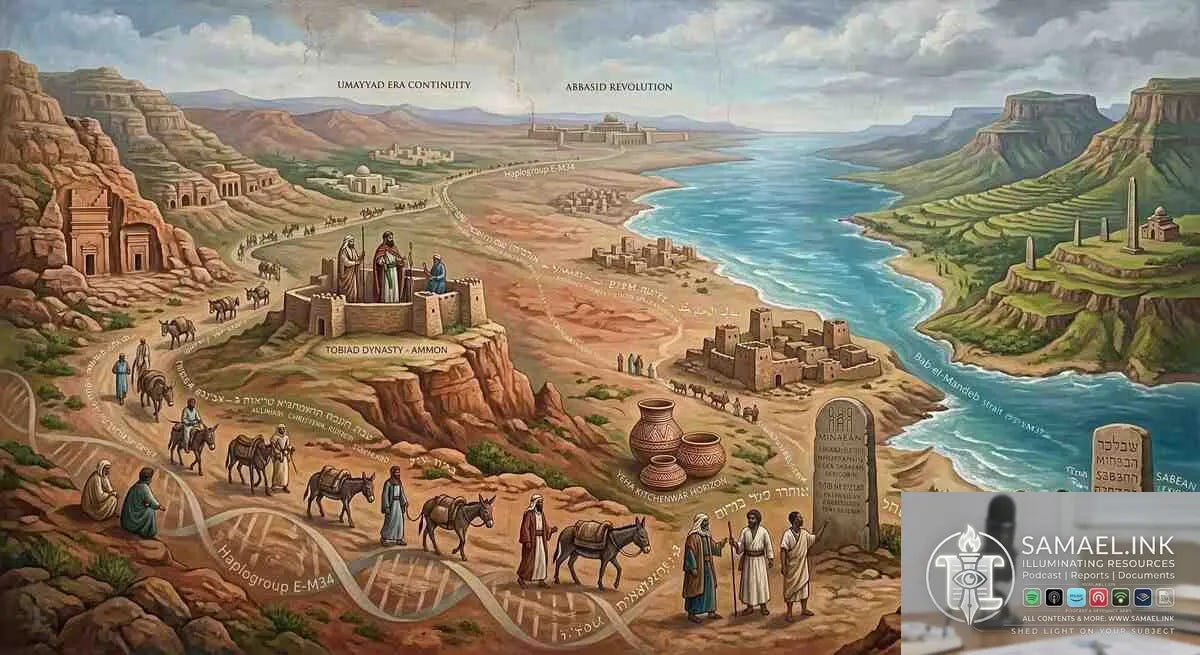
Within this nexus, the Tobiad dynasty emerges not merely as a local Jewish elite in Ammon, but as a key representative of a broader Southern Semitic identity that mapped across the Levant and the Red Sea littoral. This identity is substantiated by a multifaceted evidentiary base, including the paternal haplogroup E-M34, the distinctive Ethio-Sabaean ceramic horizon exemplified by Yeha kitchenware, and a specific epigraphic lexicon connecting Minaean and Sabaean religious structures with Hebrew traditions.
The transition from the localized continuity of the Umayyad era to the centralized disruption of the Abbasid revolution further serves to contextualize the marginalization of these southern narratives. What was once a vibrant, interconnected maritime and highland world was structurally “dried” out by the Mesopotamian shift, a historical “overwrite” that redirected the flow of power and memory away from the Red Sea and toward Baghdad.
Checkout our AI powered interactive Toba knowledge base.
The Tobiad Dynasty: From Ammonite Servants to Hellenistic Aristocracy
The Tobiads were a noble Jewish dynasty based in Ammon whose origins potentially date back to the First Temple Period. Their history spans several centuries, from the 8th century BCE through the rule of the Ptolemaic dynasty and into the early Hasmonean period, representing a persistent elite lineage that maintained influence across changing imperial administrations. The dynasty’s name is derived from the ancestor Tobias (Tuvia), meaning “God is my good,” a name that was preserved through the practice of patronymy and papponymy for hundreds of years.
The archaeological and literary evidence for the Tobiads centers on their Transjordanian estate at Iraq al-Amir, known as the “Caverns of the Prince”. This site features the monumental Qasr al-Abd, or “Castle of the Servant,” a structure that reflects the family’s high status and their role as intermediaries between the Judean population and imperial powers. Benjamin Mazar established that the Tobiads were influential landowners in the Transjordan who managed to retain their estates even after the Neo-Assyrian Empire destroyed the Kingdom of Israel. Mazar suggested that their rise to prominence in Ammon likely occurred during the reigns of King Uzziah and Jotham of Judah following their victories over the Ammonites.
The Tobiads occupied a unique and often controversial position between Judean nobility and Ammonite leadership. During the Persian (Achaemenid) period, the clan was led by Tobiah the Ammonite, who served as a high-ranking official, likely the governor of Ammon. While his rival Nehemiah used the title “Ammonite servant” scornfully, modern scholars interpret this designation as a high-standing Persian ministerial rank (ebed hammelek), signifying a “servant of the king”. Despite Nehemiah’s hostility, Tobiah remained a “Noble of Judah,” was related by marriage to the High Priest Eliashiv, and maintained an office within the Temple court in Jerusalem until he was forcibly expelled.
Under the Ptolemaic dynasty in the mid-3rd century BCE, a scion named Toubias headed a mixed-nationality military community, or cleruchy, in Ammon. The Zenon Papyri indicate that Toubias was on friendly terms with King Ptolemy II Philadelphus, supplying the Alexandrian court with exotic animals, horses, and slaves. The family’s power culminated with Joseph ben Tobias, the nephew of the High Priest Onias. Joseph secured the lucrative rights to farm taxes for Syria, Phoenicia, and Samaria for twenty-two years, effectively making the Tobiads some of the most powerful tax farmers in the Ptolemaic Empire.
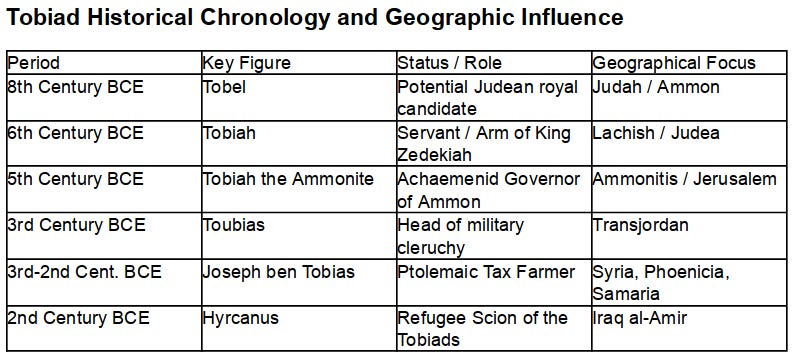
The dynasty’s prominence ended with the death of the last scion, Hyrcanus, in 175 BCE. After a violent family rift over tax-farming rights, Hyrcanus retreated to the Transjordanian estate, where he lived for seven years in conflict with neighboring Arabs before committing suicide upon the rise of the Seleucid monarch Antiochus IV Epiphanes. The Tobiad legacy represents a crucial link in the continuity of Jewish identity across the Levant and the Red Sea, characterized by a sophisticated Hellenistic cultural alignment and a robust military and administrative presence in the Transjordan.
Mapping the Genetic Landscape: The E1b1b and E-M34 Lineage
The mapping of Tobiad identity and the broader Southern Semitic migration patterns is significantly informed by recent developments in Y-chromosome DNA science. Paternal haplogroup E1b1b (also known as E-M215 or E-M35) and its specific subclades, such as E-M34, serve as genetic reagents with which to infer episodes of population history associated with elite expansion and the Neolithic agricultural revolution.
Haplogroup E1b1b is found across North Africa, the Horn of Africa, Western Asia, and Europe, with its major sub-branches thought to have originated in the general area of Northeast Africa or the ancient Levant. Subclade E-M34 is descended from E-M123 and is linked to specific ancient migrations of ancestors whose lineages span tens of thousands of years. Analysis of ancient DNA indicates that Natufian skeletal remains from the ancient Levant predominantly carried haplogroup E, and this marker remained dominant among fossils from the ensuing Pre-Pottery Neolithic B (PPNB) culture.
The distribution of E1b1b in modern populations reflects these ancient patterns. For instance, a study of modern Egyptians found that E1b1b accounts for 36.1% of male haplogroups, predominantly the E-M78 subclade. In Ethiopia, similar Eurasian genetic components are present, with multidimensional scaling plots placing both Ethiopians and Yemenis between Near Eastern and sub-Saharan African populations. This genetic continuity is consistent with the “Red Sea Nexus” model, where historic and archaeological evidence indicates tight cultural and genetic connections across the Bab-el-Mandeb for millennia.
The specific subclade E-M34 has been tentatively associated with high-status lineages and other elite migrations in the Levant. This clade is notably found in populations across the Mediterranean and is even linked to the Bonaparte family, highlighting its historical association with influential lineages. Furthermore, E1b1b has been identified in Amorite and Akkadian remains at sites like Megiddo and Ebla, as well as among Phoenician populations who settled throughout the Mediterranean.
Distribution and Significance of Haplogroup E1b1b Subclades
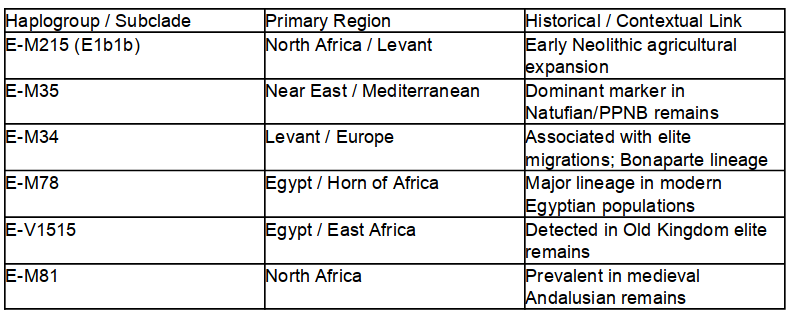
The genetic data suggests a complex history of mobility. While some branches of E-M35 are assumed to have left Africa thousands of years ago, others may have arrived in the Horn of Africa from the Near East. In the context of the Tobiads and their Ammonite base, the prevalence of these markers in the Levant and their subsequent diffusion to the Red Sea highlands aligns with the textual evidence of a mobile, high-status Semitic stratum that utilized maritime and inland trade routes to establish socio-political dominance.
Material Synthesis: Yeha Kitchenware and the Ethio-Sabaean Horizon
The material culture of the Northern Horn of Africa, particularly during the first millennium BCE, provides tangible evidence of the cultural diffusion patterns associated with the Red Sea Nexus. The polity of D’MT, centered on the site of Yeha in the Tigray Region of Ethiopia, represents the first organized state in the region and a direct precursor to the Kingdom of Aksum. Yeha was a political and cultural center of the Ethio-Sabaean culture, characterized by a sophisticated synthesis of indigenous and South Arabian (Sabaean) traditions.
The most notable evidence for Sabaean influence at Yeha is the Great Temple, a resolutely Sabaean-style structure dated to the 7th or 8th century BCE. The limestone ashlars used in its construction show typical Sabaean stonemasonry, and the temple’s exterior wall and interior layout closely resemble contemporary Almaqah temples in Yemen, such as those at Sirwah and Marib. Geological and provenance studies have shown that the limestone ashlars for the Yeha temple were transported from quarries near Wuqro, displaying identical geochemical signatures to the raw material found there.
Pottery analysis at Yeha and surrounding sites provides a more nuanced look at the domestic and social life of this period. While the elite architecture is undeniably Sabaean in style, the local ceramics—often referred to as “Yeha kitchenware”—reflect a combination of local, regional, and imported traditions. Archaeological research has classified this pottery by analyzing the mineralogy of the temper (using light microscopy and cathodoluminescence) and the main element composition of the clay matrix.
Ceramic Typology and Technological Markers in the Yeha Region
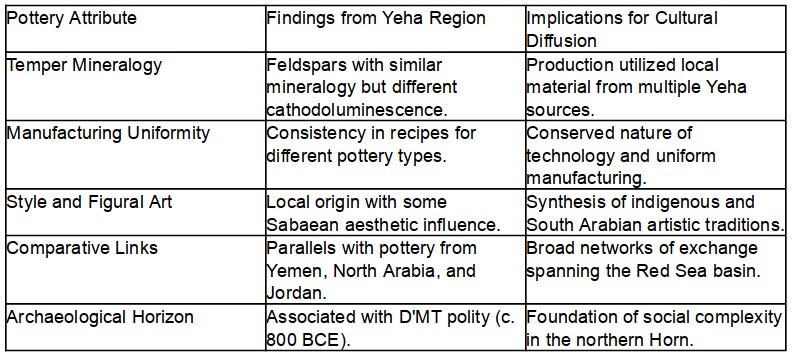
Surveys at Yeha and Hawulti-Melazo reveal pottery and terracotta figurines of undoubted local origin, though some female figurines exhibit clear Sabaean aesthetic influence. Conversely, other first-millennium BCE peasant settlements in the Eritrean-Ethiopian highlands, such as those of the Ancient Ona culture, show no signs of South Arabian influence, suggesting that the Sabaean-style cultural synthesis was concentrated among the urban and political elite at Yeha. This pattern mirrors the “elite migration” model, where high-status individuals (like the Tobiads in the Levant) introduced new architectural and cultural forms while the broader population maintained existing local traditions.
The ceramic record also highlights the variability of local traditions across the Horn. At the site of Harlaa, local ceramics identified in field surveys were situated within the wider context of Indian Ocean trade networks, showing changes in the 12th century when the site gained increased access to these routes. The study of Yeha kitchenware and its Arabian parallels confirms that while various regions had their own distinctive pottery typologies, they were influenced throughout history to a greater or lesser degree by the cultures of neighboring regions.
Epigraphic Echoes: Yisrabel, Lawiat, and the Cultic Continuum
The epigraphic record from South and North Arabia contains profound evidence of a shared religious and linguistic substratum connecting the Arabian Peninsula with the Hebrew traditions of the Levant. Central to this evidence are the terms Yisrabel and Lawiat, which suggest deep historical overlaps between Minaean, Sabaean, and Israelite identities.
The Minaean tribal confederation, which emerged in the 6th century BCE (with some inscriptions dating as far back as the 8th century or even 12th century BCE), possessed a different social structure than other Old South Arabians. Their kings worked alongside a council of elders that represented both the priesthood and high-class families. Significant Minaean inscriptions have been found at Madi’an Saleh (Hegra), a major trade post along the incense route. One such inscription mentions the god Yisrabel (or Israbaal), where Baal (meaning “Lord”) is another name for El. This term is linguistically and theologically linked to “Israel” in the biblical texts, suggesting that the deified ancestor or deity represented by this name was shared across the Semitic world.
Furthermore, the Minaeans shared with the Hebrews several specific cultic terms and practices:
Lawiat: The name for the Minaean priesthood, cognate with the Hebrew “Levites” (lawi), meaning “the coiling ones” or “those who twist/bind”.
Elohim: A biblical name for the Hebrew god, used in Minaean contexts to refer to their gods.
Yah: A shortened form of YHWH, worshiped by the Minaeans and associated with the god Wadd in various inscriptions.
Mekonah: The sacrificial cart, a shared temple accoutrement.
Ma’ser: The tithe, or religious tax.
Kahal: The congregation, or religious assembly.
Minaean and Hebrew Religious and Linguistic Cognates
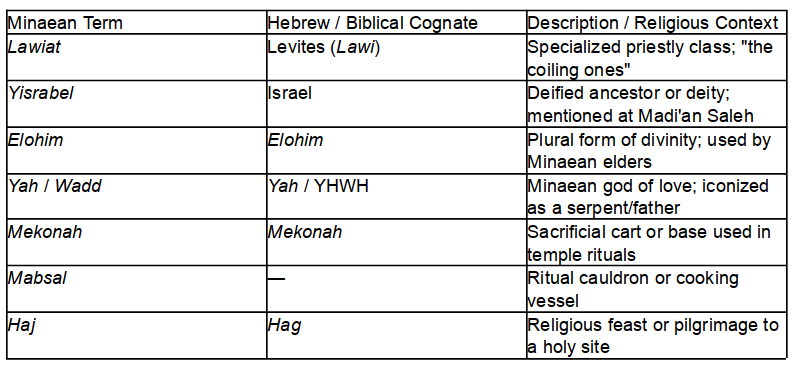
The existence of these terms in Minaean and Sabaean inscriptions, which are contemporary with or even predate the definitive recording of the Hebrew Bible, provides overwhelming evidence for a common religious heritage. Some scholars argue that YHWH traveled from the Minaeans through the Midianites and Edomites before becoming the chief deity of Judah. The tribe of Judah (Yehuwdah, meaning “Yah is Wadd”) is theorized to have begun as copper smiths (Qynites/Cainites) working mines in the Negev and Edom, locations where the Egyptians recorded the “Shasu of Yhw”.
This linguistic and cultic continuity suggests that the Tobiad dynasty was part of a larger Southern Semitic world that established hegemony over the lucrative incense trade routes running from the southern coast of Arabia into Canaan, the Levant, Egypt, and Mesopotamia. The authors of biblical mythology presented their particular deity as the source of their “right” to control these routes, framing their history within a shared Arabian-Levantine cultic framework that included the Lawiat priesthood and the Yisrabel deity.
The “Baghdad Overwrite”: From Umayyad Continuity to Abbasid Revolution
The cultural and historical memory of the Southern Red Sea Nexus was significantly altered by the political shift from the Umayyad to the Abbasid Caliphate in the mid-8th century CE. Modern revisionist scholars, such as Robert Hoyland and Peter Webb, have identified this phenomenon as the “Baghdad Overwrite”—a historiographical trend where Abbasid-era historians in Iraq intentionally restructured early Islamic history to minimize the contributions of Southern Arabian (Yemenite) and Ethiopian elites.
Under the Umayyad Caliphate (661–750 CE), the political center was in Damascus, and the administration relied heavily on the support of the Syrian-Yemenite tribal faction. This period was characterized by a relative continuity of Southern Semitic influence; Yemenite identity carried high status, and the histories documented by scholars like ‘Ubayd ibn Sharya linked the biblical world directly to the Yemeni past. Pre-Islamic Yemen was recognized as a sophisticated, literate, and unified monotheistic state that had practiced Judaism for nearly three centuries.
The Abbasid Revolution (747–750 CE) fundamentally changed this dynamic. The revolution, while supported by Yemeni factions in its early stages, drew its core strength from Muslim converts in Khurasan (Eastern Iran). Following their victory, the Abbasids established their capital in Baghdad, shifting the empire’s center toward Mesopotamia and the Persian East. To legitimize their new imperial heartland, Iraqi historians began to overfocus on the “Hijazi conquests” and the Northern Arab tribes, effectively dismissing pre-Islamic Southern Arabian history as part of the Jahiliyya (”Time of Ignorance”).
One of the primary victims of this “Baghdad Overwrite” was the Yemenite school of isra’iliyyat (Judeo-Christian lore). Wahb ibn Munabbih (d. 728/732 CE), a scholar of Persian descent living in Yemen, had provided the narrative scaffolding for much of Islamic prophetology by integrating Himyarite royal history with biblical genealogy. During the Abbasid period, however, the works of Wahb and his contemporaries were often criticized as “extravagant flights of fancy” because they challenged the emerging Baghdad-centric orthodoxy.
Historiographical Shift: Umayyad vs. Abbasid Paradigms

The transition also affected the status of the Abna, a distinct community in South Arabia whose lineage was paternally Iranian and maternally Arab, resulting from the intermarriage of Persian soldiers and local women following the 6th-century Aksumite-Persian wars. These individuals, along with converts from Judaism, had been the primary conduits for the transmission of biblical lore into the Islamic corpus. While the title Abna may have been the root of the Abna al-Dawla (”Sons of the Dynasty”) who formed the backbone of the early Abbasid army in Baghdad, the original Yemenite identity of these scholars and soldiers was increasingly overwritten by Iraqi and Khurasani affiliations.
The recovery of this southern history is a central task of modern revisionist scholarship. By examining epigraphic and archaeological evidence, researchers have established that leading military figures and troops of the early Islamic expansion were predominantly from Yemen—products of a long history of statehood and monotheism (Rahmanism) rather than “uncivilized” nomads. The synthesis of Yemenite-Jewish traditions and Ethiopic religious texts like the Orit and the Kebra Nagast provides a window into a shared sacred past that the Abbasid revolution sought to obscure.
The Red Sea Nexus: Ethiopic Orit and Yemenite Traditions
The religious and historical landscape of the southern Red Sea basin represents a “Red Sea Nexus” where exchange fostered deep intertwining of Judaism and Christianity. Central to this synthesis are the Yemenite scholars of the early Islamic period, such as Wahb ibn Munabbih, whose reputations have been the subject of intense scholarly scrutiny to rehabilitate their standing beyond mere storytellers. Analysis of the 844 CE Heidelberg papyrus proves that Wahb was part of a sophisticated writerly culture that integrated Himyarite royal history with biblical genealogy.
Striking structural similarities exist between the Yemenite Jewish tradition of the Taj (Crown) and the Ethiopic Orit (Octateuch). A Taj is a sacred text integrating the Pentateuch with Targum and Judeo-Arabic translations, reflecting a “twice-read” liturgical dynamic where Hebrew is followed by vernacular interpretation. This mirrors the Beta Israel tradition where Kessim chant the Orit in Ge’ez followed by oral interpretation in Amharic or Tigrinya.
Comparative Features of Taj and Orit Traditions


The philological connections—such as the Arabic roots of Ge’ez names—and shared motifs of Solomonic lineage provide evidence of this “Red Sea Nexus.” Recovery of southern narratives corrects the “Baghdad Overwrite” that marginalized these voices to serve the Mesopotamian heartland. The isra’iliyyat of Yemen and the Orit of Ethiopia remain the most valuable windows into a shared past where monotheism (Rahmanism) centered on al-Rahman was the common vocabulary of Jews, Christians, and early Muslims.
Deep Time and Socio-Anthropological Context: Toba and Indigenous Governance
The broader context for the development of Semitic identities in the Horn of Africa and the Red Sea is framed by even deeper environmental and social histories. The site of Shinfa-Metema 1 (SM1) in northwest Ethiopia contains Youngest Toba Tuff (YTT) cryptotephra, providing a chronological marker dated to approximately 74,000 years ago. Stable oxygen isotopes from ostrich eggshells and mammal teeth at this site indicate that modern humans were successfully adapting to periods of “high seasonal aridity” during the Middle Stone Age.
This evidence suggests that human dispersal out of Africa was not restricted to humid “green corridors” but could be facilitated by the behavioral flexibility to utilize “blue highway” corridors—seasonal rivers that receded into waterholes during arid intervals. This behavioral plasticity is cited as a key factor in the worldwide expansion of modern humans and provides a baseline for the later mobility and adaptive foraging strategies observed in the Red Sea Nexus.
Against this backdrop of deep-time migration, the indigenous governance systems of Southern Ethiopia, such as the Gedeo Baalle system, reveal a masterwork of social engineering. The Baalle system integrates political, judicial, and ecological management into a generational framework of nine rotational grades, each lasting eight years. This system ensures a peaceful transfer of power and facilitates the integration of migrant groups through the distinction between:
Akaku: The aboriginal or old-established indigenous lineages (”grandfathers”).
Dalatta: Newcomers from neighboring groups who fled famine or conflict (”the born ones”).
The Gedeo Baalle System: Generational Class Structure
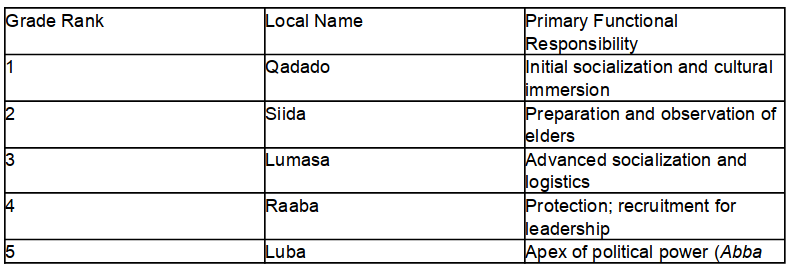
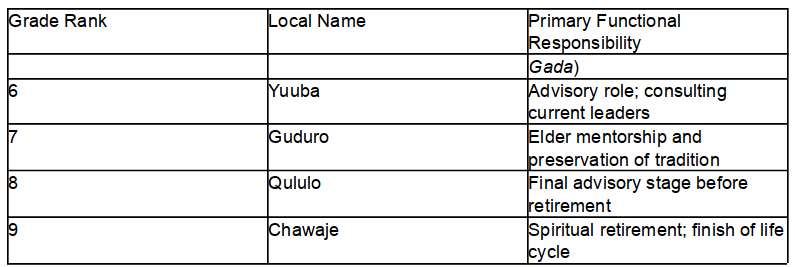
These indigenous systems are often rooted in celestial foundation myths, such as the legend of Daada, the first king of Alatta in the Sidama region, who is said to have descended from heaven on a chain or spider’s thread. Similar to the deification of the Tobiad scions or the Yisrabel deity, these myths sanctify the political hierarchy by linking the ruling lineage to a divine origin. The simultaneous diffusion of social castes, such as the progenitor of the potters (Du’a), underscores the spiritual logic behind the division of labor and specialized crafts like smithing and pottery—paralleling the role of the Lawiat or Levites as a specialized priestly class.
Historical Diffusion and Trans-Continental Mythology
Stephen Oppenheimer’s analysis of prehistoric migrations suggests that Southeast Asia (Sundaland) was a “center of the world” whose drowning at the end of the last Ice Age triggered a series of dispersals. This “Asian dispersal” established trade routes that influenced Mesopotamia, Egypt, and India long before classical history began.
Significant parallels exist between the “two-brothers” myths of the Pacific (Kulabob and Manup) and Western archetypes like Cain and Abel or Osiris and Seth. In Melanesian versions, Kulabob (the clever, lighter-skinned brother) creates sophisticated technology like ocean-going ships and specialized crafts, while his brother Manup remains associated with more primitive forms. These narratives often involve a “tree of plenty” that distributes wealth and technology when felled—a motif mirrored in the Sumerian “Huluppu tree” where Lilith and mythical birds reside before Gilgamesh strikes it down.
Parallel Motifs in Two-Brothers and Fertility Myths
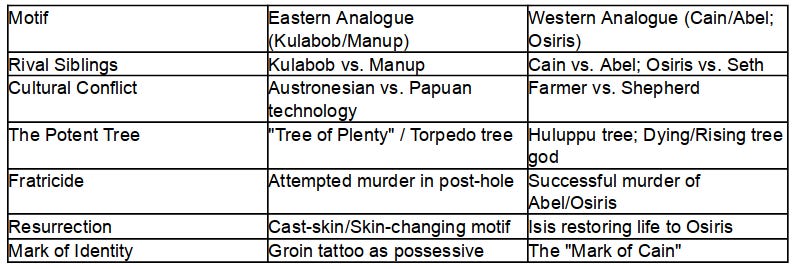

These complex story-types, sharing multiple distinct motifs, are statistically unlikely to have occurred independently. Their distribution from Polynesia through Southeast Asia to the Mediterranean suggests a direction of cultural flow from East to West. The Tobiad dynasty, with its Transjordanian base and Hellenistic cultural orientation, can be seen as a later instantiation of this mobile, elite class that acted as the primary conduit for such trans-regional ideas and religious structures.
Synthesis and Conclusion: The Nuanced Reality of Southern Semitic Identity
The mapping of Tobiad identity across the Levant and the Red Sea reveals a sophisticated and interconnected Southern Semitic world that the later “Baghdad Overwrite” attempted to minimize. The Tobiad dynasty was not merely a local Judean clan but a prominent representative of an elite military and administrative stratum that utilized the Red Sea Nexus to maintain influence across imperial shifts from the Persian to the Hellenistic eras. Their presence in the Transjordan and their diplomatic ties to the Ptolemaic court reflect a broader pattern of elite mobility characterized by the paternal haplogroup E-M34 and the adoption of high-status cultural forms.
Material evidence from sites like Yeha confirms that this identity was substantiated by a deep cultural synthesis between the Horn of Africa and South Arabia. The Yeha kitchenware horizon and the Sabaean-style monumental architecture of the Great Temple provide tangible correlates to a literate, monotheistic society that predates and informs the later Aksumite and Himyarite kingdoms. This Ethio-Sabaean culture was part of a larger cultic continuum evidenced by the Minaean-Sabaean religious terminology, where the Lawiat priesthood and the Yisrabel deity provide undeniable links to the Hebrew traditions of the Levant.
The Abbasid revolution, while transforming the Islamic world into a Mesopotamian-centric empire, significantly suppressed the memory of this Southern Semitic past. The works of Yemenite scholars like Wahb ibn Munabbih were marginalized, and the sophisticated Jewish and monotheistic history of pre-Islamic Yemen was dismissed as part of the Jahiliyya. However, the resilience of these southern narratives in the Ethiopic Orit and the Kebra Nagast ensures that the Red Sea Nexus remains a vital window into the shared sacred past of the Semitic world.
The behavioral flexibility required to survive seasonal aridity—established as far back as the Toba supereruption—and the indigenous governance systems like the Gedeo Baalle further illustrate the deep history of adaptation and integration in the region. Ultimately, Tobiad identity serves as a microcosm of the Southern Semitic experience: a history of elite mediation, religious synthesis, and persistent continuity across the shifting sands of imperial transition.
The Rift Valley: The True Engine of Sapiencization

The transition from the “1.0” Eurasian lineages to the Sapiens 2.0 (الإنسان العاقል) model was defined by a massive expansion of the Prefrontal Cortex (PFC), a biological “charge” that transformed the Rift Valley into a high-pressure laboratory for cognitive flexibility. Unlike the Ice-Age-adapted Neanderthals who specialized in physical sensory-motor sy…
All Germans Are Africans

If you trace the lineage of any person living in Germany today—from the Baltic coast to the Bavarian Alps—the path eventually leaves Europe entirely. Scientific evidence from genetics, paleoanthropology, and geology confirms that the biological foundation of every German citizen is rooted in the African continent.
Works cited
1. Haplogroup E-M35 - Wikipedia, https://en.wikipedia.org/wiki/Haplogroup_E-M35
2. Haplogroup E-V68 - Wikipedia, https://en.wikipedia.org/wiki/Haplogroup_E-V68
3. Paternal Haplogroup E-M34 - Last Names - 23andMe, https://discover.23andme.com/haplogroup/E1b1b1b2a1-paternal
4. Genetic history of the Middle East - Wikipedia, https://en.wikipedia.org/wiki/Genetic_history_of_the_Middle_East
5. Ethiopian Mitochondrial DNA Heritage: Tracking Gene Flow Across and Around the Gate of Tears | Request PDF - ResearchGate, https://www.researchgate.net/publication/8258890_Ethiopian_Mitochondrial_DNA_Heritage_Tracking_Gene_Flow_Across_and_Around_the_Gate_of_Tears
6. Israel’s Serpent/Moon God Yahweh (YHWH), the Jewish Snake God | Arabian Prophets, https://arabianprophets.com/?page_id=106
7. Sabaeans in the Horn of Africa - Wikipedia, https://en.wikipedia.org/wiki/Sabaeans_in_the_Horn_of_Africa
8. Preliminary Characterization of Pottery by Cathodoluminescence and SEM–EDX Analyses: An Example from the Yeha Region (Ethiopia) | Request PDF - ResearchGate, https://www.researchgate.net/publication/277817951_Preliminary_Characterization_of_Pottery_by_Cathodoluminescence_and_SEM-EDX_Analyses_An_Example_from_the_Yeha_Region_Ethiopia
9. Arabia Felix From The Time Of The Queen Of Sheba: Eighth Century B.C. to First Century A.D. [New ed.] 0268020043, 9780268020040 - DOKUMEN.PUB, https://dokumen.pub/arabia-felix-from-the-time-of-the-queen-of-sheba-eighth-century-bc-to-first-century-ad-newnbsped-0268020043-9780268020040.html
10. Report on Archaeological Investigations at Ethio-Sabaean Sites Nearby Wuqro (2017, 2019) - Lens Viewer, https://lens.idai.world/?url=/repository/ZOrA_16/ZOrA_16_2023_Pfeiffer_Hamel.xml
11. Archaeological Ceramics as Chronological Indicators on Islamic Sites in Eastern Ethiopia, https://search.proquest.com/openview/ac4926f168e70f09c5be7d280d1a42b0/1?pq-origsite=gscholar&cbl=51922&diss=y
12. VOLUME I - UCL Discovery, https://discovery.ucl.ac.uk/1546157/1/Gazdar_666543_vol1.pdf
13. AncientBibleHistory@groups.io | Holly, questions regarding your theory of Minaeans, https://groups.io/g/AncientBibleHistory/topic/holly_questions_regarding/75555981
14. AncientBibleHistory@groups.io | Messages, https://groups.io/g/AncientBibleHistory/messages?page=920&after=1508675789000000000&subsort=1&index=77663
15. AncientBibleHistory@groups.io | Sauska, Lawazantiya and the Levites, https://groups.io/g/AncientBibleHistory/topic/67780528
16. AncientBibleHistory@groups.io | Ancient Bible History Re: Yhwh Elohim, https://groups.io/g/AncientBibleHistory/topic/ancient_bible_history_re/67780513
17. Arab Tribes, the Umayyad Dynasty, and the `Abbasid Revolution - American Journal of Islam and Society, https://www.ajis.org/index.php/ajiss/article/download/513/2258/4987
18. Abbasid Caliphate - Wikipedia, https://en.wikipedia.org/wiki/Abbasid_Caliphate
19. Early Islamic Imperial Space (Chapter 5) - The Limits of Universal Rule, https://www.cambridge.org/core/books/limits-of-universal-rule/early-islamic-imperial-space/80FF78FB352B3D43B19B9D483BC268C1
20. The Early Abbasid Caliphate A Political History (Hugh Kennedy) | PDF | Classics - Scribd, https://www.scribd.com/document/755290907/The-Early-Abbasid-Caliphate-a-Political-History-Hugh-Kennedy-Z-lib-org
21. Al-Abna’ - Wikipedia, https://en.wikipedia.org/wiki/Al-Abna%27
22. The Abbasid Abna and Sasanid Cavalrymen - Institute for Advanced Study, https://www.ias.edu/sites/default/files/hs/Crone_Articles/Crone_The_Abbasid_Abna_and_Sasanid_Cavalrymen.pdf
23. The abnĆ’ al-dawla: The Definition and Legitimation of Identity in Response to the Fourth Fitna - Digital Commons @ Colby, https://digitalcommons.colby.edu/cgi/viewcontent.cgi?article=1068&context=faculty_scholarship