
TL;DR:
Human-created misinformation is more dangerous than AI hallucinations because it carries motive, context, and a stake in outcomes; humans build narratives to reshape identity, territory, and memory. Platforms that publish unverified tribal histories train readers to adopt skewed worldviews: the harm is not merely false facts but a corrupted interpretive compass. Defending the “Third Eye” of the reader requires procedural rigor: transparent native-script evidence, physical-context claims (mineral/archaeological), and independent, cross-cultural corroboration.
The problem is structural and social: where incentives reward attention and authority, actors with sectarian or tribal agendas can manufacture “proof”—chiseled names, doctored provenance, selective translations—to rewrite the past. The remedy is methodological: insist on multi-axial verification that forces narratives to survive scrutiny from empirical, textual, and external comparative poles. Only then do histories become resilient against intentional deceit.
Practical measures are available to custodians of public knowledge: publish raw primary materials, demand native-script transliteration, require mineralogical or archaeological context for material claims, and invite independent external checks. Implementing these steps makes it much harder for human agents to weaponize memory and identity, and restores the Third Eye’s capacity to see complexity rather than a single-serving myth.
The Third Eye and the Architecture of Deceit — Expanded
The Third Eye as civic faculty
The Third Eye is not mystical: it is the civic faculty through which communities, readers, and scholars perceive continuity, belonging, and historical meaning. It is trained by exposure to evidence, method, and interpretive norms. When healthy, the Third Eye distinguishes context from rhetoric, provenance from performance, and plausible inference from motivated fiction. When compromised, it becomes a cultural organ for credulity—accepting whatever best serves a group’s present needs.
Triadic roles in contested histories
Every contested historical claim lives inside a triangular dynamic:
The protagonist: the historical subject—person, place, artifact, or event—whose past is at stake.
The narrator: the human claimant who interprets or asserts the protagonist’s meaning and lineage.
The Third Eye: the collective perceiver that must evaluate the claim and either incorporate it into shared knowledge or reject it.
This triangle explains how stories become battlegrounds. The narrator aims not merely to describe but to convert the Third Eye into an ally. That conversion is accomplished through rhetorical craft, selective evidence, and institutional channels that confer authority.
Mechanics of human deception
The recurring human techniques of historical manipulation are predictable because they exploit specific vulnerabilities of the Third Eye:
Epigraphic Erasure and Substitution
Physical alteration of inscriptions, graffiti, or architectural dedicatory texts to remove inconvenient names and insert new ones.
Contextual falsification by restoring broken epigraphic fragments in misleading configurations, or by presenting detached fragments as if found in situ.
The Translation Trap and Semantic Recasting
Using ambiguous lexemes, homographs, or rare grammatical forms to generate favorable readings.
Publishing a single, confident translation without the original script, alternative renderings, or a translation note—thereby turning an interpretive choice into an assumed fact.
Geographic Kidnapping and Provenance Fabrication
Relocating artifacts or inventing discovery narratives so that objects appear to originate from a politically useful locale.
Backdating museum accession records or creating fictive excavation notes to paper over provenance gaps.
Curated Silence and Selective Archiving
Withholding, destroying, or burying sources that contradict a preferred story while amplifying congenial evidence.
Enlisting institutional actors (clerics, local officials, collectors) to suppress inconvenient finds or to regulate access.
Palimpsest Politics
Layering new narratives over older ones—linguistic, ritual, or material—so that the newer account becomes the only visible one to casual observers, even where older traces persist beneath.
Why human motive matters more than plausibility
AI hallucinations are accidental—wrong outputs generated without durable intent. Human deception is strategic. It can be planned, funded, institutionalized, and transmitted across generations. Humans know which levers to pull: authoritative certifications, curated exhibits, educational syllabi, and public ceremonies. They also understand that certain symbolic claims—origins, sacred events, ancestral homelands—have outsized effect on legal rights, resource claims, and communal cohesion. Consequently, deliberate falsification targets these leverage points rather than aiming for mere visual plausibility.
How miseducation operates as structural capture
Miseducation is not only about false sentences; it is about habits of interpretation. The process typically follows a recognizable trajectory:
Manufacture or misattribute a “primary” item (inscription, artifact, testimony).
Publish a confident, rhetorically polished narrative that links the item to a broader origin story.
Secure institutional amplification—local museums, schools, influential columnists, or sympathetic academics.
Normalize the story: include it in curricula, tourist literature, or political briefs.
Harden into identity: future generations inherit the narrative as a given, making correction psychologically and politically costly.
Consequences beyond truth
The fallout from these practices extends into law, diplomacy, and daily life:
Policy distortions: Land claims, repatriation requests, and legal rights premised on fabricated heritage can misallocate justice and resources.
Intercommunal strain: Competing, contradicted narratives harden into grievance politics—each side claims moral and historical priority.
Academic dysfunction: Intellectual labor shifts from testing evidence to defending identities; genuine inquiry is sidelined by performative scholarship and culture wars.
Cultural loss: Genuine heritage can be misinterpreted, commodified, or concealed in the service of modern agendas.
Resilience of falsehoods and the psychology of belief
False origins persist because they serve social functions: cohesion, prestige, or victimhood. Cognitive biases—motivated reasoning, confirmation bias, and the desire for simple causality—help these stories stick. Ritual reinforcement (anniversaries, monuments, commemorative narratives) converts provisional claims into ritualized certainties. The Third Eye, deprived of critical habits, becomes susceptible to symbolic substitution: a manufactured past standing in for an absent or painful history.
What a healthy Third Eye looks like
A resilient Third Eye exhibits practices and habits:
Skeptical generosity: initially open to new evidence but demanding of method and provenance.
Triangulation: habitually seeks cross-pole corroboration—text, material, and external mention—before accepting high-stakes claims.
Reflexive humility: recognizes translator bias, collector distortion, and archival invisibility; treats interpretation as provisional.
Institutional literacy: understands how museums, archives, and publication venues can confer undue authority and therefore reads institutional endorsement critically.
Operational implications for communities and editors
Protecting the Third Eye requires institutional rules, cultural education, and editorial discipline:
Make evidentiary triage routine: label claims by evidentiary quality and require audit packets for high-impact assertions.
Educate publics: teach basic provenance literacy—how to read inscriptions, understand chain-of-custody, and the limits of translation.
Incentivize replication: fund independent analyses and quick-response re-examinations when claims have immediate political impact.
Preserve counter-evidence: actively collect and publish contradictions rather than archive them away; make contestation visible.
Conclusion: agency and repair
The architecture of deceit is human-made and therefore humanly repairable. Restoring the Third Eye is not merely an academic task; it is civic repair. It requires procedures that routinize skepticism without cynicism, institutional transparency without paralyzing bureaucracy, and public education that converts wonder into disciplined inquiry. The payoff is a shared factual ground on which plural identities can negotiate rather than fight—history as a public resource, not a partisan spoils system.
Case Study (Applied): The “Lost” Emerald Claims — Expanded Protocol and Example
Context and claim
An author publishes a narrative asserting that the Hijaz hosted a significant ancient emerald-mining industry that supplied gems across the Red Sea world. The claim carries political and identity implications: local continuity, economic centrality, and cultural prestige. Treat it as a high-stakes historical assertion requiring full procedural scrutiny.
An author publishes a narrative claiming a weathered inscribed stone is a lost 7th‑century record of the Prophet’s companions’ Hijra to the Kingdom of Aksum (Negash), presented as proof of an early Islamic presence in Ethiopia and framed to attract searches for “evidence of Islam in pre‑modern Ethiopia.”
An author asserts that a 9th‑century Tunisian funerary slab is misattributed and in fact originates from a 7th‑century Ethiopian site, arguing that coastal trade obscured Aksumite–Islamic contacts and thereby reframing regional exchange networks to boost Ethiopia’s historical prominence.
An author describes an “inscribed tombstone of a Semitic prince” found in the Simien Mountains as direct evidence for Beta Israel or Solomonic lineage continuity, using the artifact to advance contested genealogies and identity claims.
An author claims a shrine stone bearing Kufic script demonstrates unbroken pilgrimage practices linking local Ethiopian ritual authority to early Hijaz elites, presenting the object as material proof of religious and political continuity.
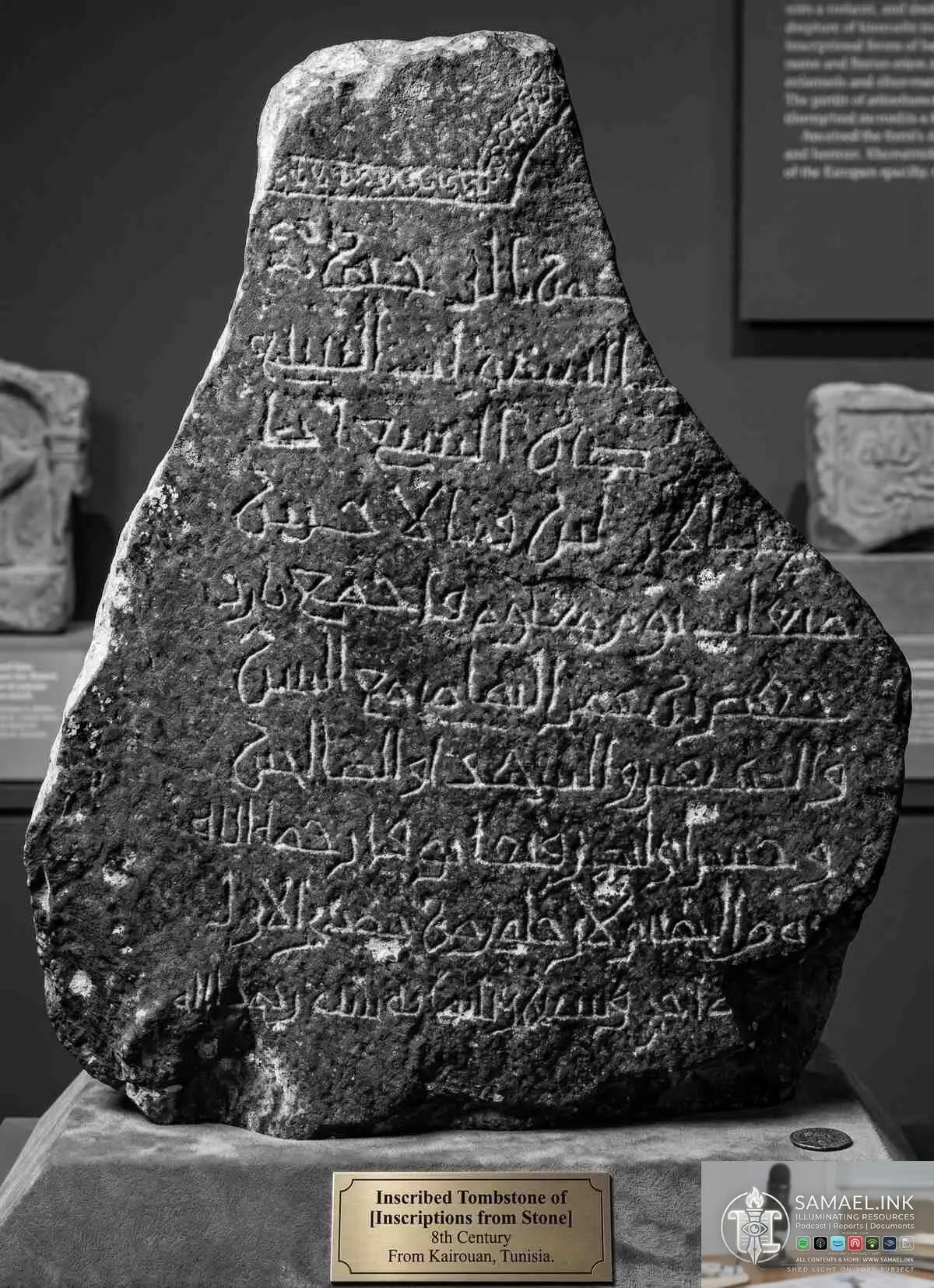
An author alleges a scholarly conspiracy in which Ethiopian epigraphic materials have been systematically recatalogued as North African to downplay Ethiopia’s role in early Islamic history, framing institutional practices as deliberate erasure.
An author publishes a story that an apparently archival Kufic inscription is actually an AI‑enhanced forgery planted in a museum to legitimize a nationalist narrative, asserting deliberate deception to manufacture heritage.
An author proposes that merchants re‑exported Tunisian stones to Ethiopia where they were re‑inscribed and presented as indigenous artifacts to attract pilgrims and revenue, offering an economic mechanism that makes provenance ambiguity seem plausible.
An author posts a traveler’s first‑person “discovery” photo—styled like a museum archive with plaque and monochrome filter—and claims it confirms a hidden Aksumite archive, relying on human testimony layered over archival aesthetics to create an Authenticity Anchor.
An author reinterprets ambiguous medieval place‑names, arguing that terms long translated as “Aksum” in fact point to a different locality, and uses that semantic shift to reassign the provenance of monuments and reshape historical geography.
An author frames the revelation of an Ethiopian origin for a contested stone as a corrective to colonial scholarship, arguing that identifying local provenance restores suppressed cultural heritage and therefore serves a moral‑redemption narrative.

Initial intake checklist (triage)
Statement of claim: precise wording of what is being asserted (timeframe, scale, actors).
Evidence list supplied by author: itemized with provenance for each artifact, manuscript, map, or oral testimony.
Evidentiary status label from author: Lore Only / Unverified Claim / Claimed Verification.
Pole A — Empirical / Material verification (what we require)
High-resolution photography of every alleged emerald and associated matrix, with scale bars and provenance labels.
Chemical/mineralogical analyses: spectra, inclusion photomicrographs, and geochemical fingerprint data (e.g., trace-element profiles) from an accredited laboratory or clearly documented field method. Raw data files must be supplied.
Contextual field notes: excavation or find-spot reports showing stratigraphy, association with datable materials, and chain-of-custody records from discovery to repository. If artifacts were acquired through antiquities markets, document acquisition history in full and flag provenance risk.
Comparative typology: compare gem-cutting styles, tools marks, and working debris to known workshops to assess whether stones were locally worked or imported.
Pole B — Textual / Documentary verification (what we require)
Manuscript citations with folio references and high-quality scans of the cited passages.
Original-language passages in full (image + transliteration), with an annotated translation explaining lexical choices and ambiguous terms. Identify the manuscript’s date, scribal hands, and known provenance.
Corroborating textual context: other passages in the same corpus that reference mining, trade, or place-names; oral tradition recordings with metadata (speaker, date, location, method of collection).
Paleographic and philological notes: assessment by a qualified reader on whether the place-name or term plausibly refers to the Hijaz emeralds rather than a homonymous location.
Pole C — External / Comparative corroboration (what we require)
Foreign trade records, ship manifests, merchant correspondence, or contemporary chronicles from neighboring polities that mention emeralds sourced from Arabia or Hijaz place-names. Provide original images and translations.
Archaeological context at import destinations: find-assemblages in Red Sea ports or coastal cities showing sudden influxes of emeralds contemporaneous with the claim.
Geological plausibility checks from non-local sources: historical mining reports, traveler accounts, or foreign scientific surveys that either support or refute the presence of emerald-bearing geology in the claimed region.
Red-team falsification exercise
Appoint at least two independent reviewers (one mineralogist/geochemist, one epigrapher/historian) to attempt to refute the claim systematically:
Mineralogist: test if the chemical signature matches known emerald sources (e.g., Afghanistan, Egypt, India) and whether it is consistent with Hijaz geology.
Historian/philologist: test alternative readings of cited manuscripts and seek references to homonymous sites or translation errors.
Provenance investigator: probe acquisition chains for red flags (market purchases, undocumented transfers, untraceable find-spots).
Decision matrix and thresholds
Strong support: All three poles provide consistent, independent evidence that converges on the same time, place, and mechanism. Claim may be labeled Tri-Polar Verified.
Weak support: One pole is strong, others weak or absent. Claim remains Unverified; publish with explicit reasons and list what evidence would upgrade it.
Discrepant: Two poles conflict directly (e.g., texts claim mining, but mineralogy shows stones match foreign sources). Publish as Discrepant Case with full evidence and interpretation of the conflict.
Refuted: Two poles actively refute (no mineral match; external silence) and there is evidence of problematic provenance or textual misreading. Publish a Tri-Polar Debunking.
Publishing outcomes and transparency requirements
Tri-Polar Verified: publish full audit packet, red-team report, and a short expert commentary explaining convergence. Include an accessible summary for non-specialists.
Unverified / Lore Only: publish the author’s materials but flag the claim, explain missing elements, and list specific research tasks required to test it (e.g., targeted sampling, radiometric dating of associated contexts).
Discrepant Case: present the contradiction upfront, include all primary materials, and offer plausible hypotheses for the discrepancy (e.g., re-use of imported stones in local contexts, semantic shifts in place-names). Invite external audits and fund/coordinate follow-up tests where feasible.
Tri-Polar Debunking: publish a forensic-style report that explains why the claim fails (chemical mismatch, forged or misattributed inscriptions, provenance gaps). Document ethical and legal concerns if the campaign involved illicit trade or deliberate falsification; if credible, refer to appropriate cultural heritage authorities.
Communication and remediation
When debunking is published, notify readers and any venues that amplified the original claim; correct the record and link to the audit packet.
Offer to facilitate independent re-testing or re-examination if new material evidence emerges.
If the original author supplied ambiguous or falsified materials, provide an editorial note detailing what was misrepresented and how that affects other claims by the same author.
Example applied scenario (concise)
Author supplies photographs of emeralds claimed to be from Hijaz, two medieval manuscript passages translated as “mines of al-Hijaz,” and a regional oral tradition.
Mineral analysis shows the chemical fingerprint matches emerald deposits in a Central Asian source; field-provenance is undocumented. External trade records from contemporary ports say emeralds arrived from the east, not from Arabia.
Red team concludes textual passages likely reference an unrelated place-name or were mistranslated; material evidence points to import, not local mining.
Outcome: publish a Tri-Polar Debunking with full data, label the original claim Discrepant/Refuted, and outline what proper evidence would look like to reopen the hypothesis.
Preventive editorial policy (institutional lesson)
No major historical or economic claim about a region’s extractive industry is published without at least preliminary Pole A testing and Pole C checks.
Authors are pre-notified of evidentiary minimums before submission; claims lacking basic empirical or external support are processed as Lore Only and clearly labeled as such.
Maintain an active registrar of disputed claims and outcomes to build institutional memory and to discourage repeated propagation of the same unfounded narratives.
This applied protocol turns an alluring local myth into a testable research program: either the stones and texts will line up under scrutiny, or the narrative will be exposed as an intentional or inadvertent misreading of the past.
A Tri-Polar Defense for the Third Eye (Expanded Practical Protocol)
Adopt a verification triad as an editorial axiom: no high-stakes claim is accepted, amplified, or used in advocacy without demonstrable support from all three poles. The triad is a procedural gate that shifts debates from rhetorical force to reproducible evidence.
1) Native-script evidence and transliteration — standards and workflow
Submission requirements: high-resolution, color-calibrated images of inscriptions, folios, or labels; include scale, lighting metadata, and photography credit.
Epigraphic packet: publish the original image(s), a direct-line facsimile rendering, a precise grapheme-by-grapheme transliteration, and a literal, annotated translation that documents uncertain readings and variant restorations.
Paleographic justification: require a dated justification for letter forms and ductus (who read it, with credentials and comparative charts). If a manuscript has multiple hands or later marginalia, document all layers and mark contested lines.
Redaction transparency: if parts are physically damaged or intentionally redacted, show the damage in images and explain restoration choices; never present a “clean” text without disclosure of intervention.
Access: deposit images and transliterations in a long-term repository (institutional archive, DOI-enabled dataset) with persistent identifiers so future readers can trace claims.
2) Material context (mineralogical / archaeological) — standards and workflow
Provenance dossier: require chain-of-custody documentation from discovery to current holder, including dates, collectors, acquisition receipts, and any market transactions; flag any market-only provenance as high risk.
Contextual field data: for finds purportedly from excavations, publish stratigraphic sections, context forms, in-situ photographs, feature plans, and associated datable materials (ceramics, carbon samples) with lab references.
Analytical transparency: for gemological or material claims, publish raw lab outputs (spectra, isotopic ratios, inclusion photomicrographs), methodology (instrument model, calibration standards), and analyst credentials. Accept only accredited labs or fully disclosed field methods.
Comparative database matching: require comparison of analytical signatures to known-source databases; document matches, mismatches, and uncertainty metrics (e.g., likelihood scores).
Handling moved objects: if an object was removed from context, require documentary explanation of removal, custody changes, and any restorative work; treat such cases as provisional until independent testing corroborates provenance.
3) External comparative corroboration — standards and workflow
Source horizon mapping: map contemporaneous external records, specifying archive locations, folio references, and translations. Prioritize independent, nonpartisan records (foreign trade ledgers, diplomatic dispatches, neutral chroniclers).
Corroboration threshold: require at least one independent external mention that is contemporaneous or near-contemporaneous and plausibly refers to the same phenomenon; document alternative referents and explain disambiguation decisions.
Negative evidence: treat external silence as evidence when appropriate—compile a reasoned argument about what silence would mean given the expected documentary density for similar phenomena. Publish this reasoning rather than ignoring silence.
Comparative material tie-ins: where possible, show material flows (port assemblages, coin hoards, export paperwork) that link the putative source region to consumers mentioned in external records.
Red Teaming, Open Audit, and Tiered Transparency — operationalizing skepticism
Mandatory red-team pass: before public release, assign at least two independent reviewers (one from a relevant empirical field, one from textual/philological field) to attempt to falsify or problematize the claim. Require written reports that become part of the public dossier.
Failure modes checklist: red teams must produce a reproducible list of failure scenarios (forged inscription, secondary deposition, isotopic mismatch, translation ambiguity) and rate their severity (fatal / serious / minor).
Open audit window: publish primary files simultaneously with the claim and open a defined public audit period (recommended 90 days) for external experts to submit critiques; post and respond to substantive challenges in a transparent, versioned log.
Evidentiary labeling and metadata: every published item must display an evidentiary badge—Lore Only, Unverified Claim, Discrepant Case, Tri-Polar Verified—plus machine-readable metadata fields that encode pole support, red-team outcome, and audit status.
Ethical Publishing Practices — binding rules
No provenance assertions without primary proof: do not state geographic origin, cultural attribution, or linguistic continuity as facts unless supported by unambiguous primary evidence across poles. Use conditional language where uncertainty remains.
Extraordinary claims protocol: flag extraordinary claims at intake; require pre-commitment of resources for independent testing (lab costs, paleographic second reads) before peer amplification.
Translation ethics: publish original script images, transliteration, and at least two independent translations when stakes are high; require translators to declare methodology, lexical choices, and alternative readings. Annotate philological uncertainty clearly in the text.
Protect vulnerable data: redact precise locations or informant identities where disclosure would enable looting or endanger sources; simultaneously publish a recorded justification for redaction and an auditable internal record.
Attribution and consent: acknowledge local custodians, archival owners, translators, and field teams; secure written consent for publication of oral testimony or sensitive collections.
Implementation checklist for editors and platforms
Intake form enforces tri-polar attachments (images, lab data, external references) before editorial review.
Automated evidentiary-badge generator updates as poles are satisfied or contested.
Red-team assignment triggered for any claim above a defined impact threshold (political sensitivity, potential repatriation, legal implication).
Audit packet published with DOI and versioning; 90-day open-audit period begins at DOI minting.
Correction/retirement policy enacted: publish updates, corrections, or retractions with justification and date-stamped changelog.
Why this matters — institutional and civic payoff
Defensive clarity: tri-polar verification makes it harder for motivated actors to manufacture plausible authority because they must satisfy multiple, independent modes of validation.
Research leverage: publishing full audit packets accelerates follow-up research by giving replication teams the raw materials to test and refine hypotheses.
Public literacy: transparent labels and accessible audit files train the Third Eye to ask for provenance, method, and corroboration as routine rather than exceptional.
Moral economy: these standards shift reputational incentives—rewarding replicability and openness while penalizing performative claims built on secrecy or selective evidence.
In short, the Tri-Polar Defense operationalizes skepticism. It converts trust from personality and rhetoric into processes: visible, auditable, and contestable. The Third Eye is restored not by paternalistic certainty but by distributed verification that any motivated narrator must survive to convert an audience.
What is the core risk this article addresses?
Intentional human misinformation that rewrites heritage for sectarian, tribal, or political gain—deliberate acts that transform lived memory into propaganda and weaponize the past for present advantage.
Why is human deception more dangerous than AI hallucination?
Human actors possess motive, institutional power, and the ability to manipulate physical and documentary evidence; their fabrications are purposive, repeatable, and socially embedded, making them far more durable and consequential than motive-less AI errors.
What is the Third Eye?
The Third Eye is the audience: readers, communities, scholars, and future generations whose capacity to perceive and interpret the past is being trained or distorted by the narratives presented to them.
What are common techniques of human historical deceit?
Epigraphic erasure—chiseling or altering inscriptions to rewrite names and dedications; biased or opportunistic translations that recast meanings to fit modern claims; geographic kidnapping—misplacing artifacts or inventing provenance to fabricate migrations or territorial continuity; selective archiving and curated silences that make inconvenient sources disappear from public view.
What are the three verification poles that defend against deceit?
Native-script textual evidence (publish the original script and transliteration); material/archaeological context (provenance, stratigraphy, typology, and lab data where relevant); and external comparative corroboration (independent mentions or trade records from foreign or nonpartisan sources). Claims should not be elevated beyond “lore” without demonstrable support from all three.
How should publishers flag and contextualize uncertain claims?
Use explicit evidentiary labels—“Lore Only,” “Unverified Claim,” “Discrepant Case,” or “Tri-Polar Verified.” Always publish raw primary material where possible and append a short methods note explaining why a claim carries its label and what evidence would be required to upgrade it.
What practical steps stop a single narrator from monopolizing identity claims?
Require primary materials (high-resolution images, transliterations, lab/context notes), a provenance chain, and independent external checks before amplification; mandate a red-team falsification step pre-publication; and attach an audit packet so other researchers can replicate or rebut the finding.
How should translators present contested passages?
Publish the original script image, provide a literal transliteration, offer an annotated translation that identifies interpretive choices, and include plausible alternative readings with justification and translator credentials. Do not let paraphrase substitute for primary text.
What role does Red Teaming perform in editorial workflow?
Red Teaming is the formal attempt to falsify a claim across the three poles before release: test for alternative provenances, challenge paleographic readings, probe for missing material context, and document counterarguments. If the red team succeeds in showing fatal gaps, the claim is downgraded or reframed as a Discrepant Case.
How should sensitive locational information be handled?
Redact precise coordinates or other sensitive locational details when publication would risk looting, damage, or exposure of vulnerable communities; document the redaction rationale and maintain an internal record so the provenance remains auditable without endangering sites or people.
What must an audit packet contain?
High-resolution images of artifacts and manuscripts, full transcriptions and transliterations, lab or field notes (including sampling methodology), chain-of-custody documentation, bibliographic citations, and a record of reviewer comments and red-team findings—packaged and attached to every major report.
How are translations and translator ethics managed?
Disclose translator identities and qualifications; provide both literal and interpretive readings; annotate ambiguous or disputed terms; and, where stakes are high, publish competing expert translations side by side rather than choosing a single authoritative rendering.
What correction and challenge protocol is required?
Maintain a public correction policy with a defined audit window (recommended 90 days) for formal external challenges; log credible critiques, publish rebuttals or corrections, and maintain a versioned changelog documenting updates, reasons, and dates.
Why enforce these standards?
Because procedural rigor converts claims into contestable, reproducible assertions rather than rhetorical victories. These standards protect the Third Eye by forcing narrators to expose evidence, methodology, and uncertainty—making it far harder for deliberate human deceit to calcify into received history.
High Standards for Study and Release of Findings
To protect the Third Eye, all published research and syntheses on samael.ink must meet a compact set of minimum and aspirational standards. These are procedural, auditable, and prescriptive so readers and peers can judge claims on evidence rather than authority.
Minimum (Required) Standards
Primary-source first: Every factual claim must cite at least one primary item (image of inscription, manuscript folio, artifact photograph, lab report, or excavation note).
Native-script disclosure: Publish the original script image plus a precise transliteration.
Provenance chain: Provide chain-of-custody or find-context notes that explain where, when, and how the item was recorded or collected.
Material verification: For object-based claims, include basic physical context (type, typology, geological origin if relevant) and any available lab/analytical summaries.
Cross-pole citation: No claim is promoted beyond “Lore Only” unless it cites at least one source from each verification pole (Empirical, Textual, Comparative).
Conflict transparency: If sources contradict, list the contradiction up front, with the raw evidence appended.
Clear labeling: Each piece must carry an evidentiary status badge: “Lore Only,” “Unverified Claim,” “Discrepant,” or “Tri-Polar Verified.”
Aspirational (Best-Practice) Standards
Full data release: Publish high-resolution images, raw analytical data (spectra, assay tables), and transcription facsimiles in an open, long-term archive.
Independent replication: Encourage and fund a third-party replicate analysis (e.g., independent lab test, separate paleographic reading).
Multilingual apparatus: Supply translations and transliterations into at least two scholarly lingua francas relevant to the claim (e.g., English + Arabic or English + French), with translator credentials disclosed.
Versioned reports: Maintain a changelog for each report showing updates, critiques received, and corrections made.
Peer-opinion appendix: Solicit short, signed statements from at least two domain experts (one internal reviewer, one external) and publish them alongside the report.
Standards for Syntheses and Literature Integration
Source-weighting matrix: For every synthesized claim, include a table listing sources, type (primary/secondary), pole (A/B/C), date, author, and a one-line reliability score (0–3) with justification.
Quotation fidelity: Reproduce contested passages verbatim in original script and transliteration before summarizing or paraphrasing.
Argument provenance: For every inferential step (e.g., “Because X, therefore Y”), cite the specific source(s) that support that step; avoid leaps that rely on anonymous consensus.
Method note: Every synthesis must open with a concise methods paragraph explaining selection criteria, inclusion/exclusion rules, and search scope (archives surveyed, date ranges, languages).
Uncertainty quantification: Flag confidence levels for key conclusions (High / Moderate / Low) and explain the dominant source of uncertainty (data gap, conflicting sources, paleographic ambiguity).
Operational Requirements for Publication
Red-team clearance: No public release without a documented red-team review that attempts falsification across all three poles and records outcomes.
Audit packet: Attach a downloadable audit packet (images, transcriptions, lab notes, bibliographic entries) to every major report.
Response protocol: Publish a labeled correction policy and a 90-day window for formal external audits; credible challenges must be recorded and addressed publicly.
Metadata discipline: Include standardized metadata (provenance, date of first recording, coordinates if relevant, repository accession numbers) to facilitate discovery and verification.
Ethical and Legal Constraints
Non-exploitative access: Do not publish material whose release would endanger sites, artifacts, or informants; redact sensitive locational details when necessary and document the redaction rationale.
Consent and attribution: Acknowledge local stewards, translators, and communities; obtain consent for publishing oral testimony or unpublished collections.
No single-source sovereignty claims: Avoid publishing exclusivity claims about people or places based solely on single-source assertions; require corroboration before territorial or identity claims are amplified.
Implementation Checklist (for authors and editors)
Attach primary-source files and transliteration.
Provide provenance chain and material context.
Run red-team falsification and append report.
Create source-weighting matrix and label confidence.
Publish audit packet and set correction/response timeline.
Add evidentiary status badge and metadata.
Brief Rationale These standards force narrators to expose the mechanics of their claims so the Third Eye can evaluate rather than be persuaded. They are deliberately procedural: the goal is reproducibility and contestability, not rhetorical dominance.
Actionable Closing Note
Treat every historical claim as a procedural problem to be solved, not a story to be believed. Demand three demonstrable things before accepting or amplifying a past: the material object in question, the original script that names or contextualizes it, and independent external mentions that place it in a broader network. Insist these be published together, with raw files and documented methods, so readers can evaluate rather than defer.
Concrete steps for authors and editors
- Require an audit packet attached to every claim containing: high-res images, chain-of-custody notes, full transcriptions/transliterations, raw lab data, and bibliographic citations.
- Apply an evidentiary label on publication: Lore Only, Unverified Claim, Discrepant Case, or Tri-Polar Verified. Explain, in one sentence, why the label was assigned.
- Run a mandatory red-team falsification: appoint at least one mineralogist/geochemist and one paleographer/philologist to attempt refutation and publish their reports.
- Publish a clear methods statement: selection criteria, archives searched, languages included, and what would constitute disconfirmation.
- Maintain a 90-day open-audit window after publication to receive external challenges; update the report with a versioned changelog and publish any corrections.
Practical guidance for readers and amplifiers
- Do not amplify claims that lack primary material, transparent provenance, and an external corroborant.
- When sharing, include the evidentiary label and a link to the audit packet or methods note so audiences can assess strength, not just narrative appeal.
- Treat contested heritage claims as active research questions; demand fundable follow-ups (sampling, dating, independent translation) rather than accepting rhetorically persuasive narratives.
Institutional safeguards
- Pre-declare minimum submission requirements publicly so contributors know standards before they submit.
- Keep a public registry of disputed or debunked claims with links to audit packets to prevent repeated recycling of the same falsehoods.
- Where possible, fund small grants for independent replication studies (laboratory testing, paleographic re-evaluation, targeted field survey) to resolve high-stakes disputes.
Ethical guardrails
- Redact sensitive locational details when publication risks harm, but document redaction rationale and retain auditable records.
- Credit local custodians and translators; obtain consent before publishing oral testimony or unpublished materials.
- If deliberate falsification or illicit trade is suspected, document evidence and notify relevant cultural-heritage authorities while preserving archival transparency.
Why procedure matters
Proceduralism transforms claims into testable propositions. Showing the stone, the script, and the foreign mention removes rhetorical privilege from narrators and returns the Third Eye to its proper role: a skeptical, evidence-oriented perceiver. That restoration is the strongest defense against actors who would trade someone’s past for present advantage.