
TL;DR:
The 1941 liberation of Abyssinia (Ge'ez: አቢሲኒያ, romanized: Abisinīyā) was secured through a psychological masterpiece of irregular warfare, where the Gideon Force (Amharic: ጌድዮን ኃይል, romanized: Gēdyon Hayl) neutralized a numerically superior Italian army by utilizing "Viper" tactics and deceptive bluffs to shatter enemy morale. This victory relied upon the indispensable ground pressure maintained by the Arbegnoch (አርበኞች, lit. 'Patriots')—most notably under the fierce leadership of Belay Zeleke (በላይ ዘለቀ)—whose relentless sieges rendered Italian garrisons untenable. By framing the campaign through the biblical motif of Gideon (Hebrew: גִּድְעוን, romanized: Gid'ōn), Wingate and Thesiger successfully synthesized British irregular strategy with the Emperor’s (ንጉሠ ነገሥት, niguśe negest) Solomonic legitimacy, transforming a desperate exile's return into a divinely sanctioned restoration.
The Inception: The “Pink Villa” in Khartoum
The campaign began in the stifling heat of Khartoum, Sudan, in late 1940. While the British military establishment, led by General William Platt, treated the exiled Haile Selassie with dismissive colonial coldness, Orde Wingate recognized the Emperor’s symbolic power.
The Recognition: Unlike his peers who saw a “forgotten” king, Wingate entered the Emperor’s presence, bowed deeply, and addressed him as “Your Imperial Majesty”.
The Strategic Bond: Wingate promised Selassie that they would not wait for massive armies but would reclaim the throne through small, elite bands of “brave men”.
The Dismissive Brits: Regular army officers viewed the Emperor as a liability and Wingate as a “security risk” or a “madman” for prioritizing guerrilla tactics over traditional supply lines.
Origins of the Gideon Force: Bible and Blade
Wingate, raised in a strict Plymouth Brethren household, viewed the world through a messianic lens. He named his unit Gideon Force as a direct reference to the biblical Judge Gideon.
The Biblical Blueprint: Just as Gideon defeated a massive Midianite army with only 300 men using trumpets and torches to create panic, Wingate intended to shatter the morale of 250,000 Italians with a handful of “irregulars”.
The Gideon-Gedeo Connection: Historically, some have noted the linguistic and symbolic resonance between the biblical Gideon and the Gedeo people of Southern Ethiopia. While the biblical name was Wingate’s primary driver, the fierce resistance of Southern Ethiopian groups like the Gedeo against Italian occupation provided a fertile ground for the “Gideon” mythos to take root locally.
The Force Composition: The unit comprised roughly 1,700 regular troops (Sudanese and Ethiopian) and 800 Arbegnoch (Patriot) guerrillas.
Thesiger’s Role: The Warrior-Liaison
Born in Addis Ababa, Thesiger was the perfect instrument for Wingate’s vision. He possessed a rare combination of aristocratic grit and deep linguistic knowledge of the Ethiopian highlands.
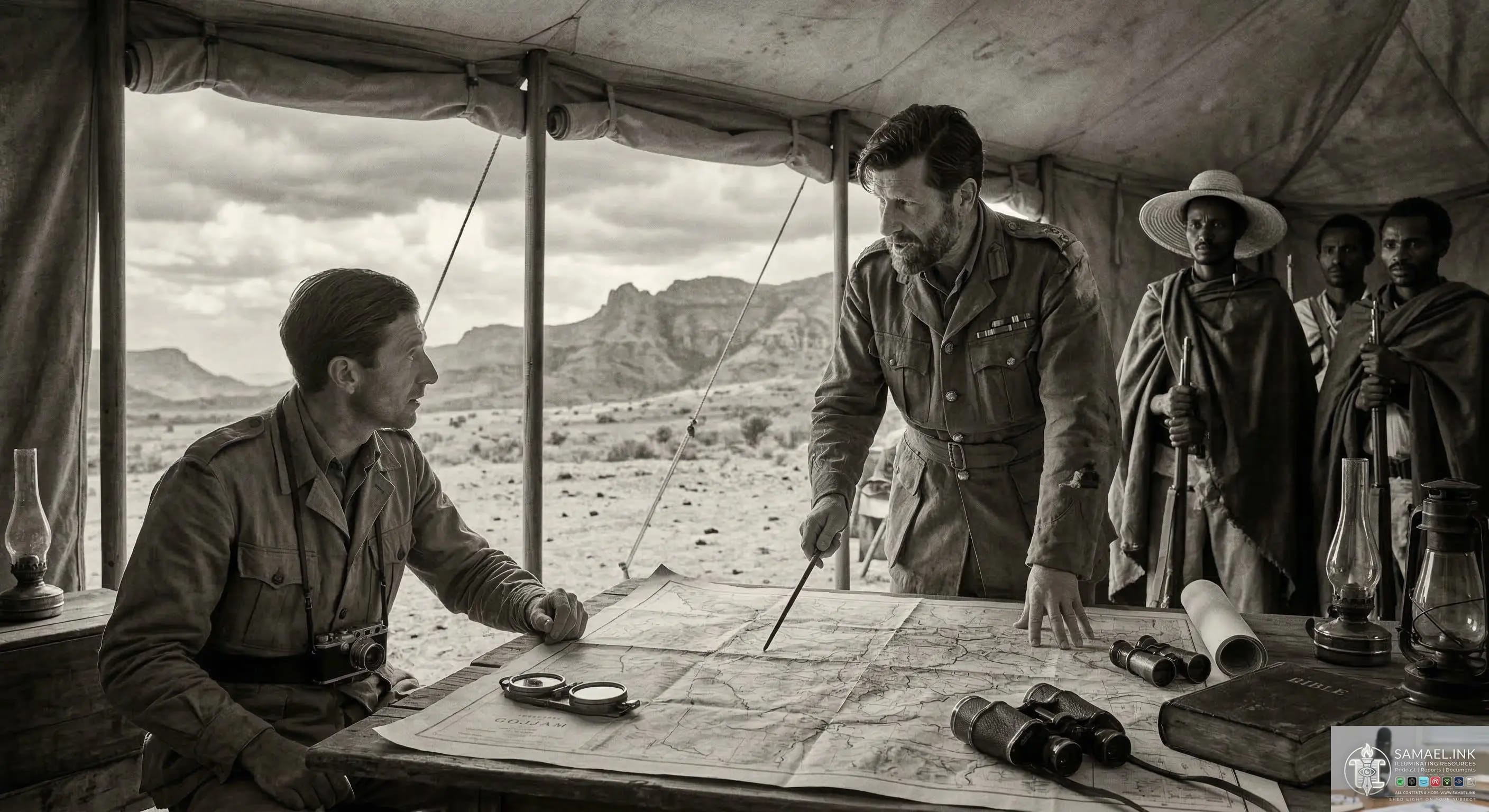
While Wilfred Thesiger was a prolific photographer, he rarely filmed moving images with a cinema camera. However, his still photography of the Ethiopian resistance is considered the most important visual record of that era.
Commanding the Patriots: Thesiger was given command of “Patriot” groups, operating as a bridge between British strategy and the fierce, independent warlords like Belay Zeleke.
The Agibar Bluff: Thesiger’s greatest exploit occurred at the Agibar Fort, where he used Wingate’s “psychological disruption” tactics. By lighting numerous fires and sounding bugles from multiple directions, he convinced 2,500 Italians they were surrounded, forcing a mass surrender to his tiny unit.
Guerrilla Tactics: Following Wingate’s “Viper” strategy, Thesiger’s units avoided occupying ground, instead striking supply lines and vanishing into the mountains.
Thesiger’s Visual Record
Thesiger used a Leica II camera. While he didn’t produce a “movie,” his sequence of photos from the 1941 campaign acts as a storyboard of the liberation:
The Blue Nile Crossing: Photos showing the grueling descent of the Gideon Force into the canyons.
The Patriot Camp: Candid shots of fighters cleaning their rifles and cleaning the Italian “Breda” machine guns they had captured.
The Surrender at Agibar: Images of the Italian officers surrendered to Thesiger, capturing the sheer scale of the “bluff.”
The Meeting at the Blue Nile
Thesiger’s primary encounter with Zeleke occurred as Gideon Force moved toward the Blue Nile gorges. Wingate sent Thesiger ahead as a scout and political liaison to “manage” the various Patriot leaders.
The Power Dynamic: When they met, Zeleke did not act like a subordinate. He met Thesiger as an equal—or even a superior—on his own land. Zeleke was surrounded by thousands of armed men, while Thesiger had only a small escort.
The “White Man’s War” Suspicion: Zeleke was initially suspicious. He, like many Patriots, feared the British were simply replacing the Italians as colonial masters. Thesiger had to use his deep knowledge of Ethiopian culture to convince Zeleke that the British were only there to facilitate the Emperor’s return.
The Conflict over “The Bluff”
A recurring point of tension between the two (and between Zeleke and Wingate) was tactical control.
Thesiger’s Approach: Thesiger favored the “Wingate method”—using small-scale psychological warfare and bluffs to get Italians to surrender without destroying infrastructure.
Zeleke’s Approach: Zeleke wanted blood. He wanted to storm the forts, seize the Italian weapons, and exact revenge for the atrocities like Debre Libanos.
The Encounter: Records suggest a heated exchange where Zeleke expressed frustration that the British were “stopping” the Ethiopians from finishing off the Italians. Thesiger had to balance Zeleke’s ferocity with the British need for an orderly Italian surrender.
The Siege of Debra Marcos
The most significant “shared” encounter was during the operations around Debra Marcos, the capital of Gojjam.
Zeleke’s forces had the city surrounded and were starving the Italian garrison.
Thesiger and the Gideon Force arrived to coordinate the final push. Thesiger witnessed Zeleke’s tactical brilliance in the mountains—how he used the jagged terrain to make his few thousand men seem like ten thousand.
The Outcome: The Italians eventually fled toward the Blue Nile. While Thesiger and Wingate took the “official” credit in British reports, Thesiger privately acknowledged in his later writings that without Zeleke’s relentless pressure, the Italians never would have broken.
The Final Break: The Medal Ceremony
The last notable time they were in the same vicinity was during the liberation celebrations.
Haile Selassie attempted to honor Zeleke, but the encounter was cold. Zeleke felt insulted by being offered a lower-tier title (Dejazmach instead of Ras) compared to “palace favorites” who hadn’t fought as hard.
Thesiger’s Observation: Thesiger watched these political collapses from the sidelines. He noted that Zeleke looked like a “caged lion” in the city. To Thesiger, Zeleke was a man of the mountains, and seeing him tangled in the Emperor’s new bureaucracy was a sign that the “heroic age” of Abyssinia was ending.
Photos of Belay Zeleke
Finding an “authenticated” photograph of Belay Zeleke is notoriously difficult because he was a guerrilla fighter who avoided the Italian-occupied cities where cameras were common.
The Iconic Portrait: Most images of Belay Zeleke seen in documentaries or on Ethiopian posters are based on a few rare photographs taken after the liberation (1941–1943). He is typically seen with a distinctive thick afro (Gofere), a symbol of the Arbegnoch (Patriots) who swore not to cut their hair until the enemy was expelled.
The Pitt Rivers Collection: In the Thesiger archive at Oxford, there are photos of “Patriot Leaders” from the Gojjam region. While many are labeled with titles like Dejazmach, specific photos of Zeleke himself are often debated by historians.
While Wilfred Thesiger and Belay Zeleke were fighting the same enemy in the same mountainous province (Gojjam), their encounters were defined by a tense, professional distance rather than a warm friendship.
They met during the “March of the Gideon Force” in early 1941, and their interactions highlight the friction between British military objectives and Ethiopian nationalist pride.
The Liberation: A Full Circle
The campaign culminated on May 5, 1941, exactly five years after the Italians had seized Addis Ababa.
The Entry: Haile Selassie rode into his capital accompanied by Wingate on a white horse and Thesiger at his side.
The Psychological Victory: The presence of the “Lion of Judah” on the soil caused mass desertions among the Italian Askari (local colonial troops), who refused to fight their own king.
Post-War Friction: The bond fractured once the war ended. Thesiger, a man of the “heroic past,” was horrified by the Emperor’s modernization of Abyssinia, famously stating he could not help the Emperor “keep the world I loved from vanishing”.