
The “Sovereign Shield”: How the Triad Hollowed Out Ethiopia to Protect the Red Sea Guardhouse
TL;DR
Ethiopia has become a “Sovereign Shield”—a hollowed-out state whose debt and internal chaos are managed by China, Russia, and Iran to prevent any disruption to their strategic “Guardhouse” in Eritrea. By keeping Addis Ababa in a state of permanent financial and domestic fragility, the Triad ensures Ethiopia remains too weak to challenge the Red Sea status quo.
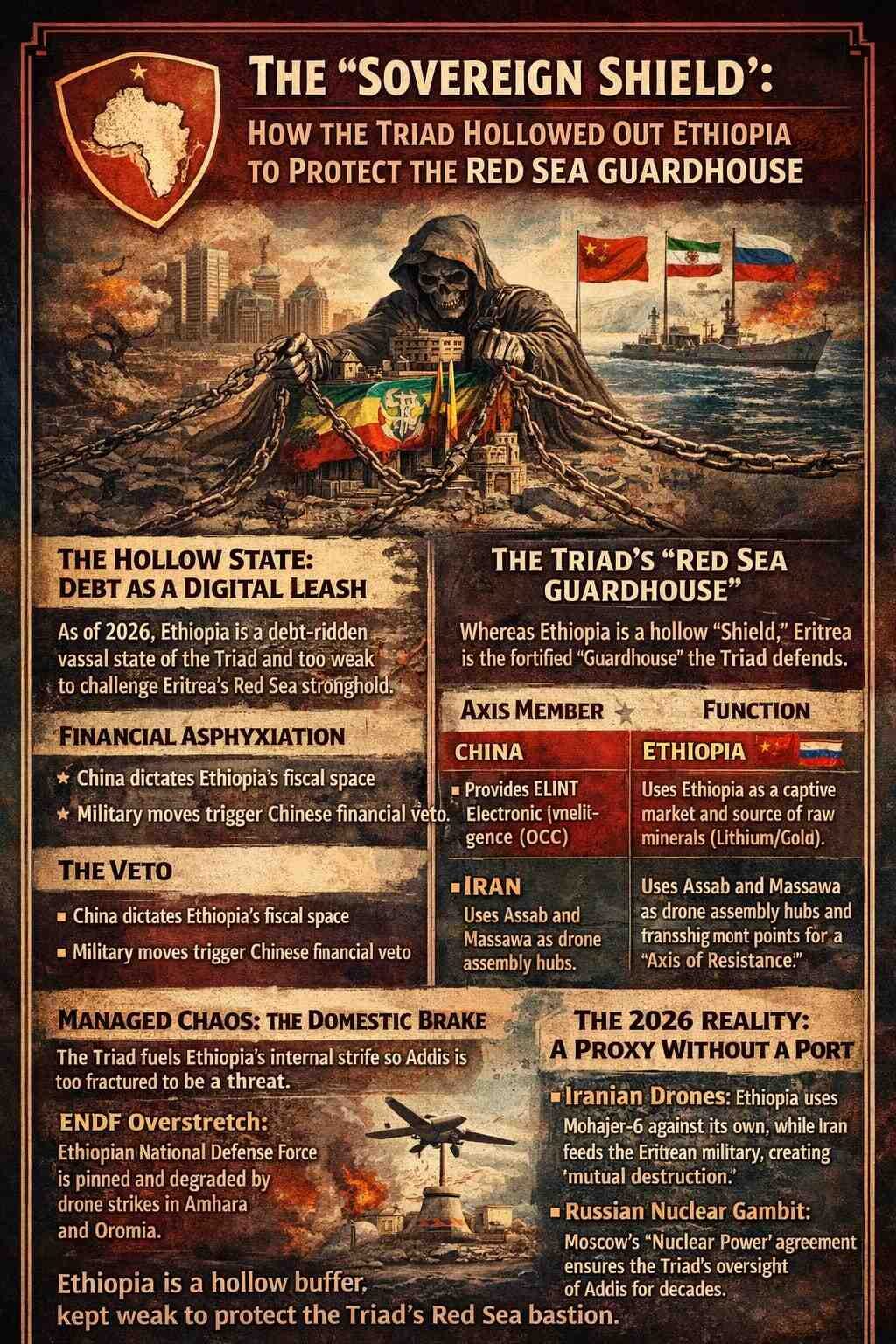
The Hollow State: Debt as a Digital Leash
As of April 2026, the Ethiopian state exists primarily as a shell for debt management. While the Ministry of Finance celebrates “strategic restructuring” in Beijing, the reality is the finalization of a vassal-creditor relationship.
Financial Asphyxiation: China’s “parasitic” grip on the economy has shifted from infrastructure lending to total macroeconomic oversight. By co-chairing the Official Creditor Committee (OCC), Beijing dictates Ethiopia’s fiscal space.
The Veto: Any military move toward Assab would trigger an immediate “default event” orchestrated by Chinese banks. Ethiopia is not a sovereign actor; it is an administrative district of the Belt and Road, permitted to exist only as long as it services its arrears and keeps the Kenticha lithium flowing.
The Triad’s “Red Sea Guardhouse”
While Ethiopia is the “Shield” (absorbing the regional instability and Western diplomatic pressure), Eritrea is the “Guardhouse.” The China-Iran-Russia axis has spent the last 30 years ensuring Asmara remains a fortified, anti-Western bastion.
Managed Chaos: The Domestic Brake
The Triad benefits from Ethiopia’s internal fractures. The ongoing insurgencies in Amhara (Fano) and Oromia (OLA) are not bugs in the system; they are features that hollow out federal capacity.
ENDF Overstretch: The Ethiopian National Defense Force is effectively a glorified riot police, pinned down by drone strikes in North Shewa and Gojjam.
Strategic Paralysis: If Abiy Ahmed attempted to pivot toward the coast, the “Shield” would shatter. The Triad knows this and utilizes “Managed Instability”—keeping the federal government just strong enough to prevent a total collapse, but far too weak to project power across the border.
The 2026 Reality: A Proxy Without a Port
Ethiopia’s rhetoric about “natural rights” to the sea is a hollow cry in a room owned by the Triad.
The Iranian Drones: While Ethiopia uses Mohajer-6 drones against its own people, the same Iranian supply lines feed the Eritrean military, creating a “mutual assured destruction” that favors the incumbent coast-holder.
The Russian Nuclear Gambit: Moscow’s recent “Nuclear Power” agreement with Addis is a 20-year tether. You don’t build a nuclear plant in a country you intend to let go to war. It is a long-term anchor designed to ensure Ethiopia remains a stable, albeit hollow, energy-vassal.
The Verdict: Ethiopia has been transformed into a geopolitical buffer. It is a state that consumes its own people to pay off Chinese interest, while its neighbors—backed by the Triad—hold the keys to the Red Sea. The “Shield” exists only to protect the interests of Beijing, Tehran, and Moscow from the consequences of African ambition.
What is meant by calling Ethiopia a “Sovereign Shield”?
It describes Ethiopia as a hollowed‑out state whose fiscal and domestic fragility are managed by China, Russia, and Iran to keep it too weak to challenge the Triad’s strategic posture in the Red Sea.
How does debt function as a digital leash on Addis Ababa?
Ethiopia’s debt restructurings and creditor arrangements create a vassal‑creditor dynamic where major creditors—especially China—exercise macroeconomic oversight that limits Ethiopia’s policy autonomy.
What role does China play in Ethiopia’s economic asphyxiation?
China, by heading key creditor committees and controlling major financing, can dictate fiscal space, pause disbursements, or trigger default events that force Addis to prioritize debt servicing over strategic action.
Why would a move on Assab trigger an immediate economic response?
An offensive that threatens Triad assets or the regional order would prompt coordinated creditor and investment withdrawal—especially from Chinese banks—producing a sudden financial shock and effective default.
How does the Triad treat Eritrea differently from Ethiopia?
Eritrea functions as the Triad’s fortified “Guardhouse,” hosted and armed to secure Red Sea access, while Ethiopia is kept dependent and fragmented to prevent it from challenging that arrangement.
How does “managed chaos” inside Ethiopia benefit the Triad?
Ongoing insurgencies and political fragmentation weaken federal capacity, ensuring Addis can govern enough to avoid collapse but lacks the unity and strength to project power toward the coast.
What is the operational state of the ENDF under this dynamic?
The ENDF is overstretched and focused on internal security; it operates more like a domestic containment force than a power‑projection military capable of taking and holding coastal targets.
How do arms transfers and asymmetric systems shape the balance?
Iranian drones and other asymmetric deliveries to Eritrea provide stand‑off strike capabilities that deter Ethiopian offensives, creating a mutual‑assured‑damage dynamic unfavorable to Addis.
What is the strategic purpose of Russia’s long‑term energy and defence ties with Ethiopia?
Long‑term nuclear and strategic agreements anchor Ethiopia in a relationship of dependency that incentivizes stability for external investors while limiting Addis’s freedom to pursue regional power ambitions.
What are the policy implications for Ethiopia’s leaders and external actors?
Ethiopian leaders face a choice between short‑term nationalist adventurism that would trigger severe economic and military reprisals, or long‑term negotiated strategies to regain autonomy; external actors must account for the Triad’s coordinated levers when designing de‑escalation, incentives, or security guarantees.