
TL;DR:
The Southern Generational Matrix reframes political and cultural claims in Ethiopia’s Rift Valley by showing that rotating-age institutions like Gadaa are part of a wider, older proto‑Cushitic family—Gedeo Baalle, Sidama Luwa, Konso Xelta—rooted in sedentary, agrarian societies rather than a single ethnic origin. This matters because contemporary narratives that single out the Oromo Gadaa as the exclusive emblem of indigenous democracy obscure the shared foundations, historical exchanges, and instances of appropriation that followed migration and political expansion from the 13th–17th centuries onward. Recovering the distinct pathways—structural design, ritual authority, and moral codes—of these systems reveals how claims of cultural ownership map onto power, memory, and modern geopolitics.
Taking the longue durée perspective shifts the discussion from a binary of “original” versus “borrowed” to a layered history of adaptation, convergence, and contestation: (1) South‑central generational systems developed in multiple sedentary polities with age‑graded rotational governance; (2) expansionary movements over centuries superimposed new identities and labels onto preexisting institutions; and (3) twentieth‑century political ruptures and wartime choices further reshaped which narratives gained prominence in state and international fora. This reorientation foregrounds the original custodians—Gedeo, Sidama, Konso—and highlights how memory, migration, and moral frameworks (halaale, seera) interact when modern political actors claim lineage or monopoly over cultural forms.
Introduction
In the southern Ethiopian Rift Valley, governance, law, ecology, and cosmology are embedded together in elaborate generational systems whose logic extends well beyond isolated ethnic claims. Labeling one such expression as the definitive “origin” flattens centuries of regional variation, social fusion, and political reworking. A comparative reading of the Gedeo Baalle, Sidama Luwa, Konso Xelta, and Oromo Gadaa uncovers a proto‑Cushitic substrate of institutions that organized life through age classes, rotational power, and ritualized legitimacy.
Christopher Hallpike and the Sedentary Logic of the Xelta
The research of Christopher Hallpike provides definitive evidence that these systems are not Oromo imports but indigenous developments of sedentary agriculturalists. In his seminal work, The Konso of Ethiopia, Hallpike argued that the Xelta system was “functionally unnecessary” for the survival of Konso society or its mode of production, suggesting it was a pure expression of a “general East Cushitic world-view” inherited from an ancient substrate. Unlike the Oromo Gadaa, which is often tied to pastoral military mobilization, the Konso system was the creation of a sedentary people living in fortified, walled cities, utilizing unique numerical foundations across different districts to track time and celestial cycles.
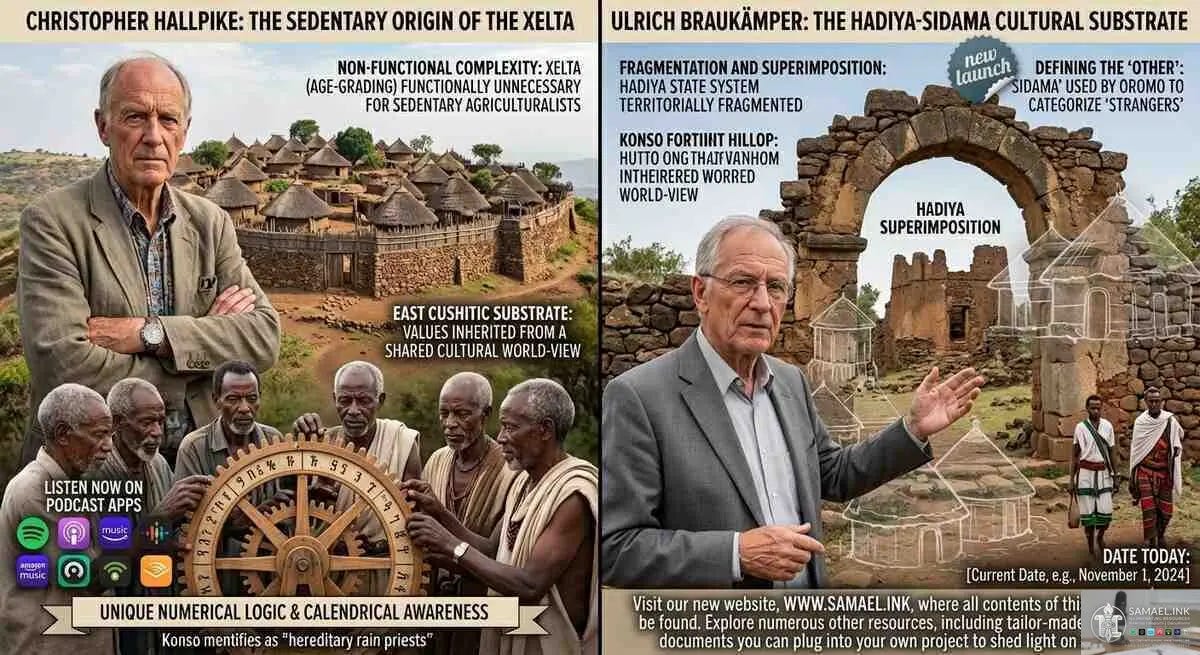
Ulrich Braukämper: The Hadiya-Sidama Cultural Substrate
Ulrich Braukämper’s extensive research, particularly in A History of the Hadiyya in Southern Ethiopia (1980), documented a powerful “Hadiya-Sidama” cultural and political layer that existed long before the 16th-century Oromo migrations.
Structural commonalities
Rotational authority: Power transfers occur through fixed age-graded classes that cycle predictably across decades, preventing hereditary monopolies and channeling leadership through communal rites of passage.
Total social architecture: These systems govern lifecycle stages, judicial functions, ecological stewardship, and spiritual roles as integrated elements rather than discrete domains.
Sedentary foundations: Evidence from field studies and ethnography situates many of these systems in settled, agricultural societies with fortified settlements and calendrical practices distinct from pastoral war-mobilizing institutions.
The case studies deepen the comparative picture of southern generational systems by showing how local history, ritual practice, territorial organization, and moral cosmologies produced distinctive institutional solutions. The Gedeo Baalle models long-cycle social cohesion with decentralized territorial coordination; the Sidama Luwa fuses age‑grades to a theologically‑anchored chieftaincy accountable to moral law; the Konso Xelta encodes civic time, ritual sequencing, and communal memory within a fortified, agricultural urbanism. Together they demonstrate that rotational governance took multiple sedentary forms, each adapted to local ecology, demography, and memory politics.
Expanded Case Studies
Gedeo Baalle
Institutional rhythm and lifecycle architecture
The Baalle’s nine grades, each eight years in length, scaffold an entire human lifecycle: initiation, training, guardianship, executive authority, advisory elderhood, and spiritual retirement. Because a full cycle spans roughly 72 years, the system organizes overlapping cohorts whose responsibilities interlock across generations, creating continuity without hereditary succession.
Territorial politics and federated ritual order
Historically the Gedeo were arrayed into three semi‑autonomous territorial units—Suubbo, Dhiibata, and Reqata—each with its own local councils, ritual centers, and dispute‑settling mechanisms. Periodic interregional assemblies synchronized calendrical rites and adjudications, so that legal norms and ritual calendars remained coherent across the landscape while local leaders retained day‑to‑day autonomy. This federated design reduced the risk that any single lineage or village could monopolize regional authority.
Conflict avoidance and social engineering
Institutional features deliberately limited concentrated power: grade transitions were collective and ceremonial, not familial inheritances; judicial authority was distributed among current grades and elder councils; marriage and land rights were regulated to prevent accumulation by nascent elites. Oral histories emphasize negotiated concessions—sometimes granting newcomers specific grades—to defuse potential insurgencies and incorporate migrant lineages into a shared moral order.
Ritual, memory, and ecological stewardship
Each grade carried named ritual duties linked to seasonal cycles, agricultural tasks, and local sacred sites. Through ritualized practices—oaths, communal labor obligations, and seasonal festivals—the Baalle reinforced obligations to land care and reciprocal support networks, binding political legitimacy to ecological stewardship and intergenerational memory.
Sidama Luwa
Structural outline and religious embedding
The Luwa’s five eight‑year classes concentrate leadership into sharper successions than the Baalle, with each transfer framed as both political succession and a ritual sacralization. The apex of Luwa governance is a divinely legitimated chieftaincy: leaders are not merely elected managers but ritual incumbents whose authority is instituted and renewed through sacred performance.
Halaale as accountability and moral technology
Halaale—translated loosely as moral truth or ritual purity—functions as the constitutive standard by which Luwa leaders are evaluated. Compliance with halaale is publicly demonstrated through rites, judgments, and omen practices; violations invite ritual sanction, loss of ritual status, and in severe cases, deposition. This makes political accountability not merely procedural but existential: leadership without halaale is illegitimate.
Judicial practice and community arbitration
The Luwa integrates adjudication into its moral cosmology. Disputes are settled through mixed forums where age‑grade peers, ritual specialists, and the incumbent chieftain participate; verdicts are rendered with ritual oaths and reparative ceremonies that renew communal bonds. Because spiritual legitimacy is central, punishment often emphasizes restoration and ritual cleansing alongside material redress.
Gender, ritual offices, and social reproduction
While male age‑grades dominate executive sequences, Luwa ritual life preserves important roles for female ritual specialists and women’s societies that regulate marriage laws, fertility rites, and lineage memory. These parallel institutions contribute to social reproduction and provide informal vetoes on abuse of power.
Konso Xelta
Urbanized sedimentary logic and timekeeping
The Konso Xelta evolved within walled towns and terraced agricultural landscapes. Without reliance on migratory pastoralism, the Xelta’s functions centered on calendrical regulation, communal labor coordination (notably terrace maintenance and irrigation), and the organization of civic festivals tied to planting and harvest cycles. Numerical systems—local counting schemes and district‑based calendrical markers—were used to align collective labor and ritual time across neighborhoods.
Fortification, leadership diffusion, and civic architecture
Konso settlements are notable for defensive walls and densely organized neighborhood clusters; the Xelta’s offices reflect this spatial logic. Leadership roles often corresponded to ward or neighborhood responsibilities (road maintenance, granary oversight, ritual site guardianship), creating a horizontal network of accountable offices rather than a single dominating center. Ceremonial plazas and public markers served as mnemonic devices encoding legal precedents and ancestral histories.
Knowledge transmission and material culture
The Xelta transmitted its temporal and ritual knowledge through apprenticeship, public inscription (stone stelae, carved markers), and embodied practice (laborsongs, terrace rites). These material forms anchored a civic memory that persisted even when external labels changed; the physical landscape acted as an archive for institutional continuity.
Ecology, reciprocity, and famine management
In a precarious highland ecology, the Xelta incorporated social mechanisms for famine mitigation—obligatory grain sharing, coordinated seed reserves, and ritualized redistribution—that distributed risk across kinship and neighborhood networks. Authority thus derived not only from ritual status but from demonstrable capacity to mobilize communal care in times of scarcity.
Cross‑case reflections
Divergent adaptive logics
Although all three systems share rotational age principles, their internal logics diverge according to settlement pattern, ecological pressures, and historical contact. The Baalle emphasizes long‑cycle federated continuity; the Luwa concentrates spiritual accountability into sharper successions; the Xelta specializes in civic timekeeping and labor coordination in an urbanized agrarian setting.
Ritual as political technology
Across cases, ritual functions as the mechanism that converts social practice into political legitimacy—binding leaders to community obligations and embedding adjudication, resource sharing, and ecological care within ceremonial forms.
Preservation and invisibilization
Material culture, oral archives, and territorial institutions often outlast external labels. Yet processes of renaming, demographic expansion, and state‑level politics can render custodial roles invisible; recognizing the distinct logics of each system is essential to restoring historical credit and shaping fair cultural policy.
Conclusion
Tracing the Southern Generational Matrix reframes cultural appropriation debates into inquiries about historical processes: who named what, when, and under what pressure? It emphasizes that rotational-age governance is not the proprietary invention of a single lineage but a distributed, adaptable institutional form shaped by sedentary cosmologies, migration dynamics, and political contestation. An accurate historical perspective honors the multiplicity of custodians and clarifies the real stakes of modern cultural geopolitics.
Contact, renaming, and memory in the southern Rift Valley produced layered institutions whose present‑day labels often mask long histories of negotiation, concession, and hybridization; the politics of the twentieth century and international recognition amplified some narratives while obscuring others. Understanding processes of superimposition, the Akaku–Dalatta settlements, and oral memory clarifies why claims of exclusive cultural ownership are historically tenuous and politically consequential. Restoring epistemic justice requires reframing Gadaa and related systems as a family of practices, centering custodial lineages, and designing policy that recognizes plural origins and reparative representation.
Processes of contact and re‑labeling
Superimposition and renaming
Mechanisms of reframing: Incoming groups moving from different ecological zones often encountered established sedentary institutions and reinterpreted their functions through their own cosmologies and political vocabularies. Rather than wholesale replacement, this frequently resulted in semantic overlays—new names, new origin myths, and selective emphasis of certain practices that resonated with migrant political projects.
Exonyms and delegitimization: Names applied by outsiders (exonyms) could carry evaluative force—categorizing groups as “strangers,” “enemies,” or “others”—and thereby reconfigure internal prestige hierarchies. The historical usage of “Sidama” as an outsider category illustrates how a labeling act can become an instrument of boundary‑making that later accrues administrative and historiographical weight.
Institutional palimpsest: Material ritual sites, calendrical practices, and local offices often remained while their public framings shifted; what appears as a new institution in written records can be the surface inscription over a deeper, older practice.
Akaku vs. Dalatta: negotiated incorporation
Modes of incorporation: Incoming Dalatta were not always violently imposed; more commonly, social peace was achieved by negotiated entry—allocation of specific grades, marriage compacts, land-use agreements, and ritual obligations that integrated newcomers while preserving core responsibilities for Akaku lineages.
Strategic concession: Akaku elites could cede temporary or partial prerogatives to Dalatta to avoid fragmentation, using institutional design (rotational grades, federated councils) to ensure newcomers could be absorbed without creating hereditary dominance.
Hybrid institutional forms: Over generations, these negotiated settlements produced hybrid practices—ritual sequences, calendrical adjustments, and dispute procedures that combined elements from both Akaku and Dalatta repertoires—making later attempts to “purify” origin claims analytically unstable.
Oral memory, mnemonic politics, and selective forgetting
Persistence of custodial narratives: Even when communities adopt new labels or integrate newcomers, oral lineages frequently conserve accounts of prior sovereignty, sacred sites, and origin myths that attest to older custodial claims.
Mnemonic competition: Ritual performances, genealogies, and sacred geographies become arenas where different groups assert precedence; control over commemorative rituals or shrines can translate into contemporary legitimacy claims.
Politics of forgetting: State formation, missionary activity, migration, and economic disruption can accelerate selective forgetting—loss of ritual knowledge or dislocation of custodial families—thus making substantive custodial rights harder to prove in modern bureaucratic or legal contexts.
Twentieth‑century political consequences
Divergent wartime allegiances and contested patriotism
Fragmented loyalties: During crises (notably the 1935–41 Italian invasion), different southern actors made divergent strategic choices—some fought with imperial forces, others negotiated with occupiers or pursued separatist aims—creating historical records that subsequent political movements invoke to claim moral authority or charge rivals with betrayal.
Memory weaponized: Histories of collaboration or sacrifice are mobilized in contemporary identity politics to legitimize territorial claims, access to resources, or moral superiority. Accusations of historical betrayal can be used to delegitimize custodial claims or to justify exclusionary policies.
Repercussive inequality: Regions that suffered demographic loss, forced displacement, or political retribution during wartime often experienced long‑term marginalization, eroding their capacity to assert custodial rights in later cultural or legal arenas.
UNESCO, heritage branding, and asymmetric recognition
Freezing narratives: International recognition—tied to a specific name, narrative, and set of performances—tends to freeze one version of a living practice into a global artifact. This increases visibility and resources for the recognized group while sidelining structurally similar but differently labeled traditions.
Resource and symbolic allocation: Recognition influences who receives institutional support, tourism revenue, and educational prominence; when one narrative is valorized internationally, it reshapes domestic prestige and bargaining power among local custodians.
Remedying asymmetry: Contesting these outcomes requires rigorous comparative documentation and advocacy that highlights common structures and insists on plural recognition rather than exclusive branding.
Implications for cultural ownership and scholarly framing
Gadaa as a family member, not an exclusive patent.
Comparative taxonomy: Treat Gadaa, Baalle, Luwa, and Xelta as related expressions within a regional family—sharing principles (rotational authority, age grades, ritualized legitimacy) while differing in local inflections. This undermines exclusivist claims while preserving legitimate cultural particularities.
Law and policy: Legal regimes and cultural heritage policies should reflect shared institutional forms by allocating recognition and protection to related traditions, not just to the most visible labeled example.
Epistemic justice and methodological corrections
Source plurality: Scholarship must combine oral histories, material culture, and archival records with comparative ethnography to recover buried custodial claims; privileging a single textual or political narrative reproduces epistemic injustice.
Naming humility: Historians and policymakers should avoid reifying exonyms or contemporary political labels as proxies for origin; instead, emphasize processes—contact, incorporation, and adaptation—that produce present forms.
Reparative historiography: Restorative practices include documenting marginalized custodial claims, supporting community‑led archives, and funding local ritual revival projects tied to custodial lineages.
Contemporary policy and identity design
Inclusive recognition schemes: Cultural policy should permit multiple coexisting inscriptions for related practices, create joint heritage listings, and support federated custodial councils that reflect historical federations like Suubbo–Dhiibata–Reqata models.
Educational curricula: School histories and museum exhibits must teach layered origins and the mechanics of superimposition to counter single‑origin mythologies.
Political mediation: Where heritage disputes overlap with land, resource rights, or political representation, mediation frameworks informed by historical institutional insights (rotational, federated, negotiated incorporation) can offer culturally resonant solutions.
What is the core claim of the Southern Generational Matrix?
The central argument holds that rotational, age‑graded governance across the Rift Valley represents a family of related institutional designs that emerged within sedentary proto‑Cushitic societies. Rather than a singular ethnic invention, these systems are variants on shared principles—interlocking age classes, ritualized transfers of authority, communal adjudication, and embedded ecological obligations—shaped by local ecologies, settlement forms, and historical contacts. Viewing them as a family highlights multi‑centred invention, long‑term diffusion, and repeated processes of adaptation rather than a single point of origin or exclusive cultural patent.
How do Baalle, Luwa, Xelta, and Gadaa relate structurally?
Structurally they converge on a set of organizing principles: rotational succession by age cohorts, role differentiation across lifecycle stages, collective adjudication, and rituals that confer legitimacy. Differences arise in cadence (nine eight‑year Baalle grades vs. five Luwa classes), spatial scale (federated Gedeo territories vs. neighborhood Xelta wards), and ritual emphasis (divine sacralization in Luwa vs. civic timekeeping in Konso). These variants function like architectural plans adapted to differing social soils—each preserves core mechanics while tailoring symbolic cosmologies, dispute procedures, and resource regimes to local needs.
Why does sedentary origin matter for interpretation?
Sedentary origins foreground agricultural calendars, fixed sacred sites, and collective labor regimes as primary drivers of institutional form. In a settled landscape, governance must coordinate planting, terrace maintenance, water management, and communal grain reserves—tasks that favor precise calendrical timekeeping, neighborhood coordination, and durable mnemonic markers. In contrast, pastoral mobilization privileges rapid military mobilities and mobile resource claims. Recognizing sedentary roots reorients interpretation away from martial or purely military explanations and toward civic, ecological, and calendrical logics embedded in everyday reproduction.
What role did migration and labeling play in the region’s identities?
Migration introduced new social languages and political grammars that often overlaid existing institutions. Incoming groups frequently adopted local offices and practices while renaming them, producing exonyms and new origin myths that reframed prestige and territorial belonging. Labels such as “Sidama” functioned historically as outsider categories that could obscure older self‑designations. Over time, administrative, religious, and historiographical practices canonized some labels, altering how communities and states represented lineage, sovereignty, and belonging.
How did twentieth‑century conflicts shape narratives of ownership?
Wartime choices—collaboration, resistance, or neutrality—became durable elements of collective memory used to justify later political claims. Groups that positioned themselves as patriotic defenders could translate that memory into symbolic capital for cultural recognition, land claims, or political leverage. Conversely, communities associated with collaboration or strategic withdrawal faced stigmatization that weakened their heritage claims. Postwar state formation and later international recognition further amplified selective narratives, privileging some custodians while marginalizing quieter bearers of institutional continuity.
What is the Akaku–Dalatta distinction?
Akaku denotes autochthonous custodial lineages—the original keepers of ritual sites, adjudicatory protocols, and land stewardship—whose authority rests on ancestral association with sacred places and long‑standing institutional roles. Dalatta refers to newcomers who enter through migration, refuge, or conquest and become integrated via negotiated mechanisms (grade allocations, marriage ties, ritual inclusion). The distinction is functional and relational rather than strictly ethnic: over generations, Dalatta may acquire custodial responsibilities, producing hybrid identities and shared institutions while historical narratives preserve the memory of original custodianship.
Why does UNESCO recognition complicate heritage claims?
International inscription tends to crystallize a particular narrative and set of practices into a global heritage brand. That process privileges a named community and its performative repertoire—granting access to funding, tourism, and political prestige—while structurally similar but differently labeled traditions receive less attention. The consequence is asymmetric distribution of symbolic and material resources, institutional consolidation around a single narrative, and potential erasure of variant custodians whose practices do not match the recognized template.
How should scholarship address contested origins?
Scholarship should adopt a comparative, process‑oriented approach: map shared structural features, document local ritual and material evidence, record oral lineages, and trace processes of contact and hybridization. Emphasize provenance (who maintained which ritual loci, when, and under what social arrangements) rather than exclusive origin claims. Prioritize community‑led documentation, interdisciplinary methods, and methodological humility about definitive origins; highlight continuity, layering, and negotiated transformations instead of binary originality narratives.
What practical consequences follow from reframing these systems?
Reframing leads to policy shifts: multi‑party heritage listings, co‑management of ritual sites, funding for custodial communities long marginalized, curricula that teach plural origins, and dispute‑resolution mechanisms attuned to federated and rotational logics. It also alters political rhetoric—discouraging exclusive cultural monopoly claims and opening space for shared stewardship, collective reparations, and inclusive cultural representation.
What is the ethical takeaway for contemporary debates over cultural appropriation?
Ethically, debates should move from policing singular ownership toward tracing histories of contact, power, and naming. Acknowledgment involves crediting lesser‑visible custodians, supporting their ritual and material infrastructure, and resisting simplistic claims that erase layered processes. Restorative action includes amplifying marginalized voices, funding custodial archives, and ensuring that international recognition does not become a vehicle for erasure.
How does superimposition reshape institutional identity?
Superimposition layers new names, myths, and emphases on preexisting practices—often leaving core ritual sites and procedural routines intact while altering public narratives and administrative categories. Over time, the superimposed label can displace older terms in official records and collective memory even where practical continuities remain, creating institutional palimpsests that complicate straightforward genealogies of origin.
Why do exonyms matter for historical claims?
Exonyms carry evaluative power: they can mark difference, delegitimize, or impose outsider meanings that affect prestige and legal recognition. Once embedded in colonial or state documentation, exonyms can become the primary identifier in archives, distorting local self‑designation and complicating claims grounded in ancestral nomenclature.
What mechanisms allowed Dalatta to enter Akaku societies peacefully?
Entry was smoothed through formalized procedures: allocation of specific age grades or offices, marriage alliances binding newcomer kin to local lineages, land‑use pacts that protected original holdings, ritual incorporation ceremonies that conferred legitimacy, and participation in federated assemblies that balanced local autonomy with regional cohesion.
How does oral memory complicate documentary histories?
Oral memory preserves alternative chronologies, place names, ritual genealogies, and custodial claims absent from state records. It generates competing narratives that can contradict archival accounts, reveal suppressed episodes, and assert custodial continuity that written sources may have erased—thereby demanding cross‑validation and respectful weighting in reconstruction.
Why are wartime choices still politically salient?
Because wartime behavior is interpreted as moral and political evidence of loyalty or betrayal; these interpretations become tools for contemporary actors to claim moral superiority, justify exclusion or inclusion, and negotiate access to resources, honors, and recognition.
In what way does UNESCO recognition distort local pluralities?
By selecting a single performative package for inscription, UNESCO can institutionalize one narrative as the canonical form—shaping funding flows, scholarly attention, and tourist imaginaries—while other local variants remain underdocumented and underfunded.
What is epistemic justice in this context?
It means correcting knowledge hierarchies: centering marginalized custodians’ testimonies, diversifying source types, returning interpretive authority to communities, and ensuring that scholarly and policy frameworks do not perpetuate historical erasures.
How should policy respond to contested heritage?
Policies should enable multiple, coexisting recognitions; create joint custodial councils; fund local archives and ritual site protection; incorporate plural histories into education; and design mediation processes that reflect rotational and federated institutional logics.
Can hybrid institutions be untangled to assign “original” ownership?
No cleanly: generations of negotiated incorporation, ritual blending, and shared stewardship produce syncretic institutions whose constituent elements resist singular provenance claims. Historical responsibility therefore favors plural recognition and shared stewardship over exclusive ownership.
What practical step can restore marginalized custodianship?
Immediate steps include community‑led documentation projects, legal protection of ritual sites, reparative funding for custodial households, co‑listing related traditions, and technical support for intergenerational ritual transmission.
How does the Baalle prevent power consolidation?
By structuring authority as a rotating collective function—grade transitions occur publicly and ceremonially; judicial powers are dispersed across grades and elder councils; marriage and land tenure rules limit accumulation; and interregional assemblies create checks that make long‑term lineage monopolies difficult.
How do the three Gedeo territories coordinate legal norms?
They convene periodic federated assemblies—ritual councils and dispute tribunals—that synchronize calendars, legislate interregional obligations, settle boundary disputes, and maintain shared ritual standards while allowing local councils to handle quotidian governance.
What makes Luwa leadership divine rather than merely political?
Luwa incumbency is constituted through sacred investiture rites, genealogical sacralization, and continuous performance of halaale; legitimacy depends on visible, ritualized conformity to moral codes rather than solely on electoral or coercive capacities.
How is halaale enforced in Sidama society?
Enforcement blends ritual censure and communal adjudication: public oaths, purification rites, seizure of ritual insignia, ritualized fines or reparative ceremonies, and the temporary or permanent removal of ritual status function together to sanction breaches.
Why does the Xelta emphasize numerical timekeeping?
Precise numerical systems enabled coordination of terracing, irrigation, planting windows, and collective labor parties across densely settled wards—synchronization that reduced ecological risk and enabled large‑scale communal infrastructure projects.
How did Konso physical architecture support institutional memory?
Durable architecture—walls, public plazas, carved stones, and terraced fields—encoded legal precedents and ritual sequences; built markers and spatial arrangements structured processional routes and seasonal festivals, making the landscape an active archive and teacher.
What roles do women play in Luwa governance?
Women hold parallel ritual offices, manage fertility and marriage rites, oversee certain communal economic resources, and sustain lineage memory through genealogical recitation and shrine custodianship; these roles provide informal checks on male executive power and shape succession practices.
How did famine management shape Xelta authority?
Leadership legitimacy hinged on demonstrated capacity to organize seed stores, coordinate redistribution rites, call labor for emergency works, and manage ritualized sharing obligations; failure to mobilize communal safety nets undermined ritual and political credibility.
Can newcomers be incorporated without erasing custodianship?
Yes: negotiated grade assignments, land protections, ritual inclusion, and federated governance permitted newcomers to gain rights while preserving ancestral custodial functions—though long‑term outcomes depended on demographic balance and political pressures.
What unites these systems despite local differences?
Across cases, a shared commitment to rotational, age‑graded authority; ritualized legitimation of leaders; governance integrated with lifecycle stages; and political forms embedded in ecological stewardship and reciprocal social obligations unites these institutions into a coherent regional family.