
TL;DR:
Since 2016, Chinese nationals working and investing in Ethiopia have become increasingly exposed to violent crime, kidnapping for ransom, and targeted attacks. What began as opportunistic robberies around worksites and urban neighborhoods has evolved into a pattern of organized abductions, armed raids on industrial facilities, and incidents in which Chinese workers are treated as proxies for the federal government. The trend is driven by Ethiopia’s fragmented security environment, regional insurgencies, and economic grievances that turn infrastructure projects into both strategic prizes and visible symbols of state-aligned influence.
Patterns and Evolution
Initially, most incidents targeting Chinese citizens and assets were localized criminality: thefts of tools, equipment and personal belongings in and around construction sites or city districts. Over time—particularly after 2018—those crimes grew more violent and more organized. Kidnap-for-ransom networks consolidated, militia groups and insurgents saw Chinese-owned facilities as leverage against the federal center, and protests occasionally escalated into looting and arson of factories and project sites with Chinese involvement. By the early 2020s the incidents clustered in the Oromia and Amhara regions, where political instability, anti-government sentiment, and ethnic mobilization created fertile ground for predation against perceived outsiders.
Major Incident Types (2016–2026)
Targeted Killings and Armed Raids
Armed raids and targeted killings have been recorded across regional corridors where Chinese projects concentrate. High-profile examples include the January 2023 attack in Gebre Guracha, Oromia, where nine Chinese nationals were assaulted and one was killed. Earlier, July 2019 attackers stormed a facility in an industrial park in Oromia, killing a Chinese employee and injuring another while stealing valuables and equipment. During high-tension periods, factories have been singled out for punitive—and sometimes lethal—raids tied to local grievances or as opportunistic strikes by criminal groups.
Kidnappings for Ransom
Kidnapping emerged as a major revenue stream for criminal networks and militias. Chinese engineers, project managers and small convoys transporting equipment have been attractive targets because of the widespread belief that companies or diplomatic channels will pay substantial ransoms. The period 2024–2025 saw a notable surge in abductions near remote project sites; many cases were resolved through discreet payments, while others resulted in prolonged captivity and trauma for victims. Embassy advisories and private-company evacuation measures increased as kidnappings broadened from ad hoc criminality to quasi-organized extortion.
Collateral Victimhood in Civil Conflict
Large-scale conflict made Chinese personnel collateral victims on multiple occasions. During the 2020–2022 Tigray War, Chinese-operated sugar processing plants and power installations were caught in combat zones; hundreds of staff were evacuated under military escort or by humanitarian channels. From 2023 onward, the Fano insurgency and localized Amhara unrest introduced exit bans, road blockades and equipment seizures. Militia-led blockades have occasionally escalated into physical assaults when workers resisted demands to hand over machinery or payments.
Regional Hotspots and Operational Vulnerabilities
Incidents cluster in Oromia and Amhara because those regions combine active insurgencies, weak state control in rural districts, and high concentrations of extractive and infrastructure projects that employ foreign personnel. Benishangul‑Gumuz and parts of North and West Shewa show spillover risk where displaced fighters, criminal networks and opportunistic militias follow supply lines or exploit gaps created by population displacement. The geography, demographics and governance deficits in these areas create predictable patterns of exposure that adversaries and criminals can exploit.
Remote project locations magnify risk. Large roadworks, hydroelectric sites, mines and industrial parks are often sited far from garrisoned military units and police stations. That distance slows emergency response times and leaves temporary camps and convoy movements dependent on on‑site security and local informants. When state presence is thin, non‑state actors can surveil sites, establish staging areas nearby, and move with relative impunity, turning once‑manageable threats into sustained campaigns of harassment or seizure.
Predictable logistics routes and fixed convoy schedules further invite attack. When heavy equipment, fuel and payroll regularly traverse the same corridors at set times, adversaries can conduct reconnaissance, plant roadblocks, prepare improvised explosive devices, or ambush vehicles with minimal risk of detection. Sophisticated abductors study rotation patterns for managers and technicians to arrange targeted kidnappings. The economics of planned interdiction are stark: a single successful ambush can yield vehicles, machinery and ransom payments that underwrite repeated operations.
Perimeter security at processing plants and temporary camps is frequently inadequate for the threat environment. Many facilities rely on light fencing, low walls, unlit perimeters and security teams trained for petty theft deterrence rather than coordinated militia assault. Access control is often lax: undocumented visitors, casual local laborers and suppliers move through checkpoints with limited vetting. Critical assets—fuel depots, power substations, spare‑parts warehouses—are insufficiently hardened, making them attractive targets for looting or sabotage that can halt operations and force costly evacuations.
Coordination shortfalls among private security contractors, company management and local authorities compound vulnerability. Contractors may be poorly vetted or operate with limited authority; company leaders sometimes prioritize cost and schedule over security investments; and local police or regional forces may be distrustful of corporate actors or lack capacity to mount joint responses. Information‑sharing gaps mean early warnings do not translate into preventive measures. In some cases multiple private firms in a single corridor do not coordinate convoy timings or share threat reports, creating exploitable seams.
Finally, local perceptions that Chinese projects serve the federal center deepen hostility. When communities associate foreign investment with land loss, inadequate local hiring, or deals negotiated with distant authorities, grievance turns into political currency. Insurgents and criminal groups exploit that narrative, framing attacks as resistance or redistribution rather than simple criminality. That delegitimizing environment reduces local tolerance for Chinese presence, discourages cooperative intelligence from communities, and increases the likelihood that residents will tacitly support or ignore predatory groups operating nearby.
Addressing these vulnerabilities requires a layered approach: shifting logistics unpredictably; investing in engineered perimeter defenses and resilient critical‑asset design; rigorous vetting, training and integration of private security with legitimate local forces; proactive community benefit programs tied transparently to employment and procurement; and standing crisis‑response protocols that link company, embassy and Ethiopian security actors. Without such measures, the structural conditions that concentrate incidents in Oromia and Amhara will continue to enable attacks and spillover into neighboring zones.
Drivers: Political, Economic and Social
Political fragmentation and contestation over governance have empowered non-state actors to exploit lawlessness. Economic factors—unemployment, land disputes, and perceptions that foreign projects bring few local benefits—have fueled resentment. Ethnic mobilization has amplified grievances and turned foreign projects into focal points for demonstrations that can metastasize into direct action. Finally, competing security actors (regional militias, federal units, criminal gangs) have made attribution difficult and response slow, creating an enabling environment for repeat offenses.
State and Corporate Responses
The Chinese Embassy has repeatedly issued high-alert warnings for Oromia, Amhara and Benishangul-Gumuz, urging citizens to avoid non-essential travel and to use enhanced security measures. Chinese firms have adapted by hiring private security, hardening camps, changing convoy procedures and temporarily suspending operations in high-risk districts. Some companies have engaged more actively with local communities—investing in employment, local suppliers and small-scale development projects—to reduce hostility, but results have been mixed and contingent on broader political stabilization.
Fuel Siege, the “Iran Tax” and Risks to Chinese Assets
Ethiopia’s stranded Gulf fuel and the February 6, 2026 U.S. Executive Order create a stark strategic dilemma: pay maritime passage fees to recover 180,000 tonnes of commercial fuel and risk catastrophic U.S. secondary sanctions, or refuse payment and impose an internal fuel rationing regime that intensifies pressure on contested regions. The U.S. sanctions framework treats payments for maritime “services” tied to Iran as prohibited contributions to sanctioned actors; a transit or passage fee paid to intermediaries linked to the IRGC could be interpreted by OFAC as a sanctionable transaction. For Ethiopia, that legal framing turns a commercial fuel recovery into a sanctions tripwire with systemic financial consequences, including potential blacklisting of major state banks and secondary exclusion of Ethiopian Airlines from international financial and maintenance networks.
The Iran Tax as a Sanctions Tripwire
The legal risk is straightforward. Paying a per-VLCC fee to secure release of commercial fuel would constitute a financial transaction that benefits sanctioned entities. Even if routed through intermediaries, OFAC’s criteria expose any country or firm that knowingly procures services from Iran-linked actors. The consequence for Ethiopia would not be limited to a single shipment: secondary sanctions could target institutions that facilitate international payments and aviation services, effectively isolating the national carrier and complicating foreign procurement and maintenance contracts essential to keeping aircraft airworthy.
The Fuel Siege Strategy
Refusal to pay the so-called Iran Tax forces Addis Ababa to manage acute scarcity through targeted rationing. The government’s objective is coercive: deprive armed rebels of mechanized mobility and aerial capability by prioritizing scarce commercial fuel for national forces, air operations and critical state functions while restricting distribution to Amhara, Oromia, Benishangul‑Gumuz and other contested corridors. The result is a deliberate Fuel Siege—one that aims to reduce rebel operational range, constrain logistics, and degrade the effectiveness of insurgent operations reliant on vehicles, generators and small aircraft.
Tactical Effects and Economic Costs
Rationing can blunt rebel mobility and leave fighters vulnerable to government strikes if the state retains sufficient intelligence, surveillance and reconnaissance (ISR) and strike assets. However, the policy also carries heavy economic costs: reduced access to fuel hampers agriculture, commerce, transportation and industry, disrupting markets and livelihoods in contested and adjacent regions. It also creates strong incentives for armed groups to seek alternative fuel sources by raiding depots, ambushing convoys or capturing fuel caches at industrial sites.
Chinese Fuel Reserves as a Flashpoint
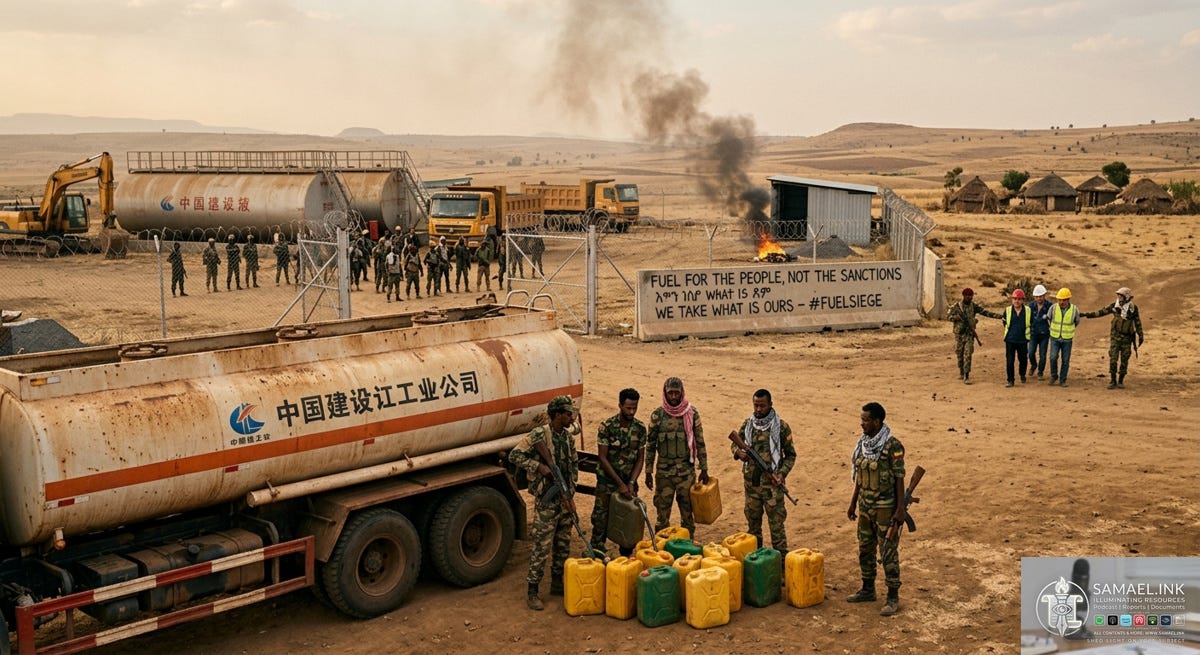
Large-scale Chinese construction and mining projects commonly maintain substantial on-site commercial fuel stocks to operate heavy machinery and generators. In a fuel-starved environment, those stocks become strategically valuable. Armed rebels increasingly view these reserves as both a tactical prize and a source of revenue. Seizing fuel from foreign-operated sites restores mobility and enables insurgent logistics; at the same time it forcibly politicizes those assets, framing them as connected to the state’s capacity to project power.
Chinese protection and operational security
Faced with heightened risk, many Chinese firms will harden sites, hire security contractors, and evacuate non-essential personnel. In the expected weeks of acute scarcity, Chinese companies are also likely to increase direct protective measures. That may include deploying private security forces that, in practice, operate with military-level capability and coordination. Beijing has previously used ostensibly private security contractors to protect overseas personnel and infrastructure; in this environment such forces will be seen as critical force multipliers to secure fuel reserves and key project assets. The presence of robust, well-armed Chinese security detachments will alter local dynamics: they can deter opportunistic raids, enable controlled transfers of commercial supplies, and provide security for convoys operating in contested corridors.
Government punitive operations will focus on armed rebel groups that seize supplies or attack infrastructure. The state’s strategy will be to use remaining fuel stocks to power counterinsurgency operations—drones, armored convoys, and air mobility—targeting rebel logistics and bases. Chinese-operated sites defending their fuel stores are more likely to attract government protection or coordinated action against attacking rebel units rather than punitive measures against the foreign firms themselves. In short, deconfliction and pragmatic alignment of interests will push the Ethiopian government to treat defended Chinese sites as assets to be preserved from rebel capture, not as targets for retaliation.
Operational and Strategic Risks
Several risks remain acute. First, defended sites can still become battlefields: armed rebels may undertake high-risk assaults against hardened compounds, producing casualties and infrastructure loss. Second, the appearance of foreign security forces in active combat zones complicates sovereignty narratives and can provoke nationalist sentiment that insurgents exploit. Third, if Chinese security forces engage lethally, there is potential for escalation between the state and local communities, requiring careful diplomatic management. Finally, the sanctions dimension remains unresolved: if Chinese actors facilitate the movement or sale of sanctioned fuel or payments, international legal exposure could arise for third parties facilitating transactions.
Mitigation and Policy Options
Diversify emergency commercial fuel procurement using clearly OFAC‑compliant intermediaries and neutral third‑party suppliers to limit sanction exposure. Establish negotiated, well-guarded corridors for commercial deliveries with international monitoring to move essential fuel without violating sanctions. Strengthen coordinated protection: joint planning between Ethiopian security forces and foreign security detachments, convoy deconfliction, shared ISR and clear rules of engagement that prioritize civilian safety. For Chinese firms, transparent local engagement—employing local labor, supporting community access to commercial services, and publicly coordinating with Ethiopian authorities—can build local legitimacy and reduce incentives for rebel seizure.
Diplomatic and Economic Imperatives
Ethiopia should pursue multilateral engagement to de‑risk transactions, seeking guarantees from neutral partners that allow commercial fuel recovery without triggering secondary sanctions—or at least to buy political cover to manage domestic stabilization while limiting international exposure. International actors can also apply pressure on intermediaries facilitating illicit maritime tolls to reduce the market for such fees.
Conclusion
The intersection of U.S. sanctions policy and Ethiopia’s commercial fuel shortage creates a fraught risk environment for both state and foreign assets. The choice between paying the Iran Tax and imposing a Fuel Siege presents trade-offs between international isolation and domestic destabilization. Chinese-operated fuel reserves will become central strategic nodes—valued by armed rebels and fiercely defended by firms protected by private security with military capacities. Absent coordinated diplomatic, operational and economic measures, these dynamics will intensify attacks on foreign assets, deepen economic disruption, and increase the potential for dangerous escalation in contested regions.
Summary Question and Answers
What is the “Iran Tax” and why does it matter to Ethiopia?
The Iran Tax refers to maritime passage or transit fees levied to release seized commercial fuel; paying them risks triggering U.S. secondary sanctions under the February 6, 2026 Executive Order because such payments can be deemed services benefiting Iran-linked actors.
If Ethiopia pays the fee, what are the immediate consequences?
Paying could expose Ethiopian financial institutions and state-linked firms to OFAC action, potentially cutting off international banking, aviation maintenance and ticketing channels crucial for Ethiopian Airlines and state procurement.
What does a Fuel Siege aim to achieve?
A Fuel Siege aims to deny armed rebels mechanized mobility and logistics by prioritizing scarce commercial fuel for national forces and critical state functions while restricting distribution to contested regions.
Why do Chinese project fuel reserves become targets?
Chinese sites often hold large commercial fuel stocks for heavy machinery; in a scarcity environment those reserves provide mobility and income for armed rebels, making them high-value targets.
Will defending fuel reserves provoke government action against the firms?
The government is likely to direct punitive operations at armed rebels that attack or seize supplies; defended foreign sites are more likely to attract state protection or coordinated operations against the rebel attackers, rather than punitive measures against the firms.
Could Chinese security forces on-site escalate the conflict?
Yes; well-armed private security detachments can deter raids but may also be drawn into firefights that raise local tensions and require diplomatic deconfliction to avoid broader escalation.
How can Ethiopia avoid both sanctions and a Fuel Siege?
Options include securing commercial fuel through neutral third‑party intermediaries with OFAC‑compliant channels, negotiating guarded corridors for deliveries, and coordinating with international partners to reduce sanction risk.
What are the economic risks of a Fuel Siege?
Denying fuel disrupts transportation, industry and commerce, increases costs for businesses, slows project timelines, and damages investor confidence in high-potential but unstable regions.
How should Chinese firms adapt operationally?
Firms should harden sites, coordinate security with Ethiopian forces, diversify local fuel storage and transfer protocols, engage communities to reduce seizure incentives, and ensure transparent compliance with international sanctions rules.
What diplomatic measures could reduce escalation?
Multilateral engagement to de‑risk fuel recovery, international pressure on intermediaries facilitating maritime tolls, and diplomatic guarantees for secure commercial deliveries can reduce incentives for armed rebels and limit sanctions exposure.
Why have Chinese nationals in Ethiopia been targeted more since 2016?
Because growing political instability, insurgent activity and criminal networks have turned visible foreign projects into lucrative and symbolic targets for ransom, loot and political leverage.
Which Ethiopian regions are most dangerous for Chinese workers?
Oromia and Amhara have seen the highest concentrations of violent incidents, with spillover risk into Benishangul-Gumuz and parts of North/West Shewa.
Are kidnappings primarily criminal or politically motivated?
Both: many kidnappings are profit-driven extortion, but insurgent groups also use abductions for political leverage and to pressure federal authorities.
How have Chinese firms adjusted security practices?
Firms have increased use of private security contractors, hardened camps, varied convoy routes and times, and in some cases temporarily suspended operations in high-risk areas.
Has the Chinese Embassy intervened in specific cases?
The embassy has issued travel advisories, coordinated evacuations, and pressed local authorities for protection, while urging citizens to avoid high-risk travel and to employ security measures.
Do local communities benefit from Chinese projects, reducing risk?
Benefits are uneven; where projects deliver jobs and local investment hostility is lower, but perceived exclusion or land disputes can intensify resentment and risk.
Could Ethiopia’s federal forces fully protect Chinese workers?
Federal protection is constrained by stretched resources, competing security priorities and areas where regional militias or insurgents hold sway, limiting full-coverage protection.
What are the costs to projects from these security threats?
Costs include higher insurance and security expenses, project delays, equipment losses, evacuation and personnel-replacement costs, and reduced investor appetite.
Can improved community engagement reduce attacks?
Yes; genuine local employment, supplier integration, conflict-sensitive land practices and transparent grievance mechanisms can lower hostility and build protective local coalitions.
What long-term solutions would reduce risks for foreign workers?
Political stabilization, strengthened regional governance, inclusive economic policies, robust rule-of-law institutions and coordinated international support for security-sector reform would address root causes and reduce long-term risk.