
TL;DR:
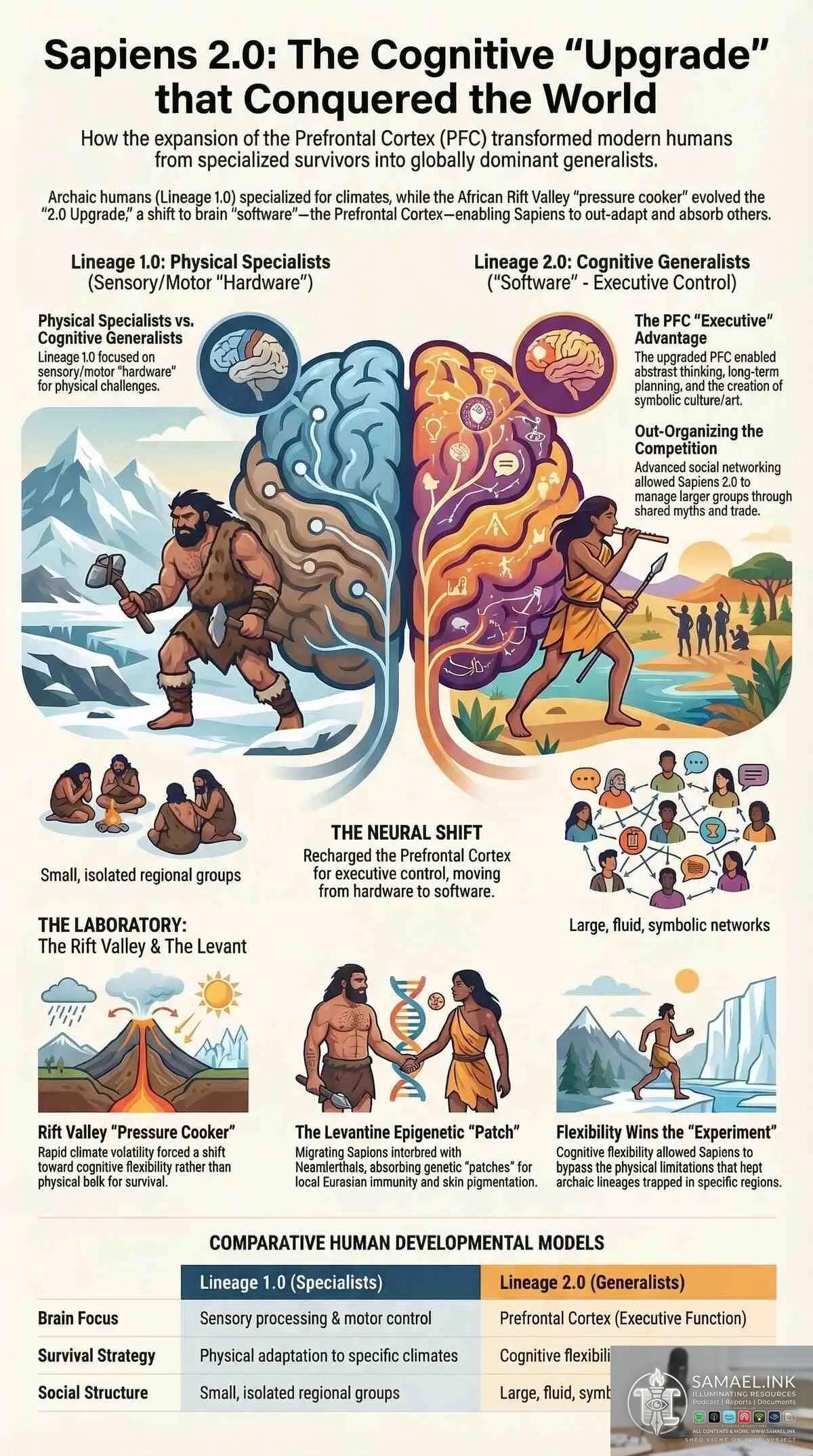
The transition from the “1.0” Eurasian lineages to the Sapiens 2.0 (الإنسان العاقል) model was defined by a massive expansion of the Prefrontal Cortex (PFC), a biological “charge” that transformed the Rift Valley into a high-pressure laboratory for cognitive flexibility. Unlike the Ice-Age-adapted Neanderthals who specialized in physical sensory-motor systems, the African 2.0 lineage developed superior Executive Function, enabling abstract symbolic innovation and the coordination of large social networks through shared myths.
This cognitive edge was refined during the Levantine Experiment, where “2.0” migrants bypassed the Neanderthal “blockade” by out-organizing their stronger rivals while absorbing critical local genetic adaptations through interbreeding. Ultimately, the Rift Valley’s climate volatility ensured that these “Generalist” ancestors possessed the mental logic required to adapt to any global environment, transitioning from regional specialists to a global force.
The Prefrontal "Charge"
The defining feature of the "2.0" lineage—the one that would eventually take over the world—wasn't just bigger muscles or better cold tolerance. It was a fundamental shift in the prefrontal cortex (PFC). This area of the brain, positioned behind the forehead, underwent a massive expansion in the African branch of the family tree.
This biological "upgrade" provided three distinct advantages that the specialized "1.0" lineages lacked:
Executive Control: The ability to inhibit impulses and plan for long-term goals.
Symbolic Innovation: Using the PFC to create abstract art and complex language, turning the environment into a "canvas" for social identity.
Social Networking: Managing much larger groups through shared myths and trade, allowing the "2.0" migrants to out-organize the isolated regional groups they encountered.
The Takeover of the "Generalists"
When the Rift Valley ancestors eventually left Africa, they didn't succeed because they were stronger than the Neanderthals; they succeeded because they were more cognitively flexible. Their PFC-driven "software" allowed them to adapt to any climate, from tropical jungles to Siberian tundras, while the "1.0" specialists remained trapped by their own adaptations.
Let's look at how this PFC expansion changed the way humans actually interacted with the world. I'll ask guiding questions along the way. Which of these should we investigate next?
The transition from the "1.0" Eurasian lineages to the Sapiens 2.0 (Arabic: الإنسان العاقل, romanized: al-insān al-ʿāqil) model is largely defined by the expansion and refinement of the prefrontal cortex (PFC).
While the "1.0" versions, like the Neanderthals, had large brains, their neural "hardware" was often tilted toward sensory processing and motor control—the systems needed to survive high-intensity physical challenges in the Ice Age. In contrast, the African "2.0" upgrade involved a "recharging" of the PFC, the area right behind your forehead that acts as the "Chief Executive" of the brain.
The Prefrontal "Upgrade"
The PFC is what allows us to engage in executive functions that distinguish us from other hominins:
Abstract Thinking: The ability to represent things that aren't physically present (the foundation for cave art and complex religion).
Future Planning: Moving beyond immediate survival to strategizing for seasons or years ahead.
Complex Social Navigation: Managing large, fluid social networks through language and empathy, which allowed Sapiens to out-organize regional groups.
The Rift Valley (Arabic: الوادي المتصدع) served as the perfect "pressure cooker" for this. The constant environmental "shaking" meant that those with a more flexible PFC—those who could innovate new "software" for survival—were the ones who passed on their genes.
The Naming of Heidelbergensis: A Geographic Accident
The story of how we name our ancestors often comes down to who finds the first bone. In 1907, a massive, primitive jawbone was discovered in a sand pit in Mauer, near Heidelberg, Germany. This "Mauer 1" mandible became the type specimen for a new species: Homo heidelbergensis (Arabic: إنسان هايدلبيرغ, romanized: Insān Hāydilbīrġ).
By the rules of taxonomy, because the German fossil was the first one documented, its name now covers an entire era of humanity—including populations living thousands of miles away in Africa.
The Rift Valley: The True "2.0" Laboratory
While the name points to Europe, the "evolving edge" of our species was actually being "charged" in the East African Rift Valley. While the European branch of Heidelbergensis was specializing for the cold, the African branch—represented by fossils like the Bodo Cranium in Ethiopia —was undergoing a different kind of "shaking."
The African environment provided a unique "upgrade" pressure:
Climate Volatility: The rapid shifting between lush lakes and dry grasslands forced the lineage toward cognitive flexibility rather than just physical bulk.
The Sapiencization Process: This African "charge" focused on social intelligence and advanced tool-making, creating the Sapiens 2.0 blueprint.
The Global Takeover: When these "upgraded" humans eventually left Africa, they didn't just move into new lands; they absorbed or replaced the specialized "1.0" residents (like the Neanderthals) who had drifted away from the modern path.
The Levantine Experiment refers to a critical period between approximately 100,000 and 50,000 years ago when the Levant (modern-day Palestine, Israel, Syria, and Jordan) served as a "revolving door" for two distinct human lineages.
In this region, Anatomically Modern Humans (Sapiens 2.0) migrating from the Rift Valley met the Archaic Pioneers (Neanderthals) moving south to escape the European deep freeze. This wasn't a single event, but a long-term "shaking" where both groups occupied the same caves at different times—and occasionally at the same time.
The Biological "Laboratory"
This period is called an "experiment" because it was the first time our lineage's new Prefrontal Cortex (PFC) "software" was tested against the heavy-duty "hardware" of the Neanderthals.
Epigenetic Mixing: This encounter wasn't just about competition. It was a genetic exchange. Modern humans "experimented" with Neanderthal DNA, absorbing SNPs (Single Nucleotide Polymorphisms) that provided ready-made adaptations for the Eurasian climate.
The Adaptation Patch: We gained genes related to skin pigmentation and immune responses—essentially "borrowing" the survival tools the Neanderthals had spent 400,000 years perfecting.
The Sapiens Edge: Despite the Neanderthals' physical strength, the Sapiens 2.0 lineage eventually "won" the experiment. Our expanded PFC allowed for more flexible social structures and better long-term planning, which proved more effective than raw physical power when the environment shifted.
The presence of Neanderthals in the Levant and Southern Europe acted as a biological and geographic "filter" that fundamentally shaped the trajectory of the Sapiens 2.0 lineage. While it might seem like their presence simply "stalled" progress, it actually provided the high-stakes environment needed to fully "charge" the modern human prefrontal cortex (PFC).
The Neanderthal "Blockade" and the PFC Response
For roughly 40,000 years, Neanderthals held a firm grip on the best hunting grounds in the Levant and Europe. This forced the arriving Sapiens to rely on their primary evolutionary advantage: cognitive flexibility.
Executive Demand: Surviving on the edge of Neanderthal territory required superior long-term planning and the ability to track complex seasonal shifts. This placed a massive "load" on the PFC, favoring individuals who could process abstract information.
Social Complexity: To compete with the physically stronger Neanderthals, Sapiens had to out-organize them. The PFC enabled the creation of Symbolic Culture—using beads, pigments, and rituals to unite larger groups of people who weren't necessarily related.
The "Experiment" Results
The interaction in the Levant wasn't just a military-style conflict; it was a 50,000-year biological experiment.

This "waiting period" in the Levant ensured that by the time Sapiens finally moved deep into Europe and Asia, their social and mental "software" was so advanced that they could bypass the physical limitations that had kept the 1.0 lineages regional.
Appendix: The Two Great Human Waves
To understand how our lineage took over the world, we can categorize the history of human migration into two distinct "waves" or "charges."
1.0: The Ethiopian Archaic Pioneers
The Ethiopian Branch (Generalization): In the Rift Valley, the Bodo Cranium (~600,000 years ago) represents the African version of this archaic stage. Unlike the European branch, this population stayed "generalized." The environment rewarded flexibility and cooling efficiency, "charging" the lineage toward the sleek Sapiens form.
1.0: The European Travelers
This era began when Homo erectus (Arabic: إنسان منتصب) first moved out of Africa roughly 1.8 million years ago. These pioneers settled across Eurasia, establishing populations in:
The Eurasian Branch (Specialization): Settlers in Georgia (Dmanisi), Germany (Mauer 1), and France (Arago) faced the "shaking" of the Ice Ages. This pressured them to evolve into Neanderthals—robust "specialists" with heavy "hardware" for heat retention.
Georgia: The Dmanisi fossils.
Germany: The Mauer 1 jawbone (Heidelberg).
UK: The Boxgrove Man.
France: Arago 21 (Tautavel Man).
Greece: The Petralona skull.
2.0: The Modern Upgrade & The Epigenetic Mix
This second wave represents the transition from the generalized African ancestors to Anatomically Modern Humans, marked by fossils like Omo Kibish (approx. 195,000 years ago) in Ethiopia.
The Levantine Experiment: As these Sapiens moved into the Levant, they encountered the "1.0" residents—the Neanderthals. This was a period of biological "experimentation" where the two lineages interacted. Through interbreeding, the Sapiens 2.0 "software" integrated specific epigenetic patches from the Neanderthals, absorbing local Eurasian traits (like immune system boosts) that helped the newcomers survive in their new environments.
The expansion of the Prefrontal Cortex was the engine behind this 2.0 wave, allowing for the social and technological flexibility to navigate these encounters. Which aspect of this "2.0" takeover should we examine next?