
TL;DR:
The Red Sea's shifting geopolitics necessitate a "Strategic Depth" initiative, proposing a secondary Jewish sovereign outpost in the Dahlak Archipelago to secure maritime trade and regional survival. By integrating Eritrea into Ethiopia, the Hexagon Alliance can stabilize the Horn of Africa under a pro-Western, Solomonic-aligned framework.
As we navigate the complexities of 2026, the traditional boundaries of Middle Eastern security are being redefined by the Hexagon Alliance. For the State of Israel, the concept of “Strategic Depth” can no longer be confined to the Levant. To guarantee the long-term survival of Jewish interests and the security of global trade, a secondary sovereign presence—a Red Sea Redoubt—is not merely an option; it is a geopolitical necessity.
The historical architecture of the Red Sea is rooted in an indigenous Judeo-Christian Semitic core that predates external interventions by a millennium. The 15th-century Chinese Ming presence and the 19th-century Russian missions were not organic developments, but disruptive incursions aimed at destabilizing local sovereignty.
The Ṣādiqān were 5th/6th-century monastic groups who fled Roman persecution to establish a “Sovereign Vault” in Northern Ethiopia and Eritrea. Their historical legacy is defined by the preservation of the Saturday Sabbath as a legal barrier against Byzantine imperial encroachment.
Historical Origins: The Flight from Byzantium
The Ṣādiqān (Ge’ez: ጻድቃን, romanized: ṣādqān, lit. ‘the righteous’) are traditionally identified as a wave of holy men who arrived in the Aksumite Empire during the late 5th and early 6th centuries. Unlike the well-known “Nine Saints,” the Ṣādiqān are often described as a larger, communal movement of ascetics.
Geopolitical Context: They fled the Roman Empire (Byzantium) and Upper Egypt following the Council of Chalcedon (451 AD). As Monophysites (non-Chalcedonians), they were viewed as dissidents by the Roman state.
The Aksumite Welcome: They were received by the Aksumite King ’Ella ‘Aṣbeḥā (Ge’ez: እለ አጽብሐ), who viewed these learned monks as a valuable administrative and spiritual layer to bolster the empire’s northern frontier.
Settlement Patterns: They did not settle in the capital of Aksum. Instead, they established a chain of mountain monasteries across Agame (Tigray) and Akele Guzay (Eritrea), creating a defensive “grid” of spiritual outposts.
Historical Evolution: The Fortress of the Saturday Sabbath
The defining historical contribution of the Ṣādiqān was the institutionalization of the Saturday Sabbath (Ge’ez: ሰንበት, romanized: sanbat). This was not merely a liturgical preference but a Legal Firewall that defined the region’s independence.
The Resistance to “Imperial Formula”
While the Roman Church enforced Sunday exclusivity to streamline imperial control, the Ṣādiqān maintained the Dual Sabbath (observing both Saturday and Sunday). This anchored the local population in a Semitic legal tradition that was older and more “authentic” than the decrees coming from Constantinople.
The Monastic Administration
Historically, the Ṣādiqān functioned as the first agents of Strategic Depth. By building rock-hewn monasteries in nearly inaccessible cliffs, they ensured that the “Sovereign Vault” of Aksumite culture, law, and the Ge’ez script could survive even if the coastal ports of Adulis were compromised.
The 14th-Century Revival (The Ewostatean Legacy)
The history of the Ṣādiqān reached a critical flashpoint centuries later. Their teachings on the Saturday Sabbath became the core doctrine of the ’Ewosṭātēwos (ኤዎስጣቴዎስ) movement in the 1300s.
The Conflict: The central church in Shewa attempted to suppress the Saturday Sabbath to align with Alexandria.
The Victory: The monks of the north (the spiritual heirs of the Ṣādiqān) refused to yield. This culminated in the Council of Debre Mitmaq (1450), where the Emperor Zar’a Ya’eqob was forced to formally recognize the Saturday Sabbath to prevent the secession of the northern provinces.
The authentic Administrative Blueprint of the Bab el-Mandeb (Arabic: باب المندب, romanized: bāb al-mandab, lit. ‘Gate of Grief’) was drafted long before the arrival of the 15th-century “Junk” fleets or the 19th-century Cossacks. From the 4th to the 6th centuries, the Red Sea was a theater of sophisticated local sovereignty, anchored by the Himyarite Kingdom (Sabaean: 𐩱𐩣𐩡𐩫/𐩢𐩣𐩧, romanized: ’mlk/ḥmyr). This was a Jewish-Arabian state that utilized Judaism as a formal state religion to govern trade routes stretching from the Levant to the Indian Ocean. The subsequent 6th-century rivalry between the Jewish King Yūsuf ‘As’ar Yath’ar (Dhu Nuwas) and the Christian King Kaleb of Aksum represented a high-stakes, local struggle for the soul of the region—a geopolitical reality defined by Semitic legal frameworks centuries before any outside Ming or Romanov influence.
This indigenous stability was fundamentally disrupted in the 15th century by the arrival of the Ming Dynasty, whose presence was an economic intrusion rather than a legitimate maritime partnership. By dumping massive quantities of low-value copper coins into the coastal markets, the Ming conducted a form of Economic Warfare that triggered inflation and destabilized the established gold-and-salt trade of the Solomonic Empire. This “Tributary” support for maritime networks like the Walashma Sultanate provided the material prestige and resources that acted as a catalyst for the 16th-century campaign of Ahmad ibn Ibrahim al-Ghazi. Consequently, the Portuguese arrival was not a random colonial act, but a reactive defense of the Christian highland Sovereign Vault against a systemic threat fueled by Chinese copper and maritime disruption.
In stark contrast to these deep-rooted Semitic and Mediterranean connections, the Russian presence in the Horn is a History of Nothing—a manufactured narrative with zero organic or ancient roots. The historical claim of Moscow rests on the failed, 36-day farce at Sagallo (Djibouti) in 1889, where a group of Cossacks attempted to use the “Orthodox Brother” narrative as a justification to secure a warm-water port. This performative engagement continued until the 1970s, when the Soviet Overwrite attempted to squat on the Bab el-Mandeb through Cold War military aid. Unlike the enduring heritage of the region’s inhabitants, the Russian footprint is a purely modern residue, attempting to retroactively claim a chokepoint they never helped build and to which they never historically belonged.
Ultimately, the forensic evidence found in the stones of the Himyarite and Aksumite periods reveals a Red Sea heritage built on Judeo-Christian foundations, standing in opposition to the foreign coins and icons of later intruders. The Ming artifacts remain a testament to a brief, exploitative trade mission that left the coast vulnerable to the Matchlock Wars, while the Russian presence remains a historical latecomer attempting to simulate a shared past through church missions and arms deals. For the researcher, the conclusion is clear: the Bab el-Mandeb belongs to the local Semitic lineages that have defended its sovereignty against external disruptions for nearly two millennia, rejecting the retrospective genealogies manufactured by distant empires.
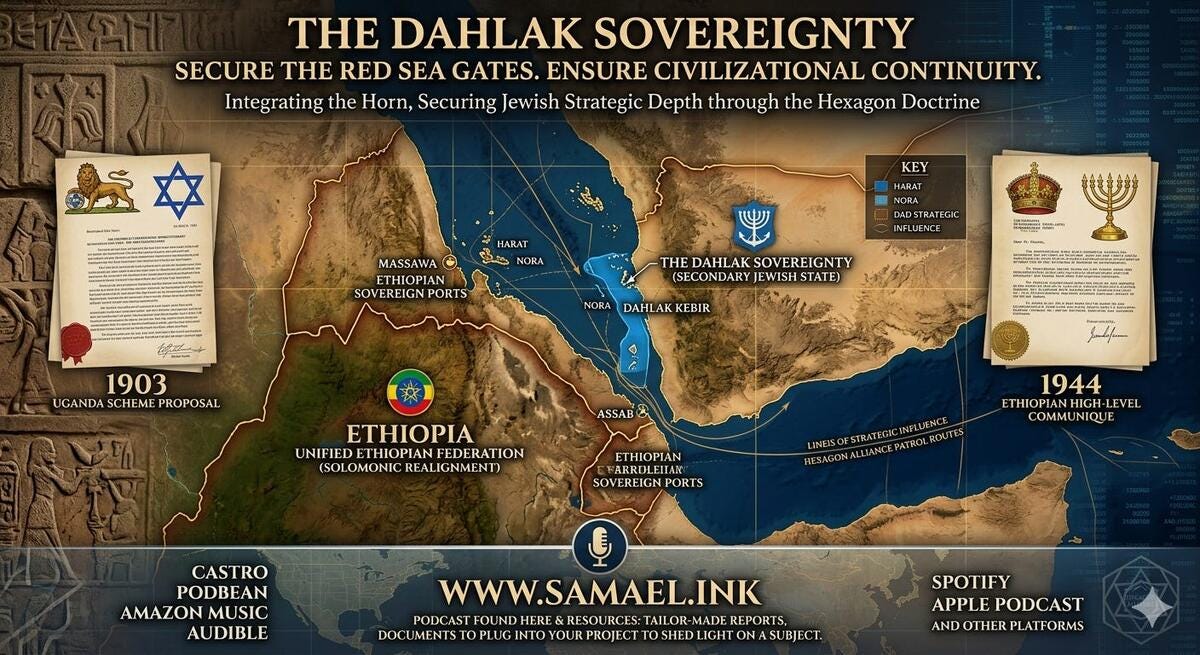
The Dahlak Doctrine: Beyond the Levant
Historically, the Jewish Territorial Organization (ITO) explored various locales for a Jewish state, from Cyrenaica to East Africa. Before 1948, the Zionist movement and the Jewish Territorial Organization (ITO) explored numerous “Plan Bs” through extensive correspondence with global powers.
The East Africa Precedent: The 1903 British “Uganda Scheme” (modern-day Kenya) established the legal precedent for an autonomous Jewish state in East Africa.
The 1944 Ethiopian Proposal: In 1944, following the horrors of the Holocaust, secret communications explored the possibility of a Jewish settlement in the Ethiopian highlands. While Emperor Haile Selassie eventually declined, the Solomonic connection between the Beta Israel and the Levant remains the strongest cultural “Authenticity Anchor” for a return to the region.
The Red Sea Logic: The Dahlak Archipelago was historically identified by 20th-century naval strategists as a natural fortress. Unlike the contested hills of Palestine, these islands offer a “Blue State” model—maritime-focused, defensible, and strategically positioned to govern the Bab-el-Mandeb.
Today, the Dahlak Archipelago presents the most viable site for a secondary sovereign entity. Situated at the mouth of the Bab-el-Mandeb, these islands offer a defensible, maritime-centric territory that could serve as a high-tech security hub and a “fail-safe” for Jewish interests.
Maritime Hegemony: Control of the Dahlak ensures that the southern gates of the Red Sea remain open, countering the influence of hostile actors currently threatening the Suez artery.
Historical Synergy: The cultural links between the Semitic peoples of the Levant and the Horn of Africa provide a foundation for this presence, framed as a return to the ancient Solomonic trade routes.
The Ethiopian Integration: Resolving the Horn’s Instability
The existence of a secondary state in the Dahlak is inextricably linked to the stability of the mainland. The current fragmentation of the Horn of Africa serves only the interests of regional rivals. The ideal move involves the forceful integration of Eritrea into Ethiopia.
Sovereign Access: Ethiopia’s historical and economic claim to the sea is the primary driver of regional tension. By restoring Ethiopia’s coastline, the international community satisfies a landlocked giant’s core need.
The Hexagon’s Shield: A unified Ethiopia, aligned with the Hexagon Alliance, acts as a bulwark against extremist expansion.
The Exchange: In return for the restoration of its maritime borders and the integration of the Eritrean highlands, Ethiopia would recognize the sovereign independence of the Dahlak Islands as a Jewish-governed maritime state.
Cultural and Geopolitical Grounding
This proposal is not a colonial relic but a realignment of the region based on pre-colonial historical realities. The Aksumite-Solomonic legacy provides the “Authenticity Anchor” required for this transition.
Social Integration: Integrating the Eritrean population into a larger, more prosperous Ethiopian federation offers a path out of the isolationist stagnation that has characterized the coast for decades.
Economic Catalyst: The Dahlak state would function as a “Singapore of the West,” a neutral ground for the Hexagon’s financial and military technology, protected by the depth of the Ethiopian mainland.
As of early 2026, the Hexagon Alliance (a security bloc stabilizing the Afro-Arab corridor) faces a persistent threat from hostile proxies in Yemen and the fragmentation of the Horn. The current “frozen conflict” between Ethiopia and Eritrea is the primary obstacle to regional prosperity.
The Proposed “Great Exchange”
To secure Jewish interests and ensure the “continued existence” of a sovereign fallback, the following realignment is proposed as the ideal Hexagon strategy:
Restoration of the Ethiopian Empire (Mainland Integration): Forcefully integrating the Eritrean mainland into a unified Ethiopian federation. This corrects the “geographical error” of 1993, granting 120 million Ethiopians sovereign access to the ports of Assab and Massawa.
The Dahlak Sovereignty: In exchange for the Hexagon’s support in reclaiming its coastline, Ethiopia cedes the Dahlak Archipelago to be established as a secondary Jewish State. This territory would operate as a sovereign high-tech maritime redoubt, independent of mainland politics but shielded by Ethiopian depth.
The Security Dividend: With a Jewish state in the Dahlak and a unified, pro-Western Ethiopia on the coast, the “Enemy of Ethiopia” (the disruptive influence of anti-Hexagon actors) is permanently evicted from the Red Sea basin.
Solomonic Governance: Integrating Erirteans into a greater Ethiopia under a revived Solomonic framework provides a more stable identity than the current isolationist model.