
TL;DR:
In the crowded, violent theater of 18th-century Ethiopian politics, a single obscure act of religious theater changed the course of a civil war. The episode — a holy man from the valley of Waldubba confronting Ras Mikael Sehul with a prophecy that compelled the warlord into a disastrous field campaign — is recorded in James Bruce’s monumental Travels to Discover the Source of the Nile. Bruce’s account is vivid, sometimes credulous, and told from the perspective of a European observer embedded in the Ethiopian court; but stripped of exoticism, the story reveals how sanctity, superstition, and political power could intersect with devastating effect.
A revered Waldubba hermit publicly prophesied Ras Mikael Sehul’s victory if he marched to Serbraxos; Mikael, fearing that ignoring a visibly sanctified figure would erode legitimacy and invite defections, obliged. The subsequent May–June 1771 campaign collapsed across three engagements in wet, chaotic conditions—undermined by damaged morale, better rebel coordination, and logistical failure—culminating in Mikael’s surrender and political ruin.
The episode highlights how symbolic authority functioned as a tangible constraint on military judgment: in a court where sanctity signaled trustworthiness, a single public oracle could reshape incentives and compel a commander to act against strategic prudence. It also underscores a wider truth about the Zemene Mesafint era—fragmented power, fragile loyalty, and the intertwining of religious ritual with political legitimacy made outcomes especially sensitive to dramatic, contingent moments like a hermit’s walk into Gondar.
This is the long-form expansion of that episode: who these actors were, why a hermit’s word carried real strategic force, and how a single prophecy helped precipitate the downfall of one of Ethiopia’s most feared kingmakers.
Setting the Stage: Ethiopia in the Late 18th Century
The Ethiopia of the 1760s and 1770s was fragmented and volatile. The imperial center at Gondar remained the nominal seat of empire, but real power passed into the hands of provincial governors and military strongmen. These warlords controlled troops, taxation, and patronage in their regions, and they vied constantly for influence over the throne. The era that followed — the Zemene Mesafint, or “Age of Princes” — would be defined precisely by this diffusion of power: emperors as instruments, regional lords as sovereigns.
Ras Mikael Sehul stood at the apex of that system. Born around 1691, Mikael rose through the ranks to become governor of Tigray and later the dominant power-broker at Gondar. He consolidated influence, installed and removed emperors, and was notoriously ruthless: Bruce (and native Ethiopian chronicles) recount his role in the murder of Emperor Iyoas, among other brutal acts. Mikael’s political sway and his reputation for ruthlessness made him a figure few dared to confront.
The political context in 1771 was especially combustible. Three powerful regional rivals — Fasil, Goshu, and Wand Bewossen — coordinated against Mikael, assembling forces to challenge his dominance. Mikael, then older and dependent on the defenses of Gondar, hesitated to meet them in the open. Defeat in the field would mean capture, humiliation, or death; yet remaining holed up risked losing legitimacy and the loyalty of troops and nobles. Into this fraught moment stepped an unlikely actor: a hermit from Waldubba.
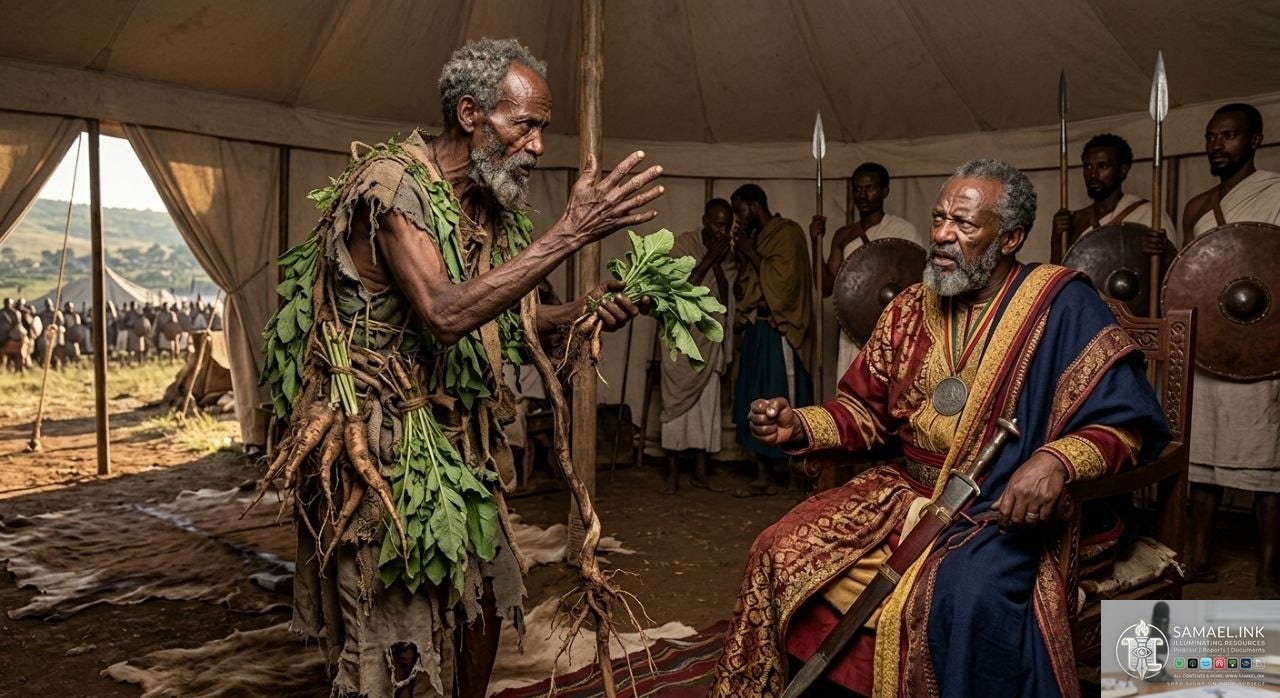
Waldubba: A Landscape of Mortification
Waldubba — roughly “Valley of the Hyena” in Amharic — was, in the 18th century, a harsh and forbidding place. Hot, swampy in parts and malarial, it nonetheless attracted a distinctive class of religious recluses. Monastic and ascetic traditions have long been central to Ethiopian Christianity; the great rock-hewn monasteries and desert hermitages of the highlands produced men and women who pursued rigorous mortification and solitude as means of spiritual authority. In local society, evidence of extreme asceticism conferred moral purity and sometimes prophetic credibility.
James Bruce records a particular hermit from Waldubba whose reputation rested on his extraordinary regimen. According to Bruce’s courtly informants, the man “never ate any thing but roots, or drank other liquor than water, since the day of his nativity.” Whether this absolute claim is literal is less important, in a political sense, than the belief in it: the hermit’s abstinence was taken by nobles and soldiers as a sign that he was uncorrupted and, therefore, divinely favored. In the robustly religious environment of Gondar’s court, being demonstrably removed from worldly appetites equated to trustworthiness and prophetic authority. As one courtier put it to Bruce: “Such a man as this, you know... cannot lie.”
The hermit’s anonymity in Bruce’s account is telling: his personal identity mattered less than the spiritual capital he wielded. He was a living symbol of sanctity, and in a polity where religious legitimacy backed political claims, symbols could move armies.
The Dare: Prophecy as Political Coercion
By May 1771, as Fasil, Goshu, and Wand Bewossen approached with combined forces, Mikael resisted leaving Gondar. Leaving the capital to fight in the plains of Serbraxos (often rendered in sources as Sarbakusa, Sabraxos, or Serbraxos) seemed reckless; besides, the rainy season and the terrain complicated campaigning. Bruce reports that the hermit left Waldubba, traveled to Gondar — a remarkable physical and symbolic journey — and confronted the Ras in person.
What the hermit offered was not counsel couched in prudence but a categorical prophecy: if Ras Mikael marched out to Serbraxos that month, he would utterly crush the rebellion. In a court in which religious signs and omens shaped public perception, such a statement amounted to a political imperative. To ignore the hermit risked mutinous doubt among soldiers who might interpret refusal as hubris or divine disfavor. To accept the prophecy, no matter how strategically unwise, allowed Mikael to preserve his legitimacy and appear divinely backed.
It is useful to consider the social mechanics at play. Mikael’s authority rested not only on force of arms but on the maintenance of an image of invincibility. A public refusal to heed a revered ascetic would have been read as weakness and may have encouraged defections or emboldened enemies. The hermit’s prophecy thus became a lever: less a genuine military forecast than a social weapon that reshaped incentives. Bruce’s characterization — that the hermit “obliged him to march out against his will” — captures how spiritual authority could overrule prudential counsel.
Sabraxos: Three Battles, One Collapse
Mikael complied. He marshaled an enormous force — Bruce gives the figure of some 40,000 men, including thousands of musketeers, reflecting both the scale of his power and the period’s militarization around gunpowder weapons. In May 1771, royalist forces moved onto the plains of Serbraxos to confront the rebel coalition.
The campaign rapidly turned into a disaster. Over a series of three engagements in rain-soaked, chaotic conditions, the royal army found itself outmaneuvered and repeatedly repulsed. Several factors help explain the collapse:
Command and morale: Mikael’s decision to campaign against his own better judgment likely undermined the confidence of his senior commanders and rank-and-file troops. A leader perceived as coerced by superstition invites doubts about competency.
Coalition tactics: The rebels — Fasil, Goshu, and Wand Bewossen — coordinated more effectively than perhaps anticipated, exploiting terrain and massing forces at decisive moments.
Weather and logistics: The seasonal rains turned the plain into a test of maneuvering and supply; musketeer formations and large bodies of men were vulnerable to disruption and attrition under such conditions.
Overextension: Even with large numbers, an army’s cohesion matters more than raw size; Mikael’s force may have suffered from patchy training, divided command, and uneven commitment among regional levies.
By early June the situation was irretrievable. On June 4 (per contemporary chronologies), Ras Mikael Sehul surrendered unconditionally. He was imprisoned for a year, humiliated, and eventually allowed to return to Tigray in disgrace. The defeat fractured his preeminence and accelerated the Zemene Mesafint’s fracturing logic: no single warlord could impose lasting centralized control if beset by internal rivals and if public legitimacy could be so publicly tested.
The Power of Sanctity in Ethiopian Politics
For modern readers, the episode illuminates both the allure and peril of treating supernatural claims as decisive proof in political life. It also reminds historians that power is not reducible to armies and treasuries; social beliefs, public rituals, and the reputations of sanctity all shape outcomes. The hermit’s power lay not in prophecy’s truth or falsity but in the shared beliefs that lent his words coercive force.
Finally, the tale endures because it is a vivid microhistory: an almost theatrical collision of an ascetic’s aura and a warlord’s earthly might. It is a reminder that history often turns on small, contingent moments — a procession to Gondar, a public utterance, a general’s unwilling march — that, when combined with the structural weaknesses of an era, produce decisive change.
Conclusion
The plant-eating hermit of Waldubba — unnamed and scarcely more than a silhouette in James Bruce’s pages — helped precipitate one of the most consequential defeats of a dominant 18th-century Ethiopian warlord. The episode is not merely a curiosity; it is a revealing case study of how religious authority could function as political force in early modern Ethiopia. Whether read as a tale of credulity, a story of performative power, or a cautionary note about the interplay of sanctity and strategy, the encounter at Serbraxos remains a brilliantly obscure deep-cut of Ethiopian history worth remembering.
Who was Ras Mikael Sehul?
Born around 1691, Mikael rose from provincial command to become governor of Tigray and the foremost kingmaker at Gondar by mid‑eighteenth century. He combined military force, strategic marriages, and ruthless political purges (including involvement in Emperor Iyoas’s murder) to dominate court politics. His power derived from regional patronage networks, control of musketeer contingents, and an ability to place pliant emperors on the throne—making him both indispensable and widely resented.
Who was the hermit from Waldubba?
The hermit remains unnamed in European accounts; Ethiopian monastic traditions often treat such ascetics as types rather than individuals. He belonged to a Waldubba ascetic milieu famed for severe mortification—fasting, isolation, and symbolic dress of roots and leaves—that signaled spiritual removal from worldly corruption. That visible austerity functioned as social proof of divine favor in a culture where holiness could translate into political authority.
Why did Mikael heed the hermit’s prophecy?
Decision-making combined risk management and reputation management. Mikael faced a credibility problem: staying in Gondar risked appearing cowardly and losing the loyalty of mercenary and noble cohorts; defying a popular holy man risked being read as impiety. Obeying preserved the narrative of divine sanction for his leadership, kept wavering supporters aligned, and avoided the immediate political cost of seeming to spurn sacred authority—at the expense of strategic prudence.
Where and when did the campaign occur?
The confrontation took place on the Serbraxos plain (rendered variously as Serbraxos, Sarbakusa, or Sabraxos) in the rainy season of 1771. The timing made campaigning difficult: wet ground hampered formations and logistics, musketeer effectiveness declined in poor weather, and supply lines became precarious—factors that magnified command and morale problems once fighting began.
What forces opposed Mikael?
The insurgent coalition brought together influential provincial leaders Fasil, Goshu, and Wand Bewossen, each commanding contingents loyal to regional interests. Their cooperation was tactical and pragmatic: combining troops, coordinating movements, and exploiting Mikael’s political isolation. Their forces included cavalry, infantry levies, and regional musketeer bands; local knowledge and shared objectives gave them an operational edge.
What caused the royal army’s defeat?
Multiple interacting causes undermined the royal army: rebels coordinated better and exploited terrain; supply and movement were disrupted by rain; Mikael’s coerced decision damaged commanders’ confidence and produced disunited execution; troops who believed their leader had been swayed by superstition likely had lower cohesion and morale. The large size of Mikael’s force could have been a liability if poorly trained or improperly led, turning numbers into logistical burden rather than combat advantage.
How decisive was the defeat?
Politically decisive even if not annihilative militarily. Mikael’s unconditional surrender on June fourth signaled a clear reversal: he was imprisoned, publicly humiliated, stripped of immediate influence, and thereafter could no longer exert the same kingmaking authority. The setback accelerated fragmentation among elites and showed how a single campaign’s failure could topple a previously dominant patron in the Zemene Mesafint’s volatile environment.
Was the hermit’s prophecy true or manipulated?
There’s no direct evidence that the hermit colluded with Mikael’s enemies or that the prophecy was a deliberate political trick; contemporary sources present him as an independent ascetic. Whether sincere or staged, the prophecy’s coercive power derived from widespread belief in sanctity and the public spectacle of an ascetic confronting a ruler—an act that altered incentives and constrained choices regardless of the prophet’s motives.
What does the episode reveal about Ethiopian politics then?
It shows legitimacy as performative and fragile—rooted in religious symbols, personal honor, and public perception as much as in force. Power depended on sustaining reputational narratives (divine favor, invincibility) across diverse, often fractious client networks. The incident also illustrates how nonstate religious actors—monastics, hermits, and ritual specialists—could exercise tangible political influence by shaping the moral calculus of elites and troops.
How reliable is James Bruce’s account?
Bruce’s Travels is invaluable for vivid detail and courtly color, but it requires critical reading. He wrote as a European observer embedded in elite circles, sometimes repeating court gossip and interpreting events through eighteenth‑century European sensibilities that exoticized asceticism. Where possible, his narrative should be cross‑checked against Ethiopian chronicles and later scholarship to separate factual reporting (dates, outcomes, participants) from interpretive embellishment or cultural misreading.