
TL;DR:
Around 1.9 million years ago, the East African Rift Valley served as the laboratory for a biological revolution: the transition of Homo erectus (Arabic: إنسان منتصب) from a primate walker to the world’s first endurance runner. This total re-engineering of the body utilized a specialized "spring" architecture—including the Achilles tendon and longitudinal arch—and a radical evaporative cooling system that allowed humans to hunt through midday heat when other mammals collapsed. This ancient "persistence" legacy was symbolically reclaimed at the 1960 Rome Olympics by Abebe Bikila (አበበ ቢቂላ), whose barefoot marathon victory shattered 17th-century myths and proved that the ultimate endurance engine remained exactly where it was invented. Read a primer article on this topic here.
The Anatomy of the "Spring"
While earlier ancestors like Homo habilis had feet designed for stable walking, Homo erectus developed a specialized architecture for high-impact movement.
The Arch and the Tendon: They evolved a permanent longitudinal arch in the foot and a long Achilles tendon. These structures act like biological springs, storing elastic energy when the foot hits the ground and "firing" it back to propel the body forward without using extra muscle power.
The Stabilizers: To prevent the head from wobbling during a run, they developed the nuchal ligament (connecting the skull to the spine) and enlarged gluteus maximus muscles (the "buttocks"), which act as stabilizers for the torso.
The Cooling Engine
Running generates massive amounts of internal heat. Most mammals, like antelopes, cool down by panting, which they cannot do while running at full speed. Homo erectus solved this through a radical "shaking" of mammalian biology:
Sweat Glands: They traded fur for millions of eccrine sweat glands.
Hairless Skin: By losing thick body hair, they allowed air to flow over their wet skin, using evaporation to dump heat mid-run. This allowed them to hunt during the hottest part of the day when their prey was most vulnerable to heatstroke.
The Persistence Hunt
This evolutionary package enabled a strategy called Persistence Hunting. An ancestor didn't need to be faster than a cheetah; they just had to be more durable. By tracking an animal for hours in the midday sun, the "Endurance Runner" would eventually drive the prey to a state of hyperthermia, where the animal simply collapsed.
This is a powerful addition to the narrative. It highlights the gap between ancient mythology and modern biological reality. For centuries, the "ideal" of the distance runner was tied to Eurocentric myths, ignoring the very region where the human body was actually engineered for that task.
Let's look at how we can integrate this "shaking" of history into the article. I'll ask guiding questions along the way.
From Myth to Reality – The Triumph of the Rift
For generations, Western education centered the "distance runner" around the Greek myth of Pheidippides or the hero Achilles. However, these stories were often used by 17th-century proponents of scientific racism to suggest that athletic endurance was a European trait. This ideology ignored the millions of years of evolutionary "engineering" that took place in East Africa.
The world was forced to confront this reality in 1960 at the Rome Olympics.
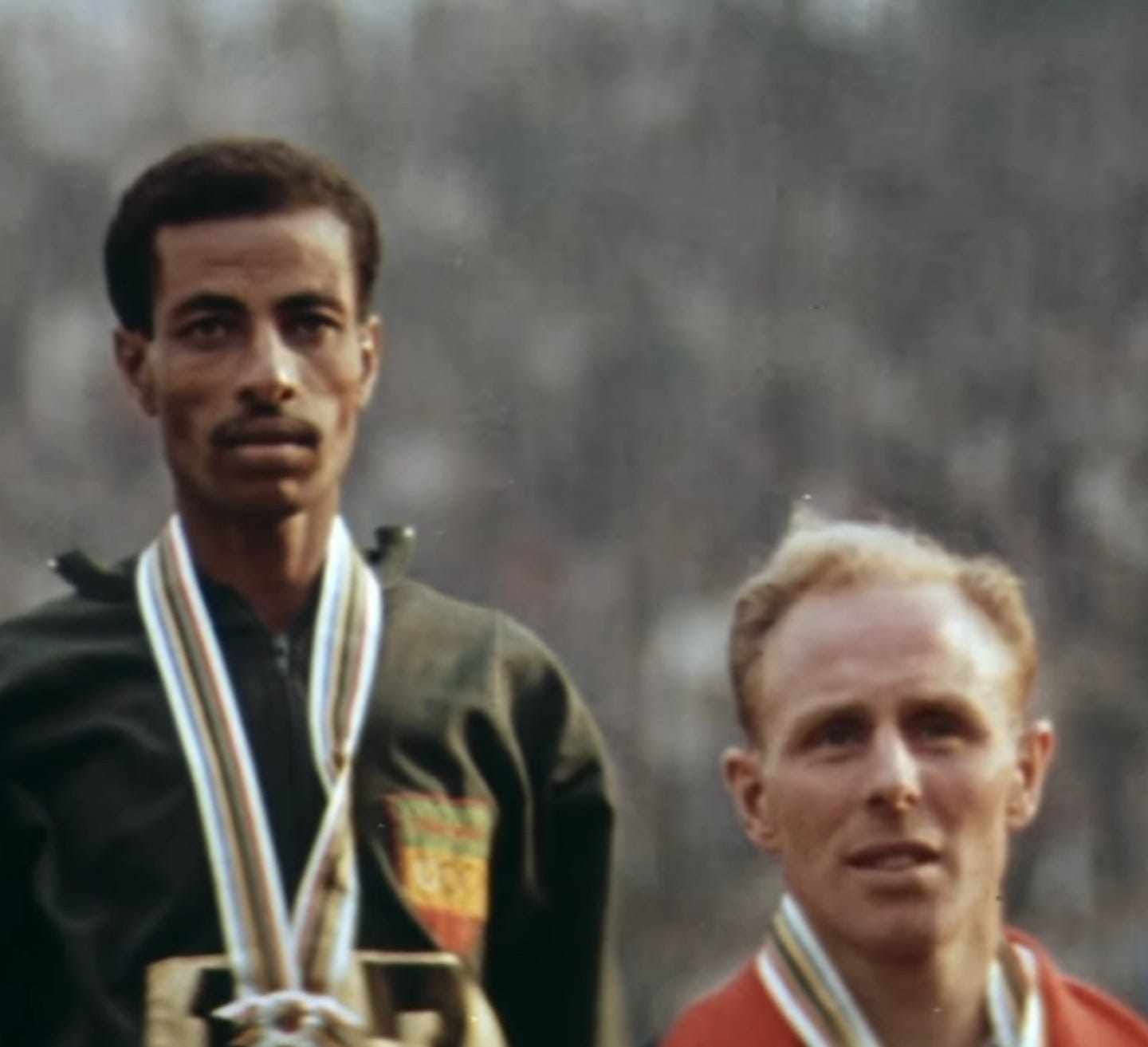
The Legend of Abebe Bikila
Abebe Bikila (Amharic: አበበ ቢቂላ), an Ethiopian highlander, entered the marathon as a late replacement. Finding that his issued shoes didn't fit, he chose to run the way his ancestors had for millennia: barefoot.
The Symbolic Route: In a poetic "reunion" of history, Bikila ran past the Obelisk of Axum, which had been looted from Ethiopia by Italian forces years earlier.
The Result: He didn't just win; he set a world record. By winning the first gold medal for Sub-Saharan Africa, he shattered the myths of the 17th-century "scientists" and proved that the ultimate endurance engine remained exactly where it was invented: the East African Rift.
The Rift Valley: The True Engine of Sapiencization

The transition from the “1.0” Eurasian lineages to the Sapiens 2.0 (الإنسان العاقል) model was defined by a massive expansion of the Prefrontal Cortex (PFC), a biological “charge” that transformed the Rift Valley into a high-pressure laboratory for cognitive flexibility. Unlike the Ice-Age-adapted Neanderthals who specialized in physical sensory-motor sy…