
TL;DR:
The history of human evolution in South Asia is often told as a series of replacements—one group arriving and another vanishing. However, the geological and genetic record of the Narmada Valley (Sanskrit: नर्मदा, Narmadā, lit. ‘Giver of Pleasure’) suggests a far more complex “Alchemical” process. During the Pleistocene, the valley acted as a high-pressure Refugium—a biological safe house where the fluctuating climate forced disparate human lineages into a “Forced Neighborhood.”
The Sahara Pump: The Climatic Valve
The primary driver of this interaction was the Sahara Pump (Arabic: الصحراء الكبرى, al-Ṣaḥrā’ al-Kubrā). This planetary-scale climate mechanism functioned like a valve, dictating when the gates to the Indian subcontinent were open or shut.
The Humid Opening: During “Pluvial” periods, increased monsoon intensity transformed the deserts of the Middle East and Thar into lush Sāwanā (Sanskrit: सवाना, savānā, lit. ‘savanna’). This created a green corridor, allowing the CT Lineage (Modern Humans) to migrate from Africa into the heart of India.
The Arid Squeeze: When the pump reversed during “Interpluvial” spells, the surrounding grasslands turned into an impassable Marusthal (Sanskrit: मरुस्थल, marusthala, lit. ‘land of death’). Water became the ultimate currency.
This “Arid Squeeze” sucked moving populations into the permanent river systems. The Narmada, protected by the Vindhya and Satpura ranges, became a permanent reservoir of life. Here, the newly arrived migrants were physically “squeezed” into the same narrow corridor as the indigenous archaic residents, such as the descendants of Narmada Man (Homo heidelbergensis or archaic Homo sapiens).
The Survival Toolkit: Merging the “Software”
In the restricted space of the Narmada Refugium, avoidance was no longer a viable strategy. The archaeological layers at sites like Hathnora provide a window into how these groups began to merge their survival strategies.
The Acheulean Legacy: The indigenous groups were masters of the Acheulean (Sanskrit: अश्म-युग, aśma-yuga, lit. ‘Stone Age’) tradition, characterized by heavy bifacial handaxes. These were the “heavy lifting” tools of the Pleistocene, essential for processing large carcasses and digging for deep tubers during droughts.
The Microlithic Innovation: The arriving lineages brought “lightweight” logic—refined flakes and eventually Sūkṣma-paṣāṇa (Sanskrit: सूक्ष्म-पाषाण, lit. ‘microlithic’) points. These were designed for high-mobility hunting and efficiency.
The record shows a unique synthesis: a “Late Acheulean” phase where heavy handaxes and sophisticated light points appear together. This represents a Saṃgam (Sanskrit: संगम, saṃgam, lit. ‘confluence’) of technology. The locals provided the territorial knowledge of Quartzite (Sanskrit: स्फटिक, sphaṭika) sources, while the migrants provided the innovative edge.
The Ghost in the Code: Genetic Persistence
The most enduring legacy of this “Forced Neighborhood” is not found in stone, but in the modern South Asian genome. The intense proximity of the Narmada Refugium facilitated a “Genetic Handshake” that preserved the Bīja (Sanskrit: बीज, bīja, lit. ‘seed’ or ‘source’) of ancient lineages.
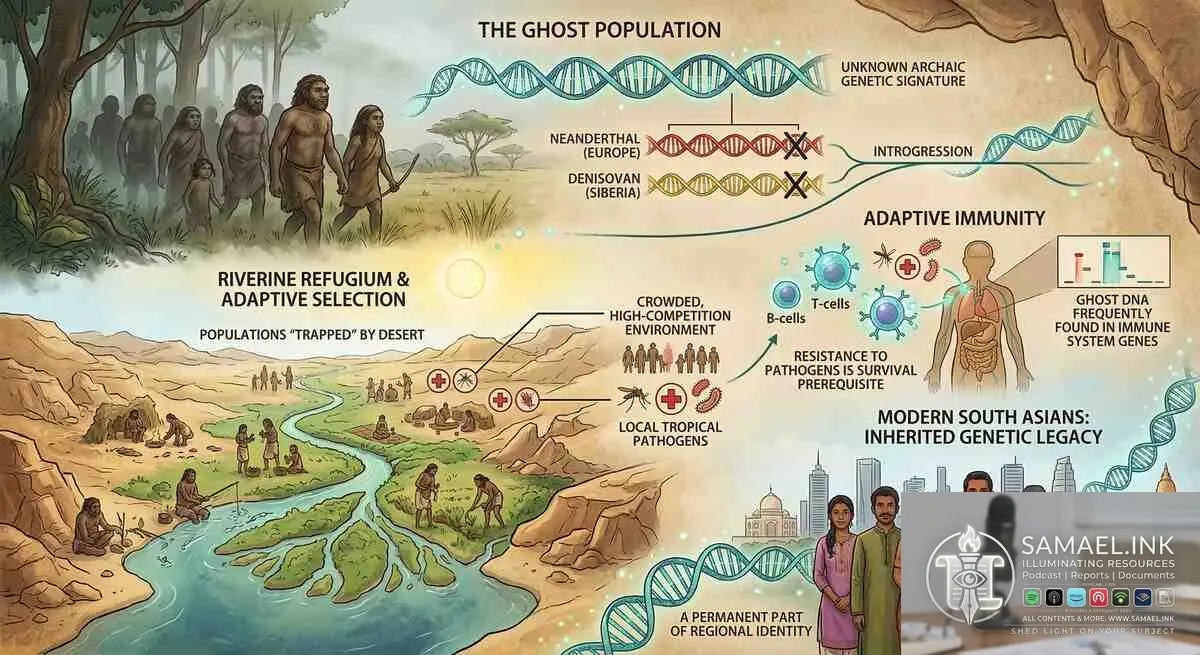
Modern South Asians carry “Ghost DNA”—genetic signatures from an unknown archaic population that does not perfectly match the Neanderthals of Europe or the Denisovans of Siberia.
Adaptive Immunity: These genes are frequently found in the immune system. In the crowded, high-competition environment of a riverine refugium, the ability to resist local tropical pathogens was a prerequisite for survival.
The Refugia Effect: Because these groups were “trapped” together by the surrounding desert, these archaic genes were not diluted by subsequent migrations. Instead, they were selected for, becoming a permanent part of the regional identity.
The “Vanara” Social Structure: Oral Echoes
This biological and technological merging likely required a new social framework. The forced co-existence of phenotypically different human groups—some perhaps more robust or “archaic” in appearance—may be the historical root of the Vanara (Sanskrit: वानर, vānara, lit. ‘forest-dweller’) descriptions in ancient oral traditions.
Rather than mythical creatures, the Vanara represent a fossilized memory of:
Complex Alliances: Different human types forming a shared Kula (Sanskrit: कुल, kula, lit. ‘clan’) to manage resources.
Dharma of Proximity: The development of Dharma (Sanskrit: धर्म, from the root dhṛ ‘to uphold’)—a code of conduct to prevent fratricidal conflict at the limited watering holes of the Narmada.
“The Narmada Valley sequence shows a unique persistence... indicating a long period of cultural continuity and interaction.” (Misra, V. N., Prehistoric Human Colonization of India).
The transition from heavy Acheulean handaxes to the more refined Middle Palaeolithic (MP) and eventually microlithic points in the Narmada Valley is not just a chronological shift; it is the physical footprint of a “cultural handshake.”
In the high-pressure environment of a refugium, the merging of these distinct lineages likely resulted in a combined survival kit that was more resilient than its individual parts.
The Survival Toolkit: Merged Technologies
When the “Indigenous Archaics” and the “CT Lineage Migrants” were squeezed into the Narmada (Sanskrit: नर्मदा, Narmadā) corridor, their respective methods for interacting with the environment began to bleed into one another.
The Heavy “Legacy” Infrastructure
The older residents of the valley were masters of the Acheulean (Sanskrit: अश्म-युग, aśma-yuga, lit. ‘Stone Age’) tradition. Their primary tool was the Biface or Handaxe—a heavy, versatile implement designed for butchering large game and processing tough plant materials.
In a dry “interpluvial” period, these tools were essential for accessing deep-seated nutrients (like tubers) and processing the remains of animals drawn to the shrinking riverbanks. The permanence of this technology in the Narmada suggest a stable, long-term Sthāna (Sanskrit: स्थान, sthāna, lit. ‘place’ or ‘abode’) of archaic knowledge.
The Migrant “Innovation”
The arriving lineages brought a different logic: the Levallois technique and later Micro-lithic (Sanskrit: सूक्ष्म-पाषाण, sūkṣma-pāṣāṇa, lit. ‘small stone’) strategies. These focused on:
Efficiency: Extracting more cutting edge from less raw material.
Mobility: Light, replaceable points that could be hafted onto spears.
Versatility: Tools designed for the faster, smaller game that survived in the scrublands surrounding the valley.
The “Alchemical” Synthesis
Excavations at sites like Hathnora and Bhimbetka (Sanskrit: भीमबेटका, Bhīmabeṭkā) reveal a fascinating overlap. We see a “Late Acheulean” phase where heavy handaxes are found alongside sophisticated flake tools.
This suggests that rather than one group replacing the other, they merged their strategies. The locals taught the migrants how to source the best Quartzite (Sanskrit: स्फटिक, sphaṭika, lit. ‘crystal’ or ‘quartz’) from the Vindhya ranges, while the migrants introduced the “lightweight” logic that made hunting more efficient during lean seasons.
“The Narmada sequence shows a unique persistence of Acheulean forms alongside emerging Middle Palaeolithic elements, indicating a long period of cultural continuity and interaction.” (Misra, V. N., Prehistoric Human Colonization of India).
The “Ghost” in the Toolkit
The Sahara Pump (Arabic: الصحراء الكبرى, al-Ṣaḥrā’ al-Kubrā, lit. ‘The Greatest Desert’) acts as a planetary-scale respiratory system. During “Humid Periods,” the valve opens, turning the desert into a lush Sāwanā (Sanskrit: सवाना, savānā, lit. ‘savanna’ or ‘grassland’)—a bridge for migration. During “Arid Periods,” the valve closes, turning the desert into an impassable Marusthal (Sanskrit: मरुस्थल, marusthala, lit. ‘land of death’ or ‘desert’), trapping lineages in “safe house” refugia.
The Climate “Valves”: Shaking the Genes
The interaction between the Sahara Pump and the Indian Monsoons created a rhythmic “push-pull” effect. This forced groups to either integrate within the Narmada (Sanskrit: नर्मदा, Narmadā) or perish in the expanding dust.
The Green Corridor (The Open Valve)
When the Earth’s axial tilt (obliquity) maximized, the African and Indian monsoons intensified. The Sahara and the Arabian deserts transformed into a network of lakes and rivers.
The Migration: This was the “Open Gate.” Modern Homo sapiens and archaic groups could move freely across the Levant into the Indus and Narmada systems.
The Result: High gene flow and low competition. Groups were spread thin, meaning “Genetic Shaking” was rare because there was no pressure to share the same small watering holes.
The Arid Squeeze (The Closed Valve)
As the monsoons weakened, the “Pump” reversed. The grasslands collapsed, and the surrounding regions became Irsh (Amharic: እርጥበት አልባ, erṭibet elba, lit. ‘moistureless’).
The Refugia Effect: Groups were “sucked” into the permanent river valleys. The Narmada became a biological trap.
The “Shaking” Mechanism: In these narrow corridors, isolation was impossible. The “Ghost DNA” we see today—traces of archaic lineages that no longer exist—is the result of this forced proximity.
The “Ghost” in the Code
Modern South Asian genomes contain specific archaic signatures that don’t match Neanderthals or Denisovans perfectly. These are the “Ghost” ancestors.
In genetic terms, a “Ghost Population” is a lineage for which we have no physical fossil DNA (like a femur or a tooth) but whose existence is mathematically certain because their “code” is found inside us.
Modern South Asians carry “Ghost DNA”—genetic signatures from an unknown archaic population that does not perfectly match the Neanderthals of Europe or the Denisovans of Siberia.
Adaptive Immunity: These genes are frequently found in the immune system. In the crowded, high-competition environment of a riverine refugium, the ability to resist local tropical pathogens was a prerequisite for survival.
The Refugia Effect: Because these groups were “trapped” together by the surrounding desert, these archaic genes were not diluted by subsequent migrations. Instead, they were selected for, becoming a permanent part of the regional identity.
The Denisovan-like Signal
While Neanderthal DNA is relatively uniform across Eurasia, South Asian populations often show a specific affinity for Denisovan (Siberian Archaic) or “Denisovan-like” markers.
The Refugia Evidence: Geneticists have identified that this introgression likely happened in “pulses.” The Narmada Valley, acting as a stable Ādhāra (Sanskrit: आधार, ādhāra, lit. ‘base’ or ‘foundation’), allowed for these pulses to settle and integrate.
Functional Legacy: These “Ghost” genes are often found in the HLA (Human Leukocyte Antigen) system—the part of our DNA that manages the immune response. Living in the high-density “Squeeze” of the Narmada required an upgraded immune system to survive the pathogens of a permanent water source.
The Unknown “Basal” Lineage
Recent studies suggest a third, unknown archaic group—distinct from both Neanderthals and Denisovans—that contributed to the South Asian genome.
The Narmada Connection: This “Ghost” likely represents the descendants of the Narmada Man (Homo heidelbergensis or a late Homo erectus variant).
The Genetic Handshake: When the CT Lineage (Modern Humans) arrived during a “Green Sahara” window, they encountered these “Ancient Residents.” The resulting offspring carried the Bīja (Sanskrit: बीज, bīja, lit. ‘seed’ or ‘source’) of both worlds.
Why the “Refugia” Mattered for Selection
In a standard migration, “dilution” happens—the smaller group’s genes eventually vanish. However, in a Refugium, the population is trapped. This creates a “Boiler Room” effect:
Genetic Persistence: Because they couldn’t leave, the archaic genes weren’t washed away; they were selected for because they provided local survival advantages.
The Result: Modern South Asians carry a unique genetic mosaic that is a direct record of who survived the “Arid Squeeze.”
“The presence of deeply divergent mitochondrial lineages in India suggests that the subcontinent served as a major reservoir of genetic diversity during the Pleistocene.” (Maji, S., et al., Genetic Heterogeneity in South Asian Populations).
The Setting: These genetic signatures suggest that the “handshake” happened in stable, long-term habitats where groups lived together for thousands of years, not just during a passing migration.
The Legacy: This interbreeding likely provided the modern lineage with Ārogya (Sanskrit: आरोग्य, ārogya, lit. ‘health’ or ‘freedom from disease’)—specifically, immune system adaptations suited for the local pathogens of the Indian subcontinent.
“Periodic increases in humidity... allowed for the dispersal of hominins, while subsequent aridification led to the fragmentation of populations and their confinement to ecological refugia.” (Petraglia, M. D., The Evolution of Human Populations in Arabia).
The Sahara Pump provided the “input” of new lineages, but the Narmada “Safe House” provided the “processing” where those lineages merged into the foundational South Asian identity.
When the climate swung toward “interpluvial” (dry) spells, the Narmada (Sanskrit: नर्मदा, Narmadā, lit. ‘Giver of Pleasure’) became a vital corridor. This geographic confinement necessitated a shift from avoidance to engagement.
The Biology of Alliances
In the restricted space of a refugium, the traditional boundaries between Homo sapiens and archaic lineages (such as the descendants of “Narmada Man”) likely blurred. This wasn’t just about survival; it was about the creation of Kula (Sanskrit: कुल, kula, lit. ‘family’ or ‘clan’) structures that incorporated diverse biological backgrounds.
As noted by Robin Dennell in The Palaeolithic Settlement of Asia, the sustainability of human populations in refugia depends heavily on “social networking” to manage resource competition. This proximity likely birthed a hybrid social identity—groups that were phenotypically different but culturally and economically integrated.
Myth as a Distant Mirror
The descriptions of the Vanara (Sanskrit: वानर, vānara, possibly derived from vana ‘forest’ and nara ‘man’, lit. ‘forest-dweller’) in ancient texts may represent a fossilized memory of these archaic-modern interactions. Rather than simple “monkeys,” these figures are often depicted as having:
Distinctive Physiology: Features that differ from the “modern” norm.
Sophisticated Tool Use: Mastery of forest-based technologies.
Complex Diplomacy: The ability to form strategic alliances with other human groups (as seen in the Rāmāyaṇa).
The “Forced Neighborhood” of the Narmada likely required the development of Dharma (Sanskrit: धर्म, dharma, from the root dhṛ ‘to uphold’ or ‘to support’)—a set of codes to govern interaction between different “types” of humans sharing the same watering holes.
The Socio-Ecological Magnet
The Narmada served as a Saṃgam (Sanskrit: संगम, saṃgam, lit. ‘confluence’) not just of waters, but of social systems. In these valleys, the “Indigenous Archaics” and the “CT Lineage Migrants” would have traded:
Territorial Knowledge: The locals knew the hidden springs.
Innovative Strategies: The migrants brought new ways of organizing.
“The Narmada Valley provides a continuous record of human occupation... suggesting it was a core area for the evolution and dispersal of diverse human groups in South Asia.” (Chauhan, P. R., The Indian Pleistocene: A Review of the Archaeological and Paleontological Record).
Conclusion: The Crucible of Identity
The Narmada Refugia Strategy demonstrates that human identity in South Asia was not “delivered” by a single migration; it was “forged” in the heat of the Pleistocene. The Sahara Pump provided the raw materials—the diverse human lineages—but the Narmada provided the crucible. We are the descendants of those who learned to share the toolkit, the territory, and the code.
Check out our other topics on genetics below.
The Rift Valley: The True Engine of Sapiencization

The transition from the “1.0” Eurasian lineages to the Sapiens 2.0 (الإنسان العاقል) model was defined by a massive expansion of the Prefrontal Cortex (PFC), a biological “charge” that transformed the Rift Valley into a high-pressure laboratory for cognitive flexibility. Unlike the Ice-Age-adapted Neanderthals who specialized in physical sensory-motor sy…
All Germans Are Africans

If you trace the lineage of any person living in Germany today—from the Baltic coast to the Bavarian Alps—the path eventually leaves Europe entirely. Scientific evidence from genetics, paleoanthropology, and geology confirms that the biological foundation of every German citizen is rooted in the African continent.