
The Star Symbol
The green star (Seal of Solomon, also called the Pentagram) was added to Morocco’s flag in 1915 under Sultan Mulay Yusef, when Morocco was a French protectorate.
The official line: the five points represent the five pillars of Islam.
But the Seal of Solomon was originally a Jewish mystical symbol, long before Islam. In Jewish tradition it represented wisdom, divine authority, and protection against evil.
Shared Symbolism in Judaism & Islam
In medieval North Africa, Jewish and Muslim cultures intermingled.
The hexagram (Star of David) and pentagram (Seal of Solomon) were used interchangeably in Jewish, Christian, and Muslim mystical texts.
Moroccan Sufi traditions even saw the pentagram as a talismanic “Solomonic” sign, linking it back to King Solomon (Sulayman in Islam, Shlomo in Judaism).
Morocco’s Jewish Heritage
Morocco had one of the largest and oldest Jewish populations in the Islamic world.
Jews lived in Fez, Marrakesh, Meknes, Essaouira, and were especially influential in trade.
The flag’s adoption of the Solomonic pentagram could reflect this shared Judeo-Islamic cultural memory — even if officially re-Islamized as a symbol of the pillars of faith.
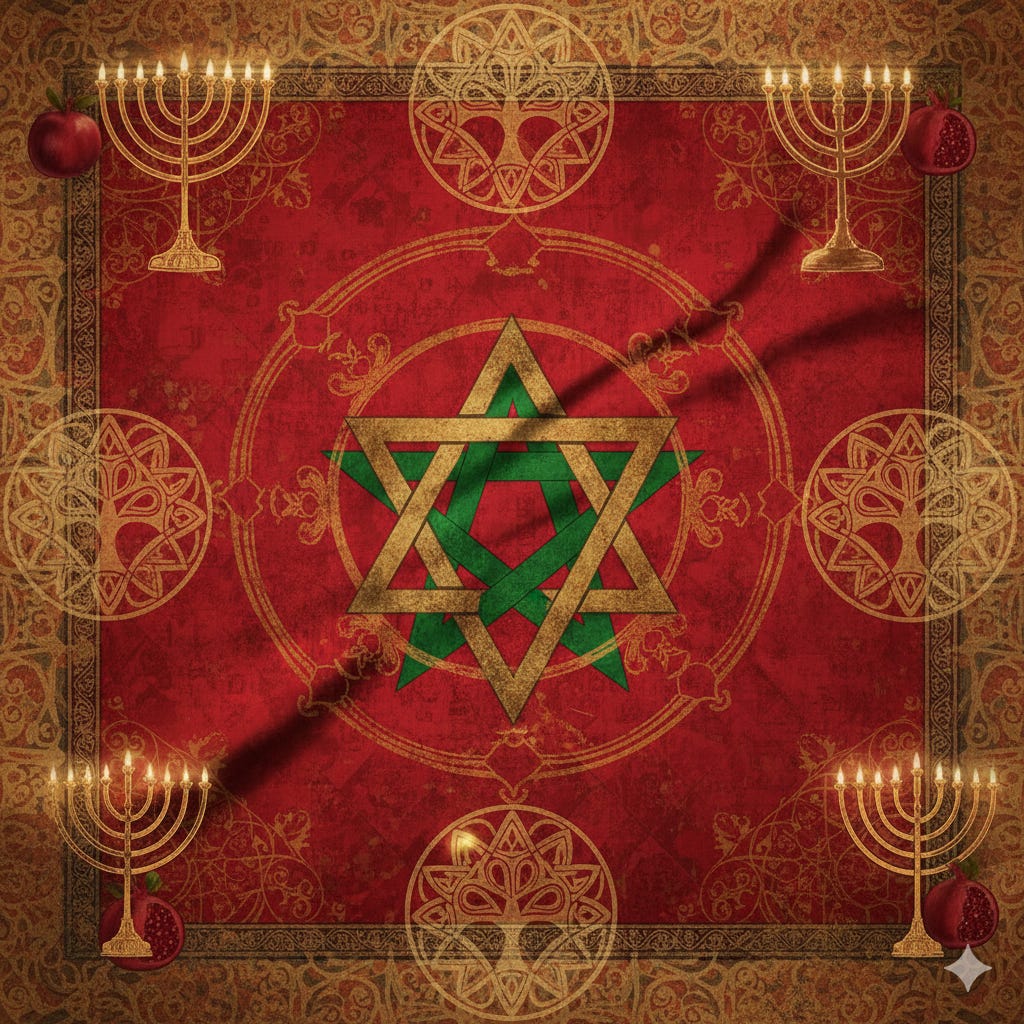
AI rendered image showing flag of Morroco and Judaic roots
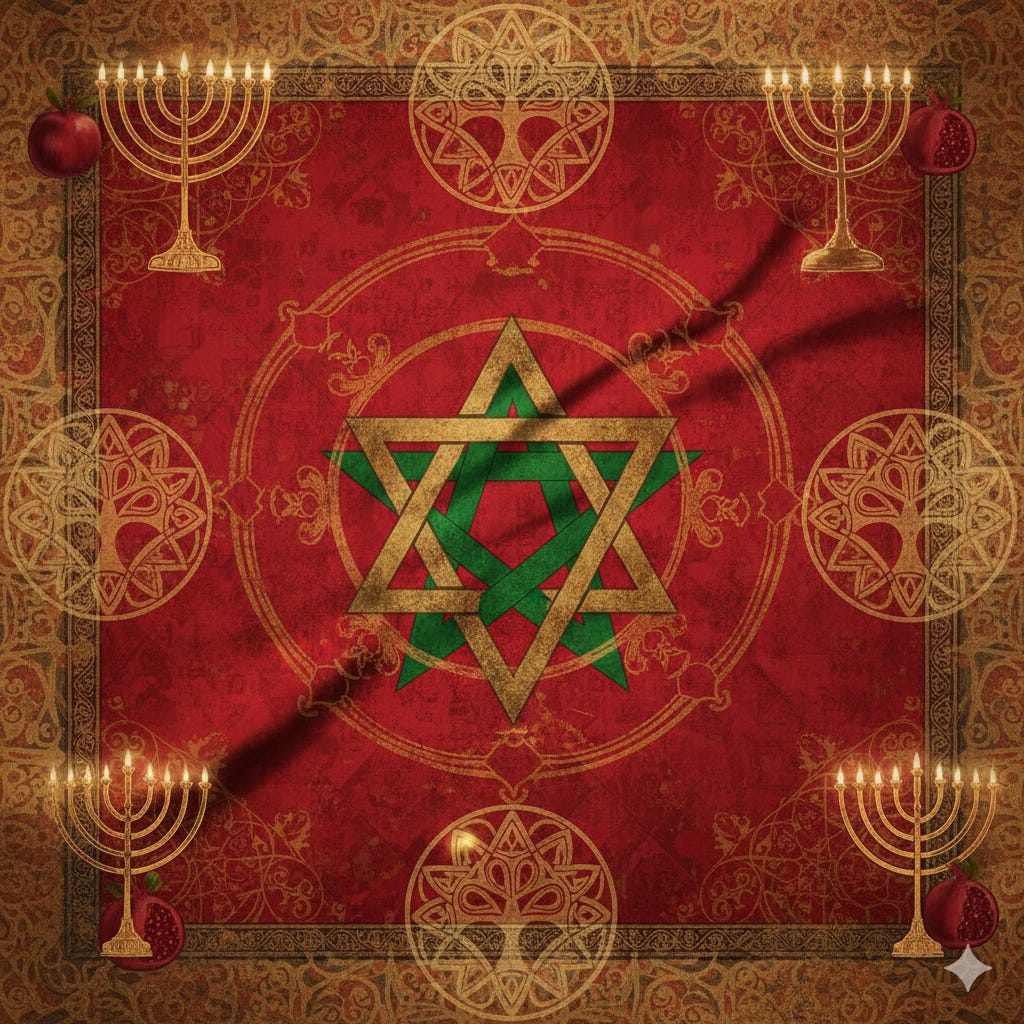
Interpretations
Official Moroccan view: The five-pointed green star = the five pillars of Islam.
Alternative view (symbolic historians): It’s also a continuation of Solomonic/Judaic iconography, adapted into Moroccan Islamic symbolism.
In this sense, Morocco’s flag can be read as an emblem of its Judeo-Islamic fusion, since Moroccan identity historically included both Muslims and Jews as integral communities.
✨ So yes — the Jewish presence in North Africa is historically explained by this Phoenician-Canaanite connection.
The same Levantine seafarers who carried Baal and Tanit westward also created the cultural channels through which Jews dispersed into North Africa.
It’s less of an “imported” community and more of a Semitic continuum stretching from the Levant to the Maghreb.
Early Jewish Presence (Hellenistic–Roman period)
Cyrenaica (Eastern Libya): Jews settled here as early as the 3rd century BCE. By the 1st century CE, Cyrene (near today’s Shahat, Libya) had a massive Jewish population.
Tripolitania (Western Libya — Oea/Tripoli, Sabratha, Leptis Magna): also had Jewish communities by the Roman era. Inscriptions, catacombs, and synagogue remains have been found.
Roman sources describe major Jewish revolts (115–117 CE, the “Kitos War”) in Cyrene and Egypt, showing just how numerous and influential they were.
Jewish Influence on the Cities of Tripolis
Economy: Jews were heavily involved in trade, crafts, and sometimes farming. They helped connect the Tripolis with broader Mediterranean networks.
Religion & Culture: In cities founded by Phoenicians and ruled by Romans, Judaism introduced another Semitic religious stream, distinct from pagan cults but still recognizable as part of the Levantine world.
Identity: Judaism added to the “multi-ethnic” character of Tripoli — alongside Punic descendants, Berbers, Greeks, and Romans.
After Rome — Vandal, Byzantine, and Islamic Periods
Under the Vandals (5th c. CE), Jews were relatively tolerated.
Under the Byzantines (6th c. CE), they faced Christian-imperial restrictions, but communities survived.
With the Arab-Islamic conquest (7th c. CE), Jews became dhimmis (protected but taxed minorities). Many local Berbers even adopted Judaism, especially in the Atlas and Tripolitanian hinterlands.
Medieval Jewish travelers like Benjamin of Tudela (12th c.) recorded thriving Jewish communities in the Maghreb.
Tripoli under the Barbary Regencies (16th–19th c.)
The Jewish community of Tripoli was substantial, living in its own quarter (the Hara).
Jews served as traders, interpreters, and sometimes intermediaries between corsairs and European states.
They were a minority but a crucial part of the local economy — much like in Tunis or Algiers.
Modern Era & Gaddafi
Italian colonization (1911) and WWII disrupted Jewish life in Tripoli; many Jews were deported or persecuted by pro-Axis forces.
After Israel’s founding (1948) and waves of anti-Jewish violence, most Jews emigrated. By Gaddafi’s rule (1969–2011), only a handful of Jews remained in Tripoli.
In a symbolic sense, Judaism — once central to Tripoli’s Mediterranean character — was erased, but its imprint remains in records, ruins, and memory.
Influence in Summary
Religious: Judaism offered a monotheistic, Semitic alternative alongside Phoenician paganism and later Christianity/Islam.
Cultural: It linked Tripoli with other Jewish communities across the Mediterranean (Alexandria, Rome, Jerusalem).
Economic: Jewish merchants and artisans were vital in Tripoli’s urban economy for centuries.
Historical Memory: From Cyrene to Tripoli, Jewish presence forms part of the long Levantine–North African continuum that shaped the region.
✨ So: Judaism in the Tripolis of North Africa was never dominant, but it was persistent, resilient, and connective — embedding Levantine monotheism into a Phoenician-Punic cultural landscape, later coexisting with Christianity, Islam, and even corsair geopolitics.