
TL;DR
The Hexagon doctrine shifted from theory to reality with a coordinated diplomatic strike in Jerusalem, establishing a maritime corridor designed to bypass the land-based “Baghdad Overwrite.” By anchoring the alliance with India, Greece, and Cyprus, Israel has effectively recharted the trade map of the Middle East for 2026.
What was the opening move of the Hexagon Alliance?
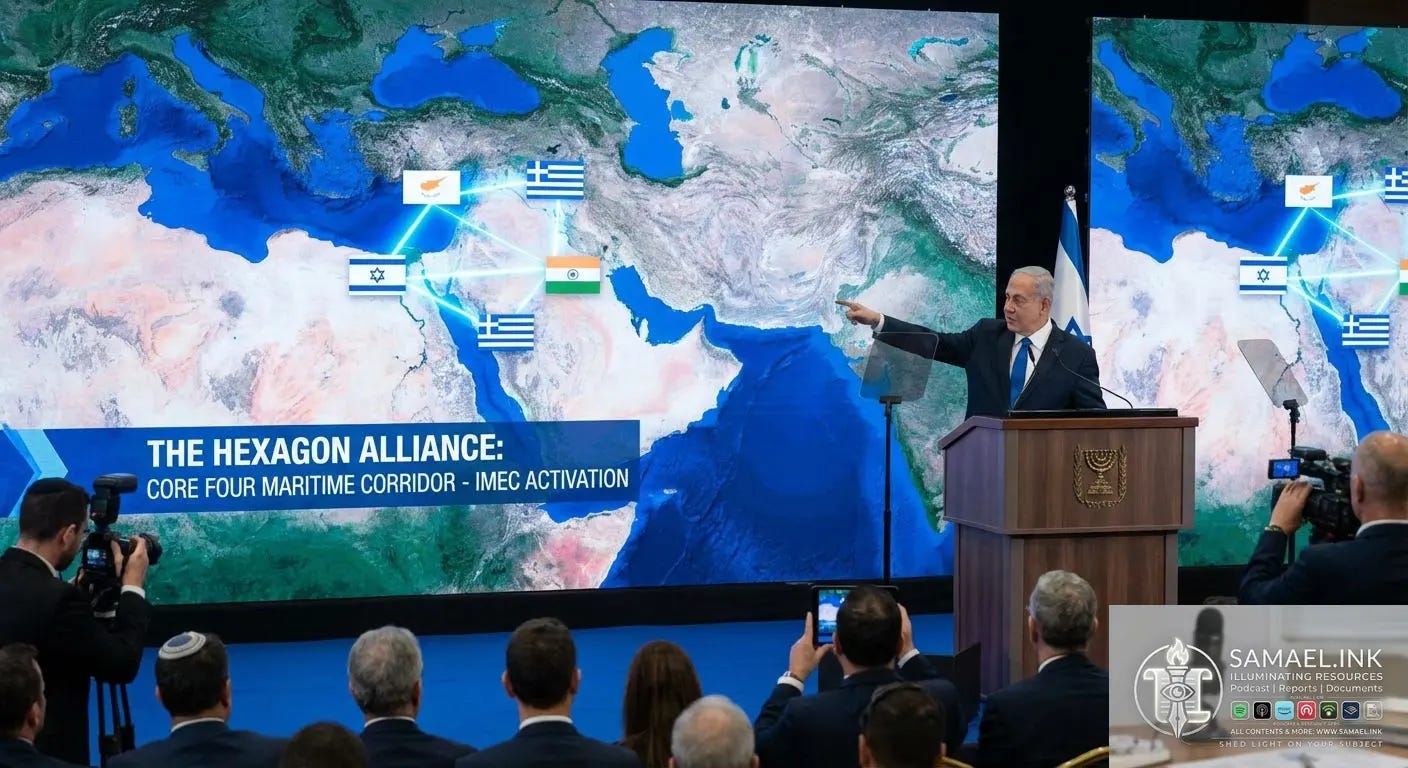
The “Hexagon” did not emerge from a vacuum; it was a deliberate response to the fragmentation of global trade routes and the systemic “Hardware Foreclosure” facing the West. When Prime Minister Netanyahu stood before the cameras on February 22, 2026, he wasn’t just announcing a security pact—he was unveiling a new merchant map for a world weary of regional chokepoints and the administrative weight of the old land powers.
By explicitly naming India, Greece, and Cyprus alongside Israel, the doctrine established a “Core Four” that effectively brackets the most volatile regions of the Middle East. This alignment represents the first physical activation of the India-Middle East-Europe Economic Corridor (IMEC), moving it from G20 theory into operational reality. Unlike the centralized “Baghdad Overwrite” models of the past—which relied on massive, vulnerable land bureaucracies and the mercy of continental hegemons—this alliance is built on decentralized maritime coordination. The strategic goal is clear: create a resilient, high-trust circuit linking the Indian Ocean directly to the European market, shielding vital goods from the threats of regional shadow networks.
Why did the “Core Four” prioritize maritime routes over traditional land borders?
The 2026 landscape—defined by the “Sino-Russian Shield” and the persistent disruption of the Red Sea—demands speed and directness. This specific alignment allows for:
Sovereign Infrastructure: Fast-tracking the IMEC North Corridor. By linking Indian ports like Mundra directly to Haifa, and onward to Piraeus in Greece, the Hexagon creates a multimodal bypass. This route effectively avoids the traditional land-based “toll booths” and the political volatility of the Levant interior.
Predictive Security: Shifting from reactive border guards to proactive maritime intelligence. Shared surveillance across the Erythraean Sea, supported by I2U2 protocols, ensures that the “Core Four” can maintain the flow of energy and goods even when terrestrial routes are compromised.
A Non-Sectarian Axis: By centering on India—a global power with no stake in intra-Islamic sectarian politics—the Hexagon creates a conceptual space where economic interests override ideological divides. This allows the alliance to act as a “Moderate Axis” that can integrate formerly hostile nodes into a singular trade architecture.