
TL;DR: The emergence of the “Hexagon” maritime alliance marks the official end of the 100-year “Baghdad Overwrite” land-power model. By linking India, Israel, Greece, and Cyprus with strategic anchors in the UAE and Ethiopia, this new trade circuit creates a resilient, high-tech bypass against the 2026 Sino-Russian Shield.
What was the opening move of the Hexagon Alliance?
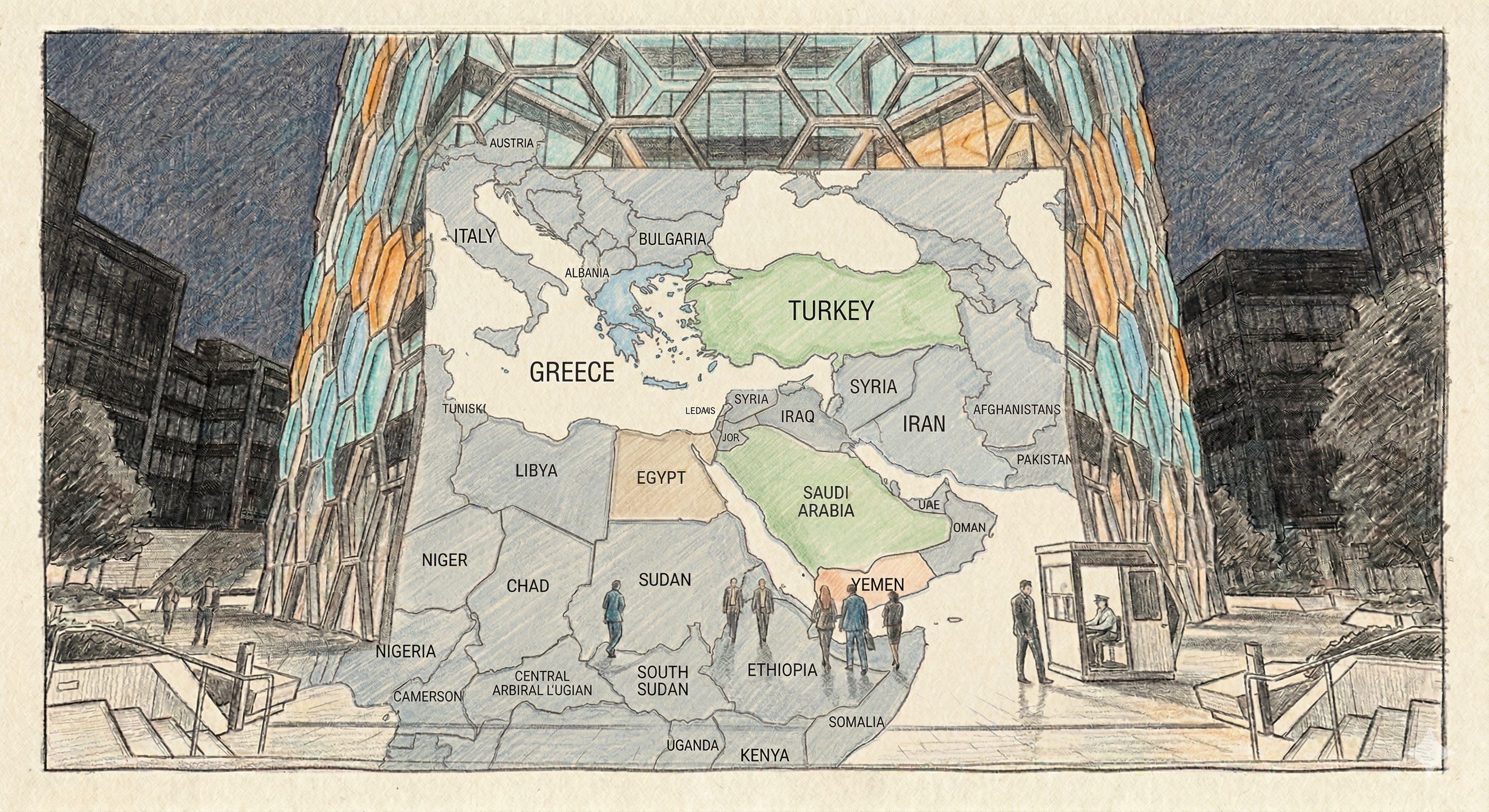
The “Hexagon” did not emerge from a vacuum; it was a deliberate response to the fragmentation of global trade routes and the systemic “Hardware Foreclosure” facing the West. When Prime Minister Netanyahu unveiled the doctrine on February 22, 2026, he wasn’t just announcing a security pact—he was unveiling a new merchant map.
By explicitly naming India, Greece, and Cyprus alongside Israel, the doctrine established a “Core Four” that brackets the most volatile regions of the Middle East. This alignment represents the first physical activation of the India-Middle East-Europe Economic Corridor (IMEC). Unlike the centralized “Baghdad Overwrite” models of the past, this alliance is built on decentralized maritime coordination. The goal is a resilient, high-trust circuit linking the Indian Ocean directly to Europe, shielding vital goods from regional shadow networks.
How did the India-Israel summit activate the Hexagon?
The February 26 summit between Modi and Netanyahu was the “ground-truth” moment. Beyond the elevation to a Special Strategic Partnership, the focus shifted to the physical integration of maritime and digital infrastructure.
By formalizing protocols between Mumbai and Haifa, the summit created a “Hardware Shield.” This includes new frameworks for Israeli military hardware exports to India specifically to secure the maritime lanes feeding the IMEC. This connection bypasses the traditional reliance on continental land powers, favoring a direct maritime circuit where India serves as the ultimate “Source Node”—a provider of manufacturing no longer dependent on land-blockades.
Why did the UAE remain the “Unnamed Arab Node”?
Strategic ambiguity serves the UAE’s interests. While referred to as an “unnamed Arab nation” to avoid friction within the Arab League, the UAE is the essential financier and logistics hub for the corridor.
Through the January 2026 UAE-India pacts, Abu Dhabi has effectively underwritten the physical bypass of the Levant interior. This “Shadow Alliance” model allows for the creation of “Trust Corridors”—physical routes where security is guaranteed by shared economic survival (and Israeli tech/Indian naval presence) rather than shifting political treaties.
How does the “Herzog Mission” secure the Southern Anchor?
President Herzog’s mission to Addis Ababa in March 2026 finalized the “Southern Tier.” This move established a framework of “Infrastructure Mutualism.” Israel provides advanced defensive technology—including anti-drone systems—to protect the Grand Ethiopian Renaissance Dam (GERD). In exchange, Ethiopia serves as the land-based guardian for the southern Red Sea gates. This creates a “Security Bracket” that shields the corridor from interference by non-state actors in the Gulf of Aden.
What is the “Recognition Trap” of the Berbera Axis?
The integration of the Berbera Corridor provides the vital maritime gateway for Ethiopia. Backed by Israeli intelligence and Emirati capital, Berbera has been transformed into a “Sovereign Outpost.”
This creates the “Recognition Trap” for rivals like the “Mogadishu Axis” (Egypt/Turkey/Somalia). By making Berbera indispensable to global trade and Indo-Israeli security, the Hexagon forces rivals to either accept Somaliland’s functional independence or risk disrupting the very trade routes they depend on. Sovereignty is being rewritten through economic necessity.
Is the Hexagon the permanent map of 2026?
Six weeks after its debut, the Hexagon has transitioned from a rhetorical doctrine to an active geopolitical circuit. It represents the final obsolescence of land-based hegemonies.
This “Living Map” follows the flow of maritime AI, undersea cables, and physical rail links. In the current landscape, sovereignty is maritime. The nations within the Hexagon have successfully out-indexed the old land powers, creating a corridor of survival that stands as the primary competitor to the Sino-Russian Shield.