
TL;DR: President Herzog’s landmark February 2026 mission to Addis Ababa signaled the activation of the Hexagon’s "Southern Tier." By anchoring Ethiopia as the guardian of the Bab al-Mandab, the alliance has secured a critical chokepoint against the "Sino-Russian Shield" and regional radical axes.
What was the purpose of the Herzog Mission to Addis Ababa?
In late February 2026, President Isaac Herzog arrived in Ethiopia for a state visit that moved far beyond symbolic diplomacy. While public statements focused on the historic bonds of the "Beta Israel" community, the strategic core of the mission was the formalization of Ethiopia as the African Node of the Hexagon.
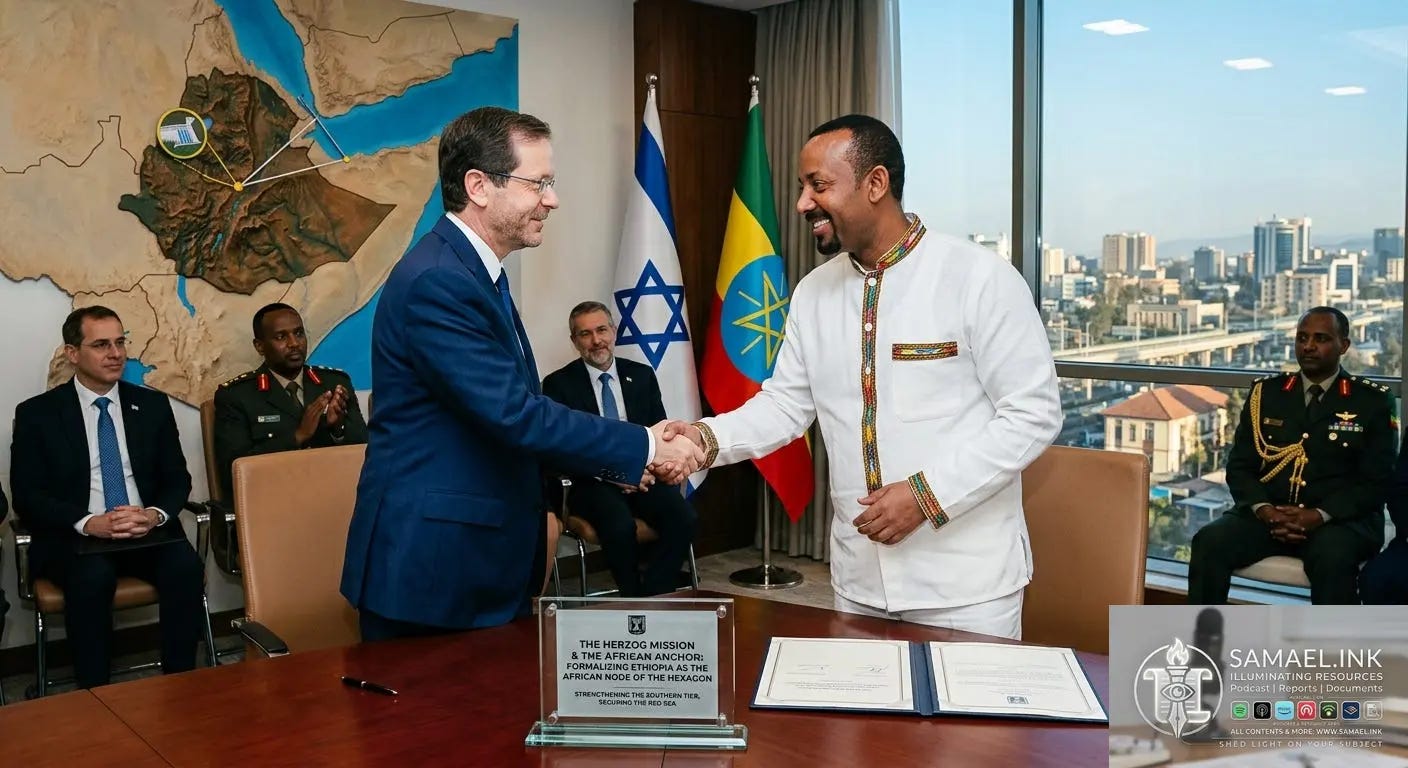
This visit was the final "bracket" needed to secure the southern Red Sea. Coming just days after the Modi-Netanyahu summit, Herzog’s mission established a framework of "Infrastructure Mutualism." Under this arrangement, Israel provides advanced defensive technology—including anti-drone systems and satellite monitoring—to protect Ethiopia’s most sensitive strategic assets, most notably the Grand Ethiopian Renaissance Dam (GERD). In exchange, Ethiopia has committed to serving as the land-based security anchor for the "Berbera Axis," ensuring that the maritime gates to the Suez Canal remain open to Hexagon-aligned trade.
How does Ethiopia stabilize the Red Sea for the Hexagon?
Ethiopia’s military mass and its status as the seat of the African Union make it the indispensable stabilizer for the southern chokepoints. By aligning with the Hexagon, Addis Ababa provides a counter-weight to the "Mogadishu Axis" (the Egypt-Turkey-Somalia alignment) that seeks to restrict Ethiopian maritime ambitions.
The stability provided by Ethiopia allows for:
The Berbera Gateway: Protecting the flow of goods from the Gulf of Aden through the newly integrated Berbera port corridor.
Regional Deterrence: Serving as a forward operating base for maritime monitoring, allowing the Hexagon to project influence directly into the Bab al-Mandab without maintaining a massive, overt naval presence.
For Ethiopia, this is not just a security pact; it is an existential move to break its landlocked status. By joining the Hexagon, Prime Minister Abiy Ahmed has secured the "Hardware Shield" necessary to protect Ethiopia’s industrial future while positioning the country as a primary stakeholder in the 2026 global trade circuit.