
TL;DR: Six weeks after its Jerusalem debut, the Hexagon of Alliances has transitioned from a rhetorical doctrine to an active geopolitical circuit. By bypassing old land-power hegemonies in favor of a decentralized maritime “mesh,” this axis is now the primary competitor to the Sino-Russian Shield for control of 2026 trade.
Is the Hexagon a permanent new regional framework?
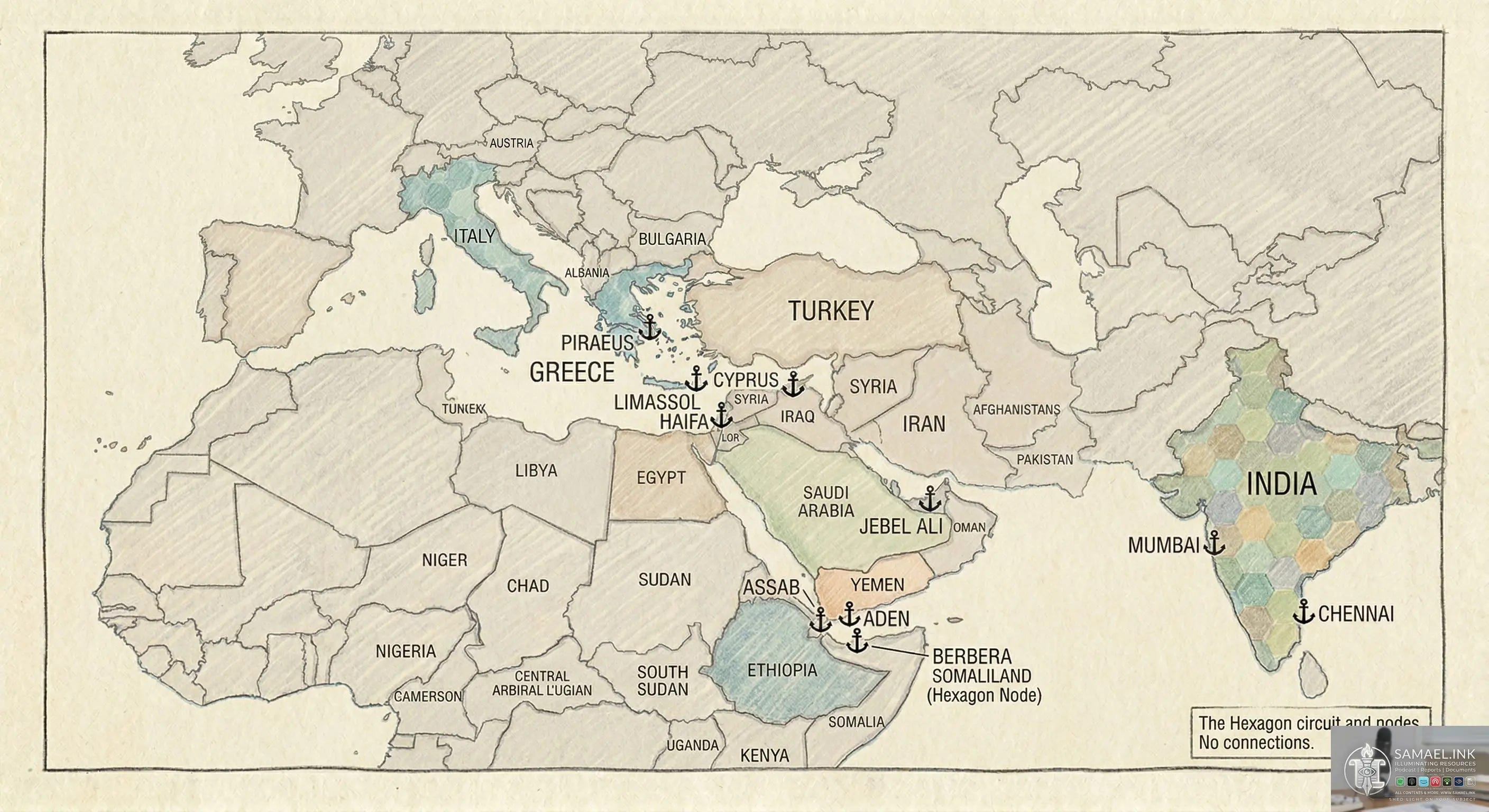
As of late March 2026, the Hexagon is no longer a mere “vision” dropped in a cabinet meeting; it is an operational reality. The “Core Four”—Israel, India, Greece, and Cyprus—have successfully integrated the “Southern Tier” (the UAE and Ethiopia), creating a continuous arc of high-trust nodes.
This structure represents the final obsolescence of the “Baghdad Overwrite”—the century-long attempt to centralize Middle Eastern power through inland administrative hubs. Instead, the Hexagon favors a “Living Map” that follows the flow of maritime AI, undersea cables, and the physical IMEC rail links. It is a decentralized system where power is measured by the efficiency of one’s transit through the world’s most critical waters rather than the size of one’s land army. By March 2026, this axis has positioned itself as the only viable alternative to the “Sino-Russian Shield,” offering a trade route that is faster, more secure, and entirely insulated from continental land-blockades.
What does the future hold for the Hexagon’s neighbors?
The activation of the Hexagon has forced a “Great Sorting” across the Erythraean space. Neighboring states now face a binary choice:
The Circuit: Joining the high-speed, high-tech trade network anchored by India and the UAE, accepting the “Recognition Trap” of Somaliland as a cost of entry.
The Island: Remaining tied to volatile, land-based systems that are increasingly out-indexed by the Hexagon’s logistical speed.
The final piece of this six-week development is the realization that sovereignty in 2026 is maritime. The nations that see “eye-to-eye on the reality”—as Netanyahu framed it—have successfully bracketed the “radical axes” and created a corridor of survival. For the independent publisher and researcher, the story is no longer about the formation of the Hexagon, but about its expansion into the next set of unnamed nodes in Southeast Asia.