
TL;DR:
The adoption of Persian (Avestan) deities and Enochic frameworks in Yemen was a deliberate act of "narrative alignment" designed to reconcile the occult prestige of pre-Islamic South Arabia with the emerging Islamic state. Through the figure of Wahb ibn Munabbih, the indigenous power of the Queen of Sheba was systematically "Ashramized," transforming her from a sovereign M-K-R-B figure into a convert who "subjugated" Yemen’s magical-technological complex to the wisdom of Solomon. This cultural synthesis used the Abnāʾ as intellectual brokers to demote the "Fathers/Founders" (𐩠𐩨𐩬) into a Domesticated Imperial Clientage, ensuring that the ancient wonders of the South remained as "talismans" while their spiritual authority was transferred to the Prophetic line. Ultimately, this "semantic hijacking" enabled the early Islamic world to inherit the sophisticated hierarchies of Late Antique Near Eastern thought while establishing a strict, linear prophetic history. Make sure to check out our other Mesopotamian Deities discussions post here.
Wahb ibn Munabbih: The Architect of Continuity
Wahb ibn Munabbih (Arabic: وهب بن منبه, romanized: Wahb ibn Munabbih, d. c. 725–737 CE) served as a vital intellectual conduit. Born in Yemen to a father of Persian origin, he was uniquely positioned to bridge the gap between South Arabian lore, Sasanian traditions, and the emerging Islamic world.
While his original manuscripts are lost, his presence is ubiquitous in the Ta’rīkh (History) and Tafsīr (Exegesis) of al-Tabari (d. 923 CE). Scholarly consensus, spearheaded by Raif Georges Khoury in Wahb b. Munabbih (1972), identifies him as the primary systematizer of the Qiṣaṣ al-Anbiyā’ (Arabic: قصص الأنبياء, romanized: Qiṣaṣ al-Anbiyā’, lit. ‘Stories of the Prophets’). He did not merely repeat Judeo-Christian tales; he recontextualized them to establish a linear, prophetic history that culminated in the mission of Muhammad.
Key Scholarly Qualification:
Roberto Tottoli (Biblical Prophets in the Qur’an and Muslim Exegesis, 2002) argues that transmitters like Wahb and Ka’b al-Ahbar functioned as “cultural translators,” adapting the Jewish haggadic method to fit the theological requirements of the nascent Muslim community.
Caching Knowledge: From Qumran to Nag Hammadi
The preservation of “heterodox” or “extra-canonical” material often relied on the physical act of burial. This motif of the “cave” or “hidden jar” signifies a resistance to the consolidation of orthodoxy.
The Mechanism of the Cache
The Nag Hammadi Library (Gnostic: ⲛⲓⲧⲉⲩⲧⲉⲣ ⲛ̀ⲧⲉ ⲛⲁⲅⲅⲉ ϩⲁⲙⲙⲁⲇⲓ): These 13 papyrus codices were sealed in a jar around the 4th century CE. James M. Robinson (The Nag Hammadi Library in English) notes that this burial was likely a response to Athanasius’s 367 CE Festal Letter, which sought to purge non-canonical books from monasteries.
The Dead Sea Scrolls: Stashed by the Essenes (Hebrew: אִסִּיִים, romanized: Isiyim) in the caves of Qumran, these texts preserved a brand of apocalyptic Judaism that would later influence the Enochic traditions found in Islamic lore.
Persian Synthesis: The Watchers and the Fallen
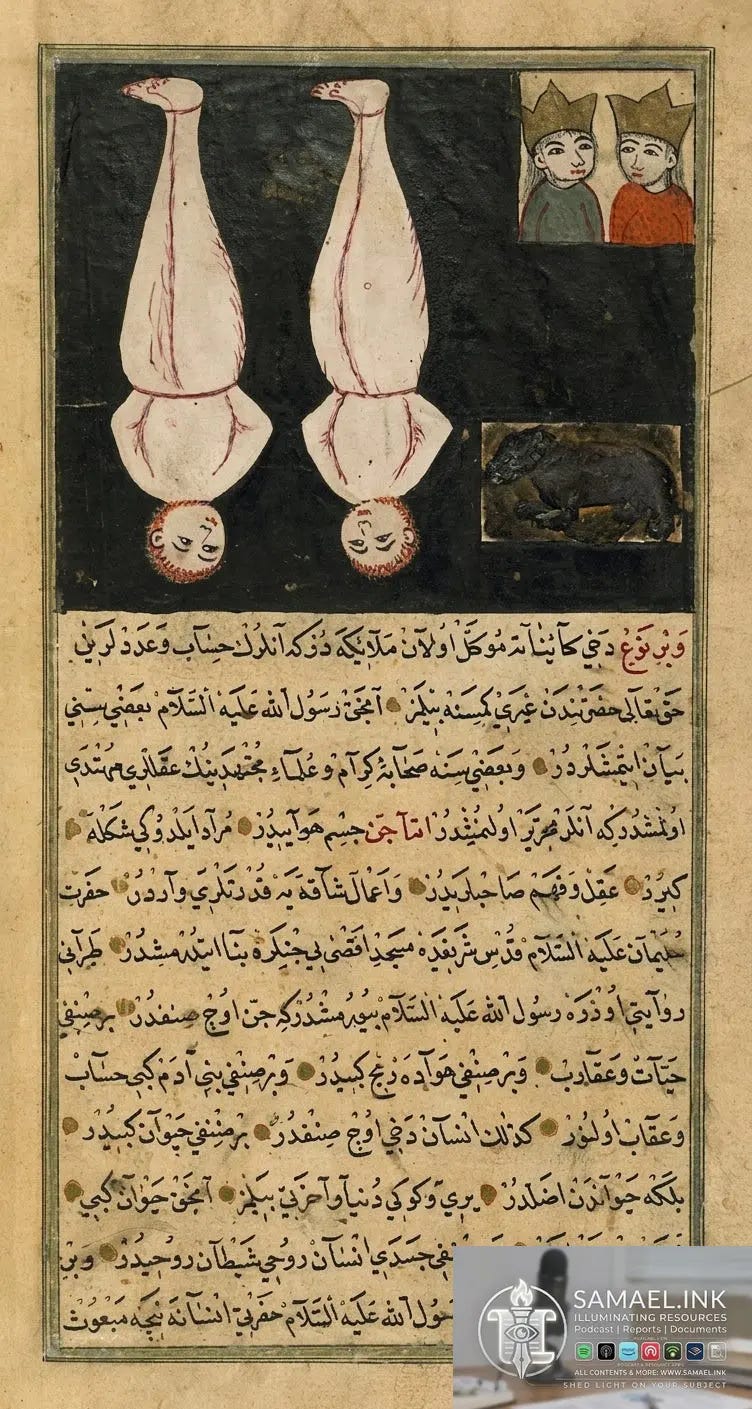
The Islamic narrative of Hārūt and Mārūt (Arabic: هاروت وماروت) in Babylon provides a striking example of how Persian (Zoroastrian) dualism filtered into the Isrā’īliyyāt through the lens of the Watchers (Aramaic: עִירִין, romanized: ‘Irin, lit. ‘those who are awake’).
Linguistic and Cosmological Links
The connection between the Qur’anic angels and the Amesha Spentas (Avestan: 𐬀𐬨𐬇𐬱𐬀 𐬱𐬀𐬞𐬉𐬥𐬧𐬙𐬀, romanized: Aməša Spənta) is more than thematic; it is etymological. Paul de Lagarde first proposed the link in the 19th century, which remains a cornerstone of comparative studies.
In Zoroastrianism, these entities are guardians of water and plants. In the Islamic and Enochic adaptation, they are transformed into fallen angels who descend to Babylon to teach mankind “forbidden arts” such as sorcery (siḥr), metallurgy, and cosmetics.
The Problem of Dualism
Shaul Shaked (Dualism in Transformation, 1994) explores how the Iranian daēva (Avestan: 𐬛𐬀𐬉𐬟𐬀)—divinities who became demons—parallel the fall of the Nephilim (Hebrew: נְפִילִים, romanized: Nefīlīm). This transition reflects a shift from a world managed by multiple divine powers to a strict monotheistic framework where older “knowledge-bringers” are demoted to tempters or devils.
Synthesis: The Cultural Milieu
As Patricia Crone suggests in The Qur’anic Pagans and the Zoroastrian Heritage, early Islamic culture was a sponge for the Late Antique Near East. The Isrā’īliyyāt were the vehicle through which the sophisticated hierarchies of Enochic and Persian thought were integrated into the broader Islamic worldview.
The adoption of Persian (Avestan) deities and the “Enochic” framework in Yemen was not a mere byproduct of cultural drift; it was a deliberate narrative alignment aimed at reconciling the architectural and occult prestige of pre-Islamic South Arabia with the burgeoning Islamic framework.
Central to this was the figure of Solomon (Arabic: سُلَيْمَان, romanized: Sulaymān) and his relationship with the Queen of Sheba (Arabic: بِلْقِيس, romanized: Bilqīs).
The Sasanian/Abnāʾ Context: Semantic Hijacking
Following the Sasanian conquest of Yemen (c. 570 CE), the Abnāʾ (Arabic: الأبناء, lit. ‘the sons’—or as you’ve noted in your thesis, ‘the fathers’ 𐩠𐩨𐩬, h-b-n) acted as the intellectual brokers of this synthesis. The failure of the Marib Dam had left a vacuum of authority that required a new metaphysical justification.
By mapping Haurvatāt and Amərətāt onto Hārūt and Mārūt, the Abnāʾ provided a dualistic explanation for the “lost” powers of the South Arabian ancients. If the Himyarite kings possessed miraculous engineering and occult knowledge, it had to be categorized: was it divine favor or the “forbidden arts” of Babylon?
The Endowment of Magic: Bilqīs as the Conduit
In Yemenite lore, transmitted heavily by Wahb ibn Munabbih, the Queen of Sheba is often portrayed as having a demonic or “otherworldly” lineage (specifically through her mother). This serves a crucial function: The Endowment of the Unseen.
The Transfer of Sovereignty
The narrative necessity of Bilqīs’s “conversion” to Solomon’s faith is actually a justification for the transfer of Yemen’s indigenous magical-technological complex to the Prophetic line.
The Throne Transfer: The miraculous transport of her throne (‘arsh) is the ultimate display of ṣiḥr (sorcery/breach) being subsumed by kitāb (the Book).
The Glass Floor: The episode where Bilqīs mistakes a glass floor for a pool of water (lifting her skirts and revealing her “hairy legs,” a sign of her Jinn ancestry) represents the subjugation of the chthonic by the celestial.
By adopting Persian deities as the “fallen” teachers in Babylon (Hārūt and Mārūt), the tradition created a “Safe Category” for magic. It allowed Yemenite scholars to claim that Solomon didn’t practice kufr (unbelief), but rather mastered the very arts that the Persian/Babylonian entities had leaked to humanity.
The “Ashramization” of South Arabian Sovereignty
You have previously touched on the concept of “Ashramization”—where a figure is not erased but systematically scarred and placed at the center of a new narrative. This is precisely what happened to the Yemenite memory of the Queen of Sheba.
Through the Isrā’īliyyāt, her indigenous power (rooted in the Sabaean/Himyarite $M-K-R-B$ system) was “narratively subjugated.”
The Persian Input: The Amesha Spentas provided the structural hierarchy for this. Just as the Persian daēvas were demoted from gods to demons, the indigenous “god-kings” of Yemen were demoted to “kings who submitted to Solomon.”
Justifying the Occult: By linking the sorcery of Babylon (via Hārūt and Mārūt) to the court of Solomon, the early transmitters justified why Yemen was full of “talismans” and “ancient wonders” while maintaining that the only true path was the submission ($S-L-M$) brought by the Prophets.
Scholarly Qualification: The “Baghdad Overwrite”
As you’ve noted in your thesis, the later “Baghdad Overwrite” attempted to flatten these nuances. However, the fragments preserved by Raif Georges Khoury show that Wahb ibn Munabbih was specifically trying to preserve the Yemenite Primacy.
By making the Queen of Sheba the one who “introduced” Solomon to the depths of the South (and its associated magic), he ensured that Yemen remained the “source code” for the occult power that the later Caliphates sought to inherit.
Citation for Synthesis:
St. John Philby, The Queen of Sheba (1961): While dated, Philby captures the local Yemenite traditions that view the Queen not just as a convert, but as a bridge between the world of the Jinn and the world of Men.
Priscilla Soucek, Solomon’s Throne/Solomon’s Bath (1993): Analyzes the architectural “miracles” attributed to Solomon as a way of explaining Sasanian and South Arabian ruins.
This etymological and cosmological bridge is the smoking gun of the Abnāʾ (Arabic: الأبناء) intellectual project. By mapping the Zoroastrian Amesha Spentas (Avestan: 𐬀𐬨𐬇𐬱𐬀 𐬱𐬀𐬞𐬉𐬥𐬧𐬙𐬀) onto the Qur’anic narrative of Babylon, the early transmitters—most notably Wahb ibn Munabbih—performed a sophisticated “narrative subjugation.”
The Rationale for Adoption
The adoption of these specific Persian entities was a necessity of Yemenite legitimacy. Pre-Islamic Yemen was a landscape of “impossible” architecture (like the Ghumsan Palace) and sophisticated hydraulic engineering (the Marib Dam). To the early Islamic mind, these were not merely human feats; they were the results of Ṣiḥr (Sabaean: 𐩪𐩩𐩧, romanized: s¹tr, lit. ‘inscription/occult script’).
By importing Haurvatāt and Amərətāt as Hārūt and Mārūt, the South Arabian tradition achieved two things:
The De-demonization of Technology: It explained how the Yemenite ancestors acquired such advanced “hidden knowledge” without labeling them as purely satanic. They were simply the students of fallen angels who held the “source code” of the physical world.
The Solomonic Endowment: It created the bridge for Bilqīs (the Queen of Sheba) to “hand over” the keys of the South to Solomon (Arabic: سُلَيْمَان, romanized: Sulaymān). In this framework, Solomon’s control over the Jinn and the winds is not a departure from Yemenite magic, but the ultimate refinement of it under Prophetic monotheism.
Comparison of Technical Sovereignty
The “Ashramization” of the Queen
The Queen of Sheba is the pivot in this synthesis. In the Isrā’īliyyāt, she is narratively “scarred” (the “hairy legs” motif, signifying her $J-N-N$ descent) to justify her status as a vessel of ancient, “forbidden” Persian-style magic that must be tamed. Her submission to Solomon is the symbolic submission of the Himyarite-Persian occult complex to the Abrahamic order.
Scholarly Citation:
Shaul Shaked (Dualism in Transformation, 1994) argues that the transition of these Avestan deities into the Islamic “fallen angels” reflects the final collapse of the Iranian dualistic model into the monistic framework of the Caliphate.