
TL;DR
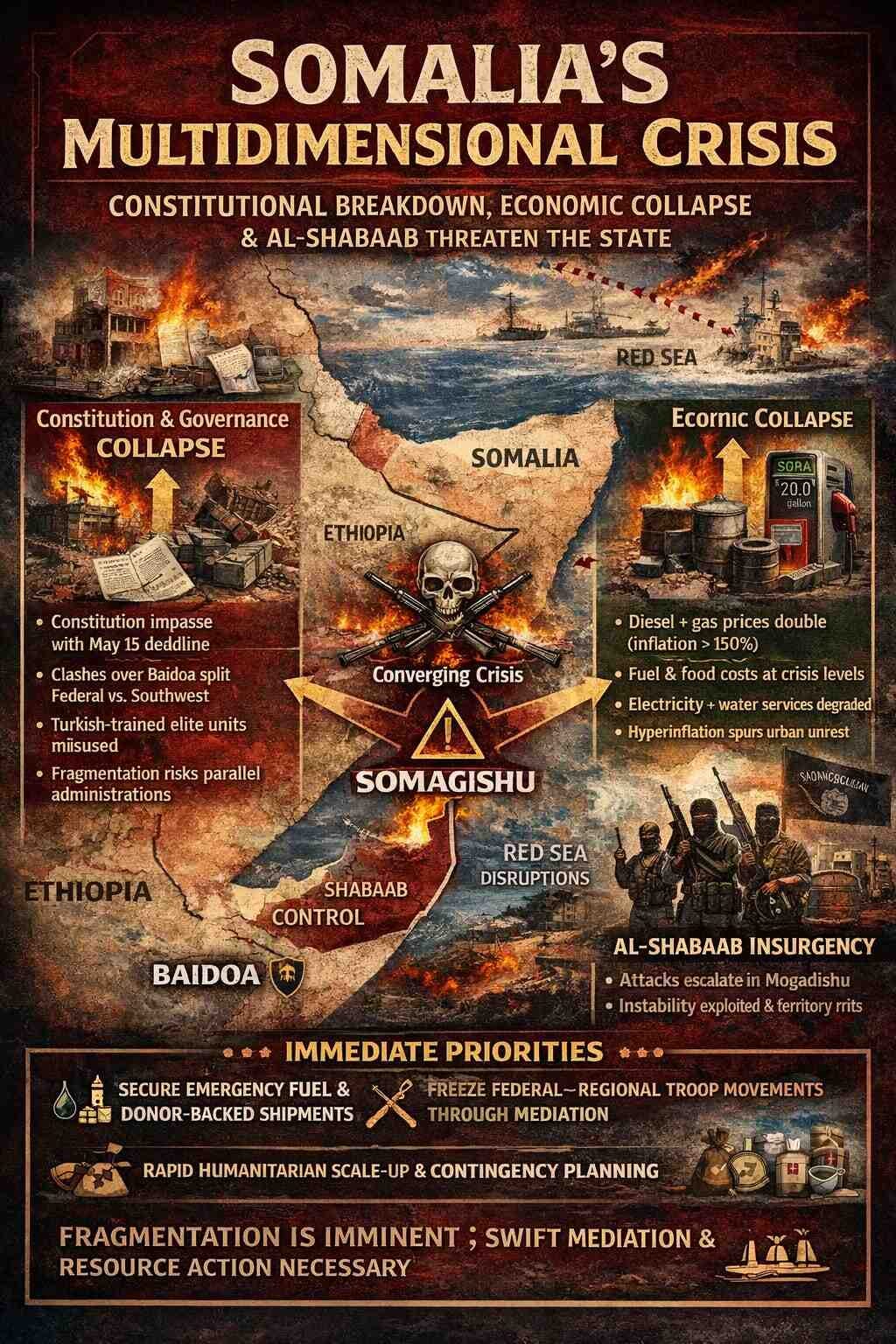
Somalia entered a critical danger phase in late March 2026 as hyper‑inflation, constitutional breakdown, and a resurgent Al‑Shabaab converged, producing a multidimensional crisis that threatens Mogadishu’s services, national cohesion, and humanitarian stability. Fuel prices and shipping insurance shocks—exacerbated by the wider Iran‑regional war and Red Sea disruptions—have driven fuel and food costs to crisis levels, degrading electricity, health services, water supply, cold chains, and transport networks across the capital.
The federal–regional political confrontation centered on Baidoa and an acrimonious constitutional process with a May 15, 2026 deadline risk splitting authority into parallel administrations; this fragmentation would create governance vacuums that Al‑Shabaab and foreign private security actors could exploit, deepening violence and complicating humanitarian response.
Immediate priorities are securing emergency fuel corridors and donor‑backed shipments to sustain hospitals and water systems, mediated AU/regional stand‑down talks to freeze troop movements and prevent Baidoa from igniting intra‑state conflict, and rapid humanitarian scale‑ups (cash assistance and contingency prepositioning). Absent swift, credible external mediation and resource lifelines, Somalia faces a rapid slide into protracted fragmentation, expanded insurgent territorial control, and sharply higher civilian casualties and displacement.
Introduction: converging shocks and regional context
By the last week of March 2026, Somalia’s security environment had deteriorated into what many analysts termed a “danger phase.” This period is characterized by the simultaneous occurrence of domestic political fracture, rapidly accelerating inflation—particularly for fuel and food—and a renewed operational surge by Al‑Shabaab. These domestic shocks occur amid a wider regional conflagration: Iran’s 2026 operations, the temporary closure of the Strait of Hormuz, and intensified Houthi activity in the Red Sea have driven global energy prices and maritime insurance costs upward. The knock‑on effects from those regional shocks—higher freight, war‑risk surcharges, and constrained tanker availability—have increased import costs for Horn of Africa states and produced acute fuel shortages in urban centers that depend on diesel generators for electricity and services. Somalia, with limited domestic energy production, extremely high import dependence, and fragile state institutions, is unusually vulnerable to these cross‑border economic shocks.
Mogadishu: an economic siege with tactical consequences
Mogadishu’s immediate crisis is best described as a tactical siege constituted largely by economic collapse. Diesel and petrol prices in the capital surged roughly 150 percent by March 31, 2026, from $0.60 to $1.50 per liter, a movement driven by increased global energy prices, higher insurance and freight costs for Horn‑bound cargoes, and local distribution frictions. Nearly all critical municipal and private services—hospitals, telecom towers, water pumping stations, cold storage facilities, and many businesses—rely on diesel generators and therefore face rolling blackouts, reduced operating hours, and sharply increased operating expenses. The doubling of imported food prices in a fortnight has intensified urban food insecurity and forced families to cut consumption, accept lower‑quality diets, or seek humanitarian assistance where available. The combination of service degradation and real‑income loss increases social stress and reduces cooperation with security actors, undermining local intelligence flows that are essential to counter‑insurgency efforts.
Al‑Shabaab’s operational posture and urban infiltration
Concurrent with this economic breakdown, Al‑Shabaab has demonstrated a significant improvement in urban operational capacity. A string of brazen attacks—including a massive suicide bombing near the presidential palace and a complex raid on the National Intelligence and Security Agency—indicate the presence of both overt assault formations and covert sleeper cells. Analysts report that the group has expanded its human‑intelligence networks inside the capital, leveraging local grievances, coercion, and opportunistic collaboration to sustain recruitment and logistics. The diversion of federal forces to political tasks and internal deployments has further widened operational space for the insurgents, enabling not only high‑impact attacks but also targeted assassinations, sabotage of infrastructure, and the establishment of contested control over key urban‑rural supply corridors. The operational effect on civilians is already visible: more checkpoints and informal roadblocks, longer transit times to markets and hospitals, and heightened exposure to collateral harm during security operations.
National fracture: the Baidoa flashpoint and Southwest State
The political risk peaked with federal orders to occupy Baidoa and remove the re‑elected Southwest State leader Abdiaziz Laftagaren between March 29–31, 2026. This move crystallized long‑standing tensions between the federal center and regional administrations and prompted official African Union warnings of imminent hostilities. The Southwest State accused the federal government of misusing Turkish‑trained elite units and Turkish‑donated drones—assets intended for counter‑terrorism—against political rivals. Such accusations, whether accurate or instrumentalized, have eroded confidence between governments and donors, and risk prompting the suspension of critical training and assistance programs. Al‑Shabaab exploited the distraction by ambushing federal columns in Daynuuney on March 29, demonstrating how insurgents leverage intra‑state conflict to expand territorial influence and degrade state reach.
Constitutional crisis: the May 15 threshold and potential for parallel authorities
The constitutional process has become an accelerant to fragmentation. The Somali parliament’s vote on a new constitution extending the presidential term polarized elites, and the May 15, 2026 deadline for implementation created a hard temporal marker that increases the incentive for unilateral action. Analysts now describe a high‑risk scenario in which failure to find a broadly accepted compromise leads to the emergence of parallel administrations and competing security command structures. Parallel authorities would likely issue separate mandates for policing and security provision, creating jurisdictional confusion, supply‑chain disruptions, and multiple claims to legitimacy over revenue streams and port access. Such fragmentation would invite deeper engagement by foreign private security contractors and states seeking to protect assets or influence outcomes under the pretext of stability, undermining long‑term sovereignty and complicating any post‑conflict reunification.
Humanitarian, economic, and social consequences
The humanitarian fallout is immediate and severe. Fuel shortages are disrupting hospital operations and vaccine cold chains, increasing morbidity and mortality from otherwise treatable conditions. Water systems dependent on diesel pumps are operating intermittently, raising sanitation and disease risks. Food price inflation is driving acute food insecurity among urban households that lack coping reserves. Economically, the spike in transport and security costs is collapsing margins for small traders and shortening the fiscal space available for the government—tax revenues fall as commerce slows and the cost of securing facilities and convoys rises. The combined effect is a negative feedback loop: degraded services reduce public trust and cooperation, which weakens security intelligence and amplifies insurgent freedom of movement, which in turn produces more insecurity and further service breakdown.
Regional and international dynamics: spillovers and leverage
Somalia’s crisis is not isolated. Regional states and international partners—Kenya, Ethiopia, Djibouti, the African Union, Turkey, Gulf partners, and Western donors—possess leverage to de‑escalate or exacerbate tensions depending on their actions. The recent allegations about Turkish‑trained units highlight how partner training can be repurposed in fragile politics; donors and trainers now face reputational and operational dilemmas. Gulf capital flight and the wider Horn of Africa shock from the Iran‑linked maritime disruptions have reduced the appetite and capacity of some external actors to provide urgent liquidity or project finance, limiting options for emergency support. Conversely, well‑timed mediation by the AU or a coordinated regional diplomatic package could create space for political compromise and temporary stabilizing measures.
Operational environment and private‑sector risk
Private firms, humanitarian agencies, and security contractors operating in Somalia must reconfigure operational plans. Expect pervasive roadblocks, adhoc checkpoints, and intermittent fuel availability that complicate logistics. Communications and power outages should be assumed; evacuation and medical contingency planning must account for degraded infrastructure and increased transit times. Private security costs will rise steeply both because of higher fuel and logistics costs and because of the premium on armed escorts in contested areas. Insurance terms for assets and personnel will likely deteriorate in tandem with the security environment, increasing operational budgets significantly.
Policy and operational recommendations
Priority one is to secure emergency fuel and logistics corridors for humanitarian and critical public services. Donor‑backed fuel shipments, temporary fuel subsidies for hospitals and water systems, and guarded humanitarian convoys can blunt the immediate service collapse. Priority two is to defuse the Baidoa flashpoint through vigorous AU and regional mediation: secure a temporary stand‑down, a freeze on troop movements, and a verification mechanism for the non‑use of foreign‑trained units in internal political disputes. Priority three is to scale humanitarian assistance rapidly with a mix of cash transfers in functioning markets, contingency prepositioning of food and medical supplies, and coordinated convoy security. Conditioning continued training and equipment support on third‑party verification and clearly defined non‑internal‑use clauses can reduce the risk of weaponization of foreign assistance.
What is the immediate cause of the fuel and food price surge in Mogadishu?
The surge is driven by external maritime disruptions and insurance shocks tied to wider regional conflict, which increased freight and war‑risk premiums for shipments to the Horn of Africa, combined with local constraints such as limited storage, opportunistic hoarding, and distribution bottlenecks that amplify price pass‑through.
How does the fuel crisis translate into broader public‑service failures?
Because many critical services—hospitals, telecom towers, water pumps, and cold storage—depend on diesel generators, fuel scarcity and price spikes cause rolling blackouts, reduced medical capacity, compromised vaccine cold chains, intermittent water supply, and failure of refrigeration for perishable goods, multiplying humanitarian harms beyond direct conflict casualties.
Why can Al‑Shabaab carry out complex attacks in Mogadishu now?
Al‑Shabaab benefits from improved urban intelligence networks, covert cells, and local informants, while federal security forces are distracted by political deployments and regional standoffs; economic hardship also reduces local cooperation with security forces, creating permissive conditions for planning and executing high‑impact operations.
Could the Baidoa confrontation turn into a nationwide civil war?
Yes; if federal forces attempt to forcibly remove the regional leadership and regional forces or militias resist, clashes could escalate and draw in allied groups, producing a wider internal conflict. The African Union’s warnings and recent ambushes by Al‑Shabaab indicate that the window for preventing such escalation is narrow.
What role should external partners play to reduce the risk of escalation?
External partners should prioritize mediation through the African Union and trusted regional actors, condition training and equipment on non‑use assurances with verification, provide emergency fuel and humanitarian support, and use diplomatic pressure and targeted incentives to freeze force movements and encourage a negotiated temporary settlement before May 15.
Is there a plausible negotiated solution before the May 15 deadline?
A plausible solution requires rapid, credible third‑party mediation that produces a temporary power‑sharing or cooling‑off agreement, a moratorium on force deployments, and an expedited dispute‑resolution mechanism for the constitutional question. Success depends on swift mobilization of regional leverage and tangible short‑term incentives for all parties.
How should humanitarian agencies adapt operations immediately?
Agencies should shift to cash‑based assistance where markets still function, preposition supplies outside high‑risk zones, coordinate armed convoy security where necessary, expand contingency fuel stocks for hospitals and cold chains, and prioritize flexible funding to respond to rapidly changing access conditions.
What indicators should be monitored to detect either de‑escalation or collapse?
Monitor fuel price trends and generator uptime at key facilities, incident frequency and clustering in Mogadishu and Baidoa, troop and militia movements, official political actions and proclamations ahead of May 15, spikes in private security contracting, and port throughput and insurance cost trends.
How can training partners prevent their assets from being used for internal coercion?
Training partners must impose contractual and legal non‑use clauses, deploy verification teams or independent monitors, condition future assistance on compliance, and be prepared to suspend training and equipment transfers if misuse is detected; transparency and clear red lines reduce reputational and operational risks.
What happens if May 15 passes without agreement?
If no agreement is reached, parallel administrations and competing security chains are likely to emerge, increasing opportunities for Al‑Shabaab to expand, strengthening demand for foreign private security actors, increasing fragmentation of revenues and ports, and raising the likelihood of protracted conflict and humanitarian catastrophe.