
TL;DR:
The vast Umayyad Caliphate (661-750 CE) was a sea power in the making. Emerging from the deserts of Arabia, the Umayyads needed a fleet to control the vital sea lanes of the Red Sea and the Indian Ocean. Looking across the waters to their powerful trading partners, the Aksumites, they found inspiration in an unexpected place: their ships.
This adoption of Aksumite ship design was a significant turning point for the Umayyad navy. The Aksumites, a powerful empire based in what is now modern-day Ethiopia and Eritrea, possessed a long and established maritime tradition. They were seasoned sailors and master shipbuilders, intimately familiar with the challenging conditions of the Red Sea and the Indian Ocean.
The Rise of the Umayyad Navy
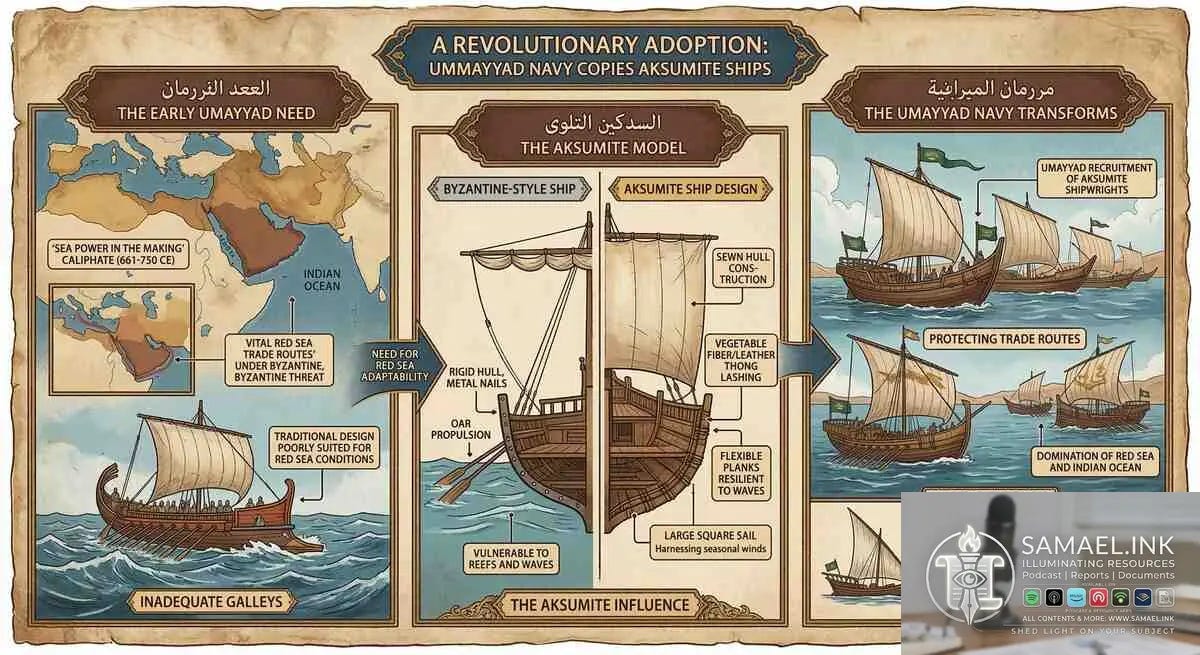
The early Umayyad Caliphate faced numerous challenges, not least of which was defending their newly acquired coastal territories from Byzantine incursions. While they inherited Byzantine-style galleys in the Mediterranean, the Red Sea and the Indian Ocean required different types of vessels.
The Red Sea, in particular, was notorious for its treacherous coral reefs, seasonal winds, and unpredictable currents. Traditional Mediterranean galleys, with their shallow drafts and oar-based propulsion, were poorly suited for these demanding conditions. The Umayyads needed sturdier, more adaptable ships.
The Aksumite Influence
The Aksumite Empire, having flourished for centuries through trade with Rome, India, and beyond, had developed specialized ship designs tailored to the Red Sea. These vessels, known from representations in coins and pottery, featured distinct characteristics that caught the attention of Umayyad observers.
One of the key features of Aksumite ships was their use of sewn hull construction. Unlike Mediterranean ships, which relied on metal nails, Aksumite shipbuilders used vegetable fibers or leather thongs to lash the wooden planks of the hull together. This technique, also used in other parts of the Indian Ocean, provided a certain degree of flexibility that made the ships more resilient to the pounding of waves and better suited for navigating rocky coastlines.
Furthermore, Aksumite ships were typically equipped with large, square sails, which allowed them to harness the powerful seasonal winds of the Indian Ocean. These sails provided excellent power and speed, particularly when sailing downwind, making them efficient cargo carriers and capable of covering vast distances.
From Observation to Adoption
It is plausible that Umayyad contact with Aksum through trade and diplomacy facilitated the exchange of shipbuilding knowledge. The Umayyads, recognizing the effectiveness of Aksumite vessels, began constructing ships based on their design. This was a logical move, as Aksumite ships were perfectly adapted to the local environment and had proven their capabilities over centuries of use.
Historical accounts suggest that Umayyad officials recruited Aksumite shipwrights to help build their new fleet. This ensured that the ships were constructed with the same level of expertise and attention to detail as the originals.
A Powerful Combination
By adopting Aksumite ship technology, the Umayyads successfully created a powerful and versatile navy capable of dominating the Red Sea and protecting their vital trade routes. These ships allowed them to project their power along the East African coast, the Arabian Peninsula, and even into the Indian Ocean, facilitating trade and solidifying their influence in the region.
The combination of Aksumite hull design and the Umayyads' extensive resources proved to be a formidable combination. The new Umayyad ships were robust enough to withstand the demanding conditions of the Red Sea and large enough to carry substantial cargos and troops. This maritime prowess played a crucial role in the Umayyad Caliphate's expansion and sustained influence in the region.
The Legacy of the Sewn Ship
The influence of Aksumite ship design extended beyond the Umayyad period. The tradition of sewn hull construction and square-sailed vessels continued to shape shipbuilding in the Red Sea and the western Indian Ocean for centuries.
These ships, collectively known as dhows, became a defining feature of the region's maritime landscape, carrying goods, people, and ideas across the ocean. While the technology evolved over time, the core principles established by the Aksumites and adopted by the Umayyads remained central to dhow construction.
A Story of Cultural Exchange and Innovation
The story of the Umayyads copying Aksumite ships serves as a powerful example of how cross-cultural exchange can drive technological innovation. It highlights the dynamic interactions between empires and the continuous flow of knowledge that shaped the world. The Umayyads' decision to embrace Aksumite maritime expertise demonstrates their adaptability and their willingness to learn from other cultures to achieve their strategic goals.