
Series: Beyond the Binary—The Genetic Truth of the Peninsula
Part 2: The Basal Eurasian Refugium
TL;DR
Southern Arabia is the world’s primary genomic refugium for "Basal Eurasians"—a ghost lineage that never interbred with Neanderthals. While Northern groups integrated with Bronze Age Levantines, the Southern highlands preserved a Neolithic profile that remains the most ancient non-African signature on Earth.
The Basal Eurasian Refugium: A Genomic Time Capsule
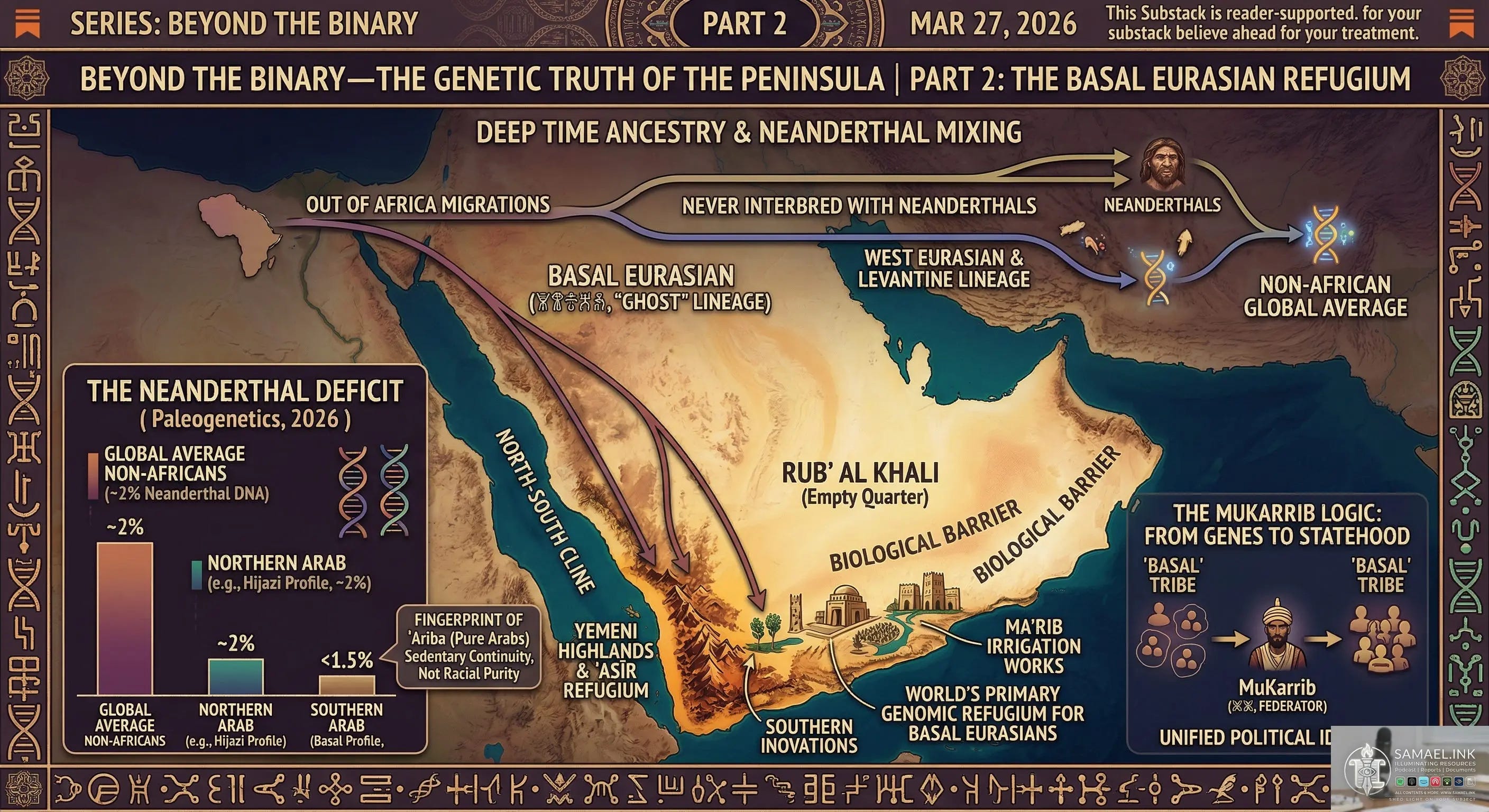
To understand the "Southern" identity, we must look past the 9th-century genealogical charts and into the deep-time reality of the Holocene. While the "Baghdad Overwrite" gave us a social binary, the earth gave us a geographic one. The rugged peaks of the Yemeni Highlands and the isolation of the ʿAsīr (Arabic: عسير) region created what genomicists call a "Refugium."
The "Ghost" Ancestor
The term Basal Eurasian refers to a lineage of humans who left Africa but branched off before the rest of the world’s non-African populations mixed with Neanderthals in the Levant or Central Asia. For millennia, this lineage was a "ghost"—hypothesized but not found in a "pure" state.
Recent large-scale sequencing (Almarri et al., 2021) confirmed that the Southern Peninsula, particularly the Sabaean (Sabaean: 𐩪𐩨𐩱, romanized: sb’) heartlands, contains the highest concentration of this ancestry. Unlike Northern "Adnānite" groups who show high affinity with Neolithic Levantine and Natufian populations, the South remained a stable, sedentary core.
The Neanderthal Proxy
One of the most startling metrics in 2026 paleogenetics is the "Neanderthal Deficit."
Global Average: Most non-Africans carry ~2% Neanderthal DNA.
The Northern/Hijazi Profile: Aligns with the global average (~2%) due to Bronze and Iron Age migrations from the North.
The Southern/Basal Profile: Drops significantly, often measuring less than 1.5%.
This is the biological fingerprint of what traditionalists call the ʿAriba (Pure Arabs). It isn't about "purity" in a racial sense, but rather sedentary continuity. These populations did not experience the massive "dilution" of the Bronze Age expansions that reshaped the North.
The Mukarrib Logic: From Genes to Statehood
This genetic stability provided the foundation for the first great Peninsular civilizations. The transition from these "Basal" tribes into a unified political identity—led by the MuKarrib (Sabaean: 𐩣𐩫𐩧𐩨, romanized: mkrb, lit. 'federator')—was a response to the desertification of the Rub' al Khali. As the "Green Arabia" of the early Holocene faded, these isolated genetic clusters were forced to innovate, leading to the massive irrigation works at Ma'rib (Arabic: مأرب).
Who are the Basal Eurasians?
They are an ancestral human group that branched off from the main "Out of Africa" line before the interbreeding event with Neanderthals occurred.
Why is the Arabian Peninsula significant for this lineage?
The Peninsula, specifically the South and East, serves as the primary global reservoir for Basal Eurasian DNA, preserved by geographic isolation.
Does "Qaḥṭānite" DNA actually exist?
Biologically, "Qaḥṭānite" corresponds to high Basal Eurasian and Neolithic South Arabian ancestry, rather than a single founding father named Qaḥṭān.
Why do Arabs have different levels of Neanderthal DNA?
It depends on the "North-South Cline." Northern groups mixed more with West Eurasian and Levantine populations (who had higher Neanderthal levels), while the South remained isolated.
What is a "Genomic Refugium"?
A geographic area (like the Yemeni mountains) that protects a population from the migrations and genetic mixing happening in surrounding regions.
How does the Rub' al Khali affect Arab genetics?
The "Empty Quarter" acted as a massive biological barrier, preventing the "Levantine Overwrite" of the North from reaching the Southern coastal and highland populations.
Is there a link between the Sabaeans and Basal Eurasians?
Yes. The Sabaean civilization was built by these "Basal" populations who transitioned from nomadic isolation to sedentary statehood through advanced irrigation.
What is the "Neanderthal Deficit"?
The phenomenon where Southern Peninsular Arabs have significantly lower Neanderthal DNA percentages (<1.5\%) compared to the rest of the non-African world.
How do we know these groups are "indigenous"?
Their genetic profile shows a continuity in the Peninsula dating back to the early Holocene, whereas Northern profiles show more recent (Bronze Age) arrivals.
Can genetics prove the "Arabized" (Musta'riba) theory?
Sort of. Science shows that Northern groups (traditionally called Adnānite/Musta'riba) have more shared ancestry with the Natufians of the Levant, suggesting a northern origin for some of their ancestral components.