
Series: Beyond the Binary—The Genetic Truth of the Peninsula
Part 1: The Baghdad Overwrite
TL;DR
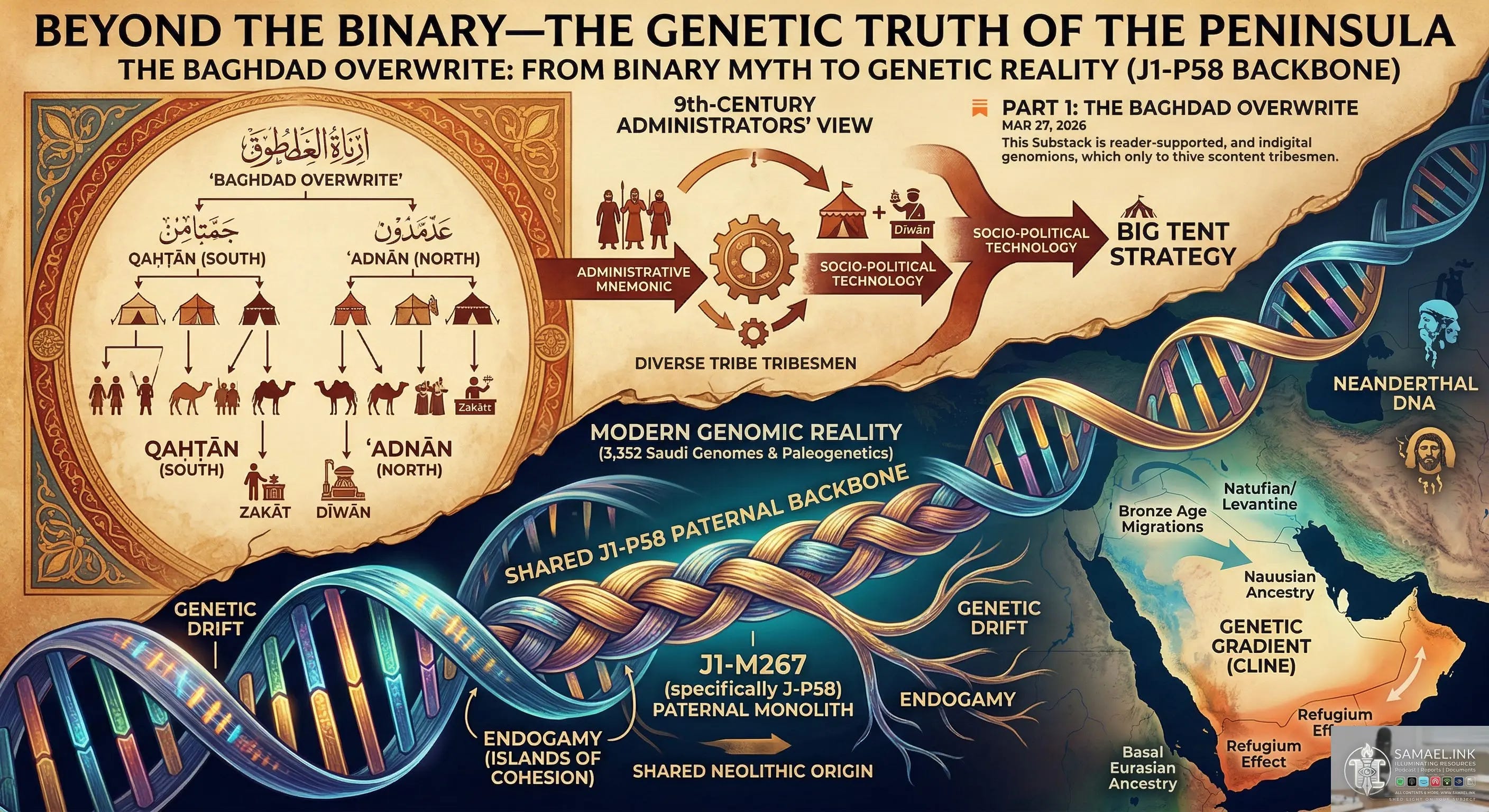
The Qaḥṭān-ʿAdnān binary is a 9th-century administrative mnemonic known as the “Baghdad Overwrite,” created to manage the Umayyad and Abbasid tax and military systems. Modern genomics reveals a shared J1-P58 paternal backbone, proving that tribal identity was a socio-political technology, not a biological divide.
The Baghdad Overwrite: Why the Binary Was Invented
For over a millennium, the history of the Arabian Peninsula has been viewed through a rigid dualism: the “Indigenous” Southern Qaḥṭān (Arabic: قحطان) and the “Arabized” Northern ʿAdnān (Arabic: عدنان). However, high-resolution sequencing from the 3,352 Saudi Genomes project suggests that this divide is a later “overwrite.”
During the expansion of the Umayyad and early Abbasid Caliphates, the state faced a logistical nightmare: how to organize millions of tribesmen into a functioning tax (Zakāt) and military (Dīwān) structure. The solution was a genealogical “Big Tent” strategy. By grouping thousands of disparate lineages into two massive super-clusters, the Baghdad administration created a scalable social architecture. This allowed for the rapid mobilization of troops and the streamlined collection of revenue by treating entire regions as single “families.”
Paternal Monoliths: The J1-P58 Reality
If the traditional binary were biologically true, we would expect to see two distinct, deeply divergent male-line ancestors. Instead, current paleogenetic research (2024–2026) shows that both groups predominantly share the J1-M267 (specifically J-P58) paternal backbone.
The “differences” cited by medieval genealogists were often the result of genetic drift—where isolated tribes married within their own ranks (endogamy), causing certain traits to become dominant. These “islands of cohesion” were later misinterpreted (or intentionally rebranded) as evidence of two separate “founding fathers.”
Is there a genetic difference between Qahtan and Adnan?
No evidence exists for two distinct male-line founders. Both groups share the J1-P58 haplogroup, with differences being geographic rather than ancestral.
What is the “Baghdad Overwrite”?
It refers to the 9th-century administrative effort by the Abbasid state to categorize diverse tribes into a binary system for easier taxation and military management.
What does “Basal Eurasian” mean in Arab genetics?
It refers to an ancient human lineage that diverged before the mixture with Neanderthals. Southern Peninsular populations have the highest levels of this ancestry.
Why do Southern Arabs have less Neanderthal DNA?
Due to the refugium effect of the Yemeni highlands and the Rub’ al Khali, Southern populations remained isolated from the Bronze Age migrations that brought Neanderthal-mixed DNA into the North.
How does J1-P58 define Arab identity?
It is the dominant paternal marker across the Peninsula, appearing in both Northern and Southern tribes, suggesting a shared Neolithic origin rather than a split.
Were the “Arabized” (Musta’riba) tribes actually foreigners?
Genetically, “Adnanite” tribes show higher Levantine and Natufian admixture, reflecting the Bronze Age migrations from the North, but they remain deeply rooted in the Peninsular core.
How did endogamy affect tribal genetics?
Strict marriage within tribes created “genetic drift,” making members of one tribe look biologically related, which was then used to justify broader “super-cluster” myths.
Is the “Pure Arab” (Ariba) label scientifically accurate?
The label “Ariba” aligns with populations that harbor high Basal Eurasian ancestry, representing a genetic continuity that has remained stable for millennia.
What role did the Rub’ al Khali play in genetics?
It acted as a biological barrier, protecting the “Basal” populations of the South from the constant genetic “dilution” occurring in the trade-heavy North.
Why is the North-South gradient more accurate than a binary?
A gradient (or cline) accounts for the gradual mix of Levant-Peninsular ancestry in the North and high-Basal ancestry in the South, rather than a “clean” split.