
TL;DR
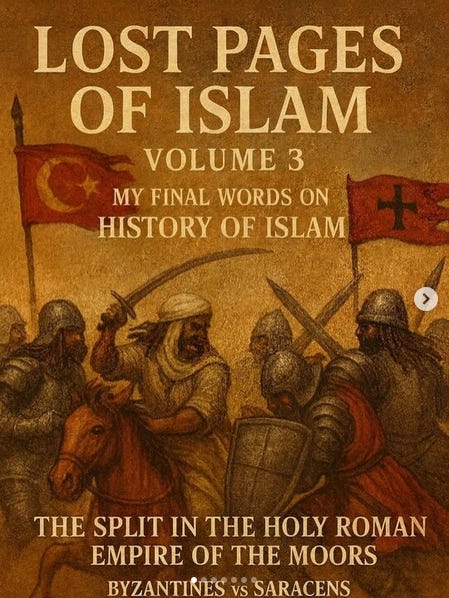
The Lost Pages of Islam Volume III argues that mainstream histories of Islam and the medieval Mediterranean are the product of systematic erasure: an extended Indigenous Afro‑Asiatic Black Saracen/Moor sovereignty that traced its roots to Ebla, Ta‑Mery (Ancient Egypt), Nubia/Kush, Nabataea, Syria, and Axum was rebranded through coordinated “Arabization” and “Europeanization.” This thesis reframes the Umayyads as the Ummaya Empire, a metropolitan, multilingual imperial administration whose phenotype, institutional continuity, and cosmological science were obscured by later historiographical interventions.
Central to the argument is the claim that the Ummaya preserved a sophisticated “Saracen Science”—an Egyptian‑Nabataean corpus of solar, metallurgical, and alchemical knowledge encoded into scripture, public architecture, coinage, and ritual. Key motifs include the “Black Throne” cosmology, Ogdoadic mathematics, Black Light Metaphysics (melanin and carbon as light‑conductive substances), and calendaric-astronomical worship practices later dislocated by new sacred geographies and legal literatures.
The book attributes the loss of this memory to an active Abbasid Reconstruction, summarized by the S.A.D. model: Scramble (resequencing older cosmologies), Add (inserting new genealogical myths and Arab origin stories), and Delete (erasing multilingual archives and explicit references to Black metaphysics). It locates the “Hadith Factory” and retroactive prophetic biographies as mechanisms by which a counter‑cosmology was produced to legitimize new ruling elites and suppress the Ummaya’s scientific statecraft.
Beyond the Near East, the work asserts a global Ummaya footprint—documented in Tang Chinese records, European medieval art, numismatic reforms, and contentious transoceanic inscriptions—arguing that both Islamic and European traditions repurposed and whitened an older Nile‑Levantine cultural core. Recovering this suppressed lineage, the author maintains, would reframe the provenance of religious texts, scientific knowledge, and imperial legitimacy across Eurasia and beyond.
To explore this revisionist project in full, purchase The Lost Pages of Islam Volume III and related titles through the author’s publications. Discover more of Dr. Ali Muhammad’s work and links at his Linktree. For further reading on related chronology and context, see Proper Chronology of Byzantine Islam & The Western Church Volume 1
Introduction: The Fabrication of History and the Erasure of the Afro-Asiatic Elite
The thesis advanced in The Lost Pages of Islam Volume III contends that the prevailing narratives regarding the origins of Islam, the nature of the Umayyad Caliphate, and the phenotypic identity of medieval Saracens are the result of a deliberate and systematic fabrication. This perspective posits that what is currently accepted as world history is a “fake” narrative constructed through the erasure of Black leadership and the theft of indigenous science. At the heart of this argument lies the concept of the Black Saracen/Moor, not as a nomadic outsider or a tribal Arab, but as the Indigenous Afro-Asiatic heir of the ancient world’s most sophisticated civilizations. This identity represents a unified, extended civilization rooted in Ebla, Ta-Mery (Ancient Egypt), Nubia/Kush, Syria, Nabataea, and Axum, which was fractured by time and subsequently obscured by a dual effort of “Arabization” and “Europeanization.”
The central thesis asserts that the original Saracen/Moor identity was that of a Black Indigenous Afro-Asiatic ruling class that governed the Near East and Nile Valley. This sovereignty was characterized by a “Black Throne” cosmology, advanced scientific knowledge, and a global administrative network that predated modern religious labels. The sources argue that this reality was systematically buried during the Abbasid Reconstruction, a strategic maneuver by Eurasian revisionists to legitimize their rule by creating an “Arab” past. This process involved the “Scramble-Add-Delete” (S.A.D.) model: scrambling original stories into new sequences, adding false genealogies, and deleting references to Black Light metaphysics and Saracen administrative records. The result was a historical record where the true phenotype and scientific achievements of the Ummaya Empire were replaced by a fictionalized Arab narrative and a whitened European antiquity.
The Lost Pages of Islam Volume III frames its argument as a corrective: by recovering these “lost pages” and decoding embedded cosmologies, it seeks to restore the Ummaya (Umayyad) Empire and the broader Saracen polity to their original place in world history. What survives in mainstream textbooks and popular imagination is a reconstructed past that obscures a contiguous Black Saracen sovereignty, replacing indigenous memory with invented genealogies, new sacred geographies, and the whitening of cultural patrimony.
The Ummaya Empire: Reconstructing the Black Saracen Sovereignty
Volume III fundamentally redefines the Umayyads, stripping away the traditional label of a dynastic Arab family to reveal what the text identifies as the Ummaya Empire: an indigenous Afro-Asiatic ruling elite. This reconstructed identity is built upon a synthesis of medieval descriptors and European iconography, which the author interprets as collective testimony that early medieval sovereigns in the Near East and Mediterranean were phenotypically Black. Contemporaneous Arabic sources are cited for using terms such as aswad (black), habashī (Ethiopian-like), and khālīṣ al-sawād (pure blackness) to describe these rulers. This phenotypic reality is further corroborated by what the sources term “European memory”—Crusader-era manuscripts and art that consistently depict Saracens as “Li Sarrasins noirs” (The Black Saracens). These artistic records portray the Saracen/Moor with Ethiopian features, specific heraldry including six-pointed stars and crescents, and “Indigenous African (Ta Mry) motifs,” standing in stark contrast to the later image of fragmented desert raiders.
Far from a confederation of nomadic tribes, the narrative casts the Saracen/Moor as metropolitan administrators and heirs of a sophisticated urbanized Nile-Levantine civilization. The Ummaya are portrayed as forged from Egypto-Levantine institutions, operating a literate, multilingual bureaucracy in Greek, Coptic, and Syriac, alongside a fiscal and legal apparatus contiguous with Byzantine and Egyptian practices. This imperial structure was underpinned by a cosmology that conceptualized sovereignty through the “Black Throne,” a cosmic kingship older than Islam itself that involved the stewardship of solar and alchemical sciences. This identity was not localized; the sources claim a global footprint for Saracen power, with “Black Saracen/Moor envoys” recorded as far as Tang Dynasty China (Hei-ren Dashi) and administrative structures present in Italy, France, and Switzerland. The Saracen-Byzantine Mirror theory further asserts that the “Real Rome” was Egyptian/Byzantine and ruled by a Black elite, positioning the Byzantines and Saracens as “two faces of one imperial house.”
This reconstructed identity stands in direct opposition to the later image of fragmented tribal Arabs. The text argues that Qur’ānic passages criticizing al-A’rāb (the desert Arabs)—specifically Surah 9, which condemns them as the “worst in disbelief and hypocrisy”—actually demarcate the Ummaya’s anti-tribal, proto-national posture. Where later historiography reads the rise of an Arab prophetic movement, The Lost Pages frames the Ummaya as a scientific, cosmological state with roots deep in Egyptian ceremonial kingship and Nabataean administrative sophistication. Consequently, the term al-ummiyyīn is reinterpreted not as “illiterate” or “Gentile,” but as referring to the Ummaya themselves: a proto-national, anti-tribal Afro-Asiatic movement that explicitly rejected the tribal fragmentation associated with the al-A’rāb. In this view, the “Umayyad” label is dismissed as a later fabrication masking the true identity of the Ummaya Empire, the last open manifestation of a global Black world order.
Saracen Science: The Custodians of Ancient Solar Knowledge
A central and striking claim of Volume III is that the Ummaya were the custodians of an advanced, solar-centric science encoded within scripture and state architecture. This framework, termed Saracen Science, is presented as a sophisticated cosmological system rooted in Egyptian alchemy and Nabataean agricultural-astronautical systems. The text argues that the Qur’ān serves as a repository for metallurgical, astronomical, and alchemical knowledge inherited from ancient Kemetic traditions. Specifically, Surah 57 is interpreted as containing an “Iron 57” code, an allegorical layering where the number 57 represents the sum of iron’s atomic number (26) and its isotopic “rings” or toroidal structures (31). Similarly, Surah 24:35 is read as an esoteric treatise on Black Light Metaphysics, focusing on the metaphysics of melanin and carbon. In this view, blackness is not merely a pigment but a “primordial substance connected to light,” functioning as a biological antenna for cosmic frequency.
The scientific foundations of the Ummaya also encompassed Ogdoadic Mathematics. The sources interpret references to “Eight” bearing the Throne (Surah 69:17) as a preservation of the Kemetic Ogdoad, representing eight primordial forces or the fundamental structure of matter and carbon cosmology. This scientific worldview fundamentally reshaped ritual practice and calendaric observance. Contrary to later traditions, the text argues that early Islamic prayer was not oriented toward the city of Mecca but was aligned with astronomical alignments, such as the winter solstice sunrise or sunset, to invoke planetary resonances. Likewise, the original Ramadan is described as a Solstice Fast synchronized with the heliacal rising of Sirius, designed to purify the body’s light-conductive pathways rather than adhering to a shifting lunar calendar.
This scientific-cosmological Islam was deliberately suppressed and replaced by what the author terms Arabized Islam during the Abbasid Reconstruction. The Abbasids, characterized as Eurasian revisionists, are accused of utilizing a “Hadith Factory“ to erase the Black Saracen heritage. This process involved fabricating tribal genealogies and shifting the sacred geography to Mecca to establish Arab supremacy. Within this reconstructed framework, the Prophet figure of the Qur’an is identified not as a historical Arab from Mecca, but as Ahmad ibn Wahshiyya, a historical Nabataean alchemist and scholar who translated ancient sciences for the Saracen leader Abd al-Malik. The book ultimately argues that modern Biblical and Islamic traditions represent “stolen property” of these indigenous peoples, reorganized into myths to conceal the original Afro-Asiatic scientific world order.
Abd al-Malik: The Architect of the Qur’ānic State
Within this revisionist framework, Abd al-Malik ibn Marwan is reconstructed as the pivotal architect of a state that fused imperial administration with a preserved, encoded ancient science. The text reframes him not as a tribal Arab ruler, but as a Black Afro-Asiatic sovereign and a descendant of ancient Egyptian (Ta-Mery) and Nabataean lineages. He is portrayed as the principal actor who transformed an older Nile-Levantine political order into a formalized Qur’ānic state. A radical reinterpretation of his role suggests that Abd al-Malik himself wore the title “Muhammad” (The Praised One) and was the primary leader who oversaw the drafting and canonization of the Qur’an in the 9th century. He is described as the student of Aḥmad ibn Waḥshiyya, a historical Nabataean alchemist who taught him the ancient alchemical and solar sciences that were later encoded into the scripture.
Driven by a desire to preserve the legacy of his Black Egyptian ancestors, Abd al-Malik commissioned the deciphering of Egyptian hieroglyphics and ancient alphabets, a project led by his teacher, ibn Waḥshiyya. Under his rule, the ancient libraries of Egypt, Carthage, and the Levant were restored, establishing the Ummaya state as a “Scientific State” governed by cosmology rather than tribal law. His physical and economic reforms served as a deliberate rejection of both Byzantine and tribal Arab influences. The Dome of the Rock is described as an “architectural Qur’ān” and a monument of Saracen alchemy, built to encode cosmological principles such as the Black Throne and the Ogdoad.
Furthermore, Abd al-Malik famously reformed the coinage, removing Byzantine crosses and replacing them with alchemical and solar symbols, such as the stone pyramid. These symbols reflected a monotheistic, anti-Trinitarian worldview rooted in Indigenous Afro-Asiatic science. His seals and coins often depicted a 4x4 grid (Bait-El or House of God), representing the four elements and four conditions used in Islamic metaphysics and alchemy. The Ummaya state under his leadership functioned as an imperial administrative machine that maintained continuity with the Byzantine world, utilizing Greek, Coptic, and Syriac as official languages long before the later linguistic “Arabization.” Despite his role as the architect of this global scientific empire, his achievements were systematically buried by the Abbasid Reconstruction, which created a fictionalized “Arab” past and a new prophetic biography to replace Abd al-Malik’s original cosmological achievements.
The Elongation of History: The 17th-Century Fabrication of Antiquity
The thesis in The Lost Pages of Islam Volume III extends its critique of historical erasure to the very structure of chronology itself, arguing that modern history is a “fake” narrative constructed to grant “pale nations” a primordial antiquity they do not actually possess. According to this perspective, the timeline of human civilization was systematically backdated and falsified only a few hundred years ago, specifically during the 17th and 18th centuries, to submerge the original Afro-Asiatic sovereignty of the Saracen/Moors. The 1700s are identified as the critical pivot point where the true phenotype of world leadership was erased and the illusion of a white, ancient past was cemented.
Central to this argument is the claim that the true phenotype of global leadership remained Black until the 1700s. The sources assert that all European nobility, including Holy Roman Emperors, Popes, and the rulers of the Byzantine Empire, were Black until the 18th century. This assertion is supported by citations of 17th-century English primary documents describing figures such as Charles II and various Earls (including the Earl of Abingdon and the Earl of Denbigh) as having a “black complexion” or being explicitly identified as a “black man”. The author contends that while these primary texts accurately recorded the Black identity of these leaders, their official portraits were later subjected to “fraudulent reconstructions” to alter their appearance to pale European standards. This systematic whitening of visual and textual records was a strategic effort designed to make “whiteness appear primordial,” thereby erasing the visible evidence of a Black ruling class that persisted well into the early modern period.
The fabrication of history is further linked to the invention of “Ancient” chronology by specific medieval and early modern scholars. The sources identify Joseph Justus Scaliger and Denis Petavius as the primary architects of the modern chronological framework (AD/BC), labeling it a “recent development” created to hide real history. A key example of this manipulation is the figure of Flavius Josephus. While standard history places him in the 1st century AD, the source cites a 9th-century papyrus (P. Brit. Libr. Inv. Or. 1060) that mentions a Saracen commander named Flavius Joseph. The author concludes that this 9th-century figure was “pushed back” 900 years by forgers to substantiate a false Roman and Jewish chronology. Similarly, the sources assert that the modern concept of Jesus was grounded only about 700 years ago (roughly the 14th century) and was then retroactively projected 2,000 years into the past to subdue indigenous heritage and establish a false timeline for the “pale nations.”
To explain the mechanics of this temporal distortion, the author applies the S.A.D. (Scramble, Add, Delete) model to the field of chronology. In this context, “Scramble” involves taking real events from the Middle Ages and placing them into a new, distant sequence to create the illusion of “Ancient Greece” or “Ancient Rome”—civilizations which the source claims never existed in the form taught today. This process is bolstered by references to the work of Anatoly Fomenko and his “New Chronology,” which suggests that many events attributed to ancient times actually occurred in the 15th and 16th centuries. The sources take this further with the “Savages” thesis, claiming that the Eurasian “pale nations” were essentially “savages (Neanderthals)” introduced to society only “a few hundred years ago.” These groups subsequently rewrote history to appear as the founders of civilization, effectively stealing the legacy of the original Black world order.
In summary, this section of the thesis posits that what is commonly accepted as “Ancient History” is actually a medieval reconstruction finalized in the 17th and 18th centuries. This reconstruction was not merely an academic exercise but a strategic tool for “worldwide identity theft,” designed to facilitate Eurasian supremacy by erasing the Black roots of global science, governance, and culture. By elongating history and backdating the achievements of the Saracen/Moors, the authors argue that the modern world has been built upon a foundation of chronological fraud that obscures the true timeline of human civilization.
The Mechanisms of Erasure: The Abbasid Revolution and the S.A.D. Model
The larger context of Volume III focuses on the systematic fabrication of history, asserting that the Abbasid Revolution was a calculated effort to erase the memory of the Black Umayyad Empire. The sources characterize the Abbasids as Eurasian or Proto-Christian revisionists who sought to legitimize their rule by Arabizing the Umayyad heritage. This involved creating the Hadith literature to obscure the real history of Islam and backdating an “Arab” past to establish a false lineage of authority. This process is explained through the S.A.D. Model (Scramble-Add-Delete):
Scramble: Taking original stories, such as solstice cycles or the Kemetic Ogdoad, and reordering them into new, Arabized or European sequences.
Add: Inserting fabricated genealogical myths, such as Ishmael as the “father of Arabs” or the “Quraysh tribe.”
Delete: Systematically removing references to Black Light metaphysics, Saracen administrative records, and the multi-lingual (Greek/Coptic/Syriac) roots of early Islam.
The primary engine of this erasure was the “Hadith Factory,” which the sources claim produced a “counter-cosmology” designed to replace the original cosmic and scientific Qur’an with tribal genealogy and social obedience. Within this framework, the historical figure of Muhammad ibn Abdullah is dismissed as an Abbasid fiction. Instead, the text argues that the “Muhammad/Ahmad” mentioned in the Qur’an was actually Ahmad ibn Wahshiyya, a Nabataean alchemist. This strategy of fabrication extended beyond Islam to the construction of Jewish and Christian scriptures, which the author describes as stolen indigenous property. Citing the Ebla tablets, the author contends that biblical figures like Abraham and Israel were based on real political leaders (such as Ibrium) and concepts from 2500 BC that were “stolen” and recontextualized into ethnic myths by later writers.
A critical component of this strategy was the fictionalization of historical figures to provide a false chronological foundation for European, Arab, and Jewish identities. Flavius Josephus and the Apostle Paul are characterized as a single fictional construct. The sources assert that both figures share an “exact same profile,” interacting with the same 33 people in 33 different locations, yet neither mentions the other in their writings. The text highlights the absence of original manuscripts for Josephus, noting that the oldest alleged copies date only to the 12th century AD. This pattern of fabrication is extended to other foundational figures such as Manetho, Ptolemy, Eusebius, St. Jerome, Alexander the Great, and Constantine. All are described as literary tools of colonial and religious deception, engineered to hide the true history of the Black Saracen/Moor empire and to sustain the illusion of a white, ancient antiquity.
The Global Footprint and the Whitening of History
The sources argue that the sovereignty of these Indigenous Afro-Asiatic heirs was not confined to the Middle East but possessed a vast global footprint. Historical records from the Tang Dynasty in China identify them as the Hei-ren Dashi or “Black Saracen/Moor envoys,” while in Europe, medieval art consistently captured their true phenotype as the “Li Sarrasins noirs”. The text posits a deep cultural connection between these heirs and Ancient American Aboriginals, citing evidence such as Kufic inscriptions in Nevada dating to 1300 AD and the presence of “Moorish people” in early Mexico (modern-day US Southwest) prior to European colonization. This extensive global presence is presented as the reason the Umayyads became a threat to subsequent European and Arab powers, necessitating their deliberate burial in historical records.
A major theme is that this original Indigenous Afro-Asiatic identity was systematically buried during the Abbasid Reconstruction and later reinforced by European powers. The sources provide examples of European nobility—including Charles V, Charles II, and various English Dukes—who were described in primary texts as having a “very Black complexion” but whose portraits were later altered to appear as pale Europeans. The Abbasid Regime is said to have needed an “Arab” past, leading them to replace Saracen cosmology with tribal genealogy. Simultaneously, the European Crown and Church are accused of whitening historical characters to make “whiteness appear primordial” and to construct a history independent of Africa. The sources assert that all European nobility, including the original Popes and Holy Roman Emperors, remained Black until the 1700s, an identity subsequently erased through “fraudulent reconstructions” of portraits and documents.
Finally, the text addresses the Invention of “Ancient” Greece and Rome, claiming that the “pale nations” of Europe backdated and falsified history to create a primordial white antiquity. The author asserts that “Ancient Greece” and “Ancient Rome,” as currently taught, never existed in that form; instead, they were reconstructions of history originally belonging to dark-skinned civilizations like the Saracens, Punic (Phoenicians), and Etruscans. Within this framework, the figure of Jesus is claimed to be a development after the Abbasid era designed to submerge real indigenous heritage, and Mecca is contended to be a late invention, with the “Hijaz” mentioned in early texts actually located in the Sinai/Egyptian region.
Restoring the Missing Link: Implications and Stakes
The Lost Pages of Islam Volume III frames its project not merely as a dispute over names and dates, but as the excavation of a suppressed civilizational memory. By reasserting the Black Saracen/Moor identity as an indigenous Afro-Asiatic ruling class, the volume seeks to reorient fundamental questions regarding the provenance of religious texts, the genealogy of scientific knowledge, and the racialized narratives embedded in modern historiography. The stakes are presented as both scholarly and political: recovering this lineage aims to recalibrate understandings of cultural transmission, challenge accepted narratives of European precedence, and restore agency to historically sidelined actors.
Throughout the work, the author marshals art, numismatics, multilingual archives, and comparative mythic motifs to construct a dense counter-narrative. The methodology remains consistent: treating material culture and vernacular descriptors as primary evidence for phenotype and institutional continuity, while interpreting textual compressions as the result of deliberate “archival surgery” effected by later regimes. Even when the argument relies on speculative identifications or reinterprets canonical texts in unorthodox ways, the core objective is to expose the layers of the S.A.D. model and reveal the true identity of figures like Abd al-Malik and the Ummaya.
Ultimately, the thesis presents the Black Saracen/Moor as the “missing link” between ancient Nile Valley science and the global world order that existed prior to the “Arabization” and “Europeanization” of history. These artistic depictions and historical records are offered as evidence that the original Saracen/Moor identity was defined by the equation “Black = Indigenous Afro-Asiatic ruling class.” The restoration of this identity is viewed as essential to awakening the collective memory of the original Black world order. The narrative challenges the reader to look beyond the “fake” narratives constructed through the erasure of Black leadership, urging a recognition of the Indigenous Afro-Asiatic heirs as the true custodians of a sophisticated, scientific, and cosmological tradition that was deliberately suppressed. By reconstructing this history, the text aims to position the Black Saracen/Moor not as an outsider, but as the central architect of the ancient world’s scientific and spiritual heritage.
What is the central claim of The Lost Pages of Islam Volume III?
The book claims that the conventional histories of Islam and the Umayyad period are fabricated and that an indigenous Black Afro‑Asiatic ruling class—the Ummaya Empire—was systematically erased.
How does the book redefine the Umayyads?
It reframes them as the Ummaya Empire: a Black Saracen/Moor indigenous elite rooted in Nile‑Levantine civilizations rather than as a tribal Arab dynasty.
What is the “Black Throne”?
A cosmological kingship model the book attributes to Ummaya sovereignty, combining solar stewardship, alchemical practice, and ritualized rulership predating Islamic orthodoxy.
What is Saracen Science?
An alleged corpus of solar, metallurgical, and alchemical knowledge transmitted through Ummaya institutions and encoded in scripture, architecture, and numismatics.
How does the text interpret Qurʾān 57?
As containing an “Iron 57” code, an esoteric metallurgical reference linking numerology to material science.
What does Surah 24:35 signify in this reading?
A metaphysical treatise on melanin and carbon—the book reads it as Black Light Metaphysics rather than a purely spiritual metaphor.
What is the Ogdoad in this context?
A Kemetic eightfold framework used as a mathematical and cosmological structure underlying Ummaya metaphysics.
Was early ritual orientation toward Mecca, according to the book?
No; the book argues ritual orientations and fasts were originally solar or stellar—solstitial and heliacal alignments—before later reorientation to Mecca.
Who is presented as the teacher of Ummaya science?
Aḥmad ibn Waḥshiyya is depicted as a Nabataean alchemist who transmitted ancient sciences to Ummaya rulers.
How is Abd al‑Malik reimagined?
As a Black Afro‑Asiatic sovereign who institutionalized a Qurʾānic scientific state and commissioned translations and restorations of ancient libraries.
What is the Dome of the Rock in this narrative?
An architectural encoding of cosmological principles such as the Black Throne and the Ogdoad, rather than only a religious shrine.
Why were Byzantine crosses removed from Ummaya coins?
The book reads these reforms as deliberate symbolic moves to assert a monotheistic solar cosmology and to dissociate from Byzantine Christian iconography.
What languages are said to have been used by the Ummaya administration?
Greek, Coptic, and Syriac are presented as continuities from Byzantine‑Egyptian administrative practice.
What is the S.A.D. Model?
An acronym for Scramble, Add, Delete—a framework the book uses to explain how older cosmologies were scrambled into new narratives, new genealogies were added, and references to original metaphysics were removed.
What does “Scramble” mean?
Relocating and resequencing older mythic or cosmological motifs into new narrative frames that mask their origin.
What does “Add” refer to?
Inserting fabricated genealogies and origin myths, such as the Ishmael‑Quraysh narrative, to legitimate new ruling classes.
What does “Delete” involve?
Erasing references to Black Light metaphysics, administrative records, and multilingual institutional evidence.
What is the “Hadith Factory”?
A term used to describe the systematic production of hadith literature and jurisprudential narratives that replaced cosmological science with tribal and legal norms.
Who does the book identify as the Qurʾān’s historical figure?
It suggests many Qurʾānic motifs stem from Ahmad ibn Waḥshiyya and related Nabataean sources, arguing the canonical prophetic biography is later reconstruction.
How does the book view historical figures like Josephus and Paul?
As potentially synthetic or literary constructs used to backdate and legitimize later historical chronologies.
What evidence does the book use for a Black Saracen phenotype?
Medieval Arabic descriptors, Crusader and European manuscript depictions, numismatic imagery, and heraldic motifs are cited as evidence.
Does the book claim a global Ummaya presence?
Yes; it argues for diplomatic, administrative, and cultural footprints reaching Tang China, Europe, and even the Americas.
What are Hei‑ren Dashi references?
Tang dynasty Chinese designations the book reads as references to Black Saracen envoys.
What role do medieval European manuscripts play in the argument?
They are used as visual testimony depicting Saracens with Ethiopian features, supporting the book’s phenotype thesis.
Are American inscriptions part of the evidence?
The book cites contested examples like Kufic inscriptions in the American Southwest as possible evidence of transoceanic contact or diffusion.
How does the book treat Ancient Greece and Rome?
As historical reconstructions or backdated inventions that displaced an original Nile‑Levantine cultural core.
What is meant by “European whitening”?
A claimed process by which portraits, genealogies, and records were altered to portray European elites as ancestrally pale.
Which European figures are cited as examples of whitening?
The book references cases such as Charles V and other nobles whose descriptions the author alleges were later altered.
What is the book’s stance on biblical narratives?
It asserts that many biblical figures and narratives were derived from older Near Eastern political names and concepts and then recontextualized.
How does the book interpret the Ebla tablets?
As evidence that high antiquity already contained administrative and political constructs later refashioned into religious genealogies.
Does the work engage with mainstream scholarship?
The Lost Pages positions itself as a corrective to mainstream narratives, arguing that established scholarship participated in or perpetuated erasure.
How are art and numismatics used methodologically?
As primary sources that, when reinterpreted, reveal alternative identities and symbolic continuities inconsistent with later orthodox narratives.
What is the political implication of restoring the Ummaya identity?
A recalibration of cultural origins that restores agency to Afro‑Asiatic peoples and contests Eurocentric origin stories.
Does the book claim the Prophet Muhammad was fictional?
It argues the canonical biography, as commonly told, results from later construction; it suggests different historical personages informed Qurʾānic material.
How does the book treat Hadith literature?
As a manufactured corpus used to enforce a counter‑cosmology and erase earlier scientific rites.
What is the significance of solar symbolism?
Solar and alchemical imagery are read as central cosmological markers of Ummaya state identity and theological orientation.
How are Nabataeans represented?
As critical transmitters of administrative and alchemical science that fused with Egyptian traditions to form Ummaya institutional culture.
What role does melanin play in the book’s metaphysics?
Melanin is theorized as a biologically resonant medium—a “light conductor” and antenna—central to Black Light Metaphysics.
Is the book primarily historical or metaphysical?
It blends revisionist historical claims with metaphysical reinterpretations of text and symbol, presenting both as inseparable aspects of Ummaya identity.
How does the work explain the Abbasid Revolution?
As a political and historiographical turning point that initiated the S.A.D. processes to legitimize new rulers and suppress Ummaya cosmology.
What are the consequences for religious studies if the thesis were true?
It would require reevaluating origins, textual formations, and the relationship between state power and scriptural codification.
Does the book propose new primary sources?
It reinterprets existing artifacts, inscriptions, and manuscripts, while also drawing attention to neglected or controversial materials.
How does the narrative address chronology?
It contends that many accepted chronologies were retrofitted, requiring reexamination of manuscript provenance and transmission.
What methodological challenges does the thesis face?
Substantial: proving intentional archival manipulation across centuries, reconciling contested artifact provenance, and demonstrating causal links between imagery and identity.
Does the book call for further research?
Yes; it urges philological, numismatic, and iconographic reappraisal to recover the purported lost legacy.
What does “reclaiming” imply in the book’s project?
Restoring suppressed authorship, reattributing technological and textual achievements, and recuperating an Afro‑Asiatic civilizational memory.
How is the reader asked to respond?
By reexamining sources, considering alternate readings of textual and material culture, and recognizing how power shapes historical memory.
Does the book claim definitive proof?
No; it presents a sustained reinterpretive thesis supported by suggestive evidence and argues for reorientation rather than claiming incontrovertible closure.
What is the ultimate goal of The Lost Pages?
To recover a submerged historical identity for the Black Saracen/Moor and to challenge the whitening and Arabization of ancient Mediterranean and Near Eastern histories.