
The Inland Sovereignty: The Historical Reality of Kubrā
TL;DR:
For much of medieval scholarship and popular retellings of Horn of Africa history, the geography of post-Aksumite power has been drawn too narrowly along the Red Sea coastline. This article argues that a sustained inland metropole—referred to in medieval Arabic sources as Kubrā (كبرى), “the Great City”—was the real administrative and religious center of the Christian polity that succeeded Aksum. The distinction between Kubrā and the Dahlak islands reframes how we understand political continuity, ecclesiastical dependency, and the strategies of survival used by the highland kings across the formative centuries that led to the Solomonic restoration.
From Maritime Aksum to Highland Kubrā: The Strategic Retreat
When Aksumite naval activity drew the attention of the early Islamic caliphates, the balance of power along the Red Sea shifted. The Umayyad consolidation of maritime nodes (including control over the Dahlak archipelago) turned the sea into a contested, increasingly Muslim-controlled arena. Facing naval encroachment after the early 8th century, the Christian polity that succeeded the Aksumite state prioritized survival by relocating its political core inland into the highlands—a territorially defensible and agriculturally resilient environment. This was not merely a bureaucratic relocation but a structural reorientation of statecraft: power became anchored in interior fortifications, ecclesiastical seats, and agrarian command points rather than coastal trade nodes.
The medieval Arab geographers, who served as external chroniclers and auditors of political geography, consistently register this change. Their registers—despite occasional coastal nomenclatural overlaps—point toward an internally focused polity typified by a dominant inland center called Kubrā or variants thereof.
Kubrā in the Arabic Geographical Tradition
Two of the most influential medieval Arab geographers provide testimony that helps disentangle inland political reality from coastal toponymy.
Al-Yaʿqūbī (Kitāb al-Buldān, c. 889): In his geographic compendium, al-Yaʿqūbī refers to the seat of the Abyssinian king by the name Kubrā (or Ku’bar in manuscript variants). His description situates this seat as the hub of an internal territorial polity, distinct from the coastal Beja populations and the Muslim maritime enclaves. The language he uses emphasizes a compact, administratively coherent center rather than a dispersed maritime confederation.
Ibn Hawqāl (Ṣūrat al-Arḍ, c. 977): Ibn Hawqāl’s account complements al-Yaʿqūbī by specifying a mountainous, well-watered interior as the locus of the king’s authority. His narrative underscores that while the coast had fallen under Muslim governors and naval controllers, the “Great City” retained political primacy and remained the destination for the Al‑Maṭrān—the Metropolitan—who represented ecclesiastical authority arriving from the Nile world.
Taken together, these testimonies favor understanding Kubrā not as an island name transferred ambiguously to inland sites, but as a deliberate identifier for a dominant inland capital.
The persistent conflation of “Kubrā” with Dahlak Kebīr reflects a long-standing tendency—found in both medieval chroniclers and some modern commentators—to map unfamiliar foreign toponyms onto the nearest familiar maritime node, but a clearer and more useful distinction emerges when one attends to the functions, sources, and geopolitical realities of the period. Medieval scribes and travelers often reduced complex place‑names to a single recognizable element: Kubrā, meaning “great” or “chief,” could be applied generically to any major settlement or hub encountered in the region. That lexical convenience, combined with the limited geographic knowledge of many itinerants and the prominence of the Dahlak islands in sailors’ mental maps of the Red Sea, produced a conflation that obscures important differences in form, function, and authority between the inland polity and the island chain.
Identity-wise, inland Kubrā functioned as the great city of the Najāšī—an inland royal and ecclesiastical hub whose identity derived from sovereign institutions, a resident court, and a metropolitan clerical apparatus. As such, Kubrā was conceived and experienced as a capital: a place where rulers lived, where the machinery of governance and justice was located, and where ecclesiastical appointments and juridical decisions were made and promulgated. By contrast, the Dahlak islands constituted a maritime complex composed of islands with a degree of local autonomy; over time, especially after Umayyad and later Muslim influence reached the region, Dahlak Kebīr and its neighbors evolved into Muslim‑governed ports and protectorates that anchored seaborne communities and commercial networks rather than inland administrative structures.
The two sites also played distinct strategic roles. Kubrā’s strengths were terrestrial: it operated as the administrative, judicial, and religious core of the Christian highland polity, deriving power from agrarian resources, hinterland control, and the defensibility of mountain terrain. It was where tax collection, legal adjudication, and ecclesiastical governance took place, and its authority radiated outward into dependent districts. In contrast, the Dahlak islands were the gatekeepers of maritime movement along the southern Red Sea, focused on controlling sea lines of communication, levying customs or port dues, provisioning ships, and sometimes serving as places of quarantine or exile. Their strategic value lay in maritime commerce and navigation rather than in the projection of inland civil authority.
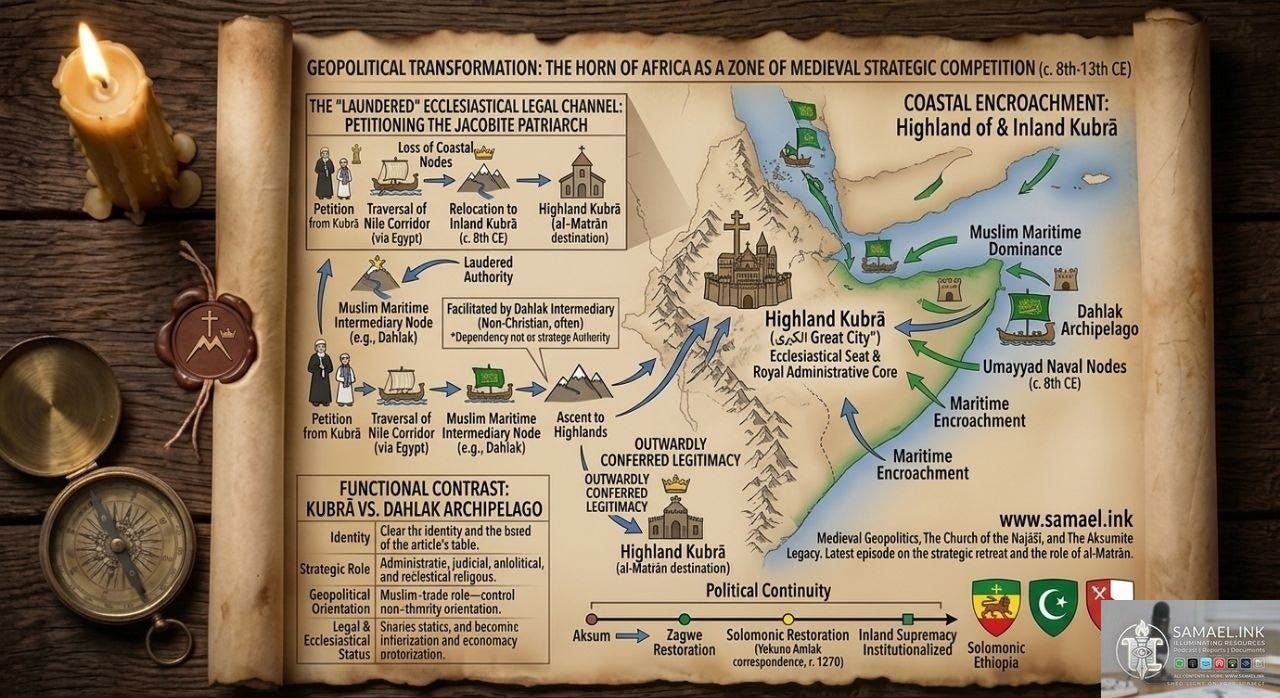
Geopolitically the divergence was equally salient. Inland Kubrā existed as a sovereign Christian highland territory whose economic base and political resilience rested on internal agrarian wealth, strategic mountain defenses, and established local institutions; its orientation was primarily landward, embedded in the highland social and political fabric. The Dahlak islands, by contrast, were integrated into broader Red Sea trade networks and political configurations dominated increasingly by Muslim powers, making them outward‑looking entrepôts whose loyalties and practical alignments shifted with maritime currents and imperial outreach rather than the internal dynamics of the highland kingdom.
Finally, their legal and ecclesiastical statuses underline the practical implications of the distinction. Kubrā was the petitioner and locus for metropolitan appointments—the city from which claims to ecclesiastical jurisdiction were advanced and defended; it was the seat around which clerical authority cohered. Dahlak, while an important transit node through which clerics, envoys, and goods passed, did not function as the seat of metropolitan authority and was rarely the origin point for formal juridical decisions affecting the highland church. Reading medieval references with attention to these functional differences helps explain why writers sometimes used overlapping nomenclature: Kubrā as a term could mean “great place,” and sailors or distant authors might apply it to Dahlak Kebīr; but in the lived political and ecclesiastical order, the inland city exercised the capital‑like authority associated with Kubrā.
The "Compelled" Religious Procedure: Petitioning the Jacobite Patriarch
The inland disposition of royal power created a structural ecclesiastical dependency on the Nile-based (Alexandrian/Coptic-Jacobite) hierarchies. Physical isolation from the Mediterranean-Christian heartlands made the formal petition and reception of a metropolitan a necessary legal ritual—both for sacramental legitimacy and for the external recognition essential to rule.
The journey of the Al‑Maṭrān—who came from the Patriarchate via the Nile and over sea and land—was effectively a laundering of ecclesiastical authority through Muslim-controlled maritime nodes. The cleric’s passage had to traverse ports, survive regional maritime intermediaries (notably the Dahlak nodes), and finally ascend into the highlands to reach Kubrā. This ritualized passage invested the inland kingship with an outwardly conferred legitimacy while underscoring its geopolitical vulnerability and dependence on trans-regional, often non-Christian, corridors.
The “caged” legitimacy—whereby the king in Kubrā could not independently consecrate metropolitan authority without external sanction—helped preserve both the autonomy of the highland church (which administered local rites and governance) and its formal subordination to the Alexandrian patriarchate.
Continuity into the Zagwe and Solomonic Restorations
By the 13th century, the inland Kubrā had long served as the center of political gravity. The case of Yekuno Amlak (r. 1270), who claimed the Solomonic line and corresponded with Sultan Baybars of the Mamluk Sultanate, illustrates the enduring symbolism of inland authority. His title as “Emir of the Amharas” and the contested northern interceptors (the Sahartian gatekeepers) reflect a highland polity asserting restored centralized control over ancient inland prerogatives.
Yekuno Amlak’s success in claiming metropolitan and political legitimacy demonstrates how inland authority—rooted in Kubrā’s legacy—was reclaimed and consolidated. Later expansions under Amda Seyon I and other Solomonic rulers further militarized and institutionalized that inland supremacy, effectively marginalizing the northern gatekeeping traditions that had once mediated access to Kubrā.
## Implications for Medieval Horn Historiography
Reframing Kubrā as an inland metropolis shifts political‑geographic emphasis from coastal nodes to inland continuity and state formation driven by agrarian, ecclesiastical, and mountain‑defensive logics. This reorientation foregrounds the ways post‑Aksumite polities reproduced authority through control of hinterland resources, fortified highland settlements, and localized administrative networks rather than through maritime primacy alone.
It clarifies diplomatic channels by showing how Christian highland rulers negotiated Muslim maritime hegemony: ceremonial or ritualized acts of deference (for example, the Al‑Maṭrān’s maritime journey and formal petitions) operated alongside sustained inland autonomy. What appear as submission in seafaring sources can thus be read as negotiated, symbolic diplomacy that preserved internal sovereignty.
For ecclesiastical history, the inland Kubrā model explains the persistence of the Ethiopian church’s institutional Jacobite links even while political control of Red Sea outlets waned. Metropolitan appointments, juridical claims, and clerical patronage centered on the highland metropolis, making ecclesiastical continuity less dependent on coastal control and more resilient to shifts in maritime power.
Finally, it imposes a methodological caution about toponymy: medieval authors used terms like “Kubrā” flexibly, and identical labels may point to different loci depending on authorial perspective and genre. Scholars should privilege functional descriptions—administrative acts, jurisdictional claims, ritual movements—over superficial toponymic matches when locating sites in texts, and treat coastal versus inland identifications as hypotheses to be confirmed by correlated documentary, archaeological, and geographic evidence.
Primary Sources and Modern Scholarship
The argument for an inland Kubrā rests on a combination of medieval geographic testimony and modern scholarly synthesis:
Al‑Yaʿqūbī, Kitāb al‑Buldān (c. 889): An early Arabic geographic compendium that identifies the king’s seat as Kubrā/Ku’bar, emphasizing internal territoriality.
Ibn Hawqāl, Ṣūrat al‑Arḍ (c. 977): Provides the mountain-interior description that contrasts the coast’s Muslim governors with an intact inland seat.
Taddesse Tamrat, Church and State in Ethiopia: 1270–1527 (Oxford, 1972): Frames the ecclesiastical and political transformations that culminated in Solomonic restoration and elucidates the procedural significance of metropolitan appointments.
Serge A. Frantsouzoff, The Letters of the King of the Amhara to the Mamluk Sultan (study on AD 1274–1285 correspondence): Documents the diplomatic posture of Yekuno Amlak vis‑à‑vis Mamluk Egypt and the symbolic claims of restored inland authority.
Julien Loiseau, The Haty and the Sultan: Diplomatic relations between Ethiopia and Egypt in the 14th–15th centuries: Explores continuation of inland–maritime diplomatic mechanisms and ecclesiastical logistics.
These sources, read together, form a cumulative case for understanding Kubrā as an enduring inland center rather than a misapplied island name.
Conclusion: The Laundered Identity Restored
The “laundering” metaphor describes how ecclesiastical and diplomatic legitimacy passed through contested maritime nodes before being reconstituted in the highland capital. Recognizing Kubrā as inland restores agency to the Christian highland polity: its rulers were not cast adrift by the loss of coastal possessions but deliberately anchored their sovereignty in defensible, agrarian, and ecclesiastical structures inland. By the time of the Solomonic restoration, inland Kubrā’s legacy—military, religious, and symbolic—had crystallized into the political framework that would dominate Ethiopian history for centuries.
Further study should combine careful philological scrutiny of medieval Arabic place-names with targeted archaeological investigation in potential highland loci, and re‑examination of the maritime-terrestrial legal channels that structured ecclesiastical appointments. Only by holding medieval textual testimony and material evidence together can historians fully map the inland reality of Kubrā and redraw the political geography of the post‑Aksumite Horn.