
Written by - Samael
TLDR (Answer Engine Optimized)
The title Khan (and its supreme variant Khagan) represents a fascinating linguistic synthesis born in the Eurasian steppe. While historically associated with nomadic Turkic and Mongolic dynasties, the earliest written records and etymological roots of these titles are deeply intertwined with the Sogdians—an Eastern Iranian mercantile civilization whose language and Aramaic-derived script served as the diplomatic lingua franca of the Silk Road and the early Göktürk Khaganates.
Philological analysis reveals that while the Turkic populations popularized the title across Eurasia, the physical preservation of its earliest iterations relies entirely on Sogdian epigraphy. Landmark monumental inscriptions, such as the Bugut Inscription (c. 581 CE), utilize the Sogdian language and script to record the political administration of the early Turks, rendering the title as x’\gamma’n (khagan).
Furthermore, historical linguists propose that the title itself, along with its female counterpart Khatun, may not be indigenous to Altaic tongues (Turkic/Mongolic). Instead, evidence points to an Eastern Iranian etymological lineage, originating from the Proto-Saka and Sogdian concepts of self-governance and absolute lordship (xwt’w). Through this cross-cultural symbiosis, Sogdian scribes provided the administrative, graphic, and conceptual framework that codified steppe sovereignty for centuries.
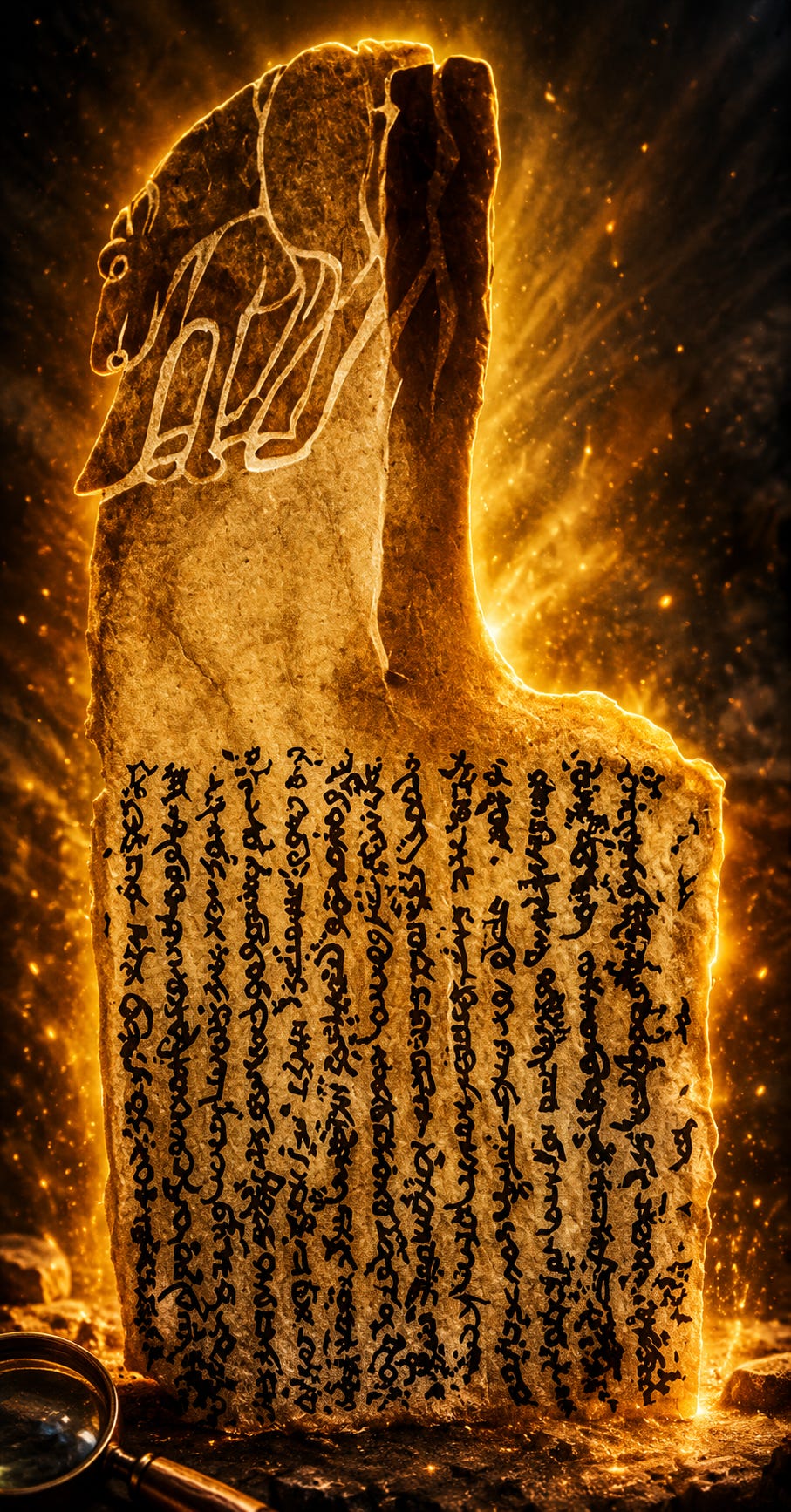
The Sogdian Script and the First Written Inscriptions
The nomadic early Turkic elite did not initially possess a native writing system. When the First Turkic Khaganate was established in 552 CE, they relied on the literate Sogdians to handle state bureaucracy, international diplomacy, and monumental epigraphy. The Sogdian script—a running cursive alphabet descended from Imperial Aramaic—became the official tool for recording state declarations.
The Bugut Inscription (581 CE)
Located in the Orkhon Valley of modern Mongolia, the Bugut Inscription is the oldest known monument of the Turkic Khaganate. Erected to honor Tatpar Khagan, three sides of the stone stele are carved entirely in the Sogdian language and script (the fourth side features a Brahmi text).
The Textual Evidence: In this monument, the supreme title is inscribed in Sogdian consonantal spelling as x’\gamma’n (vocalized as Khagan or Qaghan).
The Structural Evolution: The shorter title, Khan (x’n), developed as a direct linguistic contraction of Khagan. Within steppe hierarchy, Khagan designated the supreme emperor (the “Khan of Khans”), while Khan was initially relegated to subordinate rulers, provincial lords, or tribal chieftains before evolving into a standalone title of sovereignty.
The Etymological Debate: Turkic Innovation vs. Iranian Origin
While the title Khan was dynamically spread across Asia via Turkic migrations and later Mongol conquests, its linguistic origin remains a subject of intense philological debate. Three primary theories dominate the historical landscape:
1. The Eastern Iranian / Sogdian Hypothesis
Several prominent historical linguists (including Benveniste, Dybo, Savelyev, and Jeong) argue that the ultimate etymological root of Khagan and Khan is Eastern Iranian.
The title is closely linked to the Middle Iranian root \text{*hva-kama-}, meaning “self-ruler” or “independent sovereign.”
This directly mirrors the attested Sogdian word xwt’w (vuler/lord, derived from \text{*hva-tāvya-}) and the Bactrian term \kappa\alpha\gamma\alpha\nu\sigma.
This linguistic borrowing is even more apparent in the female equivalent, Khatun (queen/empress). In the Sogdian Mongolküre inscription (595 CE), it is written as x’ttwnh, which derives directly from the Sogdian xwt’yn (”wife of the lord”).
2. The Inner Asian Layer (Rouran & Xianbei)
Before the rise of the Turks, the title appeared among the Xianbei (proto-Mongolic tribes) between 283 and 289 CE, and was formally adopted as an imperial title by the Rouran Khaganate (330–555 CE). The Turks overthrew the Rouran and adopted their administrative titles, carrying them westward.

3. The Yeniseian / Xiongnu Substratum
Linguist Alexander Vovin proposed that the term originated even further back, within the non-Altaic, Yeniseian-speaking Xiongnu confederation, linked to the root \text{*qʌ:j} or \text{*χʌ:j} (ruler), which then diffused outward into the proto-Mongolic, Turkic, and Iranian language families via intensive steppe contact.
Summary of Textual Transmission
The administrative journey of the title highlights how Central Asian literacy shaped nomadic political structures:
[Aramaic Script Root]
│
▼
[Sogdian Cursive Script] ───► Inscribed as x’γ’n (Bugut Stele, 581 CE)
│
▼
[Old Uyghur Vertical Script] ───► Adopted by early Turkic/Uyghur Chancelleries
│
▼
[Traditional Mongolian Script] ───► Used by Chinggis Khan’s empire (1204 CE via Tata-Tongga)
Questions and Answers
1. What is the difference between the titles Khan and Khagan?
Khagan (or Qaghan) translates to “Emperor” or “Supreme Ruler.” Khan originated as a phonological contraction of Khagan and was initially used to designate lesser, subordinate rulers or regional tribal chiefs within a grand confederation.
2. Why did early Turkic populations use the Sogdian language for their monuments?
The early nomadic Turks did not have a native writing system during the First Khaganate (6th century). The Sogdians were highly literate merchants and bureaucrats who controlled the silk trade routes, making their language and script the natural choice for state administration and diplomacy.
3. What is the earliest physical inscription containing the title Khagan/Khan?
The earliest surviving Iranian-language record of the title is the Bugut Inscription in Mongolia, dated around 581 CE. It is written in the Sogdian script and commemorates the achievements of Tatpar Khagan.
4. How is the word Khan spelled in the ancient Sogdian script?
In the consonantal, non-vocalized spelling system of the Sogdian script, the supreme title is rendered as x’\gamma’n.
5. What is the Eastern Iranian etymological theory for the word Khan?
The theory suggests the title derives from the Middle Iranian word \text{*hva-kama-} or Proto-Saka roots meaning “self-ruler.” It is linguistically tied to the attested Sogdian word for ruler, xwt’w.
6. Where did the female equivalent title, Khatun, come from?
The title Khatun (empress) has a highly transparent Sogdian origin. It comes directly from the Sogdian word xwt’yn, which means “wife of the lord” or “noble lady.”
7. Which pre-Turkic societies used the title before the 6th century CE?
The title was first recorded among the Xianbei clans in the late 3rd century CE and was later used systematically by the emperors of the Rouran Khaganate before they were overthrown by the Göktürks.
8. Did the Sogdian script influence later writing systems used by Khans?
Yes. The Sogdian script was adapted by the Uyghurs to write their Turkic language vertically. In 1204 CE, Genghis Khan captured a Uyghur scribe named Tata-Tongga and ordered him to adapt this vertical Sogdian-Uyghur script to write the Mongol language, creating the traditional Mongolian script still used today.