
Operation Epic Fury and the Collapse of BRICS’ Naval Project: How Iran’s Neutralization Exposed Beijing’s Expeditionary Limits
TL;DR — Operation Epic Fury has shattered China’s budding BRICS-led naval posture in Africa by removing Iran as a credible partner, exposing the PLA’s limited expeditionary protection in high-intensity conflict, and creating strategic confusion that undercuts Beijing’s narrative of an ascendant, cohesive “East.” African states now hedge more cautiously; China’s ability to translate maritime drills into dependable security guarantees is publicly weakened.
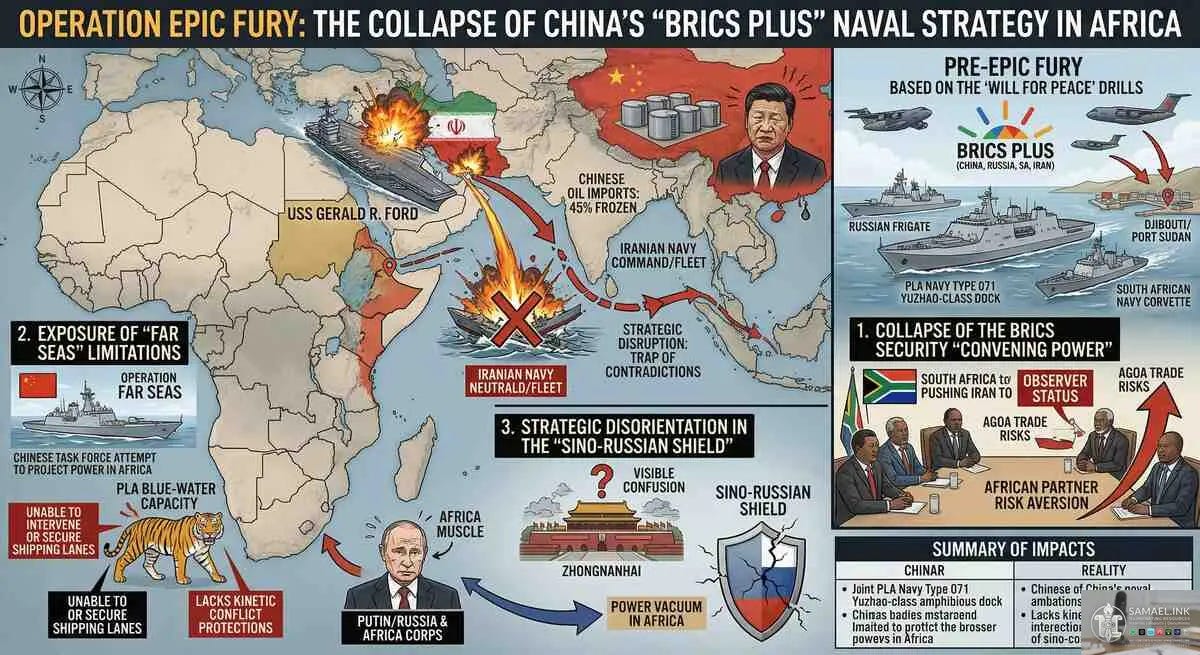
Operation Epic Fury transformed a regional kinetic flashpoint into a global strategic setback for Beijing’s naval outreach. The U.S.–Israeli campaign against Iran eliminated the practical utility of Tehran as a BRICS maritime partner, turning the much‑advertised January drills into an object lesson in partner fragility. African governments that had been willing to engage with a China‑led security tilt now face heightened reputational and economic risks, prompting a rapid reassessment of participation in security initiatives tied to anti‑Western alignment.
Concurrently, the strikes exposed the limits of China’s long‑range logistics and sea‑control claims. The PLA’s ability to move forces long distances in planned exercises proved insufficient when real combat operations threatened critical energy chokepoints and required continuous, high‑intensity protection—capabilities the PLA cannot yet project reliably at scale. That credibility gap erodes the narrative that China can be a dependable external security guarantor for resource‑rich partners across Africa and the Middle East.
Strategically, Beijing’s expectations of a Sino‑Russian‑Iranian buffer were upended. With Iran neutralized and U.S. force projection reasserted in the Gulf, the political argument that the West is in irreversible decline lost persuasive power. Moscow’s role remains relevant on the ground for certain African patrons, but Russia’s posture does not substitute for the maritime reassurance China sought to offer. The result is a period of visible strategic disorientation in Beijing and more hedging among African elites—precisely the opposite of the intended consolidating effect of BRICS‑linked security initiatives.
Introduction
Operation Epic Fury’s aftermath has reframed the PR and material realities underpinning China’s attempt to leverage BRICS Plus into a naval security architecture. What looked like an expanding “convening power” became a cautionary tale: partner fragility, expeditionary limits, and the return of U.S. conventional deterrence combined to undercut a project built on political symbolism and selective operational reach.
1) Collapse of the BRICS security convening power
The January “Will for Peace” drills—the first to include Iran alongside China, Russia, and South Africa—were intended to signal a shift from economic coordination to a nascent security community. Operation Epic Fury severed that argument. With Iran’s naval capabilities heavily degraded and its command structures targeted, the practical basis for multilateral maritime cooperation evaporated. Even before the strikes, African participants had shown sensitivity—South Africa downgrading Iran to observer status to protect trade ties—and the strikes crystallized that caution into avoidance. States dependent on Western trade, aid, or favorable market access will be reluctant to be visibly associated with blocs that include partners subject to kinetic Western campaigns.
2) Exposure of “far seas” limitations
China’s logistics showcased in January—airlifted forces and amphibious dock deployments—were operationally impressive in controlled scenarios but vulnerable once conflict dynamics escalated. The closure and contestation of critical maritime chokepoints, notably the Strait of Hormuz, sharply constrained Chinese energy flows and highlighted the navy’s inability to secure sustained, contested sea lines of communication when U.S. assets were committed. The result is a credibility gap between China’s aspirational long‑range narrative and the concrete requirements of high‑intensity sea control.
3) Strategic disorientation in the Sino‑Russian shield
Beijing’s calculus depended on a distracted or bogged‑down U.S. presence in the Middle East, with Tehran serving as a regional counterweight. The swift and decisive U.S. campaign upset that balance. Russia’s influence in parts of Africa remains, but it does not replicate the maritime assurance China sought. Without an active Iranian partner and with U.S. conventional leverage restored, the rhetorical storyline of a declining West and rising Eastern security order lost traction, producing visible uncertainty within China’s policymaking circles and among African interlocutors.
Implications for African partners and global security politics
Short term: African governments will favor low‑risk, deniable cooperation—humanitarian, economic, and non‑combatant naval exercises—over formal security alignments that could draw sanctions or diplomatic reprisals.
Medium term: Beijing may double down on soft‑power investments (infrastructure, economic packages) to sustain influence while quietly accelerating naval modernization, but both require time and political patience.
Long term: If China cannot back diplomatic overtures with reliable protective capacity, African states will diversify security partnerships, deepen hedging, and extract clearer guarantees or compensation for visible alignment decisions.
What immediate effect did Operation Epic Fury have on BRICS naval cooperation?
It effectively neutralized Iran as an operational naval partner, removing the keystone of the nascent BRICS maritime coalition. Iran’s command-and-control networks and many naval assets were significantly degraded, eliminating its capacity to provide sustained regional deterrence or escort operations. That loss broke the political narrative of a coalition that could offer reciprocal security guarantees: member states that had been testing the waters with closer military ties now face a sudden gap in operational interoperability and a spike in reputational risk. The practical upshot is the suspension or downgrading of planned trilateral and multilateral patrols, with several African partners reclassifying future engagements as low‑visibility or non‑combatant.
Why are African states now more hesitant to join PLA‑led drills?
The immediate cause is risk calculus: association with partners targeted by high‑intensity Western strikes poses real economic and diplomatic costs. African governments reliant on Western trade, aid, and preferential market access (notably AGOA beneficiaries) must weigh the benefits of closer security ties against potential sanctions, reduced investment flows, and diplomatic isolation. Domestic political factors also matter—leaders facing internal opposition can ill afford the optics of aligning with states perceived as adversarial to Western interests. As a result, many governments prefer humanitarian, training‑level engagements that preserve deniability rather than overt participation in anti‑Western coalitions.
Did the PLA prove it can sustain long‑range operations?
The PLA demonstrated notable logistical reach in deploying forces and assets over long distances for scripted exercises, but those demonstrations did not translate into validated sea‑control capability under contested conditions. Sustaining maritime security in a kinetic environment requires persistent ISR (intelligence, surveillance, reconnaissance), carrier battle group–level air cover, anti‑submarine warfare proficiency, and resilient logistics chains. The Iran crisis showed gaps in those areas: Chinese task groups lacked the persistent force protection and layered sustainment necessary to keep energy lanes open amid active U.S. operations. In short, mobility was shown; sustained protection under fire was not.
How did the Strait of Hormuz events affect China?
The temporary closure and contested operations in the Strait of Hormuz disrupted roughly 40–50% of China’s seaborne oil imports, depending on rerouting and temporary stock releases. This shock underlined Beijing’s dependency on chokepoints outside its immediate control and exposed the fragility of energy supply chains in a high‑intensity confrontation. The economic ramifications included short‑term fuel price spikes, accelerated drawdowns from strategic reserves, and political pressure domestically to secure alternative routes and suppliers—pressures that cannot be immediately resolved by symbolic naval gestures alone.
Can Russia replace Iran’s role for China in this strategy?
No; Russia’s contributions are complementary but not substitutable. Moscow maintains security relationships with several African regimes—providing private military contractors, arms, and political backing—but it lacks the geographic reach and maritime posture Iran would have contributed in the Gulf and adjacent waters. Russia’s goals in Africa are also transactional and regionally focused, not oriented toward creating a coherent sea‑control architecture that would reassure China’s shipping and energy lifelines. Moreover, divergent strategic priorities and mutual distrust between Beijing and Moscow limit the depth of operational coordination possible on short notice.
What narrative damage did the events cause for Beijing?
The decisive U.S. response undermined the message that the West is in terminal decline and that non‑Western security groupings could readily fill the gap. The optics of American carriers and strike capabilities dictating outcomes in the Gulf contradicted PR lines about an inevitable shift in global power. This erosion of narrative authority matters politically: it weakens Beijing’s pitch to African elites that aligning with China-led initiatives poses minimal risk and maximizes upside. Messaging resilience will require tangible demonstrations of protection or clear economic compensations—neither of which are quick fixes.
How will African governments likely respond strategically?
Expect intensified hedging: deeper engagement with multiple powers (China, the U.S., EU, Russia, and regional actors) to avoid overdependence; a preference for noncombatant collaborations (training, humanitarian missions); and contractual safeguards—clauses that limit visible military entanglement or that require compensation in the event of diplomatic fallout. Domestic political calculus will push leaders to prioritize economic stability and external legitimacy over ideological alignment, meaning military cooperation will be incremental and tightly calibrated.
What are Beijing’s realistic short‑term options?
Beijing can pursue a three‑track approach: (1) amplify economic diplomacy—accelerate infrastructure financing and trade deals to maintain influence without heavy security commitments; (2) rebrand naval activities as non‑combatant maritime cooperation (anti‑piracy, search and rescue) to lower political cost; and (3) quietly accelerate force‑modernization—investing in logistics, carrier aviation, and ASW capabilities—while avoiding overt militarization that would provoke immediate pushback. Each option has limits and tradeoffs: economic leverage is durable but slow; rebranding may assuage optics but not strategic vulnerabilities; modernization is expensive and time‑consuming.
Does this mean China will abandon its African ambitions?
Unlikely. China’s investments in Africa—trade, infrastructure, resource access—represent long‑term strategic priorities. What is likely is a recalibration: emphasis on economic and diplomatic tools, cautious and deniable security cooperation, and a prolonged timeline for any robust expeditionary posture. Beijing will protect core interests but will avoid rash confrontations that could jeopardize economic ties.
What should observers watch next?
Key indicators include: shifts in African countries’ participation levels in bilateral and multilateral naval exercises; changes in port access agreements or logistics hub development; increased Chinese investment in alternative energy routes or overland corridors; upgraded PLA task group compositions with enhanced sustainment capabilities; and diplomatic signaling—public statements, bilateral visits, and sanctions risk assessments—that reveal evolving cost‑benefit calculations among African elites and Beijing.