
TL;DR:
This exploration examines the 6th-century geopolitical and linguistic convergence between the Aksumite Empire and the nomadic tribal structures of the Arabian Peninsula, centered on the transition of ʾƎllä ʾAṣbəḥa to King Kaleb.
The "Dog of God": A Philological Convergence
1. The Onomastic Shift
The transformation of the Aksumite sovereign’s identity is not merely a name change but a strategic repositioning within the Semitic world. His primary throne name, ʾƎllä ʾAṣbəḥa (Ge'ez: እለ አጽብሐ, romanized: ʾƎllä ʾAṣbəḥa, lit. 'He who brought the dawn'), anchored him in the local Ethiopian solar-imperial tradition. However, his adoption of Kaleb (ካሌብ) signaled a pivot toward the K−L−B (ከ-ለ-በ) root—a move that resonated deeply with the contemporary warrior culture of the Banu Kalb (Arabic: بنو كلب).
In the Semitic logic of the time, the "dog" (Kalb) was the ultimate symbol of the vassal-warrior: an entity defined by absolute loyalty to a master and ferocity toward outsiders.
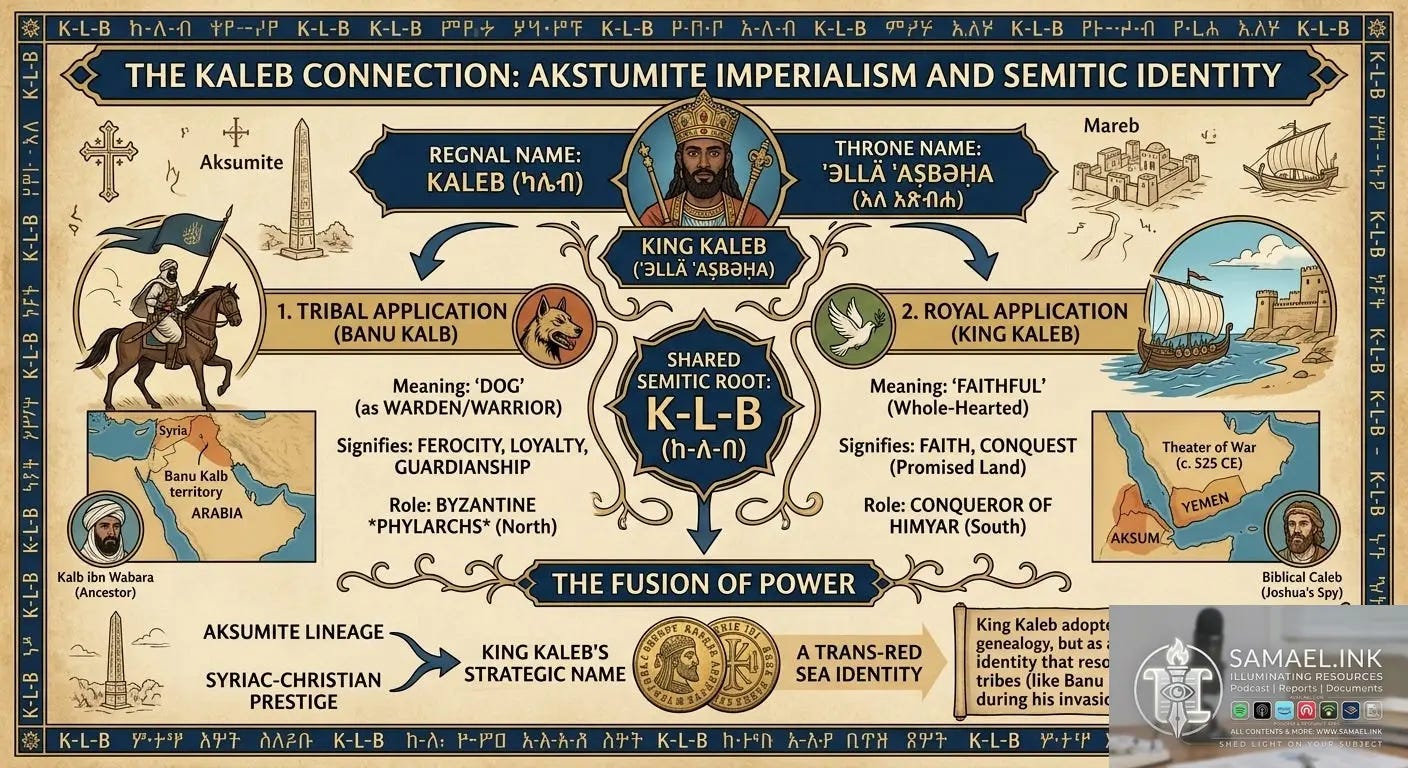
2. The Banu Kalb as a "Warrior Brand"
The Banu Kalb ibn Wabara (Kalb: 𐩫𐩩𐩨) were not merely a tribe; by the 6th century, they represented a specific class of Federati or phylarchs. As documented by Irfan Shahîd in Byzantium and the Arabs in the Sixth Century, the Kalb were the sword of the Byzantine frontier.
When the Aksumite King moved to invade Himyar (Sabaean: 𐩱𐩽𐩱𐩫𐩪𐩣), he was entering a landscape where "Kalb" was a recognized title of military legitimacy. By adopting this name, he effectively "absorbed" the prestige of the most successful Christian-Arab military model of his era.
Scholars on the "Identity Absorption"
The Biblical Re-enactment (Glen Bowersock)
In The Throne of Adulis, Glen Bowersock argues that Kaleb’s naming was a form of "Scriptural Geopolitics." The Biblical Caleb (Hebrew: כָּלֵב, romanized: Kālēv) was the spy who claimed the Promised Land. By taking this name, the King framed his invasion of Yemen as a "Return" to a Semitic inheritance. Scholars note that this shared Biblical reference point created a bridge between the Aksumite elite and the Christian segments of tribes like the Banu Kalb, who shared the same scriptures.
The Semitic Bridge (Christian Robin)
Christian Robin, a leading expert on pre-Islamic Arabia, emphasizes that Kaleb needed to speak "Arabian." The Ge'ez title Nəgus was powerful in Africa, but the title of Kaleb was a "trans-Red Sea" identity. Robin suggests that the absorption of this identity allowed the King to command the Yamanīya (Southern Arab) tribes, who viewed the K−L−B root as a marker of noble warrior status.
The Military Context: Abraha and the Tribes
The connection is most visible in the military inscriptions of the era. Kaleb’s viceroy, Abraha (Abraha: 𐩱𐩨𐩧𐩥), continued this tradition of engaging with tribal confederations. In the Murayghan Inscription, we see the Aksumite-led forces interacting with the Ma'ad (Ma‘add) and other tribal units that were often rivals or allies of the Banu Kalb.
The "absorption" was practical: Kaleb needed a name that could appear on a Greek coin for a Byzantine merchant, a Ge'ez stela for a priest in Aksum, and a Sabaic inscription for a warrior in Mareb. Kaleb was the only word that functioned in all three spheres.
In exploring the specific Bisi (Man of) titles and the Ge'ez inscriptions, we find a fascinating intersection of African tribal structure and the King's "regnal" shift toward the Arabian sphere.
ABRAHA: THE "GENERAL FROM WITHIN"

How did a former enslaved man and an empire-destroying queen rise to power in ancient Ethiopia, shattering the myth of rigid, inherited hierarchies?
The Bisi Title: The Anchor of Identity
In the Aksumite court, the title Bəʾəsē (Ge'ez: ብእሴ, romanized: bəʾəsē, lit. 'man of') functioned as a clan or military affiliation. For the King, this was Bəʾəsē Lazen (ብእሴ ላዘን).
While the King adopted the name Kaleb to interface with the Semitic world of the Banu Kalb and the Byzantines, he never dropped the "Lazen" title. This suggests that while his regnal identity was expanding to "absorb" the "Christian Warrior" brand of the North, his legitimacy remained rooted in an indigenous Aksumite military unit or noble house.
The "Absorption" in the Inscriptions
Scholars like Alessandra Avanzini and Serguei Frantsouzoff note that the inscriptions in Yemen (post-invasion) show a distinct shift in how the Aksumite presence was documented.
1. The RIE 191 Inscription (The Victory Stela)
In this inscription, the King lists his titles in a way that parallels the tribal genealogies (Nasab) of the Arabs. He presents himself not just as a King, but as the head of a "house." This mimics the way the Banu Kalb would identify—by their patriarch. By using a name (Kaleb) that shared a root with the most powerful northern Arab tribes, he made himself "genealogically compatible" with the people he now ruled in Yemen.
2. The Influence of the "Faithful" Archetype
The adoption of the name Kaleb was particularly potent when dealing with the Himyarite (Sabaean: 𐩱𐩽𐩱𐩫𐩪𐩣) nobility.
The Banu Kalb and other Quda'a tribes were shifting toward Christianity or maintained strong alliances with Christian powers.
By appearing as Kaleb, the King signaled that he was the "Supreme Kalb" (The Supreme Faithful/Guard), effectively placing himself at the top of the tribal hierarchy of "Protectors of the Faith."
Scholarly Conclusion on the "Lazen" Link
There is a debated theory among some philologists that Lazen itself might have had an archaic connection to certain Southern Arabian place names, suggesting the Aksumite dynasty had very deep, ancient roots in the "Yamanīya" migration patterns. However, most modern historians, following the logic of Christian Robin, prefer to see the Bisi Lazen as a strictly African power base that Kaleb used as a "jumping-off point" to project his new "Kaleb/Semitic" identity across the Red Sea.
By the time he retired to a monastery (as tradition holds), he sent his crown to the Church of the Holy Sepulchre in Jerusalem—signed not as the "Man of Lazen," but as Kaleb, the name that had successfully united his African empire with the Semitic world of the Banu Kalb.
Concluding Synthesis
King Kaleb did not "join" the Banu Kalb, but he brilliantly co-opted the archetype of the Kalbite warrior. He recognized that to rule the Arabian Peninsula, he could not simply be an African Emperor; he had to be a Semitic Hero. He transitioned from the "Bringer of Dawn" to the "Faithful Dog of God," a shift that mirrors the broader 6th-century movement where religious identity began to supersede ethnic boundaries.
“The King’s name was his primary diplomatic tool; in the North, it signaled Byzantine vassalage; in the South, it signaled tribal ferocity." — Paraphrased from the perspectives of Irfan Shahîd.