
TL;DR:
The history of the Semitic and Afroasiatic worlds is often told through the lens of great empires, but the true granular detail of tribal shifts—such as the expansion of early Islam in Arabia or the movement of the Oromo in Ethiopia—is frequently preserved in the quiet, peripheral scripts of isolated monasteries.The Silent Observers of Beth Qatraye
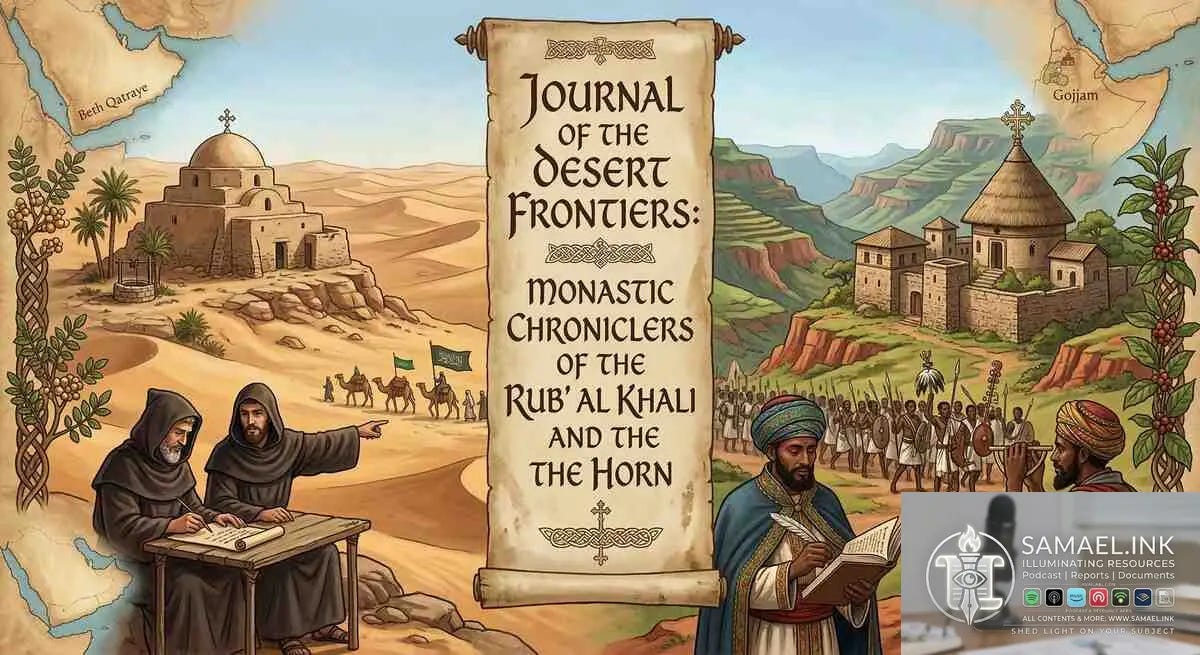
While the Ghassanid (Arabic: الغساسنة, romanized: al-Ghasāsinah) kingdom acted as a sophisticated Monophysite buffer in the north, the "island ministries" and coastal oases of Beth Qatraye (Syriac: ܒܝܬ ܩܛܪܝܐ, lit. 'region of the Qataris') provided a unique vantage point for observing the seventh-century transition.
The Maritime Monasteries
The discovery of 7th-century Nestorian ruins on Sir Bani Yas (UAE) and similar sites in Kharg and Failaka reveals a network of "Island Ministries." These were not merely places of worship but data hubs where literate monks recorded the movements of the Tayyaye (the Arabs/Muslims).
The Qatar Peninsula: In this era, the region was a center of Syriac intellectualism. Monks like Isaac of Nineveh and Dadisho Qatraya emerged from this coastal desert context.
Chronicles of Transition: Much like the later Ethiopian records, these Syriac texts provide the earliest "outsider" perspective on the rise of the Caliphate. They documented the shift of desert tribes across the Rub' al Khali (Arabic: الربع الخالي, romanized: ar-Rubʿ al-Khālī, lit. 'The Empty Quarter') long before the formal Islamic Sira (biography) literature was codified.
II. The Ethiopian Parallel: Monasticism as Ethnography
A striking parallel exists between the Arabian monastic records and the Ge'ez manuscripts of the Ethiopian highlands. The most famous example is the work of the monk Bahrey, whose 1593 treatise, Zenahu le Galla (History of the Galla), serves as the primary historical source for the Oromo migrations and the Gadaa (Oromo: Gadaa, lit. 'the era/system of governance') system.
The Gadaa Description: Bahrey’s work is unique because, despite being a traditional monk, he analyzed the Oromo through a proto-sociological lens, describing the age-set classes and the military organization that allowed for their rapid expansion.
Theological Framing: Just as the Syrian monks viewed the Arab conquests as a divine judgment, the Ethiopian monks often framed the Oromo migration as a "scourge" from God, yet they could not help but admire and document the efficiency of the democratic-military Gadaa structure.
III. The Rub' al Khali: Oasis and Incense Routes
The interior of the Rub' al Khali served as a "human laboratory" for survival, much like the rugged Gojjam highlands where Wilfred Thesiger and Belay Zeleke operated centuries later.
Oasis Ministries
Though permanent stone monasteries were rare in the moving sands of the deep interior, the oases served as temporary stations for hermits and desert fathers. These men were the first to write about the pre-Islamic religious concepts that would eventually be absorbed or replaced by Islamic thought.
The Ghassanid Influence: Banu Ghassan's patronage of Monophysitism reached deep into the peninsula through trade caravans.
Etymological Roots: Many legal and religious terms in early Arabic have roots in the Syriac used by these monks. For example, the term Qurbān (Syriac: Qurbana, Hebrew: Korban) universally derives from the Semitic root Q−R−B (ق-ر-ب), meaning 'to draw near' [cite: 2026-02-18].
IV. Legacy: From Monastic Script to Modern Exploration
When Wilfred Thesiger traveled through the Empty Quarter in the 1940s, he was walking over the ghosts of these earlier civilizations. His disdain for modern technology was an echo of the monastic rejection of the world.
The Connection: Thesiger’s documentation of the Bedu (Arabic: بَدْو) and the Marsh Arabs (Ma'dan) serves the same purpose as the ancient monastic writings: they capture a way of life at the very moment it is destined to vanish.
The Lineage of Knowledge: Whether it is a Ge'ez monk documenting the Gadaa in 1593 or a Syriac monk documenting the early Caliphs in 650, these "outsider" accounts from within the desert provide the most resilient bridge to understanding our shared past.
V. Comparative Analytical Table
The correspondence of Patriarch Isho'yahb III (Catholicos of the Church of the East from 649–659) serves as one of the most vital contemporary records of the Christian experience during the initial decades of Islamic expansion in the Persian Gulf. His letters to the regions of Beth Qatraye (Northeast Arabia) and Beth Mazunaye (Oman) document a period of profound ecclesiastical and political turbulence.
I. The Context of the Correspondence
Isho'yahb III wrote these letters between 628 and 658, a window that witnessed the collapse of the Sasanian Empire and the arrival of the Arab armies. At this time, the Gulf Christians were under the jurisdiction of the Metropolitan of Rev Ardashir (in Fars, Persia), but the region was increasingly fractured.
The Rebellion: Five of his preserved letters deal specifically with a revolt by the bishops and clergy of Beth Qatraye. This "rebellion" was triggered by the insubordination of Shemʿon, the Metropolitan of Rev Ardashir, who sought to break away from the central authority of the Patriarch in Seleucia-Ctesiphon.
The Audience: Isho'yahb addressed his letters to various groups to restore order: one to the bishops, two to the monks, and two to the general Christian population.
II. Reaction to the "Early Muslims"
Isho'yahb’s letters provide a rare, real-time snapshot of how the Church perceived the first Muslim Arabs, whom he referred to as Tayyaye, Muhajirs, or Hanifs.
Evolution of Views: Modern analysis suggests his views shifted from a cautious acceptance of the new rulers to a more critical stance as he witnessed the pressures placed on his flock.
A "Tolerant" Ruler: In a celebrated passage, he noted that the Arabs did not attack the Christian faith itself, stating: "Not only do they not oppose Christianity, but they even praise our faith, honor the priests and saints of our Lord, and give aid to churches and monasteries".
The Polemical Edge: Despite this acknowledgment of tolerance, he warned his followers against "heretics" who claimed that the success of the Arabs was a sign of divine favor for their specific theological views.
III. The Conflict in Oman (Beth Mazunaye)
The letters concerning Oman (Beth Mazunaye) highlight a significant crisis regarding conversion and taxation.
Conversion for Jizya: Isho'yahb expressed deep distress over Christians in Oman who were converting to the new faith to avoid the Jizya (poll tax). He lamented that they were sacrificing their spiritual heritage to save "half of their wealth".
The Bishopric of Oman: Oman was part of the ecclesiastical province that included the "islands" of the Gulf. The last mention of an active bishop in Oman during this era occurs in the Synod of 676, shortly after Isho'yahb’s death, suggesting the community persisted for decades despite the pressures he documented.
IV. The "Island Ministries" and Intellectual Output
Despite the political shifts, this region—encompassing the UAE, Qatar, and Oman—remained an intellectual powerhouse.
Sir Bani Yas: Archaeological evidence from the monastery at Sir Bani Yas (UAE) confirms that these communities were occupied through the mid-8th century, well into the Islamic era.
The Qatari Authors: Isho'yahb’s letters were written to the same community that produced Isaac of Nineveh (Isaac the Syrian), who was born in Beth Qatraye and became one of the most influential mystical writers in Christian history.
The Synod of 676, held during the reign of Isho'yahb’s successor, Patriarch Gewargis I, marks the final resolution of the "Beth Qatraye" rebellion and provides the definitive map of the Christian landscape in the Persian Gulf during the Umayyad period.
The Resolution of the Rebellion
While Patriarch Isho'yahb III spent his final years in a bitter jurisdictional battle with the Metropolitan of Rev Ardashir (Shemʿon), it was this Synod that physically brought the leaders together to heal the schism.
The Meeting Point: The Synod was unusually held in Dayrin (on Tarut Island, modern-day Saudi Arabia), right in the heart of the rebellious region of Beth Qatraye.
Signatories: The acts of the Synod were signed by the bishops of Dayrin, Mashmahig (Bahrain), Talun, and Hatta, as well as the Bishop of Mazunaye (Oman).
Ecclesiastical Independence: The primary victory for the Gulf communities was their official separation from the Persian Metropolitan of Rev Ardashir. From this point forward, the "Island Ministries" and Oman were directly responsible to the Patriarch in Seleucia-Ctesiphon.
The Role of the "Bishop of Mazunaye" (Oman)
The presence of the Bishop of Beth Mazunaye (Oman: ܒܝܬ ܡܙܘܢܝܐ) at this Synod is a critical piece of historical evidence regarding the survival of Christian lineages in the southern peninsula.
Geographic Jurisdiction: The bishop's seat in Oman oversaw the communities that Patriarch Isho'yahb III had previously feared were converting to Islam to avoid the Jizya.
Survival through Transition: The fact that a bishop was present and participating in Church law in 676—decades after the Arab conquest—proves that the "ministries" in Oman remained a functioning part of the Christian world well into the Islamic era.
Intellectual and Legal Legacy
The Synod of 676 did not just settle territory; it established laws (canons) that reflect the unique pressures of living under the early Caliphate.
Marriage and Social Conduct: Several canons were passed to prevent Christians from adopting non-Christian social practices, showing that the "monastic writing" of this period was increasingly focused on maintaining a distinct identity amidst the rising Islamic culture.
The Qatari Monks: This was the environment that shaped the young Isaac of Nineveh, who likely witnessed the transition from the chaotic days of Isho'yahb III to the stabilized, direct patriarchal rule established in 676.
This Synod represents the "High Water Mark" of organized Christianity in the Gulf. Much like the Ethiopian Gadaa system was a resilient indigenous structure, these Christian communities used their own legal synods to survive a rapidly changing political landscape.
The Synod of 676 established nineteen canons that sought to tighten the social and spiritual boundaries of the Christian communities in the Persian Gulf as they became increasingly integrated into the Umayyad economic sphere. These canons were essentially a survival manual for maintaining a distinct identity while living under the rule of the Tayyaye (Arabs).
Canons on Trade and Interaction
The monks and laypeople of Beth Qatraye and Oman were heavily involved in the maritime trade of pearls, incense, and textiles. The Synod addressed the risks of this close contact:
Prohibition of “Pagan” Customs: Several canons strictly forbade Christians from adopting the hairstyles, dress, or social customs of the surrounding non-Christian tribes.
Trade Integrity: The Synod mandated that Christian merchants maintain absolute honesty in their dealings with the Tayyaye, as their behavior was seen as a direct reflection of the “honor of the Church”.
Against Usury: To differentiate Christian trade practices, the Synod re-emphasized the prohibition of charging interest (usury) among brothers, a stance that mirrored the growing Islamic prohibitions on Riba.
Canons on Marriage and Lineage
Just as the Ethiopian monastic writings of Abba Bahrey focused on the lineage and social classes of the Oromo to define the “other,” the Synod focused on the domestic sphere to prevent assimilation:
Mixed Marriages: The Synod prohibited Christian women from marrying non-Christian Arabs. If such a marriage occurred, the woman was to be excluded from the Eucharist until she returned to the community.
Legal Autonomy: Christians were instructed to settle their disputes through the Bishop’s court rather than taking their grievances to the external “secular” governors, preserving a parallel legal existence.
The period from the 7th-century Gulf to the 20th-century Ethiopia shows a consistent pattern: when a traditional culture faces a massive external force, it retreats into “monastic” or “irregular” structures to preserve its core.