
TL;DR:
Italy practices a deliberate double‑bind: invoking uninterrupted cultural continuity with ancient Rome to claim prestige and seniority, while legally disavowing that continuity to avoid restitution liability.
This manifests as a “Glory” narrative that brands Rome—and Italy—as a 2,000‑year heir to imperial power, paired with a “Liability” defense that treats the modern Republic as a distinct legal entity immune from claims for ancient removals.
The Aksum precedent (return of the Obelisk of Aksum) narrowed that legal slipperiness by tying mid‑20th‑century thefts to modern responsibility, creating a potential contagion risk for other contested artifacts; Italy therefore practices temporal arbitrage to keep benefits while minimizing obligations.
Introduction: the paradox of continuity
Italy’s stance on cultural patrimony exemplifies a geopolitical cognitive dissonance: the state cultivates an uninterrupted historical identity for diplomatic prestige and soft‑power leverage while simultaneously adopting legal positions that sever that continuity when confronted with restitution claims. This dual strategy preserves the symbolic capital of Rome—its claim to be the “Eternal City” and a foundational European civilization—without accepting the legal and moral consequences of being a continuous successor to ancient polities that committed acts of appropriation across centuries.
The “Glory” continuum: culture, branding, and political capital
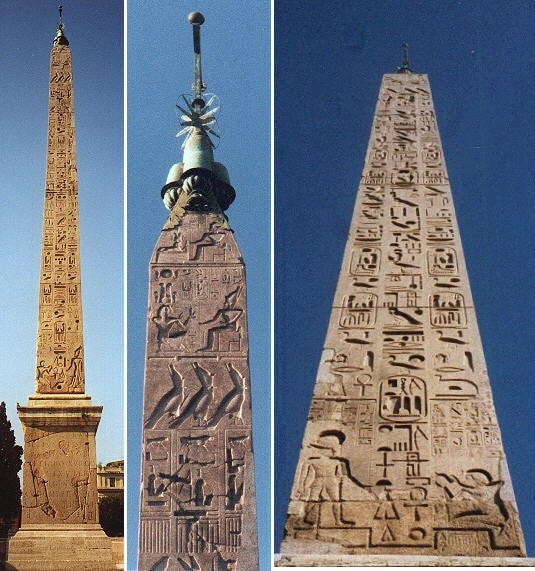
In cultural diplomacy and tourism, Italy aggressively markets itself as the inheritor of Roman grandeur. The symbolism is reinforced through urban monuments, museum narratives, and public rituals that present Rome as a living extension of imperial history. Objects such as the Ramses II obelisk in Piazza dei Cinquecento are framed as part of Rome’s palimpsest: artifacts that have been assimilated into the city’s urban fabric and public memory. This narrative confers advantages beyond tourism revenues; it provides moral weight in diplomatic forums, shapes European institutional perceptions of Italy’s seniority, and underpins the global appeal of “Made in Italy” as a product of millennia of cultural evolution.
The “Liability” severance: legal self‑redefinition and defensive doctrine
When confronted with repatriation claims, Italian legal strategy pivots. Rome’s defenders emphasize State Succession Theory and the discrete legal identity of the modern Republic, arguing that continuity is not a legal basis for liability. Centuries of possession are framed in terms of adverse possession, statute‑of‑limitations logic, and the practical impossibility of establishing direct legal privity to ancient regimes. This defense leverages temporal distance to claim that objects have been integrated into new legal and cultural contexts, complicating restitution via customary international law, museum codes, and national property regimes.
Case contrasts: Aksum, Ramses, and the limits of temporal arbitrage
The return of the Aksum Obelisk after prolonged legal and diplomatic pressure demonstrated a critical limit to temporal arbitrage: when appropriation occurred within living memory or under regimes tied to the modern state, legal and political pressure becomes acute. The 1937 removal could not be plausibly disowned by postwar Italy, especially under treaty obligations that forced acknowledgment of Fascist‑era wrongs. By contrast, objects taken in antiquity—or in eras without direct legal continuity to today’s state—fall into a gray zone where claims meet resistance rooted in narratives of cultural assimilation and urban identity. The Ramses II obelisk sits at the center of this gray zone: presented as a Roman landmark long integrated into Roman topography, yet Egyptian in origin and removed by force centuries ago.
Ethical, legal, and practical tensions
The Italian double‑bind raises three tensions. Ethically, it poses questions about historical justice and the rights of source communities to recover their heritage. Legally, it exposes gaps and inconsistencies in international restitution frameworks, which struggle to reconcile cultural continuity narratives with state‑level responsibility. Practically, wholesale repatriation driven by strict historical ownership principles could destabilize museum collections and international loans, disrupt global cultural exchange, and force difficult reallocations of resources. Nations and institutions therefore face a policy trade‑off between moral redress and the operational viability of cultural stewardship.
Is this institutionalized gaslighting or pragmatic preservation?
Labeling the practice “institutionalized gaslighting” captures the rhetorical dissonance: Italy asserts continuity when it serves prestige and denies it when it raises liability. Yet the alternative framing views it as pragmatic legal defense meant to preserve cultural institutions and public goods for global audiences. The distinction comes down to normative judgment. If one prioritizes corrective justice and the restoration of provenance, the maneuver reads as cynical evasion. If one prioritizes preservation and broad access under current custodianship, it reads as cautious pragmatism to prevent destabilizing mass repatriation.
Policy implications and pathways forward
Resolving this paradox requires clarified international norms and better provenance transparency. Multilateral frameworks could distinguish cases by offense era, coercion evidence, and the practical costs of repatriation, creating clearer standards for claims. Expanded loan, shared custody, and collaborative exhibition models offer intermediate solutions: source states regain access and narrative control while custodial states preserve continuity of display and conservation. Enhanced provenance research, open databases, and negotiated bilateral settlements—combining cultural loans, capacity assistance, and symbolic restitution—can reduce reliance on temporal arbitrage and promote fairer outcomes.
Conclusion: continuity, accountability, and cultural diplomacy
Italy’s double strategy reflects a broader tension in global cultural heritage: the desire to claim long civilizational pedigrees for soft power while avoiding legal responsibility for historical wrongs. The Aksum precedent demonstrated that temporal boundaries are contestable and that legal and moral accountability can be enforced for modern‑era appropriations. Addressing the broader challenge requires legal refinement, ethical commitment, and creative diplomacy that honors source communities without collapsing global museum ecosystems.
How does Italy reconcile claiming Roman continuity while denying legal succession?
Italy reconciles this through role‑differentiation: it promotes cultural and historical continuity for diplomatic and branding purposes while invoking a distinct modern legal identity to deflect restitution claims, effectively deploying different narratives depending on context.
Why is the Ramses II obelisk a potent symbol in this debate?
The obelisk is potent because it physically anchors Rome’s imperial narrative in modern urban space, serving as a visible symbol of continuity; its Egyptian provenance, however, exposes the tension between cultural assimilation and historical appropriation.
What made the Aksum Obelisk case different from older repatriation claims?
The Aksum case involved a removal within the 20th century under Fascist rule, which left a clear causal and legal thread to the modern Italian state and international law, making it politically and legally harder for Italy to disavow responsibility.
Is Italy’s legal reliance on adverse possession defensible under international law?
Adverse possession and long‑term integration are contentious in international cultural property law; while domestic doctrines can support custodial claims, international norms increasingly emphasize provenance, coercion, and moral restitution—making adverse possession a weak shield in high‑profile cases backed by strong diplomatic pressure.
Would full repatriation of antiquities destabilize European museums?
Widespread repatriation would pose significant operational and financial challenges to museums, potentially reducing public access to global heritage; however, carefully adjudicated returns combined with collaborative exhibition models can mitigate destabilization while addressing justice claims.
Can shared custody or long‑term loans be a fair compromise?
Yes; shared custody and revolving loans allow source countries greater control and visibility without removing artifacts permanently, supporting cultural diplomacy and capacity building while preserving broad public access.
How should provenance research influence restitution decisions?
Robust provenance research should be foundational: clear chains of custody, documentation of coercion or illegality, and historical context must guide case prioritization. Transparent databases and independent scholarship reduce politicization and increase legitimacy.
Does admitting continuity for cultural branding imply liability across the board?
Not automatically, but consistency in narrative and legal posture would reduce opportunistic defenses; acknowledging cultural continuity ethically strengthens claims for shared stewardship and may necessitate clearer frameworks for addressing historical wrongs.
Are there practical paths to reconcile national pride with restorative justice?
Practical paths include negotiated returns for particularly significant items, capacity assistance for conservation in source countries, joint displays, repatriation accompanied by exchange exhibitions, and formal apologies or commemorations that acknowledge historical injustices while preserving transnational cultural exchange.
What immediate steps can diplomats and museum directors take to reduce conflict over artifacts?
They can accelerate provenance audits, open dialogue with source states, pilot shared custody agreements, produce joint research publications, and commit to transparent, case‑by‑case negotiation frameworks that balance legal, ethical, and conservation priorities.