
TL;DR:
Identity is not an organic evolution but a State Technology used to manage land rights and labor. This post deconstructs how the Abbasid Baghdad Overwrite transformed indigenous, Basal Eurasian populations into Zanj outsiders to justify land seizures and cultural erasure.
The history of the Middle East and the Horn of Africa is often presented as a neat progression of dynasties and religious awakenings. However, if we apply Genomic Stratigraphy—the layering of ancient DNA results over historical chronicles—a much more predatory picture emerges. We begin to see that “Identity” is the most potent weapon in the state’s arsenal, used to “otherize” indigenous populations until they become foreigners in their own ancestral homes.
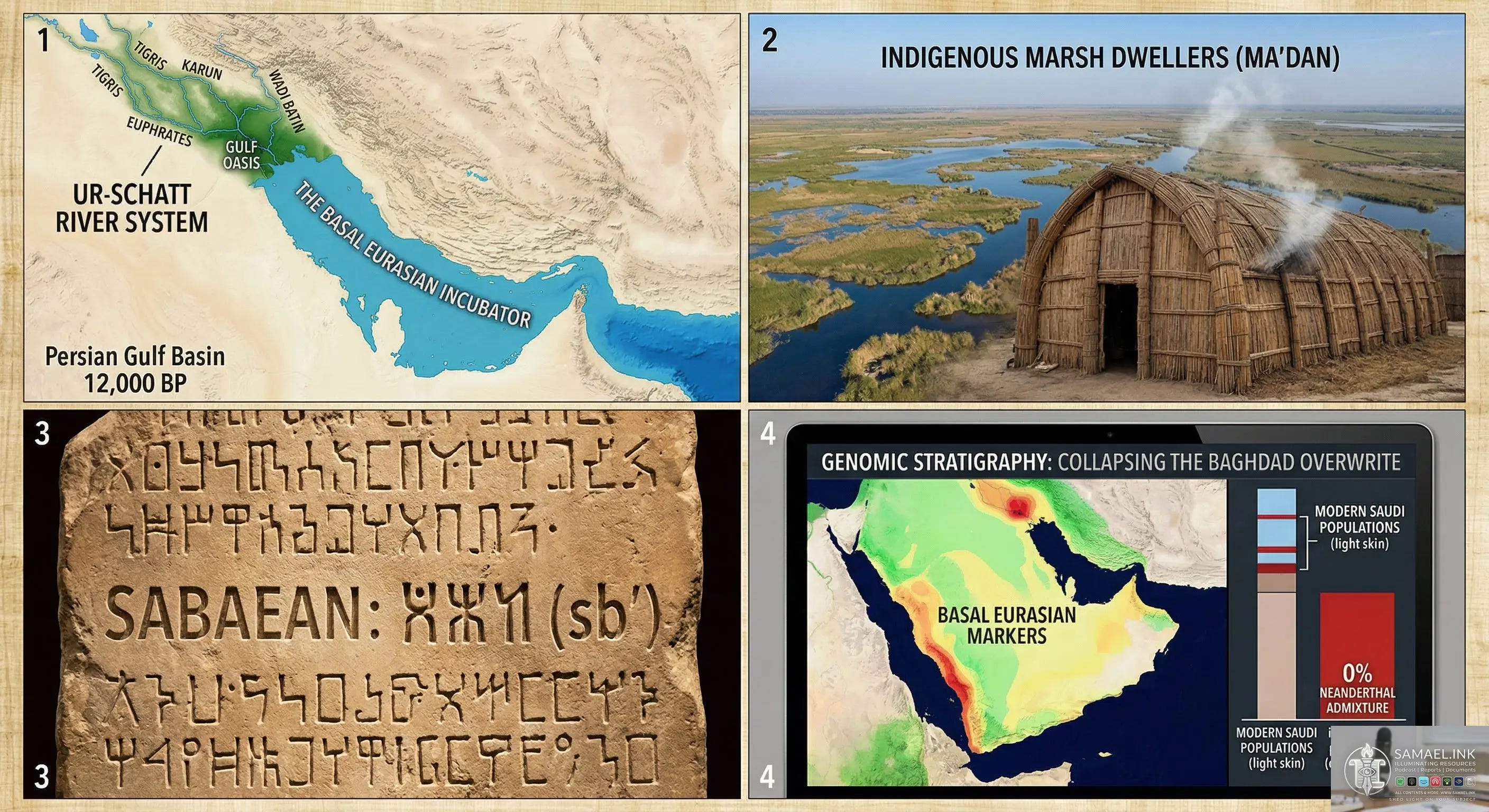
The Gulf Oasis as the “Basal Eurasian” Incubator
The Ur-Schatt system was not just a river; it was a 1,000-mile freshwater artery. Research by Jeffrey Rose and Iosif Lazaridis suggests this basin served as a 60,000-year “incubation chamber” for the Basal Eurasian lineage.
The Neanderthal Filter: While other “Out of Africa” groups moved North and admixed with Neanderthals in the Levant or Iran, the Gulf Oasis population remained isolated by the surrounding hyper-arid deserts. This created a “pure” Sapiens lineage with 0% Neanderthal DNA.
The 2026 Saudi Genome Milestone: Recent data from the Saudi Genome Project has identified “Genetic Islands” in the Tihama coastline and the Mesopotamian Marshes. These populations carry the highest concentration of these Basal markers, proving they are the “First Eurasians” who never left the peninsula, rather than later migrants from Africa.
The “Zanj” Label: A Tool of Dispossession
The Abbasid shift from a tribal confederation to a Persian-style bureaucracy required land. The fertile Shatt al-Arab and the marshes were the primary targets.
Legal Alchemy: Under Islamic law, Mawat (dead land) could be claimed by the state for “revitalization.” However, these lands were already inhabited by dark-skinned indigenous groups. By re-labeling these locals as Zanj (implying they were foreign captives brought from the East African coast), the Abbasids stripped them of their Dhimmi or tribal protections.
The Plantation Logic: Once classified as “foreign slaves,” the indigenous population was forced into labor on the very lands they previously owned. The Zanj Rebellion was not just a quest for freedom; it was an Indigenous Land Back movement.
Al-Jahiz and the “Aesthetic Containment”
The work of Al-Jahiz served as the intellectual “firewall” for the Overwrite. By creating a “Pro-Black” literature, he shifted the conversation from Geopolitics to Poetics.
Recognition without Rights: This is a classic “Containment Strategy.” By praising the “Black” subjects of the Caliphate for their strength or musicality, the Baghdad elite could acknowledge their humanity while denying their Aboriginal Title. It transformed a sovereign people into a “minority group” within an imperial framework.
Mediterraneanism and the Phenotype Erasure
The modern “Mediterranean” identity of the Middle East is a secondary layer—a “veneer” applied over the Basal substrate.
The Byzantine Aesthetic: As the Abbasids and later Ottomans adopted the aesthetics of Rome and Persia, the original, darker phenotype of the Basal Eurasians was cast as “primitive” or “African.”
The Archaeological Blind Spot: Because the “cradle” of this civilization (the Gulf floor) is underwater, 90% of the physical evidence for the original Near Eastern phenotype is inaccessible. This allows modern states to claim “Mediterraneanism” as the default, treating the indigenous dark-skinned populations as an historical “accident” of the slave trade.
The “Slaver’s Logic” as a Modern Technology
This logic remains the primary weapon against indigenous Afro-Asiatic groups today. It operates on a simple, false syllogism:
You are dark-skinned.
Slaves were dark-skinned.
Therefore, you are a descendant of slaves and have no ancestral claim to this land.
This “technology” of identity erasure is currently being challenged by 2026 Genomic Stratigraphy, which shows that the “Black” populations of the Hijaz, Yemen, and Iraq are often more genetically “Arab” (in the sense of being Basal to the region) than the lighter-skinned elites who claim that title.
Was the “Zanj” Identity a Weaponized Label?
In the 9th century, the Abbasid Caliphate faced a crisis in the Sawad (the fertile alluvial plains of Southern Iraq). The inhabitants of these marshes, the Ma’dan (Arabic: معدان, romanized: Maʻdān), were not recent arrivals. As 2026 paleogenetics from the Saudi Genome Project confirms, these populations carry the highest concentrations of Basal Eurasian (Arabic: بـاسال, romanized: bāsāl) ancestry—a lineage that has remained in the region for over 50,000 years.
To the Baghdad elite, these people were Genetic Fossils with a legal and spiritual claim to the land that predated the Caliphate. The solution? The Baghdad Overwrite. By labeling the indigenous Marsh dwellers and their allies as Zanj (Arabic: زنج, romanized: Zanj, lit. ‘land of the blacks’), the State performed a masterclass in identity manufacture.
Alienation: If they are “Zanj,” they are from Africa.
De-legitimization: If they are from Africa, they are “imported labor.”
Dispossession: If they are imported labor, they have no ancestral right to the Sawad.
The Al-Jahiz Containment Strategy
Every imperial overwrite requires a narrative gatekeeper. Enter Al-Jahiz (Arabic: الجاحظ, romanized: al-Jāḥiẓ). Traditional history celebrates his treatise Fakhr al-Sudan ‘ala al-Bidan (The Boast of the Blacks over the Whites) as a defense of Black dignity.
In reality, this was a Containment Strategy. By creating a “safe” literary space for “Black” identity within the Empire’s adab (culture), Al-Jahiz helped the state ghettoize the population. He gave them a “cultural room” so they would stop demanding the “political house.” It was the 9th-century version of modern corporate diversity initiatives: celebrate the “aesthetic” while the state continues to strip the “assets.”
Is Modern “Mediterraneanism” a Continuation of the Overwrite?
The manufacture of identity didn’t end in Baghdad. As we track modern census trends in 2026, we see the promotion of a “White-Washed” or “Mediterranean” Arab identity. This narrative suggests that the “True Arab” is light-skinned and Levant-adjacent, while the darker-skinned, Basal aboriginals of the Peninsula are the result of “later migrations” or the slave trade.
This is a recurring imperial technology. Just as the 18th-century Transatlantic model used the “One-Drop Rule” to manage labor, the Baghdad Overwrite used the “Zanj” label to manage land. Both systems rely on the same lie: that if you are dark-skinned and indigenous, you must be a “migrant” from elsewhere.
What exactly is the “Baghdad Overwrite”?
The Baghdad Overwrite refers to the systematic restructuring of history, genealogy, and legal status conducted by the Abbasid Caliphate (750–1258 CE). As the Caliphate transitioned from a revolutionary movement to a centralized imperial state, it faced a demographic problem: the vast, fertile Mesopotamian Marshes and the Southern Peninsula were inhabited by indigenous, dark-skinned populations with ancient land claims.
To consolidate power and implement large-scale plantation economies, the Baghdad elite utilized a “scholarly” overwrite. By rewriting the nasab (genealogy) of these groups, the state categorized them as Zanj (Arabic: زنج)—a term traditionally referring to the East African coast. This effectively transformed indigenous inhabitants into “foreigners” and “captives” in their own ancestral lands. By stripping them of their native status, the state could legally seize their territories for “land reclamation” projects, gifting them to the military elite and wealthy merchants (Citations: Popovic, A., The Revolt of African Slaves in Iraq).
Who are the “Basal Eurasians”?
In the field of paleogenetics, Basal Eurasians are a “ghost” lineage—a population that diverged from the main branch of non-Africans before the latter interbred with Neanderthals.
Genetic Signature: They are defined by a lack of Neanderthal DNA, which is present in all other non-African populations (Europeans, East Asians, and later West Asians).
Aboriginality: They represent the most ancient, continuous lineage in the Near East, likely the descendants of the populations that occupied the Gulf Oasis during the Late Pleistocene.
Phenotype: Genetic reconstruction suggests a darker-skinned, “Old World” phenotype that remained distinct from the later “Mediterranean” migrations.
How does the 2026 Saudi Genome Project support this?
The 2026 Saudi Genome Project has provided the Genomic Stratigraphy necessary to dismantle the Baghdad Overwrite. By sequencing the DNA of “Black” Arab populations in the Southern Peninsula and the Ma’dan (Marsh Arabs) of Iraq, researchers found that these groups are not recent migrants from Sub-Saharan Africa.
Instead, they carry the highest concentrations of Basal Eurasian markers. This data proves they have been in situ for tens of thousands of years. The “African” label applied to them in the medieval era was a political fiction; they are, in fact, the biological “ground layer” of the Arabian Peninsula and Mesopotamia.
Why was Al-Jahiz’s work considered a “containment strategy”?
The famous scholar Al-Jahiz (himself of possible Zanj descent) wrote The Glory of the Black Race (Arabic: فخر السودان على البيضان, Fakhr al-Sudan ‘ala al-Bidan). While often seen as a defense of Black people, revisionist strategists view it as a containment strategy.
By validating “Blackness” as a literary and aesthetic category, Al-Jahiz allowed the Abbasid state to acknowledge the existence of these people without acknowledging their indigenous land rights. It turned a political and territorial dispute into a “merits of the race” debate. It allowed the elite to say, “We respect your color, but you are still guests (or slaves) in this land,” thereby neutralizing the threat of indigenous sovereignty.
Was the Zanj Rebellion purely a slave revolt?
Traditional history portrays the Zanj Rebellion (869–883 CE) as a simple uprising of East African sugar-cane laborers. However, the Baghdad Overwrite obscured the coalition nature of the revolt.
It was a multi-ethnic, indigenous resistance movement. The coalition included:
The Ma’dan: Indigenous Marsh dwellers fighting against state-sponsored drainage of their lands.
Local Bedouin: Tribes whose traditional grazing routes were being enclosed.
East African Laborers: Who shared a common social status (and phenotype) with the indigenous poor.
The rebellion was a war against state dispossession. By calling it a “slave revolt,” the Abbasid chroniclers delegitimized the indigenous grievances, framing it as “foreigners attacking the state” rather than “natives defending their home.”
How does “Mediterraneanism” serve the modern state?
Mediterraneanism is the aesthetic and historical preference for a “lighter” Near Eastern identity, often aligning regional elites with Byzantine (Roman) or Persian models.
This serves the state by casting the original, darker Basal phenotype as a “foreign import” (the Zanj). By identifying with the Mediterranean world, the ruling classes can claim a “civilizational” link to the West and North, while treating the darker, indigenous substrate as an “African” anomaly that arrived late via the slave trade. It is a psychological extension of the Baghdad Overwrite.
What is the “Slaver’s Logic” in this context?
Slaver’s Logic is the imperial trope that: “If you are black, you are a slave from Africa.”
In the Near East, this was a technology used to detach people from their geography. If a person with a dark phenotype claimed ownership of a date palm grove in Basra or a well in the Sarat, the state used Slaver’s Logic to demand “papers” or “lineage.” Since the Baghdad Overwrite had already categorized their entire demographic as “Zanj,” their claim to the land was discarded. It is a tool of erasure-through-identification.
Why is the term “Zanj” problematic in this framework?
The term Zanj became a catch-all label to otherize anyone the state wanted to displace. It functioned similarly to how “squatter” or “insurgent” is used today. By applying the label “Zanj” to the indigenous people of the Southern Peninsula and Iraq, the state effectively “cleansed” the records of their ancient ancestry. It replaced their specific tribal identities with a generic, derogatory term associated with servitude.
Can we see this overwrite in other cultures?
Yes. It mirrors the American model where indigenous identities (such as “Black Indians” or the Yamasee) were often reclassified as “Black” or “Mulatto” in census records. By moving them into a racial category defined by slavery, the state could legally ignore their Indigenous Title to the land. In both Baghdad and the Americas, “Blackness” was used as a legal cage to trap indigenous people and strip them of their territory.