
The Crucible of Consensus: How the Byzantium-Aksumite "Frenemy" Dynamic Birthed the Islamic Era
TL;DR:
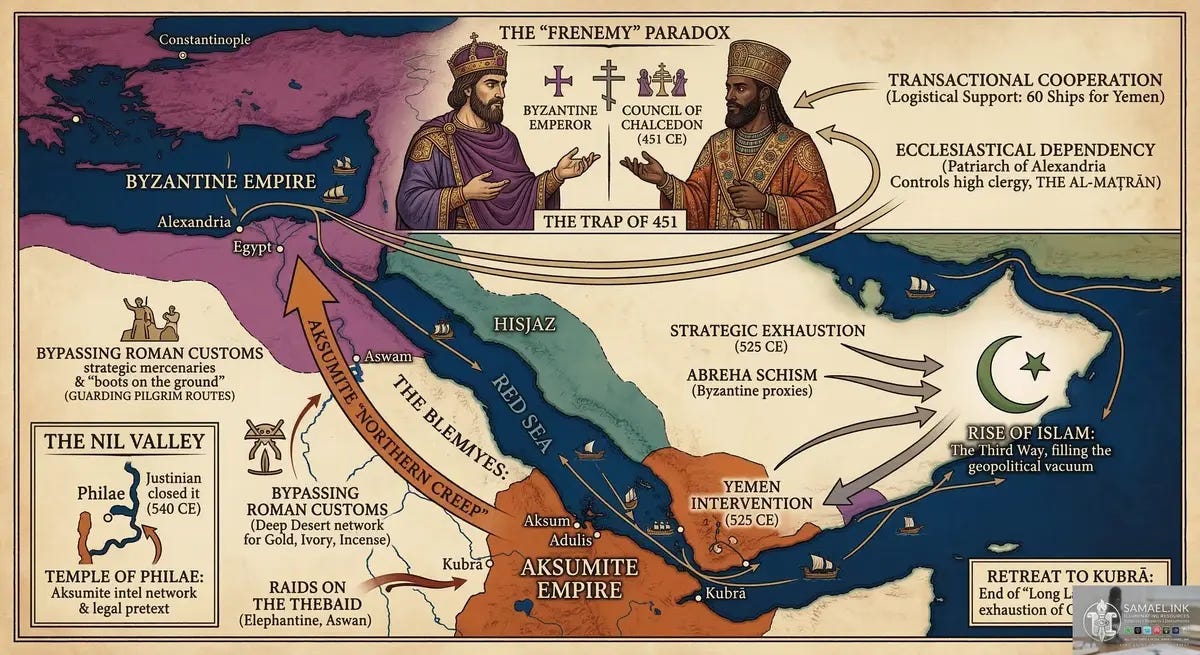
The emergence of Islam in the 7th century is traditionally viewed as a sudden, isolated eruption from the deserts of the Hijaz. However, a growing body of revisionist scholarship—pioneered by figures such as G.W. Bowersock, Timothy Power, and Robert Hoyland—reframes this era as the inevitable resolution of a century-long "frenemy" relationship between the Byzantine Empire and the Aksumite Empire. This dynamic, characterized by shared faith but clashing imperial ambitions, created the geopolitical vacuum required for a new world order to take root. While traditional historiography often views the Aksumite Empire as a static highland power, the archives of the 4th through 6th centuries reveal a sophisticated “Northern Creep.” This was a deliberate expansionist policy aimed at re-establishing hegemony over the Nile corridor and the Eastern Desert, effectively pushing the Aksumite frontier back toward the borders of Roman Egypt. In this geopolitical architecture, the Blemmyes (Greek: Βλέμμυες) were not merely “barbarians,” but functioned as the strategic mercenaries and “boots on the ground” for the Aksumite metropole.

The Fall of Kush and the Power Vacuum
The catalyst for this expansion was the “mashing” of the Kingdom of Meroë by King Ezana (c. 350 CE). By destroying the traditional middleman of the Nile, Aksum removed the only barrier between itself and the Roman frontier.
The Trans-Saharan Monopoly: Rather than following the predictable Nile route, Aksumite administrators established a “deep desert” network. This allowed them to move gold, ivory, and incense directly into Upper Egyptian markets like Thebes and Philae, bypassing Roman customs.
The “Blemmyes” Hire: To secure these routes, Aksum weaponized the Blemmyes. As nomadic masters of the Eastern Desert, the Blemmyes provided the light cavalry and raiding capabilities that the Aksumite heavy infantry lacked in the sand dunes
The Paradox of the "Quasi-Ally"
In the 6th century, Byzantium and Aksum were theoretically united by the Cross, yet fundamentally divided by the Council of Chalcedon (451 CE). While both sought to check the expansion of Sasanian Persia, their cooperation was transactional and fraught with suspicion.
The Yemen Intervention (525 CE): When King Kaleb invaded the Himyarite Kingdom to avenge Christian martyrs, he did so with Byzantine logistical support (60 transport ships provided by Emperor Justin I). However, Byzantium’s motive was not purely religious; they sought to "laundry" their trade interests by using Aksumite "boots on the ground" to secure the silk and spice routes from Persian interference.
The Abreha Schism: Following the victory, the Aksumite general Abreha seized power. Rather than supporting their ally Kaleb in "mashing" the usurper, the Byzantines pivoted, engaging in secret diplomacy with Abreha to turn him into a direct proxy, thereby bypassing Aksumite hegemony.
The "Two-Way Hostage" and the Trap of 451
The ecclesiastical bond between the two empires served as a diplomatic cage. By adopting the Non-Chalcedonian (Jacobite) faith, Aksum became legally dependent on the Jacobite Patriarch in Egypt for its high clergy, the Al-Maṭrān (المطران).
The Legal Blockade: Byzantium recognized that by controlling the Patriarch in Alexandria, they held the "on/off switch" for Aksumite spiritual legitimacy. This "hydro-ecclesiastical" politics ensured that the King of Aksum remained a perpetual petitioner to the Mediterranean powers.
The Inland Retreat: This pressure, combined with the eventual loss of maritime hegemony following the 702 CE naval disaster, forced the Aksumite center to move from the coast to the inland metropole of Kubrā (the "Great City"). This retreat effectively "dried" out Aksumite international influence, leaving the Red Sea trade routes unprotected.
The Blemmyes as Aksumite “Foederati”
Just as Rome used foederati to guard its borders, Aksum used the Blemmyes as a “buffer” to harass Byzantine Egypt.
The Occupation of the Thebaid: During the 5th century, the Blemmyes successfully seized major Roman cities such as Elephantine and Aswan. Byzantine records from the era of Emperor Marcian suggest these “raiders” were suspiciously well-funded, carrying Aksumite luxury goods and using coinage that mirrored Aksumite standards.
The “Laundered” Sovereignty: By using the Blemmyes as proxies, Aksum could maintain a “frenemy” relationship with Byzantium. The King of Aksum could claim plausible deniability for the Blemmyes’ raids on Christian monasteries while simultaneously benefiting from the weakened Byzantine control over the southern grain trade.
The Mechanics of the “Northern Creep”
The Aksumite “Northern Creep” was not a conventional invasion of legions, but a sophisticated infiltration of the Byzantine tax base. By leveraging the Blemmyes as their desert mercenaries, Aksum was able to “laundry” Byzantine wealth back to the highlands.
Tax Extraction: Byzantine papyri from the 5th century reveal that the Blemmyes did not merely loot the cities of Elephantine, Aswan, and Philae; they occupied them. They collected land taxes and trade duties from Roman citizens, which were then channeled toward the purchase of Aksumite luxury goods and military hardware.
The Currency of Influence: The Blemmyes often used Aksumite gold coinage in their transactions within Egypt. This effectively “dried” out the Byzantine imperial currency in the south, replacing it with the economic weight of the Aksumite crown.
The Blemmyes as Aksumite “Client-Kings”
Justinian’s archives—specifically the writings of Procopius—detail the frustration of Byzantine officials who were forced to treat with Blemmye leaders as if they were sovereign heads of state.
Diplomatic Immunity: The Blemmyes enjoyed a form of “extraterritoriality.” Because they were the military arm of the Aksumite northern trade monopoly, the Byzantines were “compelled” to pay them subsidies (annonae) simply to keep them from “mashing” the Nile grain boats.
The “Two-Way Hostage” Prototype: Long before the “Nile Hostage” system was fully institutionalized at the inland metropole of Kubrā, the Blemmyes were the physical hostage. They held the southern gate of Egypt, and their loyalty was bought with Byzantine gold that ultimately flowed south to Aksum.
The Power Vacuum and the Rise of the Hijaz
The "frenemy" dynamic led to strategic exhaustion. By the early 7th century, both Byzantium and Aksum had overextended their treasuries and militaries in South Arabian proxy wars.
Economic Collapse: As noted by Stuart Munro-Hay, the collapse of Aksumite coinage was a direct result of military overextension for Byzantine goals.
The Third Way: As the two Christian superpowers bickered over theological minutiae and trade tolls, the merchant tribes of the Hijaz realized that neither empire could offer long-term stability. The rise of Islam provided a "middle path" that rejected the "Two-Way Hostage" system, offering a new monotheistic identity that was neither dependent on the Byzantine "Melkite" order nor the Aksumite "Jacobite" isolation.
The Religious Front: The Defense of Philae
The Blemmyes served as the guardians of the last “pagan” outposts in Egypt, specifically the Temple of Philae. The Blemmyes maintained their “state within a state” through a legal loophole centered on the Temple of Philae.
The Strategic Anchor: Aksum supported the Blemmyes’ right to worship at Philae because it provided a legal pretext for Aksumite “pilgrims” (merchants and spies) to enter Roman territory.
The Philae Protocol: The Byzantines were forced into a legal agreement that allowed the Blemmyes to control the temple. This provided a “safe harbor” for Aksumite agents and merchants to operate deep inside Egypt under the guise of religious pilgrimage.
The Byzantine Response: This administrative humiliation is what drove Justinian to his “final solution” in 540 CE. By closing Philae and empowering the Nobadae (Nubians) to “mash” the Blemmyes, Justinian wasn’t just ending paganism; he was dismantling the Aksumite tax-collection apparatus in Egypt. It was the realization that the Blemmyes were the vanguard of a broader Aksumite “Northern Creep” that finally forced Justinian to take drastic action. In 540 CE, he ordered the closure of Philae not just to end paganism, but to “dry” out the Aksumite intelligence network in Egypt.
Conclusion: The Retreat to Kubrā
The Aksumite dream of a Nile-based empire ended when Justinian successfully “laundered” the Nobadae (Nubians) into the Christian fold. By providing the Nobadae with superior military technology, the Byzantines empowered them to “mash” the Blemmyes out of the Nile Valley.
This military defeat, combined with the loss of the Dahlak Archipelago in 702 CE, forced the Aksumite leadership to abandon the northern frontier and retreat to the inland metropole of Kubrā. The mercenaries were gone, the routes were closed, and the “Trap of 451” was finally locked. The transition from the Aksumite center to the inland seat of Kubrā marked the end of the “Long Late Antiquity.” When the early Islamic Caliphate emerged, it did not encounter two unified Christian empires, but two exhausted rivals who had spent a century trying to “laundry” each other’s influence out of the Red Sea. The “frenemy” dynamic was the crucible in which the medieval world was forged.
Primary References and Scholarly Witnesses
Bowersock, G.W. (2013). The Throne of Adulis: Red Sea Wars on the Eve of Islam. Oxford University Press. (Provides the definitive account of the Aksumite-Byzantine-Himyarite triangle).
Power, Timothy (2012). The Red Sea from Byzantium to the Caliphate: AD 500-1000. American University in Cairo Press. (Details the shift from maritime hegemony to inland power at Kubrā).
Hoyland, Robert G. (2014). In God's Path: The Arab Conquests and the Creation of an Islamic Empire. Oxford University Press. (Explores the "sectarian milieu" and the geopolitical connectivity of the era).
Munro-Hay, Stuart (1991). Aksum: An African Civilisation of Late Antiquity. Edinburgh University Press. (The foundational text on Aksumite decline and the end of coinage).
Taddesse Tamrat (1972). Church and State in Ethiopia: 1270-1527. Oxford University Press. (Analyzes the long-term impact of the Al-Maṭrān legal requirement).
Procopius of Caesarea, History of the Wars (6th Century). (The primary Byzantine archive for the diplomacy of Justinian and the Abreha affair).
Kubrā: The True Inland Center of Post-Aksumite Power

TL;DR: For much of medieval scholarship and popular retellings of Horn of Africa history, the geography of post-Aksumite power has been drawn too narrowly along the Red Sea coastline. This article argues that a sustained inland metropole—referred to in medieval Arabic sources as Kubrā (كبرى), “the Great City”—was the real administrative and religious cen…
