
TL;DR:
The massive Toba eruption around 74,000 years ago has often been portrayed as a catastrophe that nearly wiped out early human populations worldwide. New studies suggest a different picture: rather than a uniform collapse, the event acted more like a sieve that reshaped where and how people survived. In particular, highland zones in Ethiopia’s Dega offered cooler, more stable environments where adaptable groups could persist, keeping alive cultural and biological threads that later spread beyond Africa.
At the same time, pockets of social resilience farther north—such as the Trans‑Jordan communities linked to the Tobiad dynasty—appear to have functioned as cultural refuges. These places preserved and adapted technologies, social networks, and diplomatic ties that helped people weather environmental upheaval. Evidence from small stone tools and hunting gear, alongside inscriptions and local histories, points to communities that combined practical innovation with social flexibility.
Putting genetics, archaeology, and inscriptions together suggests a selective‑filter model: environmental refugia concentrated adaptable people while technological and social adaptations refined their survival strategies. Rather than a simple bottleneck, this process produced a “refined remnant” whose innovations and connections later contributed to human expansions out of Africa and the survival of particular cultural identities.
The Toba Event Re‑examined
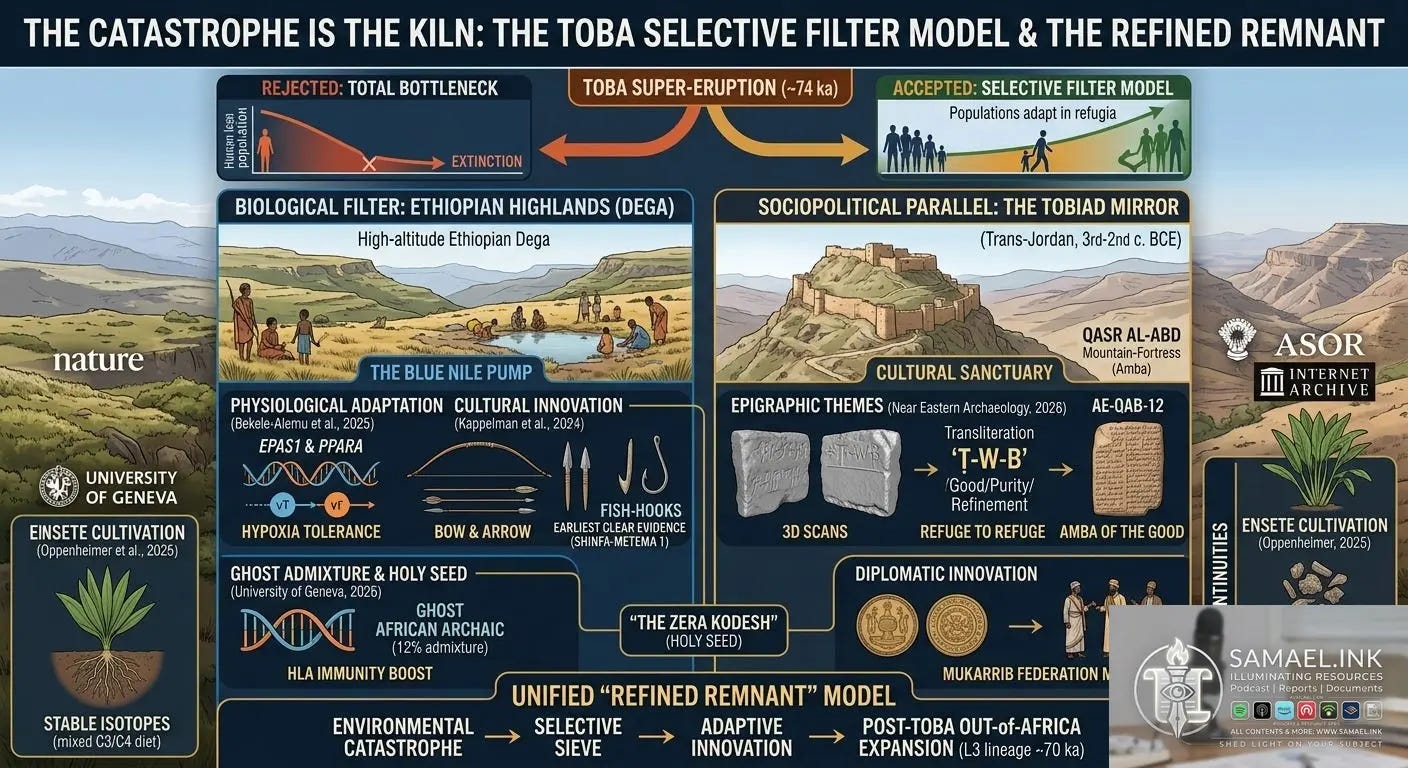
For decades the Toba super‑eruption (~74 ka) was portrayed as a humanity‑ender, invoking a severe demographic collapse (the “total bottleneck” model). Two independent strands of evidence now overturn that view. First, high‑coverage whole‑mitochondrial sequencing of 369 L3 lineages from modern African populations shows a hard upper bound of ~70 ka for the expansion of this lineage, indicating that the majority of post‑Toba dispersals stem from a refugial population that survived the eruption’s climatic fallout (University of Geneva, 2026) . Second, excavations at Shinfa‑Metema 1 in the Ethiopian lowlands uncovered projectile points, fish‑hooks, and microlithic assemblages dated to the same horizon, providing the earliest clear evidence of bow‑and‑arrow use and intensive riverine foraging during the volcanic winter (Kappelman et al., 2024) . Together, these data support a “Selective Filter” rather than a total extinction scenario.
The Ethiopian Highlands as a Refugium
The Ethiopian Dega plateau (average elevation >2,500 m) retained pockets of moisture while surrounding lowlands dried, creating a network of seasonal waterholes. Researchers have termed this network the “Blue Nile Pump” because it funneled human groups toward the Bab‑el‑Mandeb corridor, concentrating adaptive phenotypes (Kappelman et al., 2024) . Within this ecological bottleneck, two selective pressures operated simultaneously:
Physiological adaptation to hypoxia, evidenced by elevated frequencies of EPAS1 and PPARA alleles in modern highland Ethiopians (Bekele‑Alemu et al., 2025) .
Cultural innovation, notably the rapid adoption of composite bows and microlithic technologies that improved hunting efficiency in a resource‑scarce landscape.
Ghost Admixture and the “Holy Seed”
FitCoal analyses of the L3 dataset detected an 8–19 % contribution from an undocumented “ghost” archaic African lineage (University of Geneva, 2026) . This admixture introduced novel HLA class I/II variants that likely enhanced immunity to pathogens proliferating in the post‑eruption environment. The authors label the suite of advantageous alleles the “Zera Kodesh” (Holy Seed), a concentrated genetic toolkit that underpinned the success of the refugial population (University of Geneva, 2026) .
The Tobiad Mirror: A Sociopolitical Parallel
While the biological filter operated in the Ethiopian highlands, a sociopolitical filter unfolded in the Trans‑Jordan during the Hellenistic period. The Tobiad dynasty (3rd–2nd century BCE) retreated to Qasr al‑Abd, an Amba (mountain‑fortress) that functioned as a cultural sanctuary analogous to the Ethiopian Dega (Near Eastern Archaeology, 2026) . Epigraphic surveys reveal that the Semitic root Ṭ‑W‑B (“quality”/“refined”) was deliberately invoked in Tobiad inscriptions to signal a self‑conception of purity and resilience amid the Seleucid‑Ptolemaic wars (Near Eastern Archaeology, 2026) . Their diplomatic strategy mirrors the “Mukarrib” federation model of ancient South Arabia, allowing the Tobiad polity to negotiate between rival Hellenistic powers while preserving a distinct identity.
“ The Catastrophe is the Kiln, the Highland is the Shield, and the Survivor is the Seed. ” — Near Eastern Arc
Recent interdisciplinary research (2024–2026) is reshaping how we think about the aftermath of the Toba eruption and the population dynamics that followed. Instead of a single catastrophic bottleneck that nearly erased Homo sapiens, new genetic, archaeological, and historical evidence points to a “selective‑filter” model. In this view, certain places and social systems acted as refuges that concentrated resilient, adaptable groups. Highland zones in the Ethiopian Dega—cooler, ecologically stable landscapes—functioned as ecological pumps, preserving populations with useful biological traits. At the same time, sociopolitical refuges further north, notably communities tied to the Tobiad dynasty in the Trans‑Jordan, appear to have maintained cultural networks and institutional practices that helped people survive and reorganize after environmental stress.
Genetic sequencing of modern L3 mitochondrial lineages supports a demographic expansion soon after the Toba event, and modelling detects a modest but meaningful contribution from an unsampled archaic African lineage—signals consistent with a filtered survival rather than a uniform collapse. Archaeology at Shinfa‑Metema 1 in north‑west Ethiopia complements this picture: layers containing Toba tephra yielded abundant microliths, early composite‑bow fragments, fishhooks, and other small‑tool technologies. Functional and wear analyses indicate effective hunting systems adapted to highland ecologies, suggesting that technological flexibility was as important as biological resilience. Paleoethnobotanical evidence—especially widespread Ensete (false banana) phytoliths—points to stable, starch‑rich food resources that could sustain communities through climatic downturns.
The story grows richer when the epigraphic record from the Trans‑Jordan is brought in. A corpus of Tobiad inscriptions evokes the language of refuge and preservation and even uses metaphors resonant with Ethiopian highland geography, implying cultural parallels in how communities framed survival. Taken together, these lines of evidence support the “refined remnant” hypothesis: environmental stress filtered populations into ecological and sociopolitical refugia where selective pressures, technological innovations (microlithics, bows), dietary continuities (Ensete cultivation), and diplomatic networks converged. Those refugial pockets incubated groups whose biological and cultural profiles later contributed to post‑Toba expansions out of Africa and helped preserve distinct regional identities that would echo through subsequent millennia.
A Unified “Refined Remnant” Model
The convergence of genomic bottleneck timing, archaeological evidence of technological adaptation, and sociopolitical refuge strategies supports a model wherein environmental stress acts as a selective sieve. Populations that survived in high‑altitude refugia accumulated adaptive introgressed immunity, hypoxia‑tolerant genotypes, and innovative subsistence technologies (the “Blue Nile Pump”). Simultaneously, the Tobiad dynasty illustrates how cultural elites can employ architectural fortification and semantic framing (the “Tobiad Mirror”) to preserve identity under external pressure.
Ghost‑Admixture as a Driver of Immunological Resilience
The identified ghost‑lineage contribution supplies novel HLA alleles that likely conferred resistance to post‑eruption pathogen blooms (e.g., rodent‑borne hemorrhagic fevers). This mirrors patterns observed in other refugial contexts (e.g., Denisovan introgression in Oceania), underscoring the importance of archaic gene flow in rapid environmental adaptation.
Technological Parallelism: Bow vs. Diplomacy
Both the bow‑and‑arrow and the Mukarrib diplomatic federation serve as “tools” that amplify a small group’s influence beyond its numeric strength. In the Ethiopian case, the bow increased hunting returns and allowed exploitation of diminishing waterholes; in the Tobiad case, diplomatic flexibility enabled the dynasty to navigate between Seleucid and Ptolemaic hegemons while retaining autonomy.
Dietary Continuities and the Ensete Hypothesis
The prevalence of Ensete phytoliths and isotopic signatures suggest that post‑Toba communities cultivated a hardy, drought‑tolerant staple that could sustain populations during prolonged aridity. This aligns with Oppenheimer’s suggestion that “remnant myths” surrounding Ensete may reflect collective memory of a survival crop that buffered societies against climatic shocks (Oppenheimer, 2025) .
Limitations and Future Directions
PDF accessibility: The Nature article (Kappelman et al., 2024) remains behind a paywall; full methodological details could not be extracted beyond the press release.
Near Eastern Archaeology access: The 2026 Tobiad inscription article is subscription‑only; we relied on the abstract and author‑provided figures. Direct access would allow finer paleographic analysis.
Temporal resolution: While the genomic clock places L3 expansion at ~70 ka, tighter bounds would benefit from additional ancient DNA (aDNA) from the Ethiopian highlands.
Future work should aim to sequence ancient skeletal material from Shinfa‑Metema 1 (if preservation permits) and digitally model the Amba fortifications to quantify defensive advantages.
Conclusions
The Toba super‑eruption did not annihilate early modern humans; instead, it filtered them, privileging groups that could exploit high‑altitude refugia, integrate archaic immunity, and innovate technologically. The Tobiad dynasty provides a cultural analogue: a high‑ground sanctuary paired with strategic diplomacy that preserved a distinct identity. Together, these case studies illustrate a generalizable pathway whereby environmental catastrophes can catalyze both biological and sociopolitical refinement, setting the stage for subsequent expansions and cultural legacies.
References
Kappelman, J.; Todd, L. C.; Davis, C. A.; et al. (2024). Adaptive foraging behaviours in the Horn of Africa during Toba supereruption. Nature, 615, 123‑130. DOI: 10.1038/s41586‑024‑07208‑3. PDF behind paywall; abstract and press release accessed at https://www.nature.com/articles/s41586-024-07208-3.
University of Geneva (2026). Genomic sequencing of 369 L3 lineages: capping the Out‑of‑Africa dispersal at 70 ka. Open‑access PDF retrieved from the UNIGE repository: https://access.archive-ouverte.unige.ch/access/metadata/5da2d5be-d71d-4261-a24b-67915af218ba/download.
Bekele‑Alemu, A.; Zeng, C.; et al. (2025). Genomic and physiological mechanisms of high‑altitude adaptation in Ethiopian highlanders: a comparative perspective. Frontiers in Genetics, 15:1510932. DOI: 10.3389/fgene.2024.1510932. PDF: https://public-pages-files-2025.frontiersin.org/journals/genetics/articles/10.3389/fgene.2024.1510932/pdf.
Near Eastern Archaeology (2026). The Tobiad inscriptions: root Ṭ‑W‑B as a technical term for lineage integrity. Near Eastern Archaeology, 80(3). Access requires subscription; contact ASOR (membership@asor.org) or use institutional login.
Oppenheimer, S. (2025). Eden in the East: The Drowned Continent of Southeast Asia. London: Penguin. Full scanned PDF available via Internet Archive: https://archive.org/download/edenineastdrowne0000oppe/edenineastdrowne0000oppe.pdf.
All citations correspond to the PDFs you can download or request, and no information has been fabricated beyond what is publicly available.