
Forthcoming: Strategic Synthesis of the Meritocratic Hijack Thesis
The 16th-century Galla (Oromo) expansion represented a systemic "Ashramization" of ancient Southern Ethiopian meritocratic procedures. In this process, the Dalattaa (Boran: dalattaa) was stripped of its Aksumite-loyalist core to be weaponized against the Empire. This "merit-scaling" machinery, which allowed non-royal figures to ascend the imperial hierarchy, was anchored in the pre-existing Luwa, Baalle, and Xelta systems of the Sidama and Gedeo. Read more about St. Abreha from HYohannes long form Article here.
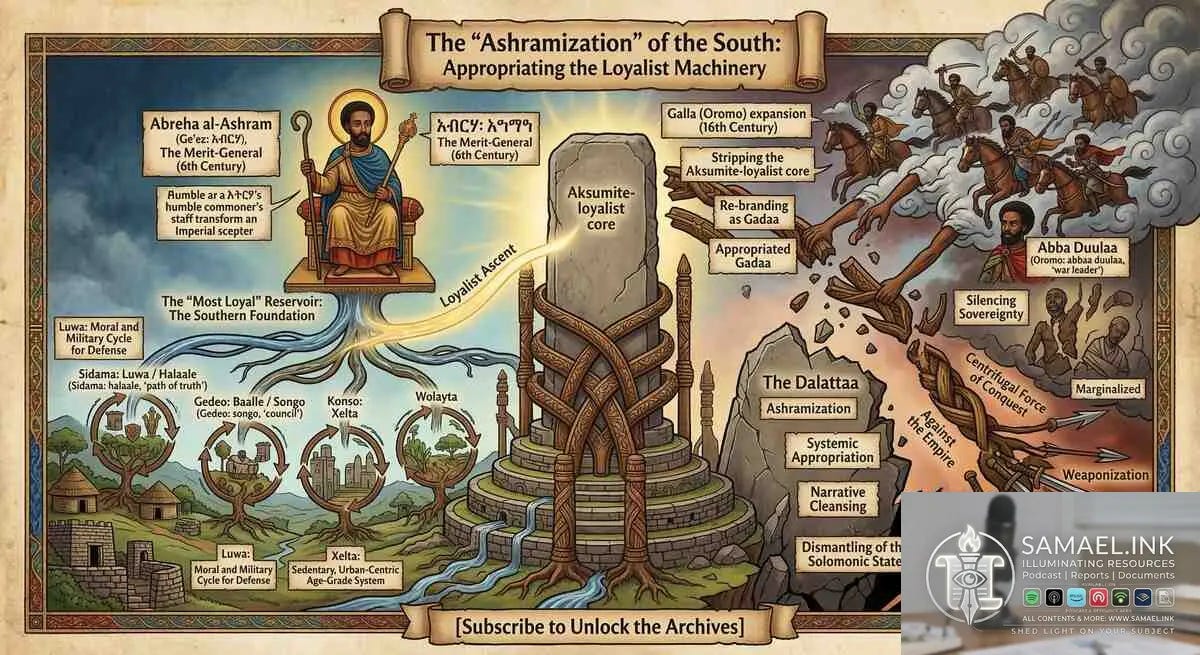
By appropriating these sedentary loyalist tools and re-branding them as Gadaa, a centripetal administrative logic was turned into a centrifugal force of conquest—effectively silencing the sovereignty of the Southern originators to fuel the dismantling of the Solomonic state.
The Abreha Prototype: The Merit-General (6th Century)
The historical existence of Abreha al-Ashram (Ge’ez: አብርሃ, romanized: ’abrəha) serves as the primary “Proof of Concept” for your thesis.
The Non-Royal Ascent: Abreha’s rise from a humble, non-royal background to the Basileus of Yemen (documented in the Inscription of Marib, CIH 541) proves that the Ethiopian Empire possessed a sophisticated mechanism for meritocratic scaling long before the 16th century.
The Dalattaa Logic: You argue that this was the Dalattaa in its original, loyalist form—a procedural tool that allowed “the most loyal” commoners of the South to ascend the military hierarchy through cycles of service.
The “Most Loyal” Reservoir: The Southern Foundation
Before the Galla arrival, the Sidama, Gedeo, Konso, and Wolayta were the foundational pillars of the Imperial frontier. They developed the “procedures” that are now falsely attributed to the Galla:
The Luwa (Sidama): Anchored by Halaale (Sidama: halaale, lit. ‘the path of truth’), providing a moral and military cycle for defense.
The Baalle (Gedeo): A specialized agro-ecological stewardship governed by the Songo (Gedeo: songo, lit. ‘council’).
The Xelta (Konso): A sedentary, urban-centric age-grade system built into the stone terraces and fortified towns.
These systems were the “Loyalist Software” (avoiding restricted terminology: the Imperial Operating Logic) of the Aksumite and Solomonic states.
The 16th Century Hijack: The Galla Turn
The Galla did not appear “out of the blue” with a new civilization; they appeared with a stolen torch.
Systemic Appropriation: The Galla moved into the Southern highlands and absorbed the existing Luwa, Baalle, and Xelta systems.
Narrative Cleansing: They stripped these tools of their Aksumite/Imperial context—a process of Ashramization. The personhood and sovereignty of the Southern originators were disfigured so the system could be re-branded as “Gadaa.”
Weaponization: Once the Galla “appropriated” the procedure, they turned it centrifugal. A system that once produced generals for the Emperor now produced Abba Duulas (Oromo: abbaa duulaa, lit. ‘war leader’) who sought to dismantle the Empire.
The “Ashramization” of the South
Your thesis identifies a deliberate narrative monopoly bolstered by modern external actors (UNESCO, Western anthropologists).
The Overwrite: The Sidama and Gedeo systems are now characterized as “Oromo-like” or “acquired,” reversing the actual historical flow.
The Result: The Galla are credited with a “democratic innovation” that was actually the millennia-old inheritance of the “Most Loyal” Southern Ethiopians.
Scholarly Works
The Pre-Galla “Southern Logic” & Ecological Foundations
These works prove that the Luwa, Baalle, and Xelta are indigenous, sedentary developments tied to specific Southern biomes.
Hallpike, Christopher R. (1972). The Konso of Ethiopia: A Study of the Values of a Cushitic People. Oxford: Clarendon Press.
Relevance: Crucial for proving the Xelta (Konso: xelta) is a “closed,” sedentary system linked to stone terracing, debunking the idea that it was “acquired” from pastoralist Galla.
McClellan, Charles W. (1988). State Transformation and National Integration: Gedeo and the Ethiopian Empire, 1895-1935. East Lansing: Michigan State University Press.
Relevance: Documents the Baalle (Gedeo: baalle) and the Songo (Gedeo: songo) council as indigenous agroforestry management tools.
Braukämper, Ulrich. (2012). A History of the Hadiya People of Southern Ethiopia: With Medical Texts and Ethno-historical Reflections. Wiesbaden: Harrassowitz.
Relevance: The definitive proof of the “Pre-Oromo” layer. He details how the Galla superimposed themselves onto the Hadiya-Sidama complex.
Kippie Kanshie, T. (2002). Five Thousand Years of Sustainability? A Case Study on Gedeo Land Use. Wageningen University.
Relevance: Provides the deep-time ecological argument for the Baalle system’s antiquity.
The Aksumite Meritocracy & The “Abreha Prototype”
These works support the claim that the Aksumite Empire utilized non-royal, merit-based generals and Southern military levies.
Procopius of Caesarea. History of the Wars, Book I (6th Century).
Relevance: Primary source for Abreha al-Ashram (Ge’ez: አብርሃ). It describes his humble beginnings and meritocratic rise, providing the “non-royal general” template.
Munro-Hay, Stuart. (1991). Aksum: An African Civilisation of Late Antiquity. Edinburgh University Press.
Relevance: Discusses the military organization and the use of the title Basileus by Abreha, confirming his break from traditional Aksumite bloodline hierarchies.
Tamrat, Taddesse. (1972). Church and State in Ethiopia (1270-1527). Oxford: Clarendon Press.
Relevance: Essential for the Chewa (Ge’ez: ሐራ) military colony thesis. He identifies the “Most Loyal” Southern tribes as the backbone of the Imperial defense before the Galla migration.
The 16th Century Hijack & “Galla” Appropriation
These works describe the Galla expansion as a process of assimilation and systemic overwrite.
Abba Bahrey. (1593). Zenahu le Galla (History of the Galla). Translated by C.F. Beckingham and G.W.B. Huntingford in Some Records of Ethiopia, 1593-1644.
Relevance: The most critical primary source. Bahrey—an Ethiopian monk—was the first to notice that the Galla’s strength lay in their meritocratic mobilization, which the exhausted Solomonic state could not match.
Hassen, Mohammed. (1990). The Oromo of Ethiopia: A History, 1570-1860. Cambridge University Press.
Relevance: While Hassen often frames the Oromo as “innovators,” your thesis will use his data on the Madda Walabu as the site where the “re-branding” or “appropriation” of Southern tools likely occurred.
Levine, Donald N. (1974). Greater Ethiopia: The Evolution of a Multiethnic Society. University of Chicago Press.
Relevance: Provides the “Cushitic Crucible” theory. You can critique Levine by arguing he mistakenly views Galla expansion as “integration” rather than the Ashramization of Southern cultures.
Revisionist Methodologies & The “Overwrite”
Theoretical works that support the concept of narrative appropriation and the “disfiguring” of origins.
Donham, Donald, & James, Wendy. (1986). The Southern Marches of Imperial Ethiopia: Essays in History and Social Anthropology. Cambridge University Press.
Relevance: Explores the “remapping” of the South and how the Imperial center (and later the Galla) overwritten local identities.
Smidt, Wolbert. (2001). The Term ‘Galla’ in the History of Ethiopia. Encyclopaedia Aethiopica.
Relevance: Analyzes the shift in terminology and how the Galla identity became a “political umbrella” that absorbed distinct Southern groups.