
We are excited to announce a forthcoming comparative study into the divergent archetypes of sovereignty within the Wolayta (Wolaitta: 𐒡𐒨 things, Wolaitta) historical consciousness. This upcoming article examines the tension between the “Sacred King” and the “Deviant Autocrat,” tracing the lineage of authority from the mystical origins of the Damot kingdom to the mid-19th-century imperial crisis.
This research contrasts the foundational reign of Motolomi with the volatile five-year rule of King Damote (1848–1853). By analyzing oral traditions and hagiographic records, the article explores how leadership in the southern highlands was validated through spiritual transformation or, conversely, delegitimized by “spiritual possession” and the erosion of the traditional order.
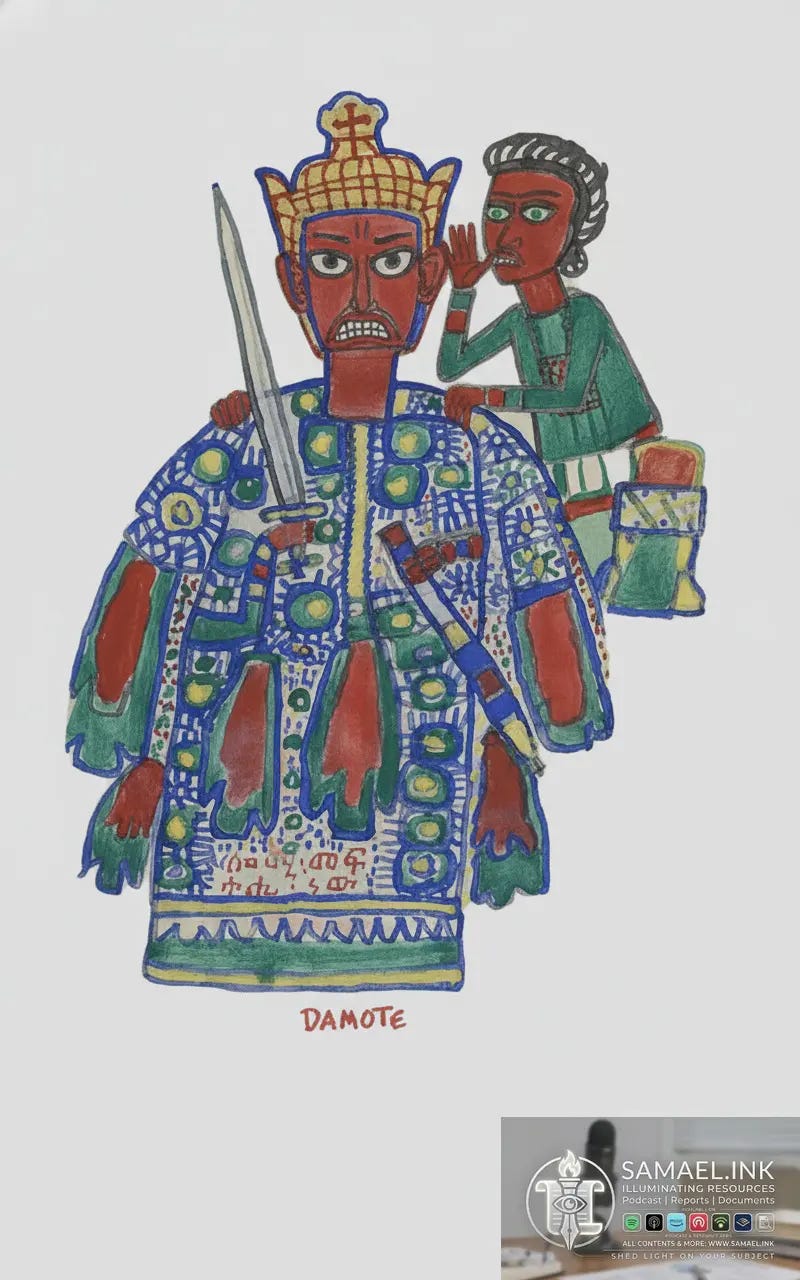
Core Themes of the Investigation:
The Conversion of Motolomi: A deep dive into the 13th-century encounters between the pagan sovereign of Damot and Saint Tekle Haymanot. This section investigates the “trial by fire” and the subsequent establishment of Gararya Maryam, the region’s first Christian church.
The Madness of Damote (1848–1853): An analysis of the “Deviant Autocrat” who nearly fractured the Wolayta empire. We examine the breakdown of “wise restraint” in favor of impulsive warfare and the “general legal uncertainty” that characterized his brief, aggressive tenure.
Topographical Destiny: The symbolic importance of Mount Damota (Wolayta: Damota) as a site of both sacrificial birth and imperial naming, serving as a pillar for Wolayta regional identity.
Comparison of Imperial Archetypes
AttributeMotolomi (The Founder)King Damote (The Deviant)OriginAncient Kingdom of Damot19th-Century Wolayta EmpireAuthoritySacred TransformationSpirit-Possessed/AutocraticMilitaryDefensive StabilityErratic AggressionLegacyAncestral “Apostle” and Founder”Terrible Memory” of Near-Collapse
Originally, Damot was a powerful, independent kingdom located south of the Abay River (Blue Nile), encompassing parts of what is now Wolayta and Kaffa. During the 16th-century expansion of the Oromo people, the traditional heartland of Damot was bypassed or directly pressured.
The Pretext of Expansion: As noted in earlier research, southern sultanates and polities often used the Oromo expansion as a pretext or opportunity to shift their own centers of power.
Refugee Elites: The ruling classes and the Christianized population of Damot began moving north across the Abay to seek protection within the strengthening Solomonic heartland in the central highlands.
The Administrative “Transplantation”
By the late 16th and early 17th centuries, the name “Damot” was officially transferred to a territory north of the Abay, in southern Gojjam. This was a common administrative tactic:
Maintaining Titles: To preserve the prestige of the ancient kingdom, the Solomonic Emperors (such as Sarsa Dengel and Susenyos I) re-established the province of Damot in Gojjam.
The Damot Regiment: The military units originally hailing from the south—the famous Damot cavalry—were settled in Gojjam to act as a “shield” for the imperial capital against further southern incursions.
According to the document “The Wolaita”, several ancient kingdoms and territories were recognized and eventually integrated into the central Ethiopian administrative structure (the “Amhara center”), often being redefined as provinces:
The Kingdom of Damot
The most significant ancient kingdom recognized in this context is Damot.
Recognition and Equivalence: The Christian court of Menilek II and historical chroniclers equated the country of Wolaita directly with the ancient kingdom of Damot. This identification was so “matter-of-fact” that Wolaita was often referred to as Wolaita-Damot, the capital of the legendary King Motolomi.
Provincial Status: The geographical extent of this ancient kingdom is roughly preserved in the province of Damot, located west of Gojjam The Wolaita themselves view their fatherland as the heart of this semi-mystical ancient state.
Wolaita as a Special Province
Following its conquest by Menelik, Wolaita was established as a special province directly subordinate to the Ethiopian Emperor.
Administrative Category: It belonged to the category of “mad bet” (kitchen) provinces, meaning its tribute was destined specifically for the imperial budget
Later Reorganization: In 1941, the empire was reorganized into twelve provinces, and Wolaita was incorporated into the Sidamo-Borana province as a sub-province (awurajaa)
Other Kingdoms and Regions
The document also references other historical entities that interacted with or were absorbed into the broader imperial structure:
Kogo: A disappeared country near Wolaita that now survives only as a clan name within the region.
Hadiya: Mentioned as a neighboring group that faced conquest and was a major rival during the expansion of the Wolaita state
Kaffa, Male, and Basketto: These are noted as having traditional administrative divisions (often based on the sacred number twelve) similar to those later adopted by the central empire
Scholarly Citations:
This article integrates ethnographic data and historical frameworks from:
Eike Haberland, Elisabeth Pauli, Wolfgang Kuls: The Wolaita. Their extensive fieldwork (1924–1992) remains the definitive record for understanding these royal lineages and the social transitions of the region.
Sophia Thubauville: For her scholarly focus on the preservation of southern Ethiopian historical narratives and the evolution of the Damot identity.
Subscribe for the Full Release
To receive the complete analysis of these contrasting reigns and further updates on the history of the southern Ethiopian sultanates and kingdoms, please subscribe to our research series.