
Ethiopia Under Strain: How the 2026 Iran Crisis, Hormuz Closure, and Maritime Insurance Shock Are Driving Imported Inflation and FX Stress
TL;DR
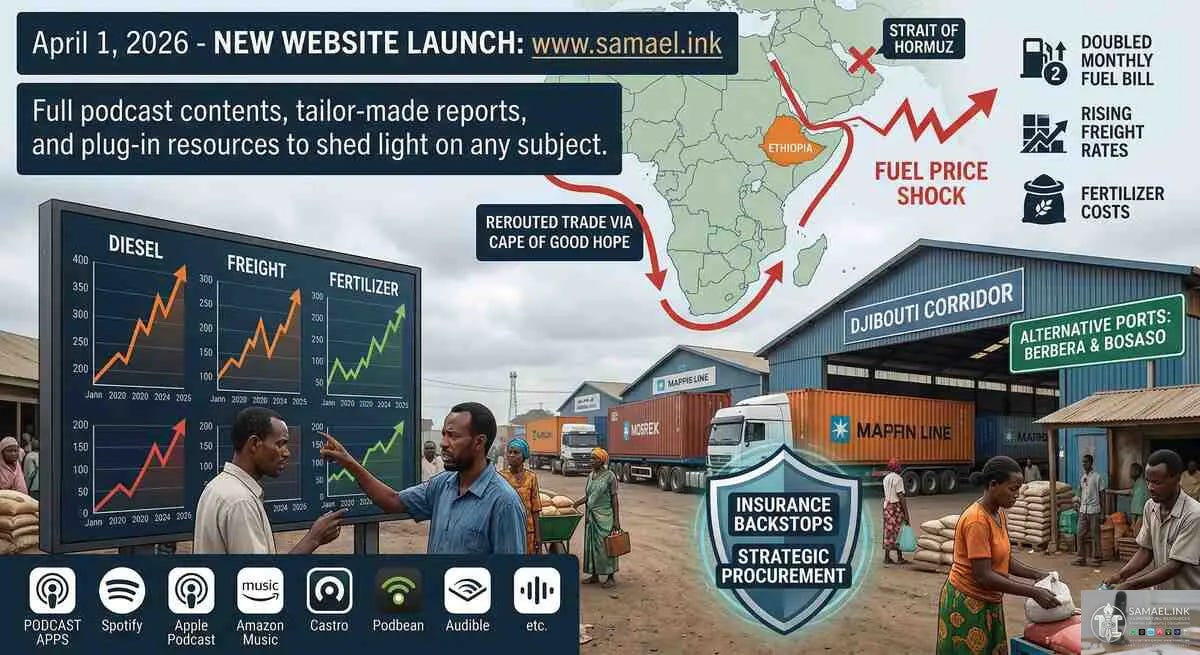
Iran’s March–April offensive and the temporary closure of the Strait of Hormuz precipitated a sharp jump in global crude and bunker prices and an acute maritime insurance shock. For landlocked, import‑dependent Ethiopia these developments have immediate and wide‑ranging effects. The spike in global energy costs doubled Ethiopia’s monthly fuel import bill, freight and insurance surcharges have made marginal shipments uneconomical, and rerouting around the Cape of Good Hope is lengthening voyages and tightening container availability for Horn‑bound trade. The combined effect is rising imported inflation, accelerated foreign exchange outflows, strained project pipelines, and a set of painful policy tradeoffs between subsidies, reserve management, and investment.
How the fuel price shock transmits to the real economy
Price mechanics and immediate fiscal impact
A crude price surge roughly doubling international oil benchmarks immediately raised the dollar value of Ethiopia’s fuel imports. For an economy that imports nearly all refined fuels, the fiscal and external implications are swift: higher import bills increase monthly FX outflows and push up the cost base for transport, power generation where fuel is used, and fuel‑intensive inputs.
Transport channel
Diesel and bunker price increases feed directly into trucking, rail fuel costs, and feeder services between Djibouti and Addis Ababa. Freight rate rises and elevated bunker costs inflate logistics bills for firms and raise retail prices for transported goods. Higher demurrage and congestion at Djibouti add to landed costs and delivery uncertainty.
Agricultural channel
Higher fuel raises the local cost of operating irrigation pumps and of producing and transporting fertilizer. Fertilizer price pass‑through and higher on‑farm fuel costs raise unit costs for staple crops, increasing wholesale and retail food prices and tightening food security for vulnerable households.
Industrial channel
Energy‑intensive manufacturers face margin compression as fuel and transport costs rise. Some may cut output to avoid losses; others push price increases into export markets, reducing competitiveness and hurting export volumes. Supply‑chain interruptions and higher input costs can depress manufacturing investment and employment.
Maritime isolation and the insurance shock
War‑risk and kidnap/ransom premium dynamics
The conflict raised war‑risk and kidnap/ransom surcharges on vessels operating in Red Sea, Gulf of Aden, and southern Arabian Sea lanes. These surcharges add significantly to liners’ and charterers’ cost of carriage. For many small‑margin exporters and importers, higher insurance and freight render trade unprofitable or push shippers to consolidate shipments and raise unit costs.
Rerouting and time‑cost impacts
To avoid high‑risk corridors, many vessels reroute around Africa’s Cape of Good Hope. The longer voyages materially increase voyage costs, bunker consumption, and turnaround times, pushing up spot freight rates and reducing the availability and frequency of container slots to the Horn of Africa. Reduced call frequency further pressures Djibouti’s throughput and container dwell.
Port congestion and operational knock‑on effects
Longer transit times and fewer vessel calls create irregular arrival patterns, worsening port congestion and raising demurrage and detention costs. Container shortages and schedule unreliability force inventory hoarding or pass‑through of costs to consumers, further elevating inflationary pressures.
Financial stress: FX depletion and imported inflation
Reserve dynamics and program pressure
Rapidly higher import bills accelerate FX outflows and erode central bank foreign reserves, reducing import cover and straining adherence to IMF program targets or conditionalities. When reserves fall, the central bank faces harder currency‑defense choices and pressure on confidence.
CPI pass‑through and monetary complications
Energy, transport, and agricultural input cost increases transmit into consumer prices. Rising CPI complicates monetary policy choices: allowing inflation to rise undermines real incomes and welfare, while aggressive tightening to defend the currency risks constraining growth, increasing unemployment, and worsening debt sustainability for corporates and households.
Capital reallocation and financing shortfalls
Regional Gulf states and private funds are reallocating capital toward reconstruction, domestic energy projects, and strategic stockpiles. The diversion of Gulf financing and slower disbursement of previously committed funds create financing gaps for major Ethiopian infrastructure projects and raise the cost of borrowing for both public and private sectors.
Disruption of Gulf capital and project pipelines
Project delays and cancellations
Major Gulf lenders and investors prioritizing domestic recovery and regional energy security have delayed disbursements or reallocated pipelines. Hydropower, port, and transport projects that depended on Gulf equity and concessional finance face pauses, slower implementation, or cancellation risk.
Fiscal and debt implications
Financing shortfalls push the government to reallocate budgetary resources or seek higher‑cost external borrowing. Increased borrowing raises debt service burdens and constrains fiscal space for recurrent spending, maintenance, and new capital projects.
Private sector drag and multiplier effects
Contractors and suppliers face payment delays and higher risk premia, reducing working capital and appetite for new bids. Investment slowdowns affect jobs and local supply chains, creating negative spillovers into consumption and tax revenues.
Macro and social policy tradeoffs
Subsidies versus reserves
Implementing or expanding food and fuel subsidies can blunt political unrest but accelerates FX depletion and fiscal strain. Policymakers face a choice between using reserves and fiscal buffers to stabilize living costs or conserving buffers and allowing prices to rise.
Monetary tightening versus growth
Tightening policy to defend the currency and curb inflation can stabilize exchange rates but risks deepening output losses, increasing unemployment, and making debt servicing harder for private borrowers.
Targeting dilemmas and distributional impacts
If transport and energy costs are allowed to adjust while subsidies are narrowly targeted to food, the poor may still bear concentrated pain via higher transport costs for basic goods. Broad subsidies are costly; narrowly targeted transfers require administrative capacity and timely external financing to be effective.
Operational and supply‑chain responses available to Ethiopia
Corridor diversification and capacity scaling
Accelerate operationalization of alternative ports such as Berbera and Bosaso where feasible, while fast‑tracking inland rail and road upgrades that reduce dependence on Djibouti. These measures require quick contracting, focused financing, and short‑term operational improvements at port terminals to absorb diverted volumes.
Strategic procurement and payment terms
Negotiate concessional fuel supply contracts, deferred‑payment swaps, or direct fuel tankering agreements to smooth immediate availability and reduce dollar‑value strikes against reserve positions. Prioritize long‑term, predictable supply lines for power generation and critical transport.
Insurance backstops and guarantees
Seek multilateral or bilateral reinsurance, guarantee facilities, or pooled public‑private schemes to cap war‑risk premiums on essential cargoes. Donor or multilateral facilities that underwrite a portion of premiums for staple imports can preserve trade flows at sustainable cost.
Prioritization and rationing of critical imports
Temporarily prioritize or ration essential imports such as food, medicine, and fuel for power and transport to stretch FX buffers while external lifelines are mobilized. Such measures should be time‑bound, transparent, and accompanied by mitigating transfers to protect the poorest.
Short‑term fiscal and social mitigations
Implement narrow, temporary, and well‑targeted transfers to food‑insecure and transport‑vulnerable households to reduce the likelihood of unrest. Combine cash transfers or vouchers with in‑kind emergency support where markets are disrupted.
Signatures and indicators to monitor
Track monthly fuel import value in USD and import volumes relative to historical baselines to detect continuing pressure on the balance of payments. Monitor container throughput, vessel calls, and average transit times at Djibouti and at alternative ports such as Berbera and South African transshipment hubs to assess rerouting intensity and congestion. Observe movements in war‑risk insurance premia for Horn lanes to gauge insurance market stress. Watch Gulf capital inflows and the gap between signed and disbursed project finance for major infrastructure projects to detect pipeline deterioration. Follow central bank reserves and import cover measures to assess reserve adequacy and stress.
Outlooks and scenario framing
Short term (weeks to months)
Rapid drawdown of FX reserves, rising CPI, immediate project finance slowdowns, localized spot shortages in transport capacity and essential fuels, and heightened risk of price shocks for staples in major urban markets.
Medium term (three to twelve months)
If conflict persists, expect prolonged project delays, re‑scoped infrastructure plans, a shift toward higher‑cost or shorter‑tenor borrowing, and higher domestic social unrest risk unless mitigation is rapidly scaled and financed.
Longer term (beyond a year)
Possible outcomes diverge depending on conflict trajectory and external support. One path is a managed but costly status quo with sustained subsidies, constrained growth, and heavy fiscal costs. Another is protracted fragmentation, with chronic underinvestment, stalled projects, and a weaker private sector. A less likely optimistic path would be a negotiated regional security stabilization that restores corridor stability and investor confidence, allowing project pipelines to resume.
Strategic note
If maritime disruption persists, Ethiopia will likely need time‑limited, targeted subsidies for staples and prioritized transport for critical imports financed by emergency external support or measured reserve drawdowns. Each option carries macro tradeoffs and potential conditionality from external partners; sequencing and targeting will determine social and economic outcomes.
Has Ethiopia’s fuel import bill doubled?
Yes. The global crude price surge roughly doubled the dollar value of Ethiopia’s monthly fuel imports, immediately increasing FX outflows and the cost base for transport and energy‑dependent sectors.
Are transport and food prices already rising?
Yes. Diesel and bunker cost increases are lifting trucking and feeder costs from Djibouti, while higher fuel and fertilizer costs are raising agricultural production costs and retail food prices.
Is Djibouti still the main route for Ethiopian trade?
Yes. The Addis–Djibouti corridor remains the dominant seaborne gateway; heavy reliance on this single corridor amplifies exposure to Red Sea and Gulf shocks.
Are insurance costs making shipments uneconomical?
Yes. War‑risk and kidnap/ransom surcharges have spiked, pushing up overall carriage costs and rendering many small‑margin shipments uneconomical without subsidies or guarantees.
Can Ethiopia quickly switch to alternative corridors?
Partially. Berbera and Bosaso can provide relief but require rapid capacity upgrades, operational scale‑up, and financing to meaningfully reduce dependence on Djibouti within months.
Will FX reserves come under severe strain?
Yes. Elevated import bills, combined with possible capital reallocation away from the country, are accelerating reserve depletion absent timely external lifelines.
Do Gulf capital withdrawals threaten projects?
Yes. Reallocation of Gulf capital toward domestic or regional reconstruction and energy security is delaying disbursement and increasing the risk of cancellations for major infrastructure projects in Ethiopia.
Are targeted subsidies a viable short‑term fix?
Yes, but costly. Narrow, time‑bound subsidies can blunt unrest and protect the poorest, yet they require external financing or reserve drawdowns and risk worsening macro balances if prolonged.
What immediate policy steps should be prioritized?
Secure concessional fuel and FX lifelines, mobilize insurance backstops for essential imports, operationalize alternative corridors quickly, and deploy narrowly targeted social transfers while seeking emergency external financing.
How should the government sequence actions to minimize macro‑social harm?
Prioritize stabilizing essential fuel and FX flows and capping insurance costs for staples first to keep supply lines open. Rapidly operationalize highest‑impact corridor alternatives in parallel. Use narrowly targeted social transfers to shield the most vulnerable while avoiding broad subsidies that would accelerate reserve depletion. Seek external emergency financing to avoid an unsustainable drawdown of reserves.
What are the key indicators most useful for early warning?
Monthly USD fuel import values and volumes, container throughput and vessel call frequency at Djibouti and alternate ports, war‑risk premium movements on Horn lanes, signed versus disbursed Gulf and other project finance, and central bank reserves and import cover.
Could Ethiopia self‑insure or pool risks regionally for war‑risk cover?
Potentially. Multilateral or regional pooled reinsurance schemes or donor‑backed guarantee facilities could underwrite part of war‑risk exposure for essential shipments. These require quick donor buy‑in and technical design but could be a cost‑effective bridge while commercial markets recalibrate.
What fiscal tradeoffs are politically and economically feasible?
Narrow, time‑limited transfers to the poorest and critical subsidy support for staple freight are politically feasible if matched with external financing. Large, open‑ended subsidy programs would prevent reserve rebuilding and undermine long‑term macro stability.
Is stagflation likely?
Yes. The mix of supply shocks and FX pressure that raises prices while constraining growth creates stagflation risks unless decisive external financing and operational measures restore supply and reserve buffers.
Final assessment
Ethiopia faces a rapid external shock that has been transmitted into domestic prices, logistics, and financing. The policy response must be multi‑pronged: immediate external lifelines for fuel and FX, rapid insurance and logistics backstops to keep essential trade flowing, accelerated corridor diversification to reduce single‑route exposure, and narrowly targeted social protection to manage unrest risks. Timing, targeting, and external financing will determine whether the country weathers a sharp but manageable shock or slips into prolonged macroeconomic stagnation and infrastructure stagnation.