
TL;DR:
Ethiopia’s pre‑election environment (June 1, 2026) shows a rapid contraction of civic space: widespread arbitrary detentions concentrated in Oromia and Amhara, systematic suppression of independent media (including the February 24 revocation of Addis Standard’s license), and administrative pressure on civil‑society and healthcare workers—practices that undermine due process and raise risks of abuse.
Operationally, the vote faces serious logistics and security shortfalls: thousands of polling stations remain offline in conflict-affected regions, unaudited digital systems are legally contested by opposition parties, and late‑March fuel shortages disrupted staffing and ballot distribution, all of which threaten inclusiveness and the credibility of results.
Silencing the Newsroom: The Abduction of Million Beyene

TL;DR: Million Beyene (Ge’ez: ሚሊዮን በየነ), the Managing Editor of Addis Standard, was abducted from his office by unidentified plainclothes individuals on April 15, 2026. Despite CCTV evidence of the coordinated seizure, major law enforcement agencies deny having him in their custody.
Immediate priorities are clear: restore due‑process and release those held without credible evidence; reinstate or halt punitive media actions lacking transparent legal basis and permit independent election coverage; and urgently audit and allow third‑party verification of electoral technology while securing fuel and logistics to keep polling stations operational.
By early April 2026, the human rights environment in Ethiopia had deteriorated markedly as the country moved toward nationwide elections scheduled for June 1. Independent monitors and the Ethiopian Human Rights Commission (EHRC) report a sharp rise in arbitrary detentions, a systematic squeeze on independent media, and mounting obstacles to a credible electoral process. The government frames many measures as security responses to regional insurgencies; rights groups warn they are instead producing a shrinking civic space and undermining core freedoms essential to a free and fair vote.
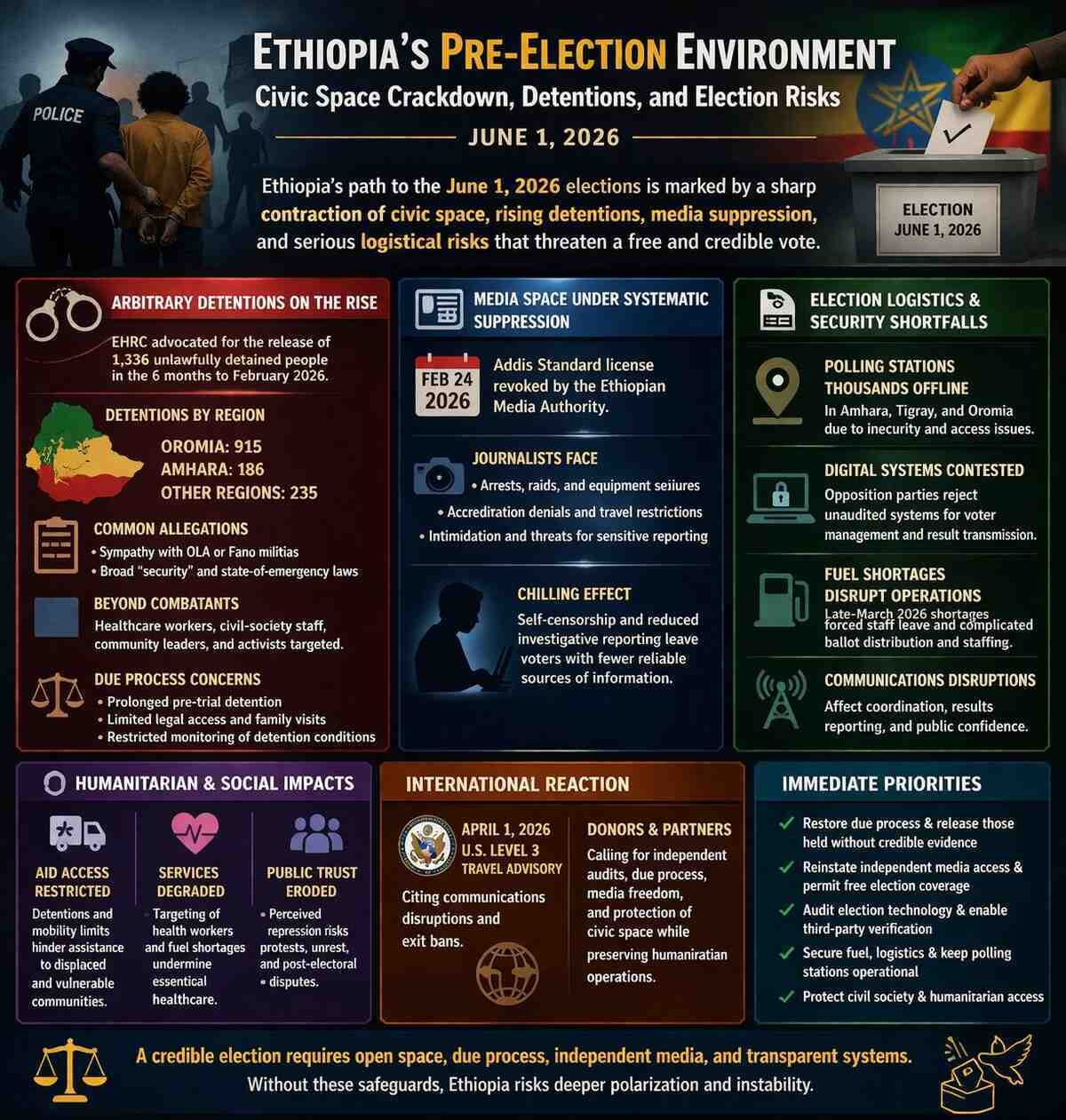
Key statistics include 1,336 reported unlawful detentions, concentrated in Oromia and Amhara regions. Sections describe due-process concerns such as prolonged detention without charge and limited legal access.
A media panel highlights the revocation of Addis Standard’s license and broader repression of journalists through arrests and intimidation. Another section focuses on electoral challenges, including insecure polling stations, contested digital systems, and fuel shortages disrupting logistics.
Additional panels cover humanitarian impacts (restricted aid, weakened healthcare services), international reactions (including a U.S. travel advisory), and recommended priorities such as restoring due process, ensuring media freedom, and auditing election systems.
Background and political context
Since 2018, Ethiopia’s political landscape has been shaped by episodic reforms, recurrent communal and insurgent violence, and periodic central–regional tensions. The run‑up to the June 2026 elections has exposed those fault lines: political actors face intense pressure to secure territorial control and electoral advantage amid persistent insecurity in Amhara, Oromia, and Tigray regions. The administration’s stated priority—stability—has translated into expanded security powers that critics say are being applied selectively against perceived opponents, civil society, and independent media.
Arbitrary detentions: scale, patterns, and targets
EHRC interventions and international monitoring indicate a significant increase in detentions in late 2025 and Q1 2026, with a pronounced geographic concentration:
Scale and distribution: The EHRC says it advocated for the release of 1,336 unlawfully detained persons in the six months to February 2026. Reported figures show large concentrations in Oromia (915) and Amhara (186), with remaining cases scattered across other regions.
Patterns of arrest: Many detainees are accused—often without transparent evidence—of sympathizing with armed groups such as the Oromo Liberation Army (OLA) or the Fano militia. Authorities have reportedly invoked broadly worded security statutes and state‑of‑emergency provisions to detain suspects without prompt charge or judicial review.
Institutional targets: Beyond alleged combatants, security operations have targeted healthcare workers, community leaders, and civil society staff. Arrests of medical personnel protesting poor conditions and repeated administrative suspensions of rights organizations by the Authority for Civil Society Organizations illustrate widening pressure on non‑political civic actors.
Due process deficits: Multiple reports document prolonged pre‑trial detention, limited access to legal counsel, and impediments to family visits and independent monitoring—practices that heighten the risk of abuse and contravene international standards.
The shrinking media space
Independent reporting has contracted sharply in the months preceding the vote, undermining scrutiny and public debate:
Licensing and closures: On February 24, 2026, the Ethiopian Media Authority revoked the license of Addis Standard, one of the country’s few remaining prominent independent outlets. Other media have faced investigative raids, equipment seizures, and administrative suspensions.
Journalists under pressure: Local and foreign journalists have been subject to arrests, travel restrictions, and accreditation denials after covering sensitive topics such as regional conflicts, displaced populations, and security force conduct. Outlets reporting on training camps and the use of foreign‑trained units face particular scrutiny.
Self‑censorship and information gaps: The combined effect of punitive administrative actions and criminal risk has induced widespread self‑censorship. Reduced investigative capacity and fear of reprisals have created informational blind spots precisely when voters require reliable reporting to make informed choices.
Electoral logistics and security constraints
Operational obstacles—both security‑driven and logistical—threaten the inclusiveness and integrity of the vote:
Voter registration and polling access: Official data indicate over 9 million registered voters, but thousands of polling stations remain offline or insecure, particularly in Amhara, Tigray, and Oromia. Low polling‑station availability risks disenfranchisement and concentrated crowding where voting does occur.
Digital voting and legal disputes: Opposition parties have publicly rejected the government’s unaudited digital systems for voter management and result transmission, citing insufficient transparency and legal safeguards. Ongoing legal challenges and limited independent audits fuel contestation over the process’s credibility.
Infrastructure and resource constraints: Acute fuel shortages in late March 2026 compelled some local officials and civil servants to take mandatory leave, complicating logistics for ballot distribution, polling‑station staffing, and results aggregation. Communications disruptions reported by travelers and the State Department have further compounded operational uncertainty.
Humanitarian and social implications
The clampdown on civic space and media, coupled with heightened insecurity, carries broader social costs:
Humanitarian access: Increased military operations, mobility restrictions, and arbitrary detentions heighten barriers to aid delivery in conflict‑affected areas, constraining assistance to internally displaced persons and vulnerable communities.
Public trust and political legitimacy: Perceptions of selective enforcement and curtailed freedoms risk eroding public confidence in electoral outcomes, potentially fueling protests, localized unrest, and cycles of repression and resistance.
Health and service impacts: Targeting of healthcare workers and disruptions to transport and fuel supplies degrade essential service delivery at a time when communities rely on functioning clinics and humanitarian support.
International reactions and diplomatic stakes
Key external actors have expressed concern over the pre‑election environment. On April 1, 2026, the U.S. Department of State renewed a Level 3 Travel Advisory citing communications disruptions and exit bans. Donor governments and multilaterals are weighing responses that balance pressure on rights violations with the need to preserve essential humanitarian operations. Regional actors and the African Union face diplomatic dilemmas: pressing for respect for political freedoms risks straining ties while inaction could embolden further restrictions.
Legal and normative assessments
Under international human rights law, arbitrary detention, denial of fair trial guarantees, restrictions on freedom of expression, and punitive measures against civil society are unlawful except under narrowly constrained and proportionate security measures. The patterns documented by EHRC and international monitors suggest that emergency and counter‑insurgency powers are being applied in ways that may breach Ethiopia’s international obligations. Independent, transparent investigations into detention practices and media restrictions are necessary to establish accountability and restore public confidence.
Monitoring indicators
To assess trajectory and risks in the remaining pre‑election period, stakeholders should monitor:
Numbers and geographic distribution of detentions and releases (EHRC and independent tallies).
Media closures, journalist arrests, and indicators of self‑censorship.
Polling‑station operational status and voter turnout data where voting occurs.
Fuel and logistics availability affecting electoral operations.
Incidents of violent disruption, crowd dispersals, and emergency restrictions on movement or communication.
Conclusion
Ethiopia’s June 1, 2026 elections are taking place against a backdrop of heightened insecurity and a contracting civic space. The documented surge in arbitrary detentions and the systematic curtailment of independent media undermine the conditions for a credible, participatory vote. Domestic authorities, opposition actors, and international partners all have roles to play in reducing tensions, safeguarding fundamental rights, and ensuring that the electoral process meets minimum standards of fairness and transparency. Absent rapid corrective measures—restoring due process protections, reopening independent media space, and guaranteeing transparent electoral systems—Ethiopia risks intensified domestic polarization and destabilizing post‑electoral disputes.
What are the main human‑rights concerns before the June first election?
Rising arbitrary detentions, muzzling of independent media, restricted civil society activity, and constraints on due process.
How many unlawful detentions did the EHRC report?
The EHRC said it advocated for the release of one thousand three hundred thirty‑six unlawfully detained people in the six months to February two thousand twenty‑six.
Where are detentions most concentrated?
Primarily in Oromia with about nine hundred fifteen cases and Amhara with about one hundred eighty‑six cases.
Who else has been targeted besides alleged combatants?
Healthcare workers, civil‑society staff, community leaders, and journalists have faced arrests, administrative suspensions, or other reprisals.
What happened to Addis Standard?
The Ethiopian Media Authority revoked Addis Standard’s license on February twenty‑four, two thousand twenty‑six.
How are journalists being restricted?
Through license denials, arrests, raids, equipment seizures, accreditation suspensions, and informal intimidation that drives self‑censorship.
What electoral logistics problems threaten voting?
Thousands of polling stations remain offline in insecure areas, opposition rejection of unaudited digital systems, fuel shortages disrupting staffing and transport, and communications disruptions.
What legal or due‑process failures are reported?
Prolonged pre‑trial detention without charge, limited legal access, restricted monitoring of detention conditions, and use of broad emergency and security powers.
How are international actors responding?
Heightened concern and travel advisories such as the U.S. Level Three advisory on April first two thousand twenty‑six; donors weigh conditional engagement balancing rights concerns and humanitarian needs; calls for independent audits and monitoring.
What are priority actions recommended?
Restore due‑process guarantees and release those held without evidence; reopen or reverse punitive media actions lacking legal basis; audit and allow independent verification of election technology; protect civil‑society space; and condition international support on verifiable safeguards while preserving humanitarian access.