
Energy Apartheid: The Beijing-Tehran Alliance and the Controlled Collapse of the Ethiopian Birr
TL;DR
Eritrea has become a critical western logistics node enabling Iranian resupply to regional proxies through Assab, Massawa, and nearby islands, creating a maritime pincer across Bab el‑Mandeb that raises the risk to commercial shipping and military escalation.
Modular, containerized movement of missile and UAV components, covert air links, and island handoffs (e.g., Dahlak) allow Iran and the IRGC to sustain Houthi and Sudanese capabilities while minimizing detection.
Eritrea gains hard-currency rents and fuel deliveries in exchange for port access and permissive facilitation, but faces increased sanctions, diplomatic isolation, and the possibility of kinetic countermeasures that could destabilize the Red Sea corridor.
Strategic context and geographic significance
Assab and Massawa are strategically located on the western approaches to the Red Sea and Bab el‑Mandeb, a narrow international choke point linking the Indian Ocean to the Suez Canal. Control or effective denial of movement through that strait has outsized economic and strategic consequences. Eritrea’s relative political opacity, one‑party governance, and existing port infrastructure make those ports high‑value candidates for covert dual‑use logistics: they can host legitimate commercial traffic while serving as low‑visibility transshipment hubs for military components. The Dahlak Archipelago and other small islands provide convenient island staging areas for the transfer of material between larger ships and smaller dhows that cross to Yemen or other Red Sea shores.
Launched Today: Explore full reports, tailored documents, and the deep-dive podcast series at www.samael.ink. Available now on Spotify, Apple Podcasts, Amazon Music, and all major platforms.
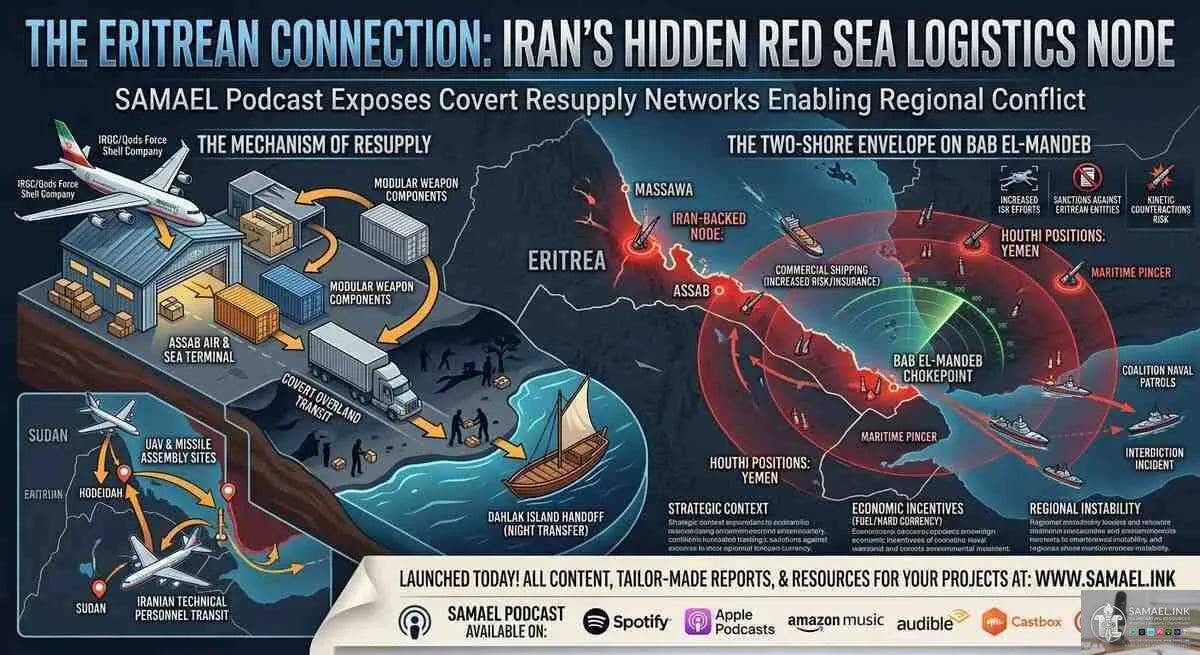
The Maritime Pincer: A strategic breakdown of how Eritrea has emerged as a primary logistics hub for Iranian-backed operations. This map illustrates the covert pipeline—from modular component transshipment at Assab and Massawa to night-time island handoffs—that enables a dual-shore envelope over the Bab el-Mandeb chokepoint.
Launched Today: Explore full reports, tailored documents, and the deep-dive podcast series at www.samael.ink. Available now on Spotify, Apple Podcasts, Amazon Music, and all major platforms.
Mechanisms of the “forward base” transformation
Commercial port infrastructure is ideal for containerized logistics: components for UAVs, cruise missiles, and guidance kits can be broken into small, innocuous packages and mixed with lawful cargo to exploit inspection gaps. Iranian cargo flights—direct or operated through shell companies and third‑country registries—can offload into Assab or Massawa air and sea terminals. From there, components move overland or directly to coastal staging points and are transferred at night to small wooden dhows or fast boats. Air corridors via Eritrea allow Iranian technical personnel to transit under commercial, contractor, or diplomatic cover, enabling on‑site assembly and training in Hodeidah, Sudan, or other recipient sites while avoiding busier surveillance corridors through the Gulf of Aden.
Operational effect: the two‑shore envelope on Bab el‑Mandeb
By enabling Iranian‑backed nodes in Eritrea opposite Houthi positions in Yemen, a two‑shore envelope forms that effectively brackets transits through the strait. This overlapping coverage increases the probability of detection and successful interdiction of shipping and allows for layered strike options using UAVs, anti‑ship missiles, and fast attack craft. The result is a credible coercive posture: insurers raise premiums, shippers reroute around Africa at higher cost, and naval escorts and interdictions become routine—each step increasing the risk of direct clashes between state navies or between coalition forces and IRGC‑affiliated assets.
Houthi resupply pipeline: modular smuggling, island staging, human traffic
Rather than moving whole missiles, modular smuggling breaks weapon systems into subcomponents that fit in containers, trucks, or small boats—reassembled at the destination by technicians. Dahlak and satellite islands serve as transshipment nodes where larger ships offload to smaller craft under cover of darkness or poor weather. The Eritrean hop—air or sea transit through Eritrea—reduces exposure of Iranian technical personnel to surveillance concentrated on the Gulf of Aden and offers a lower‑risk route for trainers and engineers to reach Houthi or Sudanese assembly sites. These modalities combine to give the Houthis and other Iranian partners a sustained replenishment pipeline even under periodic strikes.
Economic incentives and the regime calculus in Asmara
A fragile, sanction‑choked Eritrean state gains hard currency and fuel access through transshipment rents and bilateral barter arrangements. Payments may be in US dollars, euros, or Yuan, and fuel‑for‑access deals—regular deliveries from tankers operating in gray‑zone registries—can insulate military and regime elites from domestic shortages. For an isolated regime, the short‑term calculus favors revenue and regime survival, but the long‑term costs include targeted sanctions on port operators and shipping firms, diplomatic fallout, and potential military retaliation that could damage infrastructure and deter normal trade.
Military‑technical implications for regional conflict dynamics
Sustained access to Iranian components and expertise can improve Houthi strike precision, range, and tempo—enabling longer‑range cruise missiles, better‑guided artillery or anti‑ship munitions, and more capable reusable UAV fleets. Even limited numbers of precision weapons act as force multipliers, threatening commercial shipping, regional military bases, and critical infrastructure. For coalition forces, this presents a multi‑domain challenge: dispersed island staging areas, low‑signature small craft, and clandestine air movements require increased ISR, port inspection regimes, and multinational naval coordination to interdict effectively.
Signatures and indicators for intelligence and interdiction
Maritime indicators: irregular AIS behavior (darkening), unusual call patterns between Iranian‑affiliated ships and Eritrean ports, frequent night small‑boat transfers around Dahlak islands, and increased visits by tankers with opaque ownership. Air indicators: new or more frequent cargo flights between Iranian airports and Assab/Massawa, aircraft using shell‑company registrations, or rapid increases in chartered cargo movements. Financial indicators: sudden hard‑currency inflows to Eritrean state entities, atypical payments routed via third‑country banks, or use of non‑dollar clearing channels. Ground indicators: refurbishment of unmarked warehouses, expansion of port sidings, increased security around specific berths, and a higher presence of foreign technicians or contractors with nonstandard credentials.
Likely counteractions, limits, and escalation pathways
Coalition and U.S. responses can include enhanced naval escorts, interdiction of suspect logistics vessels at sea, targeted strikes on confirmed transshipment points, expanded sanctions against Eritrean entities, and intensified intelligence sharing with regional partners. Diplomatic levers might include offers of fuel or economic incentives in exchange for non‑cooperation, but effectiveness is conditioned on Asmara’s security calculations and alternative patrons. Limits on counteraction stem from the risks of striking sovereign ports (legal and escalation concerns), the challenge of fully interdicting small‑boat networks, and the ability of adversaries to obfuscate ownership and movements through third‑country registries and shell companies.
Broader geopolitical and commercial implications
China’s transactional or strategic support—direct payments, logistics, or enabling investments—could deepen great‑power competition in the Red Sea and Indian Ocean. Neighboring states may realign, seeking security guarantees or port partnerships with Gulf, Western, or Indian actors to offset an Iran‑Eritrea axis. For global commerce, repeated incidents or credible threats around Bab el‑Mandeb increase insurance premiums, force rerouting of container and energy shipments (with attendant costs and delays), and can amplify volatility in fuel and commodity markets.
Short‑ and medium‑term trajectories
Short term (weeks–months): Continued covert modular resupply, episodic interdictions and strikes, rising maritime insurance and shipping costs, and increased naval patrols in the southern Red Sea and approaches.
Medium term (3–12 months): Potential consolidation of logistics networks (regularized covert flight corridors, hardened storage), expanded sanctions or diplomatic isolation of Eritrea, growing naval deployments from interested powers, and elevated risk of miscalculation leading to direct engagements.
This is a report of something that is happening or about possibility? Is there any verifiable evidence for these allegations?
https://newbusinessethiopia.com/trade/ethiopia-forced-to-cut-fuel-supply-by-half/?hl=en-US
https://metro.global/2026/03/31/fuel-disruption-drives-ocean-bunker-volatility/?hl=en-US
https://kpiasacademy.com/strait-of-hormuz-crisis-global-energy/?hl=en-US
https://www.bruegel.org/analysis/what-war-iran-means-china?hl=en-US#:~:text=Iranian%20oil%20was%20paid%20for,financial%20transactions%20to%20Western%20authorities
https://africa.businessinsider.com/local/markets/ethiopia-deploys-fuel-subsidies-as-global-oil-shock-ripples-from-middle-east-conflict/0b0prhh?hl=en-US#:~:text=According%20to%20the%20finance%20ministry,fuel%20supplies%20to%20prevent%20shortages.