
TL;DR:
Barbary and Christian corsairs were state‑sanctioned privateers who dominated Mediterranean maritime predation for centuries—attacking shipping, raiding coasts, and fueling an economy built on prize capture, ransom, and slavery.
Operating from Algiers, Tunis, Tripoli, and Salé under Ottoman patronage or local autonomy, Barbary corsairs combined naval entrepreneurship with political brokerage. Leaders like the Barbarossa brothers turned privateering into territorial influence, using prizes and ransoms to fund fortifications, fleets, and client networks that blurred lines between state and outlaw.
The Knights Hospitaller on Malta and other European privateers pursued a mirrored system: letters of marque legitimized raids on Ottoman and Barbary shipping, while ransoms and slave sales sustained island economies. Religious rhetoric justified the corso, but practice often replicated the same extractive, violent logic as their Ottoman counterparts.
Corsair warfare relied on galleys, chebecs, and agile sailing vessels crewed by mixed personnel and often powered by enslaved rowers. Raids terrorized coastal communities across Italy, Spain, and beyond; captured people provided labor, ransom income, and a marketed commodity central to port wealth and civic infrastructure.
The corsair era ended as heavy navies, diplomatic pressure, Enlightenment norms, and colonial conquest dismantled corsair bases. Yet their imprint survived—in maritime law, coastal defenses, archival ransom records, and cultural memory—revealing an age where religion, commerce, and naval warfare interwove into a sustained system of sea‑borne predation.
This article was originally published on November 11, 2025.
Barbary Corsairs: Institutions, Leaders, and the Prize System
Barbary corsairs operated from Algiers, Tunis, Tripoli, and Salé under varying degrees of Ottoman protection and local autonomy. These port cities combined Muslim, converted Christian, and European renegade sailors into hybrid maritime entrepreneurships that preyed on Mediterranean commerce. Their leaders—most famously Oruç and Hayreddin Barbarossa—did more than raid: they consolidated territorial bases, negotiated treaties, and integrated corsairing into Ottoman maritime strategy. The economic model centered on prizes: seized ships and cargoes, ransom of wealthy captives, and the sale of others into slave markets. Revenue funded fortifications, naval arsenals, and client networks inland. Corsair polities thus blurred the lines between state, semi‑private enterprise, and criminality, posing persistent diplomatic and military challenges to European powers.
Maltese and Christian Corsairs: The Knights’ Maritime State and Commercial Privateers
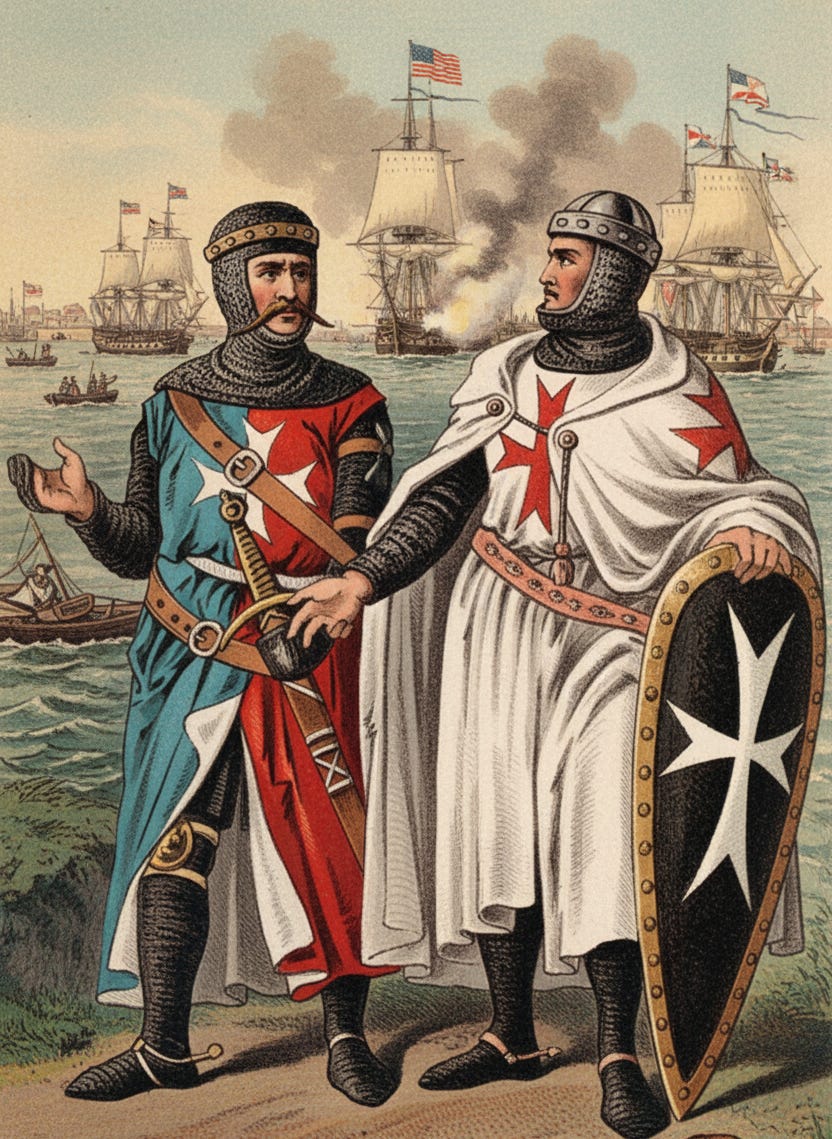
On the Christian side, the Knights Hospitaller transformed Malta into a militarized, revenue‑driven polity whose raison d’être combined holy war and prize economics. With letters of marque issued by the Grand Master, Maltese corsairs—plus Tuscan, Neapolitan, Sicilian, and Catalan privateers—patrolled choke points and preyed on Ottoman and Barbary shipping, often targeting neutrals trading with the enemy. Malta’s economy relied heavily on ransoms, slave labor, and taxes on prizes; its galleys and later chebecs and frigates projected power across the central Mediterranean. Christian corsairing reveals how religious rhetoric and economic necessity intertwined: crusading language justified actions that, in practice, replicated the same extractive practices the Christians reproached in Barbary ports.
Naval Technology and the Mechanics of Raiding: Galleys, Chebecs, and Crews
Corsair warfare depended on specialized vessels and crew structures optimized for speed, boarding actions, and coastal raids. Galleys—oar‑powered, low‑freeboard ships—offered unmatched maneuverability in calms and confined seas, while later adoption of chebecs and armed sailing vessels increased endurance on open water. Crews mixed professional sailors, knights (or private captains), mercenaries, and often enslaved rowers taken in previous raids. Armament emphasized shipboard artillery and boarding equipment: grapnels, boarding ramps, and close‑quarters weapons. The logistics of corsair operations included port infrastructures—shipyards, arsenals, slave depots (bagnios), and ransom brokers—that transformed episodic raids into sustained maritime commerce in human captives and booty.
Jewish Mariners and Corsairs of the Early Modern Mediterranean and Atlantic
Sinan Reis, often called “Sinan the Great Jew” was a prominent Ottoman naval commander active in the early to mid-16th century and a senior lieutenant of the famed Hayreddin Barbarossa. Serving as a chief admiral of the Ottoman fleet, he played a central role at the Battle of Preveza in 1538, where the Ottoman navy decisively defeated the Holy League—a coalition that included Spain, Venice, and the Papacy. Spanish records frequently referred to him as “The Great Jew,” and contemporaries noted his sophisticated use of navigational tools such as cross-staffs and other maritime instruments, which helped Ottoman squadrons outmaneuver European vessels across the Mediterranean.
Moses Cohen Henriques was a Dutch‑Jewish privateer of Portuguese Sephardic origin who operated in the early 17th century under the aegis of the Dutch West India Company and alongside notable Dutch naval leaders. In 1628 he assisted Admiral Piet Pieterszoon Hein in the capture of the Spanish treasure fleet off Cuba—a spectacularly successful raid that yielded a vast appropriation of Iberian bullion and remains one of the most lucrative maritime prizes in history. Henriques later took part in Dutch military and naval efforts in Brazil, playing a key role in the Dutch incursions and temporary conquest of parts of Northeast Brazil from Portuguese control.
Samuel Pallache belonged to a prominent Sephardic family in Morocco and combined roles as merchant, diplomat, and corsair in the late 16th and early 17th centuries. Operating with the authority of the Moroccan sultan and later enjoying the support of Prince Maurice of Orange, Pallache commanded a small fleet that attacked Spanish merchant shipping in both the Atlantic and the Mediterranean. His career was notable for the legal and diplomatic duality he embodied: he conducted raids under letters of marque issued by both Moroccan and Dutch authorities, effectively bridging state‑sponsored diplomacy and privateering.
Yaacov Kuriel began life as a captain in the Spanish fleet but, after persecution during the Inquisition, turned to piracy in the Caribbean as an act of reprisal. He commanded a modest flotilla of three ships crewed largely by fellow marranos (crypto‑Jews) and spent years targeting Spanish galleons and treasure convoys. After a prolonged career at sea, Kuriel ultimately retired to Safed, where he devoted himself to Kabbalistic study, completing a life that moved from naval service and clandestine violence to religious scholarship.
Human Cost and Coastal Societies: Slavery, Ransom, and Social Memory
The human toll of corsairing was profound. Raids on coastal settlements in Italy, Spain, the Balearics, and even more distant shores produced captives who were ransomed, sold, or enslaved as galley rowers and laborers. Entire coastal economies adapted defensively—fortified watchtowers, withdrawal of settlements inland, and the ritualization of ransom networks and confraternities. On the flip side, corsair ports institutionalized slavery as economic infrastructure: markets, prisons, and broker systems underwrote civic wealth. Cultural memory preserves both trauma and valor: European coastal communities commemorated raids in oral histories and churches, while North African port archives record ledgers, treaties, and ransom correspondences that testify to the mechanics of an economy built on human commodities.
Decline: Naval Supremacy, Diplomatic Pressure, and Colonial Conquest
By the late 18th and early 19th centuries, several structural changes undermined corsair systems. Western European navies developed ships of the line and frigates with heavier artillery and broader logistical reach, making the light corsair fleets increasingly vulnerable. Diplomatic norms shifted as the Enlightenment and commercial liberalism delegitimized privateering and slavery; states increasingly insisted on freedom of the seas. Military interventions—such as Anglo‑Dutch bombardments of North African ports and the Barbary Wars involving the United States—dealt direct blows to corsair bases. Finally, colonial expansion, most notably France’s conquest of Algeria (1830), physically eliminated many corsair strongholds. The result was a rapid contraction of institutional corsairing and a transition of Mediterranean maritime order toward state naval control and modern international maritime law.
Were Barbary and Christian corsairs fundamentally different?
No—while their political and religious allegiances differed, both operated as state‑sanctioned privateers who monetized maritime violence through prize capture, ransom, and slave markets. The distinction is mostly one of legitimation (Ottoman/Islamic vs. Christian/European) rather than method.
How did letters of marque work in the corsair context?
Letters of marque were formal commissions granting legal authority to attack specified enemy shipping. Issued by sovereigns or the Knights’ grand masters, they converted private captains into lawful combatants yet often exceeded legal bounds, provoking diplomatic disputes when neutrals were seized.
What economic role did ransom versus slave sale play?
Ransom was lucrative for high‑value captives—nobles, merchants, officials—while the sale of lower‑status captives and conscription into galley labor provided steady labor and cash. Together they formed a diversified revenue stream that funded naval operations and port economies.
How common were coastal raids into Europe?
Relatively common in vulnerable stretches of coast from Italy and Spain to the Balearics and parts of France; episodic raids also reached as far as the British Isles and Iceland in extreme cases. Coastal communities developed defensive systems and local militia in response.
Were corsairs racially or religiously uniform?
No. Barbary crews often included renegades—Christian converts, European captains, and North African sailors. Christian crews likewise included mercenaries and convicted sailors. Religious identity was important rhetorically but crews were pragmatically mixed.
Did corsairing influence international law?
Yes. The persistence of privateering, piracy, and state‑sponsored seizure forced European powers to clarify maritime law; debates about prize law, neutrality, and the rights of non‑combatants contributed to later treaties limiting privateering and shaping modern maritime law.
How did corsair economies integrate with local societies?
Corsair wealth funded urban patronage networks, fortifications, and shipbuilding industries. Families, guilds, and brokers profited from ransom negotiations. Ports institutionalized slave processing—prisons, markets, and taxation systems—making slavery an urban economic pillar.
Why did navies like Britain’s pose an existential threat to corsairs?
Royal navies built larger, heavily armed ships with sustained cruising ranges, superior gunnery, and blockading capability—systems that could destroy corsair fleets in port, protect merchant convoys, and project force into North African harbors.
What legacy did corsairing leave in Mediterranean culture?
Enduring legacies include coastal fortifications, maritime folk tales, ransom ledgers in archives, artistic depictions of captive‑ransom narratives, and a record of legal adjudications. The corsair era also shaped intercommunal mistrust and diplomatic memory between North Africa and Europe.
Could corsair‑style privateering return under modern conditions?
Unlikely in identical form due to state monopoly on naval power and international law, but private military companies, state proxies, and hybrid maritime predation (piracy, illegal fishing, armed robbery at sea) echo some corsair logics—profit through violence and political ambiguity—especially in failed‑state littorals.
Fascist Symbolism in USA

TL;DR: Fasces—bundles of rods, sometimes with an axe—are classical Roman symbols of collective authority and lawful force. Adopted widely in U.S. government architecture and art from the 18th century onward, they appear in the Capitol, Lincoln Memorial, Oval Office, Supreme Court and other civic spaces. Though their literal link to Roman republican ideal…
Borderlands Lost: How Force and Ultimatum Redrew British North America’s Map

TL;DR: Three themes emerge: persistent U.S. military pressure, repeated British strategic withdrawals, and the steady erosion of territory once administered from British North America. Across the 19th century and into the 20th, contested borderlands and maritime points were taken from Canadian-administered control through force, threat, or occupation—oft…
Why Canada Hates Black People

TL;DR: Slavery in the northern colonies and New France functioned on the same legal premise as plantation slavery elsewhere: people reduced to property. Though smaller in scale and more geographically dispersed than the large cash-crop plantations of the American South and Caribbean, northern enslavement embedded Black and Indigenous labour into domestic…
Black Canadians: The Overlooked Pioneers of Canada’s Diversity

TL;DR: Long before 20th‑century immigration waves from Asia, Europe, and the Middle East reshaped Canada’s cities, Black communities were already establishing roots—working, resisting, building institutions, and shaping the social and cultural life of the country. From Mathieu da Costa in the early 1600s to Black Loyalists, Jamaican Maroons, and Undergro…