
TL;DR:
The maritime corridor anchoring the Red Sea and the Bab el-Mandeb strait has long served as a critical bottleneck for global commerce, connecting the civilizations of East Asia, the Middle East, and the African interior. This strategic waterway, flanked by the ancient ports of Adulis in the Horn of Africa and Aden on the Arabian Peninsula, witnessed a complex evolution of monetary systems that reflected the shifting tides of empire, trade, and cultural exchange. Far from being a static region, the economic lifeblood of this area flowed through a succession of distinct currency regimes, each leaving an indelible mark on the archaeological record and the economic consciousness of the peoples who inhabited its shores. The story of money in this region is one of indirect connections, where the reach of empires like Tang China and Ming China was felt not through direct diplomacy or military conquest, but through the quiet, persistent seepage of copper cash into the markets of the Horn of Africa.
The narrative begins with the Kingdom of Aksum, a maritime superpower that flourished between the first and eighth centuries. At its zenith, Aksum distinguished itself as the only sub-Saharan African state to mint its own coinage in antiquity. These coins, crafted in gold, silver, and bronze, were not merely local tokens but were deliberately engineered for international trade. Their weights were calibrated to match the Roman solidus, ensuring seamless exchange across the Red Sea and into the Mediterranean world. This alignment with Roman standards allowed Aksumite merchants to participate fully in the global economy of the time, facilitating the export of ivory, gold, and exotic goods. However, by the eighth century, the empire retreated from the coastal lowlands into the highlands, ceding its status as a maritime hegemon. Yet, the ports it had established, particularly Adulis, remained active hubs of commerce, now operating under local and early Islamic control.
It was in this transitional period that the first whispers of East Asian currency began to echo in the Red Sea. The Tang and Song dynasties of China, spanning from the seventh to the thirteenth centuries, produced vast quantities of copper cash coins. While imperial edicts often prohibited the export of copper to prevent domestic currency shortages, the porous nature of global trade allowed these coins to leak out of China. They traveled not via direct Chinese fleets, which never reached the Red Sea, but through a sophisticated relay system of Indian and Middle Eastern intermediaries. Chinese merchants traded these coins to Indian and Southeast Asian traders in ports like Guangzhou, who then passed them to Persian and Arab merchants dominating the western Indian Ocean. These intermediaries transported the coins westward to the Arabian Peninsula, where they entered the Red Sea network, eventually arriving at Adulis and the inland settlement of Harlaa.
The presence of Tang and Song copper coins in these African and Arabian sites reveals a profound truth about pre-modern globalization: economic integration did not require direct political contact. The Chinese coins found in the strata of Harlaa and the Dahlak Archipelago were not viewed by local Aksumite or successor merchants as symbols of a foreign emperor’s authority. Instead, they were treated as commodity money, valued for their intrinsic copper content and their utility as petty change in local markets. This phenomenon represented a form of economic seepage, where the “petty cash” of the Chinese empire filled a monetary vacuum left by the cessation of Aksumite coinage production. It was a black-market solution to a lack of local small change, driven by the insatiable demand for copper in the Red Sea trade network.
As the centuries progressed, the monetary landscape of the Red Sea became increasingly diverse and complex. The Abbasid and Fatimid Caliphates introduced the gold dinar and silver dirham, which became the “petrodollars” of the medieval era, establishing silver-to-gold ratios that governed regional trade. These Islamic currencies circulated alongside the lingering Chinese copper cash, creating a hybrid economy where high-value transactions were conducted in precious metals while daily market exchanges relied on the base metal coins of the East. The Venetian ducat also emerged as a dominant force, known as the “check” of the Mediterranean and Red Sea, preferred for high-value spice transit and serving as a bridge between European and Asian markets.
The fourteenth and fifteenth centuries marked a significant shift in the nature of Chinese currency in the region. Unlike the passive leakage of the Tang and Song eras, the Ming Dynasty saw a deliberate “dumping” of copper coins into the Red Sea. This was driven by the expansion of the Adal Sultanate and the voyages of Zheng He, whose treasure fleets used copper coins as diplomatic gifts and ballast. The result was a massive influx of Ming cash, such as the Yongle Tongbao, which flooded the ports of Aden and Zeila. This was no longer mere seepage but a strategic flooding of currency, intended to facilitate the massive scale of the spice and ivory trade and to monetize the tribute system. The Adal Sultanate thrived in this environment, acting as a bridge between the Venetian gold of the Mediterranean, the Rasulid silver of Yemen, and the Ming copper of the East.
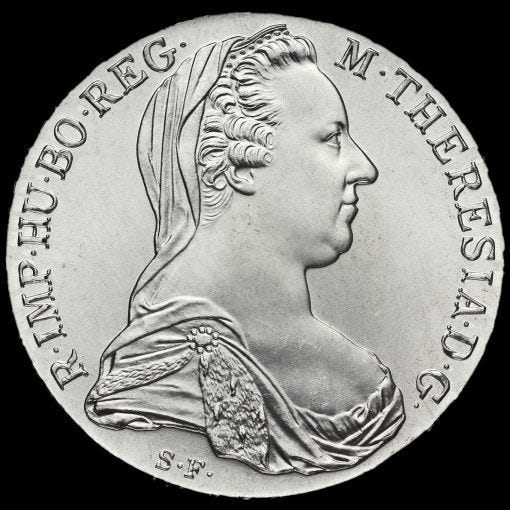
The arrival of the Ottoman Empire in the sixteenth century brought new currencies to the region, including the para and piastre, though these were often debased, leading to a reliance on foreign silver. The most enduring of these foreign currencies was the Maria Theresa Thaler, a silver coin dated 1780 that became the de facto national currency of Ethiopia and the tribal currency of the Aden hinterland. Its success lay in its consistent silver content, which earned the trust of local populations who were notoriously savvy with metal purity. Even when Ethiopia began minting its own coins, they had to match the Thaler’s weight exactly to be accepted. The Thaler remained in circulation for over a century, with the Austrian Mint continuing to strike coins with the same date long after the empress had died.
The nineteenth century saw the imposition of a British administrative shell over the region. Following the capture of Aden by the East India Company in 1839, the port was administered as part of the Bombay Presidency, and the Indian Rupee became the official legal tender. This created a two-tier economic reality where port duties and British salaries were paid in rupees, while the hinterland trade in coffee, hides, and salt continued to rely on the Maria Theresa Thaler and strings of older copper coins. The Italians also attempted to assert economic dominance in the late nineteenth and early twentieth centuries by introducing the Tallero Eritreo, a clone of the Maria Theresa Thaler. However, this effort failed because the silver content was slightly off, and the local population rejected it in favor of the Austrian original.
The twentieth century brought further fragmentation and transformation to the region’s monetary systems. The post-war period saw the introduction of the East African Shilling, followed by the sovereign fracturing of the Cold War era, which resulted in the division of Yemen into the South Yemeni Dinar and the North Yemeni Rial. Today, the region is characterized by extreme monetary divergence, with the Yemeni Rial split between rival central banks, the Djiboutian Franc pegged to the US dollar, and the Eritrean Nakfa standing as a symbol of financial sovereignty. Despite these modern complexities, the legacy of the past remains visible in the archaeological record, where the copper coins of Tang China and the silver of the Maria Theresa Thaler continue to tell the story of a region that has always been a crossroads of the world.
The following table provides a comprehensive overview of the various currencies that have circulated in the Red Sea and Aden basin from the height of the Aksumite Empire to the present day, illustrating the rich and complex history of monetary exchange in this vital maritime corridor.
The history of currency in the Red Sea is a testament to the resilience and adaptability of the peoples who have lived along its shores. From the gold of Aksum to the copper of China, from the silver of Austria to the paper of modern nation-states, each currency tells a story of trade, power, and cultural exchange. The region has always been a crossroads, a place where the economies of the world converge and diverge, shaped by the tides of history and the relentless flow of commerce. As we look to the future, the legacy of this rich monetary history remains a vital part of the identity of the Red Sea basin, reminding us of the deep connections that have bound these lands together for millennia.