
TL;DR
The security landscape in Mogadishu has shifted from “high risk” to “existential threat” for Chinese interests as of early 2026. The “Chinese Parasite State” is currently grappling with a environment where its traditional “non-interference” policy is being forcibly replaced by an aggressive, paid security posture to prevent a total loss of investment.
Direct Threats to Chinese Nationals
For the first time in decades, Chinese personnel are being explicitly targeted and restricted by the deteriorating situation:
High-Level Postponements: In January 2026, Chinese Foreign Minister Wang Yi postponed a historic visit to Mogadishu due to “complex and severe risks of terrorism.” This unprecedented delay signaled that even state-level security details could not guarantee safety in the capital.
Maritime Hijackings: In early March 2026, armed groups hijacked a Chinese fishing vessel off the coast. While the crew was eventually rescued, the Chinese Embassy took the rare step of labeling it a “blatantly vicious action” intended to disrupt bilateral ties.
Movement Restrictions: Chinese embassy staff and contractors are largely confined to “green zones” or heavily fortified compounds near Aden Adde International Airport. The risk of kidnapping and IED attacks on transit routes has made physical oversight of projects nearly impossible without elite armed escorts.
Impact on Chinese Investment
The instability is forcing a “securitization of development,” where the cost of protecting an asset often rivals the cost of the asset itself.
The “Security Overhand”: Major projects now include a mandatory 10–15% budget allocation specifically for private security. China is moving toward a “layered security model” using firms like Beijing DeWe and Frontier Services Group to manage local militias, as they no longer trust federal forces to provide adequate protection.
Stalled Onshore Ambitions: While China is desperate for Somali oil and minerals to offset the Strait of Hormuz closure, onshore exploration in Mudug and Nugaal is effectively frozen. The “extreme uncertainty” and the threat of Al-Shabaab recapturing territory have made long-term infrastructure investment a “suicide mission” for capital without massive state subsidies.
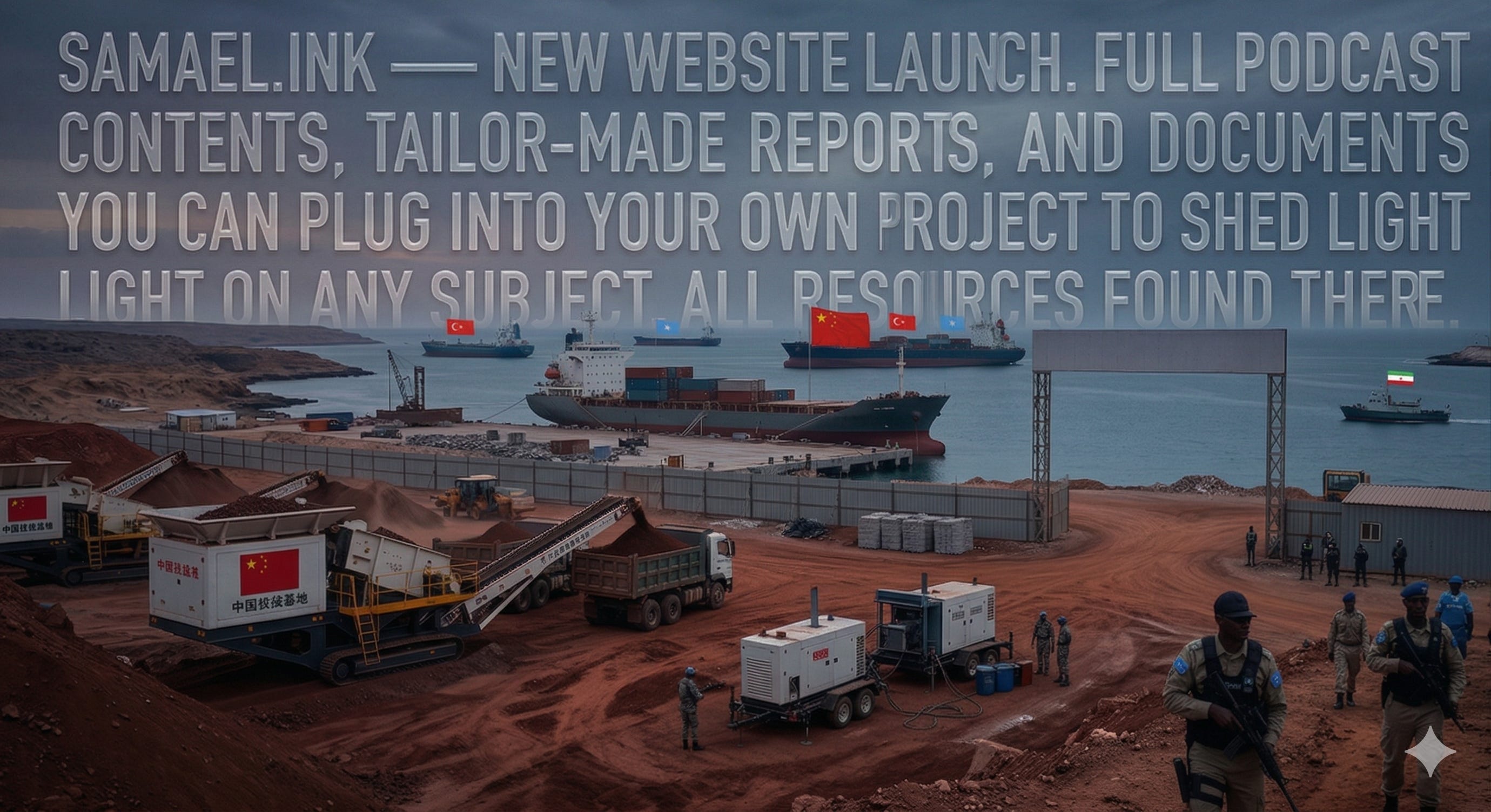
Infrastructure as Targets: Chinese-built roads and ports are increasingly viewed by Al-Shabaab as “legitimate targets” because they symbolize the federal government’s strength. This has led to “sabotage taxes,” where Chinese firms are indirectly forced to pay protection money to local clans or insurgent-linked intermediaries to keep equipment from being destroyed.
The 2026 Strategic Pivot
Because of these threats, the “Chinese Parasite State” has officially pivoted in its 15th Five-Year Plan (2026–2030):
From Reactive to Proactive: China is shifting from “emergency evacuations” to establishing a permanent security footprint. This includes deepening PLA training for Somali police—not for national stability, but specifically to secure the roads and ports linked to Chinese extraction sites.
Geopolitical De-risking: Chinese legal experts are now advising investors to “look beyond the Gulf” and consider Central Asia as an alternative, as the security costs in Somalia and the Middle East become unsustainable due to the Iran-US conflict and regional anarchy.
The Bottom Line: China is no longer just an “investor” in Somalia; it has become a security stakeholder that must pay a massive “instability tax” to keep its personnel alive and its assets from being seized or sabotaged.
Why has China shifted from investor to active security stakeholder in Mogadishu?
A sharp rise in targeted violence, including attacks on personnel and infrastructure, has made passive investment untenable. Recurrent incidents (diplomatic visit postponements, maritime hijackings, IED and kidnapping threats on supply routes) show that commercial presence now faces direct physical threat. Protecting those assets requires sustained security expenditures, operational control over local protection, and direct engagement with Somali armed actors—functions that convert a purely economic role into a security one.
How immediate and severe are the direct threats to Chinese nationals?
Severe and immediate: senior-level visits have been cancelled for safety reasons; embassy staff and contractors are largely confined to fortified compounds; maritime attacks on Chinese fishing vessels have occurred; and travel outside secure zones is judged too risky without elite armed escorts. These conditions reduce routine oversight, lengthen project timelines, and elevate the probability of casualties or hostage crises that would demand a forceful response.
How exactly is China securitizing development projects?
Project contracts now routinely include a security line item (commonly 10–15% of project costs). That money funds private security firms, paid local militias, fortified compounds, armed convoys, and surveillance equipment. Chinese firms increasingly hire international security companies (and local intermediaries) to provide layered protection—physical perimeter defense, route security, and armed rapid-reaction elements—effectively making protection a core project deliverable rather than an ancillary cost.
What roles are private security firms and local militias playing, and what are the risks?
Private firms manage logistics, training, vetting, and coordination with local actors; they also recruit and pay clan-based militias for local route and site security. Risks include lack of accountability, entanglement with predatory local actors, corruption, and escalation: paid militias may pursue their own agendas, create rivalries, or become targets themselves, and the use of non-state armed groups complicates legal exposure and diplomatic fallout.
Why are onshore resource projects in Mudug and Nugaal effectively frozen?
The combination of persistent territorial contestation, weak state control, and the high likelihood of insurgent recapture makes long-term infrastructure investments extremely risky. Security costs are prohibitive; supply chains and personnel movements are vulnerable; and insurers and financiers balk at underwriting projects where assets can be easily seized or destroyed. Without massive state subsidies or an unprecedented security guarantee, developers deem onshore exploration financially and operationally infeasible.
How are Chinese-built infrastructure projects being targeted and monetized by local actors?
Roads, ports, and other visible Chinese projects are framed by insurgents as extensions of federal authority or foreign exploitation—making them legitimate military and propaganda targets. Attacks take the form of sabotage, ambushes, and extortion. Local intermediaries and clan actors may demand “protection” payments to prevent attacks or to allow construction—effectively a shadow taxation that raises operating costs and normalizes bribery and coercion as a cost of doing business.
What does the 2026 policy pivot look like operationally inside China’s institutions?
The pivot manifests as several changes: (a) formal incorporation of security budgets and force protection into trade and infrastructure planning; (b) expanded PLA involvement in training and equipping Somali police and security units with a narrow mandate to protect extractive and transport infrastructure; (c) increased use of state-backed security firms and diplomatic pressure to create secure zones; and (d) legal and financial guidance pushing investors to alternative regions where geopolitical risk is lower.
Could China’s increased security footprint provoke political or military pushback?
Yes. A deeper Chinese security presence risks domestic political backlash in Somalia (seen as violation of sovereignty), rivalry with other foreign actors that have security interests in Somalia, and escalation with insurgent groups who may intensify attacks to demonstrate resistance. It also raises the prospect of international scrutiny and diplomatic costs if Chinese security measures produce civilian harm or bolster unpopular local power brokers.
How sustainable are the increased security costs for China’s long-term strategy in the Horn of Africa?
Not very, without trade-offs. Constantly subsidizing security diminishes the economic return on investments and diverts political capital. China can sustain high costs for strategically vital assets but is likely to reprioritize or redirect investments if the security “tax” outstrips economic benefit. That is why legal and investment advisories now emphasize de‑risking—shifting capital to more stable jurisdictions unless Beijing opts for a long-term, costly security commitment.
What are the likely regional and geopolitical consequences if China continues this securitization approach?
Several outcomes are plausible: (a) China deepens ties with Somali security actors and local power-brokers, increasing its political leverage but also entangling it in local conflicts; (b) rival powers or regional states could respond by increasing their own security roles, complicating an already crowded theater; (c) Chinese investors shift some capital to alternative regions, reducing economic engagement in the Horn; and (d) humanitarian and governance challenges could worsen as infrastructure becomes militarized and insurgents punish communities perceived as collaborators—potentially prolonging instability and undermining long-term strategic aims.