
China’s invisible cage and the Eurasian Triad: how Beijing, Tehran, and Moscow constrain Ethiopia’s ambitions in 2026
TL;DR
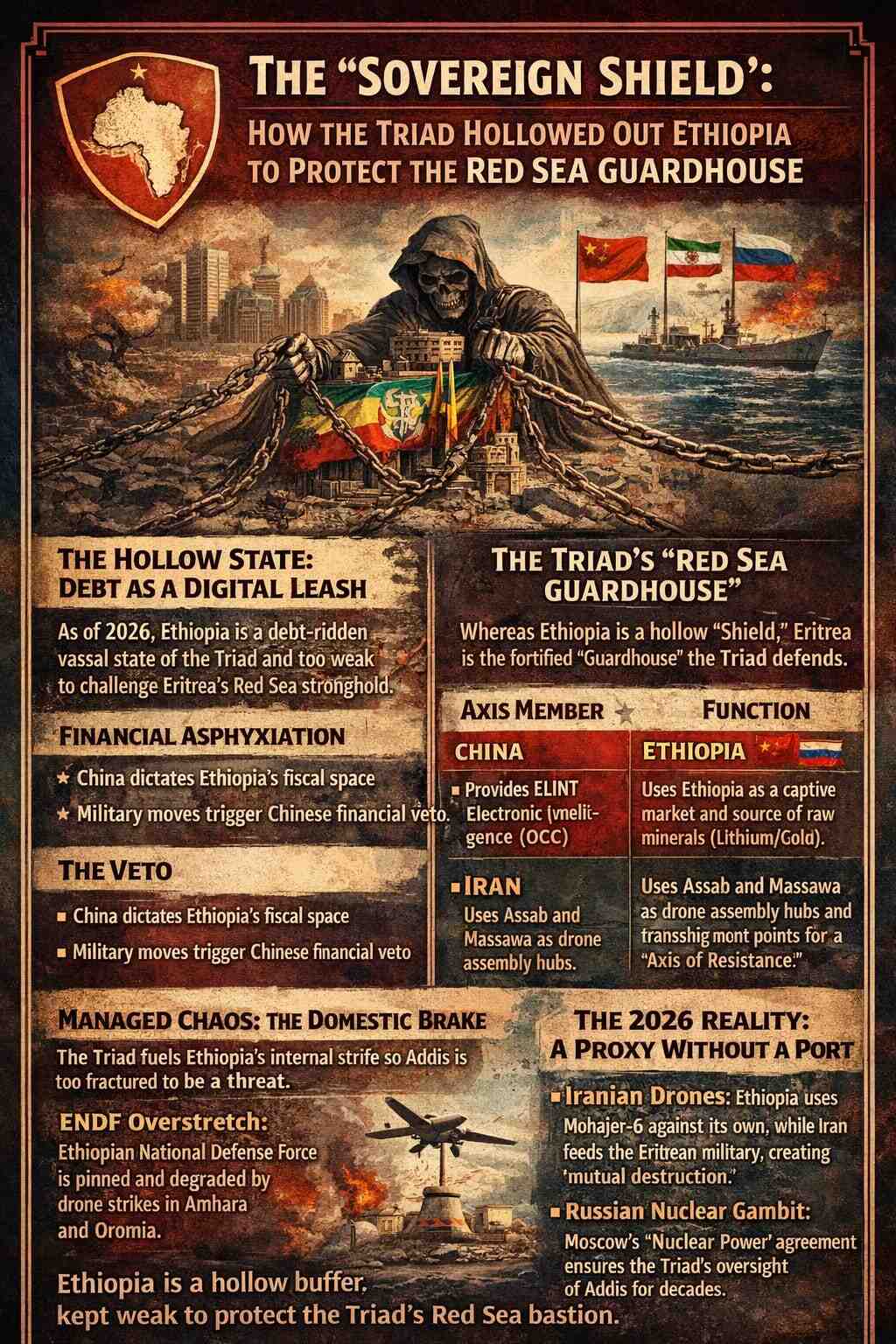
In 2026 Ethiopia’s strategic options are constrained by more than bilateral dependence on Beijing. The emergence of a China‑Iran‑Russia axis—what some analysts call the Eurasian Triad—has transformed Eritrea into a strategic linchpin for an anti‑Western bloc in the Red Sea. That alignment deepens and multiplies the mechanisms that keep Addis Ababa from attempting a costly seizure of Assab or a broader campaign against Asmara. The following expands the earlier argument about China’s “invisible cage” by showing how the Triad amplifies financial, military, intelligence, and diplomatic restraints and converts Eritrea into an unsinkable strategic platform for Axis interests.
Eritrea as the Southern Anchor of the Triad
Eritrea’s decades‑long posture of militarised self‑reliance and asymmetric diplomacy has paid strategic dividends: Asmara is now a trusted partner for each of the Triad members, and it plays a distinct operational role for each.
The Iranian forward base: By March 2026 Iran appears to have deepened ties to Assab and Massawa, using Eritrean ports as logistics and assembly points linked with Houthi activity in the Red Sea. For Tehran, those sites extend its ability to threaten maritime traffic and marshal asymmetric means against regional rivals. An Ethiopian strike on Assab therefore risks striking Iranian facilities that form part of Tehran’s broader Red Sea envelope.
Russian naval ambitions: Moscow has pursued a low‑visibility but steady effort to secure a logistics foothold on the Red Sea. Eritrea’s willingness to host or facilitate Russian access converts Asmara into a diplomatic and operational counterweight to Western bases in the region and gives Russia a bargaining chip at international fora.
Chinese continuity: China’s investments and infrastructure footprint in Ethiopia remain central, but Beijing also values a regional order in which Eritrea acts as a buffer and a node that Beijing can rely on—particularly when that node helps deny unfettered Western maritime dominance of the Red Sea.
How the Axis multiplies China’s levers
China’s financial and infrastructure sway over Ethiopia is reinforced—indeed multiplied—when it operates in concert with Russia and Iran, because each Axis member supplies complementary capabilities that raise the costs of Ethiopian adventurism.
Financial coercion plus armed deterrence: Beijing can threaten to withhold loans and projects; Tehran can arm Eritrea with asymmetric strike tools; Moscow adds intelligence, diplomatic shielding, and potential cyber or naval support. Together, these tools make the prospect of a punitive response to an Ethiopian attack broader, faster, and more politically costly.
Diplomatic containment: The Triad’s combined influence in international fora can blunt efforts by Addis to mobilise regional legitimacy or to portray an Ethiopian offensive as a unilateral defensive act. Diplomatic vetoes and messaging from the Axis undercut Addis’s legal and narrative options.
The “Kill Zone” and maritime securitization
The Axis treats the Red Sea and adjacent waterways as a strategic belt. Joint exercises and security cooperation in 2026 signal a collective interest in deterring outside intervention and in preserving corridors favourable to Axis logistics and weapons movement.
Maritime Security Belt 2026: The joint drills and increased patrols demonstrate an Axis capability to monitor, and if necessary contest, naval movement across the southern Red Sea and Gulf of Oman. That presence increases the risk that any conventional land war that spills into maritime chokepoints would invite broader naval involvement.
The veto on escalation: For China, an expanded naval confrontation threatens trade routes and logistics; for Iran, it threatens the covert use of maritime denial tools; for Russia, it invites renewed great‑power competition. The Axis therefore prefers to deter Ethiopian moves through layered pressure rather than to allow an unpredictable regional war that would draw in NATO, the U.S. Navy, or coalition partners.
Asymmetric defenses: drones, sensors, and information
Eritrea’s military modernization under Axis patronage transforms the asymmetry between Addis and Asmara.
Iranian drones and loitering munitions: Transfers of Iranian strike drones and loitering munitions give Eritrea stand‑off options to hit high‑value Ethiopian infrastructure—airfields, power grids, transport hubs, or even symbolic targets like the GERD—without massed ground offensives.
Chinese surveillance and electronic warfare: Satellite imagery, signals intelligence, and GPS countermeasures supplied or facilitated by Axis partners materially improve Eritrean situational awareness and targeting while degrading Ethiopian C4ISR in contested scenarios.
Russian intelligence and cyber support: Moscow’s contributions can include intelligence sharing, electronic‑warfare systems, and cyber tools that complicate Ethiopian command, control, and logistics in the opening phases of any offensive.
The geopolitical squeeze and regional alignments
Ethiopia’s partial attempts to diversify—such as the MOU with Somaliland—cannot fully offset the squeeze the Triad imposes.
Fragmentation as a policy preference: The Axis benefits when the Horn remains politically fragmented. A landlocked, economically dependent Ethiopia is easier to manage than an assertive regional hegemon that could challenge external access or strike deals that weaken Axis leverage.
Competing patrons: Turkey, Qatar, and other regional actors court coastal partners and may tilt local balances, but their influence does not yet match the combined financial, military, and diplomatic weight the Triad can bring to bear on Addis when core strategic assets are threatened.
Player interests and consequences for Ethiopia
The Triad treats Eritrea as an operational platform, and their combined posture imposes clear consequences for Ethiopian strategy:
China: Seeks secure trade arteries and commodity access; will cut or withhold financing and infrastructure support if regional instability jeopardises returns.
Iran: Seeks staging points and asymmetric leverage in the Red Sea; will equip Eritrea with drones and other denial capabilities to deter Ethiopian operations on coastal targets.
Russia: Seeks naval logistics and diplomatic partners; will provide intelligence, cyber support, and UN‑level diplomatic cover to blunt condemnation or intervention.
Why a move on Assab is now a collective liability
Assab’s value has shifted from a tactical port to a strategic flashpoint. An Ethiopian attack on Assab would no longer be a bilateral dispute with Eritrea but a strike against facilities integral to the Triad’s Red Sea posture. That means:
Immediate military risk: Stand‑off strikes on Ethiopian infrastructure with Axis‑supplied drones and missiles; naval and air monitoring that could expose ENDF movements; potential for escalation beyond a conventional border war.
Rapid diplomatic isolation: Coordinated diplomatic messaging and vetoes that limit Ethiopia’s ability to secure regional backing or emergency financing.
Economic shock: Quick suspension of Chinese project disbursements, withdrawal of investment commitments, and coordinated economic pressure that could collapse foreign‑exchange stability.
Limits and levers: what the Triad will not do
The Axis seeks stability for its operations, not unlimited war. Its likely behavioural limits include:
Avoiding full‑scale direct combat deployments against Ethiopia: The Triad prefers deterrence, proxy arming, and coercive economics over deploying large expeditionary forces to fight a conventional land war on Eritrean soil.
Minimising transatlantic escalation: The Axis calculates to deter Ethiopian moves without triggering an overwhelming Western military response that would jeopardise Axis assets and longer‑term strategic aims.
Policy implications for Addis Ababa and external actors
The combined China–Iran–Russia posture narrows Ethiopia’s feasible strategic set:
For Addis: Pursuing Assab by force risks punitive economic and military responses that would quickly undercut gains. Political leaders must weigh short‑term strategic prestige against durable material dependencies.
For external actors: Western and regional states must factor the Triad’s presence into de‑escalation strategies; efforts to deter Ethiopian adventurism must combine credible security guarantees, rapid diplomatic engagement, and economic measures that reduce Addis’s incentives to gamble.
Conclusion
Ethiopia in 2026 is constrained by a layered, transregional architecture of influence. China’s “invisible cage” remains central—but it now operates within a broader Triad that arms, surveils, and diplomatically shields Eritrea. Eritrea’s role as the Triad’s southern anchor turns Assab from a local target into a strategic red line: an attack there threatens the collective interests of Beijing, Tehran, and Moscow. The result is not simple peace preservation for its own sake; it is a geopolitically enforced status quo that preserves external access and extraction while limiting Ethiopian strategic autonomy. For Addis Ababa, the calculus is clear: the costs of winning Assab could exceed any conceivable benefit when measured against the economic, military, and diplomatic power aligned to defend it.
What is the core strategic constraint on Ethiopia in 2026?
Ethiopia’s options are constrained by a transregional China‑Iran‑Russia axis that treats Eritrea as a strategic linchpin, multiplying financial, military, intelligence, and diplomatic pressures that deter Addis from seizing Assab or launching a broader campaign against Asmara.
How does Eritrea function within the Eurasian Triad?
Eritrea acts as the Triad’s southern anchor, hosting Iranian logistics and drone assembly in its ports, facilitating Russian naval and diplomatic access, and serving as a buffer node that Beijing values for regional balance.
How does the Triad amplify China’s leverage over Ethiopia?
China’s financial coercion is reinforced by Tehran’s provision of asymmetric strike capabilities and Moscow’s intelligence, cyber, and diplomatic shielding, making any punitive response to Ethiopian action broader, faster, and costlier.
What military and maritime tools does the Axis employ to deter Ethiopian action?
The Axis uses joint naval patrols and drills to securitize the Red Sea, Iranian loitering munitions to enable stand‑off strikes, Chinese surveillance and electronic‑warfare tools for targeting and disruption, and Russian intelligence and cyber support to complicate Ethiopian operations.
Why would an attack on Assab risk wider escalation?
Assab hosts facilities integral to the Triad’s Red Sea posture, so attacking it could provoke stand‑off strikes on Ethiopian infrastructure, increased naval monitoring or intervention, coordinated diplomatic isolation, and rapid economic pressure that would destabilize Ethiopia.
Can Ethiopia offset the Triad’s pressure through other regional deals?
Limited diversification, such as agreements with Somaliland or engagement with other regional patrons, cannot fully counterbalance the combined financial, military, and diplomatic weight the Triad can deploy when core strategic assets are threatened.
What limits the Triad’s likely responses?
The Triad prefers deterrence, proxy arming, and economic coercion over committing large expeditionary combat forces, and it seeks to avoid triggering overwhelming Western military escalation that would jeopardize its longer‑term interests.
What are the immediate risks to Ethiopian infrastructure if conflict occurs?
Axis‑supplied drones and missiles could target power grids, transport hubs, and symbolic infrastructure like the GERD; Chinese and Russian surveillance and cyber tools could degrade Ethiopian command, control, and logistics; and maritime chokepoint tensions could disrupt trade routes.
How would the Triad act diplomatically and economically against Ethiopia?
The Triad can coordinate diplomatic messaging, use vetoes or shielding in international fora to limit Addis’s legitimacy, and suspend or withdraw financing and investment commitments—actions that could precipitate a foreign‑exchange and development shock.
What should Addis Ababa and external actors consider in policy terms?
Addis should weigh short‑term territorial gains against durable dependencies and likely punitive responses, while external actors should craft de‑escalation strategies combining credible security assurances, diplomatic engagement, and economic measures that reduce incentives for Ethiopian adventurism.