
TL;DR:
The discovery of cannabis residues in the Lalibela Cave (located in the Lasta region of the former Begemeder Province) is one of the most significant archaeological milestones for understanding the history of smoking in Africa. It provides the "smoking gun" evidence that psychoactive substances were consumed in the Horn of Africa long before the arrival of the tobacco plant from the Americas.
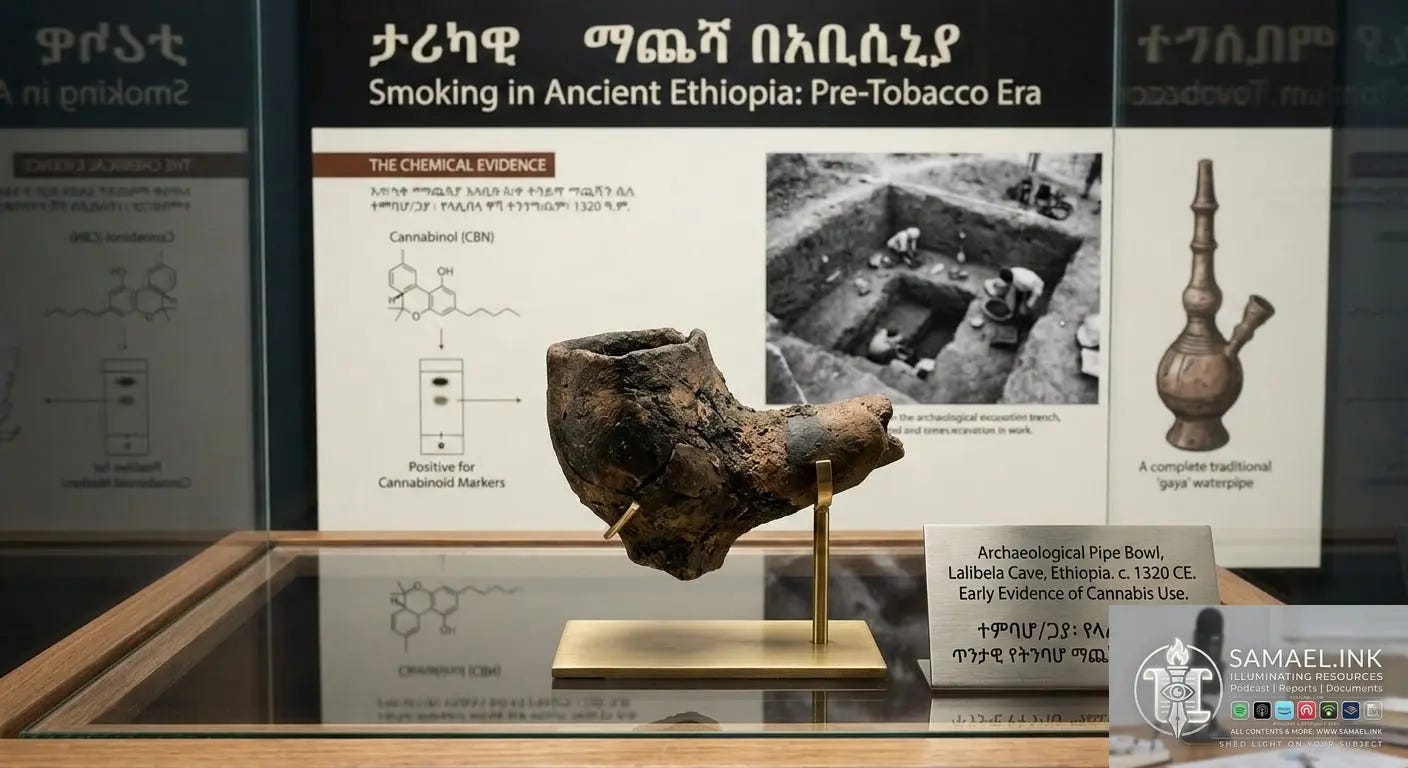
The Archaeological Context
The artifacts were excavated in 1971 by J.C. Dombrowski. Unlike the famous rock-hewn churches of the same name, this site is a domestic cave dwelling near Lake Tana that revealed layers of human occupation spanning several centuries.
The Artifacts: Two ceramic smoking-pipe bowls were recovered from Level 2 of the cave.
Radiocarbon Dating: The organic material associated with these pipes was dated to approximately 1320 \pm 80 CE. This places the use of these pipes firmly in the 14th century, nearly 300 years before tobacco reached Ethiopian shores.
The Chemical Breakthrough
In 1975, scientist Nikolaas J. van der Merwe applied a modified Thin-Layer Chromatography (TLC) technique to the internal residues of the pipe bowls.
The Findings: The analysis yielded positive results for cannabinolic compounds (the chemical markers of Cannabis sativa).
The Absence of Nicotine: Crucially, no traces of nicotine were found, confirming that these early waterpipes were used exclusively for cannabis or other indigenous herbs at the time.
Chemical Stability: The success of the test was due to the fact that while THC degrades quickly, its oxidative metabolites (like Cannabinol or CBN) can survive for centuries when trapped in the porous ceramic matrix of a pipe bowl.
Cultural and Historical Implications
This discovery completely reframed the history of the Gaya (waterpipe) and smoking in the region:
Indigenous Technology: It proved that the technology of the waterpipe was an indigenous or early Red Sea adoption, likely introduced by Arab maritime traders in the 1st millennium CE, rather than a European introduction.
The Pre-Tobacco Era: It suggests a "pre-tobacco smoking culture" in Ethiopia. When tobacco finally arrived in the 17th century, it did not introduce the habit of smoking; rather, it replaced or was added to an existing tradition of cannabis use.
Semitic Expansion: Dombrowski used the presence of these ceramics to support the hypothesis that Semitic-speaking populations had established complex sedentary cultures in the Lake Tana region by at least 1100 CE.
Summary of the Lalibela Pipes
Citation: The primary chemical validation of these finds can be found in Van der Merwe, N. J. (1975), "Cannabis Smoking in 13th-14th Century Ethiopia: Chemical Evidence," published in Cannabis and Culture.