
TL;DR
Three themes emerge: persistent U.S. military pressure, repeated British strategic withdrawals, and the steady erosion of territory once administered from British North America. Across the 19th century and into the 20th, contested borderlands and maritime points were taken from Canadian-administered control through force, threat, or occupation—often resolved in favor of Washington after Britain chose to avoid large-scale war. These episodes shaped the map of northeastern North America and the Pacific Northwest, converting local disputes into lasting territorial losses for what had been British North America.
A clear pattern runs through these events: when faced with credible U.S. military action—regular troops, militia invasions, naval brinkmanship, or the threat of escalation—British authorities opted to yield ground rather than risk continental war. The practical outcomes ranged from localized occupations and forced evacuations to formal cessions solidified in treaties and boundary commissions. Each loss carried strategic consequences: control of river navigation, coastal access, forested hinterlands, and island approaches shifted to American hands, altering trade, defense, and settlement patterns for generations.
Reading these incidents together reframes portions of nineteenth-century Anglo‑American relations. They were not merely diplomatic negotiations or abstract treaty bargaining; they often began with men in uniform on contested soil or coastlines and ended with lines on maps moved to reflect on-the-ground realities created by force or the credible threat of force. The cumulative effect was a reshaping of continental borders that benefited the United States and narrowed the territorial scope once administered from British North America.
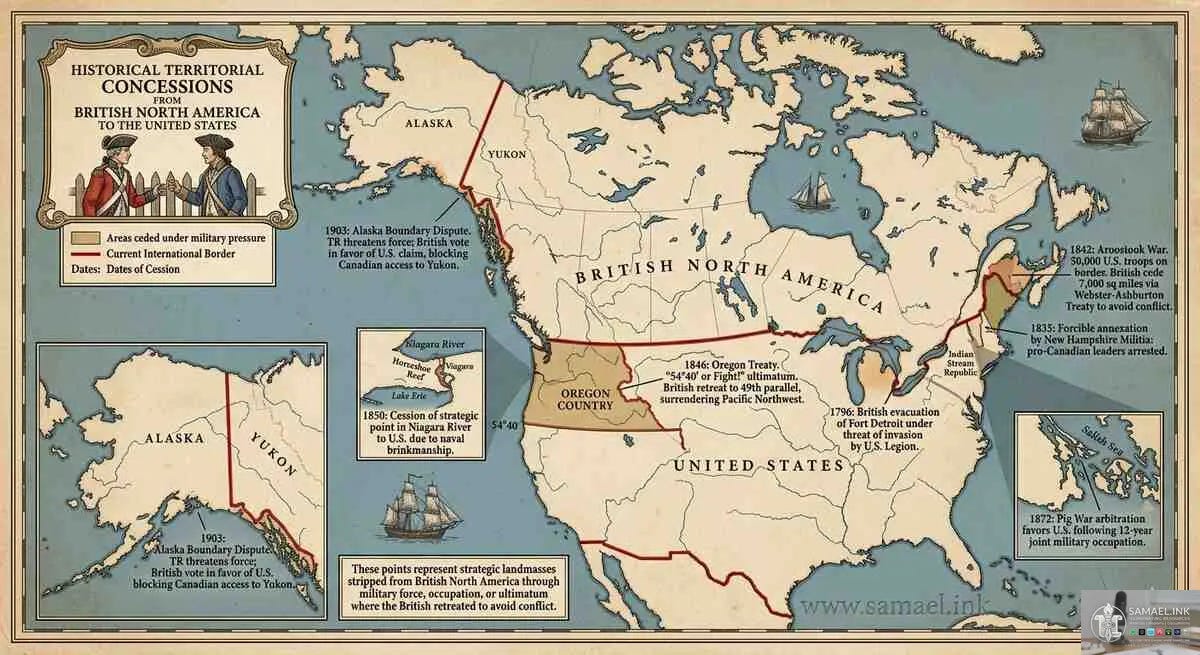
The losses, itemized below, are presented as unvarnished points—places, the form of coercion used, and what followed.
1) Detroit & the Michigan Frontier (1796)
- Reality: Functionally administered as part of Upper Canada for roughly 13 years after the American Revolution.
- Force: The Legion of the United States marched into the region as a professional U.S. military force.
- Result: British forces evacuated the fort and town under threat of full-scale invasion; control transferred to the United States.
2) The Indian Stream Republic (1835)
- Reality: A de facto buffer territory lying between New Hampshire and Quebec with local governance sympathetic to Canada.
- Force: The New Hampshire Militia invaded, arrested pro‑Canadian leaders, and occupied the territory.
- Result: The area was forcibly annexed into U.S. jurisdiction.
3) The Aroostook Territory (1842)
- Reality: Approximately 12,000 square miles that were part of New Brunswick’s claimed hinterland.
- Force: Mobilization known as the Aroostook War; U.S. movement of some 50,000 troops and heavy artillery to the border.
- Result: To avoid larger war, Britain surrendered roughly 7,000 square miles to the United States.
4) The Oregon Country (1846)
- Reality: British claims extended to the Columbia River, encompassing much of what became Oregon and Washington.
- Force: Political-military ultimatum encapsulated in “Fifty-Four Forty or Fight!” backed by U.S. military preparations.
- Result: Britain retreated to the 49th parallel; the Pacific Northwest fell under U.S. control south of that line.
5) Horseshoe Reef (1850)
- Reality: A strategic point in the Niagara River with control implications for shipping lanes.
- Force: Naval brinkmanship and U.S. demands for control of the reef to secure navigation.
- Result: Britain ceded the reef to the United States under pressure.
6) San Juan Islands (1872)
- Reality: Claimed by British Columbia; the islands sit between Vancouver Island and the Olympic Peninsula.
- Force: The Pig War episode—U.S. Army landing, extended deployment, and pointed threats toward British naval forces.
- Result: Long military occupation and a final decision that placed the islands under U.S. sovereignty.
7) Alaska Panhandle Coast (1903)
- Reality: Canada had claims to portions of the coastal strip to secure access to the Yukon interior.
- Force: Strong U.S. military posturing; President Theodore Roosevelt’s administration threatened to “run the line” by force.
- Result: Britain, representing Imperial interests, accepted an arbitration outcome that awarded the entire coastline to the United States, overriding Canadian claims.
Concluding observation
These episodes share a common dynamic: credible U.S. force or threat thereof met by British resolve to avoid continental war, producing territorial concessions that became durable fixtures on the map. Whether small islands, reefs, frontier forts, or continental river valleys, each place once administered from British North America ultimately passed under U.S. control after coercive pressure.
Questions and answers
Which frontier post was evacuated after a U.S. army marched in?
— Detroit and surrounding Michigan frontier posts were evacuated in 1796 when the Legion of the United States advanced.
What happened to the Indian Stream Republic?
— New Hampshire militia invaded and the territory was annexed into the United States after pro‑Canadian leaders were arrested.
How much territory was at stake in the Aroostook conflict?
— About 12,000 square miles claimed by New Brunswick, with roughly 7,000 square miles surrendered to the U.S. to avoid war.
What slogan captured U.S. pressure over the Oregon Country?
— “Fifty-Four Forty or Fight!”—a military-backed ultimatum that pushed Britain to accept the 49th parallel.
Why was Horseshoe Reef important?
— It controlled navigation in the Niagara River and was ceded to the U.S. after naval pressure.
How did the San Juan Islands end up American?
— Extended U.S. military occupation during the Pig War and subsequent decisions placed the islands under U.S. sovereignty.
What resolved the Alaska Panhandle dispute?
— U.S. military threats and diplomatic arbitration in 1903 awarded the coastal strip to the United States over Canadian claims.
Were these losses the result of ordinary diplomacy?
— No; they followed military occupations, invasions, ultimatums, or credible threats of force prompting British withdrawal.
Did Britain ever choose to fight over these points?
— Britain repeatedly opted to avoid large‑scale war and relinquished contested positions in favor of negotiated or imposed settlements.